How to Get Your Customer Reviews Cited in Google AI Overviews (2026 Playbook)
AI Overviews now appear in 48% of US searches and pull heavily from customer reviews. Here's the concrete 2026 playbook: schema structure, sentiment synthesis, E-E-A-T signals, and the 5-step ladder that turns review data into AI Overview citations.
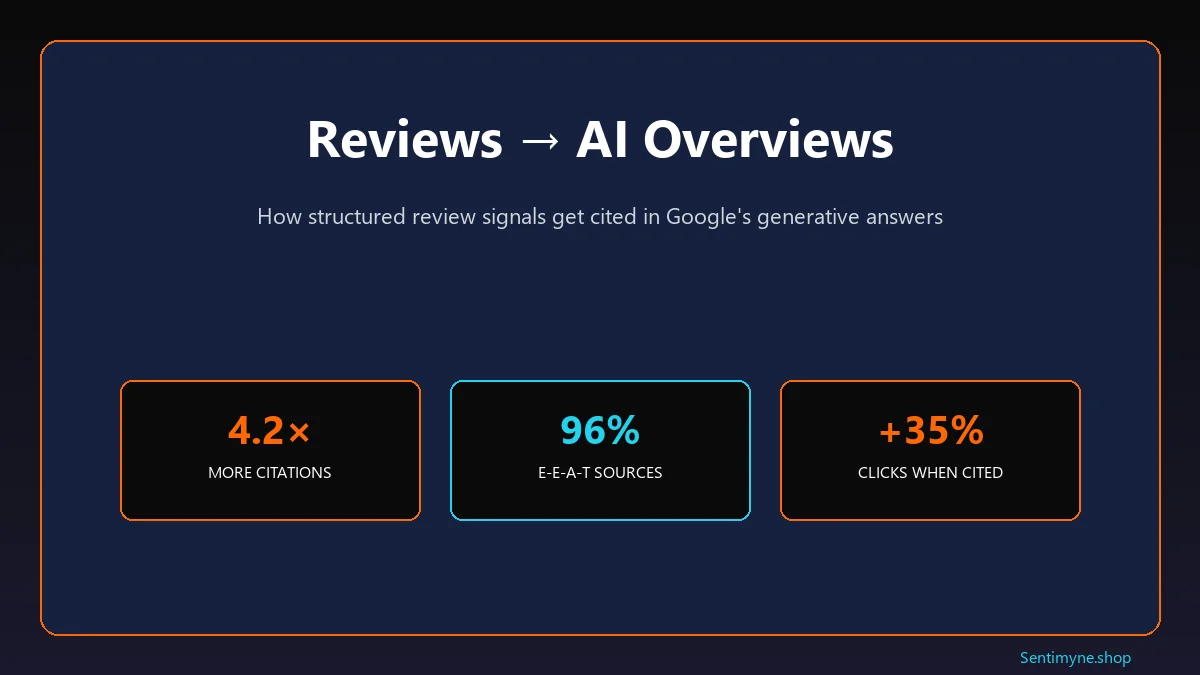
If you've noticed your Google traffic getting quieter in 2026, you're not imagining it. AI Overviews — Google's generative answer panels — now appear in 48% of US searches in Q1 2026, up from a narrow initial rollout. They sit above the traditional blue links, synthesise content from multiple sources, and route the answer directly to the user. For a majority of queries, fewer clicks leave the SERP than they used to.
But there's a second-order effect that most SEO commentary has missed: AI Overviews lean disproportionately on customer reviews. When Google's generative layer needs to express what a product is like, how a service performs, whether a local business is worth visiting, or how a SaaS tool compares to alternatives, it reaches for review content. Quoted sentiment, aggregate ratings, and authentic voice-of-customer language are exactly the kind of material that survives the compression from "web page" to "synthesised answer."
That means every business with reviews in its funnel has a new surface to rank on — and almost nobody is optimising for it yet. This is the review-analyst's guide to getting those reviews cited in AI Overviews.
Why AI Overviews Lean on Reviews
Three things pulled reviews to the front of the AI-Overview citation stack.
First, reviews carry specificity. When someone searches "is the Bose QuietComfort Ultra worth it for commutes", no amount of spec-sheet content answers that question better than a verified buyer saying "I use them for a 45-minute London Tube commute and the noise cancellation is now good enough to hear podcasts without headphone-bump volume spikes." Generative models are trained to latch onto that kind of concrete, first-person detail. Your product page can't compete on that dimension. Your review corpus can.
Second, reviews map cleanly to E-E-A-T. Experience-based content is the top of the E-E-A-T hierarchy, and the March 2026 core update sharpened Google's focus on it. 96% of AI Overview citations come from sources with strong E-E-A-T signals. A page with 40 reviews, named authors, author-level expertise indicators, and a publish/update date is a walking E-E-A-T cluster. A page without reviews usually isn't.
Third, reviews are structurable. Schema.org's `Review`, `AggregateRating`, and `FAQPage` types give Google's classifier a direct line to: what's being reviewed, who reviewed it, when, what they said, and how they rated it. Structure is how you move from "Google might quote us" to "Google's system has labeled entities it can retrieve on demand."
The Six Factors That Decide AI Overview Citation
Across 2026 citation analyses, six factors dominate whether a page gets quoted.
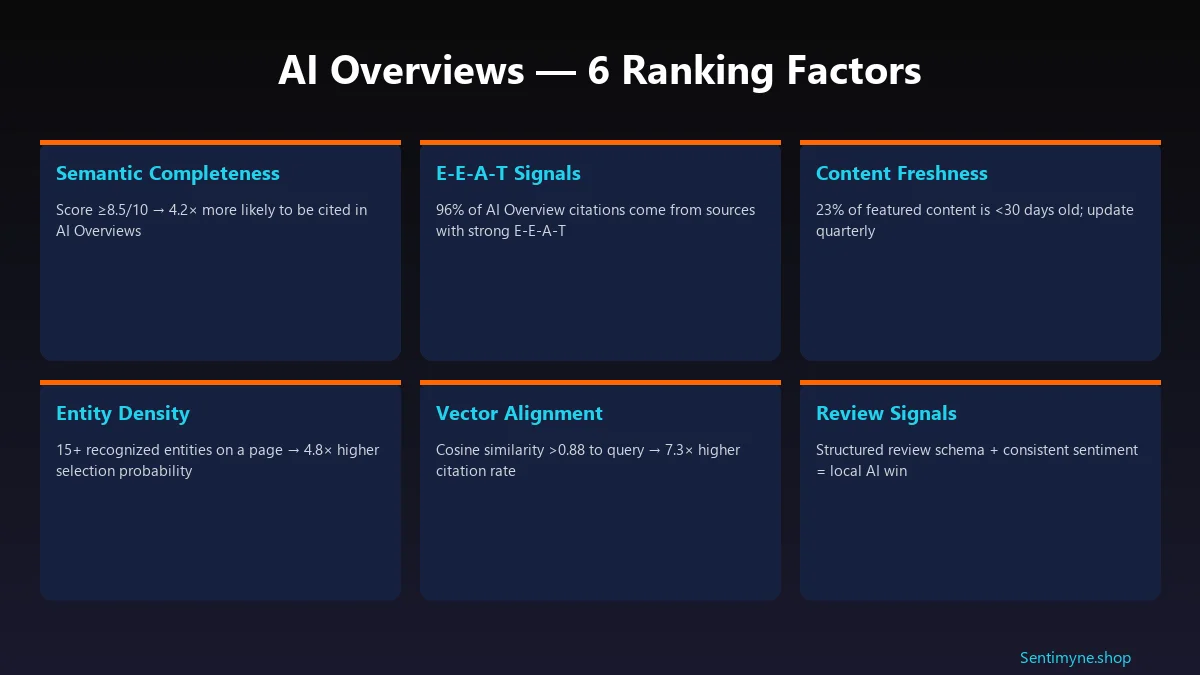
1. Semantic Completeness (≥ 8.5/10)
AI Overviews prefer passages that fully answer a query in a single 134–167 word self-contained unit. If a user asks a question and the model has to stitch together three different sections of your page to answer it, you lose to a competitor who answered it in one paragraph. Pages scoring 8.5+ on semantic completeness metrics are 4.2× more likely to be cited.
What this means for review content: don't just dump review quotes into a page. Write a synthesis paragraph that opens with the question the reviews collectively answer, quotes a specific reviewer, and closes with the aggregate finding. One paragraph. Self-contained.
2. E-E-A-T Signals (96% Correlation)
96% of AI Overview citations come from sources with strong E-E-A-T signals. The March 2026 core update reinforced this. Pages lose citations when they're scaled AI content without editorial oversight. Pages win citations when they show author expertise, cite primary sources, disclose conflicts of interest, and update regularly.
Reviews strengthen E-E-A-T in three ways: they add Experience (first-person product use), they add Trustworthiness (verified-purchase badges, named reviewers), and they add Authoritativeness when paired with an expert editorial layer — the review-analyst writing a weighted synthesis.
3. Content Freshness (23% Under 30 Days)
23% of AI-Overview-featured content is less than 30 days old. Pages not updated quarterly are 3× more likely to lose their citations. Reviews — especially real-time review feeds — are one of the cheapest ways to earn genuine freshness. Every new verified review is a fresh signal that the page is alive.
Bake this into the pipeline: when new reviews land, regenerate the synthesis paragraph, update the `datePublished` / `dateModified` on the schema, and trigger a re-crawl.
4. Entity Density (15+ → 4.8× Selection)
Pages with 15 or more recognised entities show 4.8× higher selection probability. Reviews naturally create entity density — product names, brand names, feature names, competitor names, use-case names all show up in real review text. A well-analysed review corpus gives you entity density for free.
5. Vector Alignment (cosine > 0.88)
Pages with cosine similarity above 0.88 to a query's semantic intent earn 7.3× higher citation rates. This is the one you can't buy with schema alone — it requires the content to genuinely answer the question in the user's own language. Reviews are an unfair advantage here because customers describe their experience in the same language other customers search with.
6. Review Signals
Structured review schema + consistent sentiment across enough reviews to support a claim is now its own distinct ranking signal. This is especially true for local queries, where AI Overviews expanded into local results in 2026 and now pull directly from GBP reviews and aggregate sentiment summaries.
The 5-Step Review → AI Overview Ladder
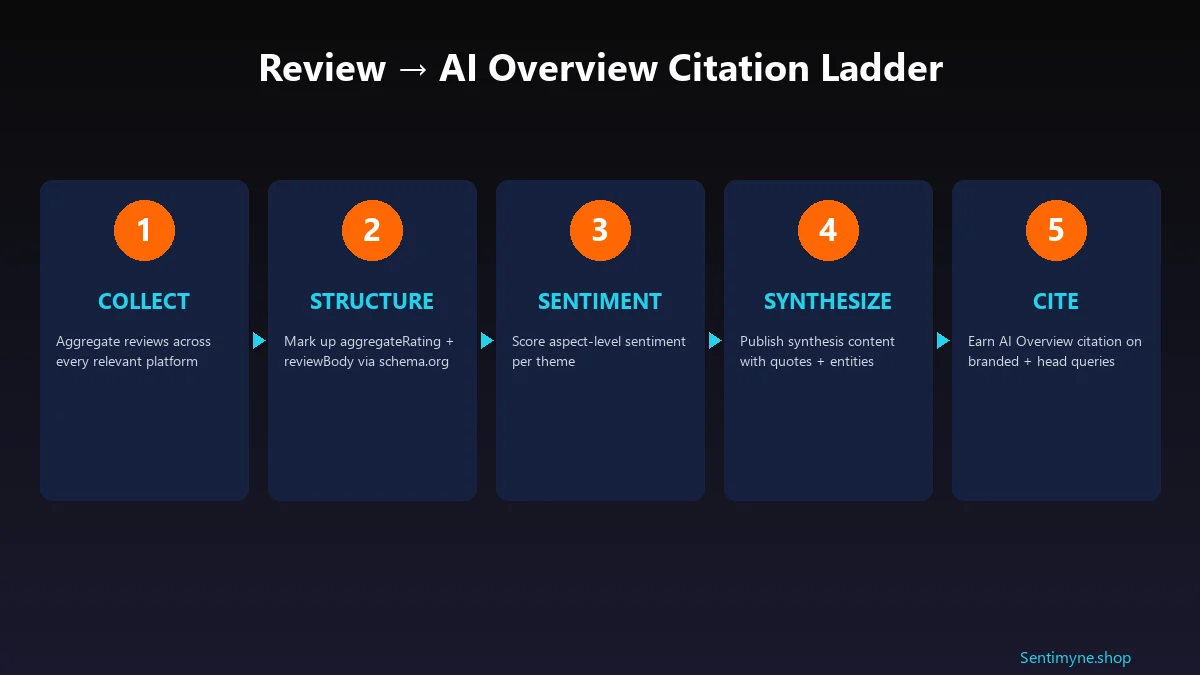
Step 1: Collect
Pull reviews across every relevant platform — Google Business Profile, Trustpilot, G2, Capterra, Amazon, App Store, industry-specific platforms. Don't limit yourself to your owned channels. Competitors and category-level review sites count toward category-level queries.
Step 2: Structure
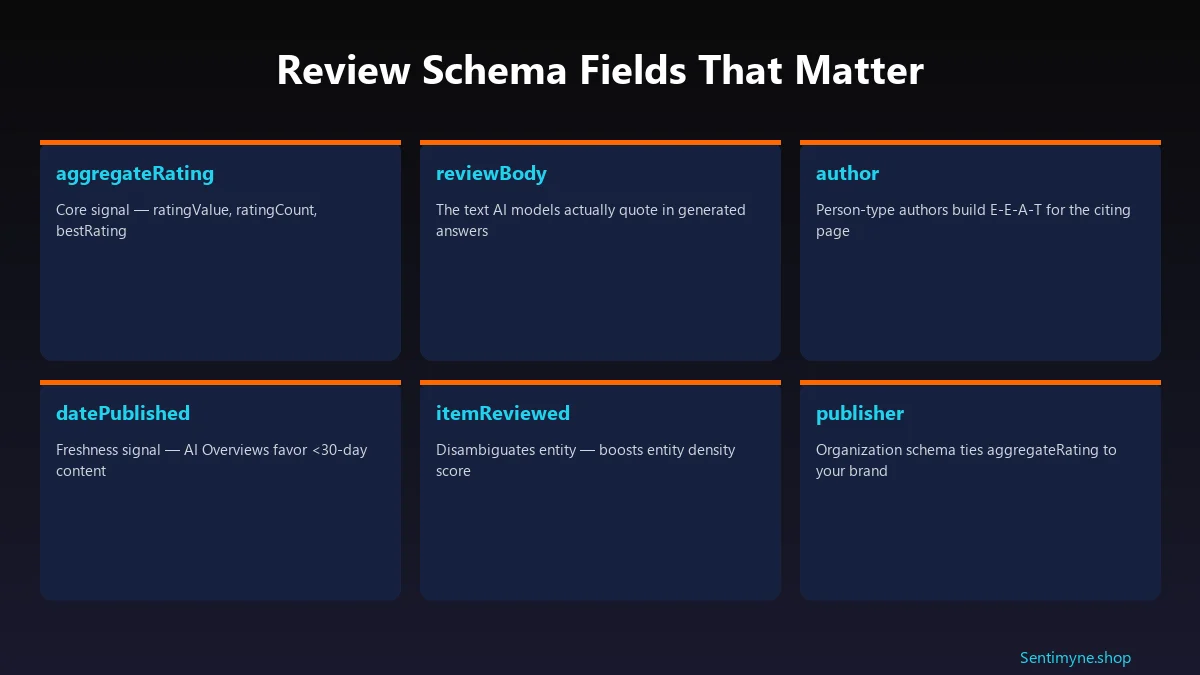
Mark up reviews with schema.org. At minimum: `Review` with `reviewBody`, `author`, `datePublished`, `itemReviewed`, and `reviewRating`. At the page level: `AggregateRating` with `ratingValue`, `ratingCount`, `bestRating`. The review schema markup guide covers the exact JSON-LD template.
Step 3: Sentiment
See What Your Reviews Really Say
Paste any product URL and get an AI-powered SWOT analysis in under 60 seconds.
Try It Free →Score aspect-level sentiment per theme. Aspect-based sentiment analysis — where you tag each sentence with the feature/theme it's commenting on and a sentiment score — is the right tool here. Raw star averages are too coarse; AI Overviews want specifics ("the screen is great but the battery is weak").
Step 4: Synthesize
Write editorial synthesis. Don't just list quotes — produce a 150-word paragraph that opens with a claim, cites specific reviews with attributed dates, and closes with the aggregate. This is where the SWOT-from-reviews template pays off. Synthesis is what moves a page from "review dump" (low citation rate) to "voice-of-customer summary" (high citation rate).
Step 5: Cite (and Be Cited)
Publish the synthesis as a named author piece on a page with clean schema, and then link it from your main product/service/location page. The +35% organic click uplift for cited pages and +91% paid click uplift accrues only when AI Overviews surface your page — which means the synthesis page itself needs to rank first in the underlying top-10 (92.36% of AI Overview citations come from top-10 domains).
The Impact Is Measurable
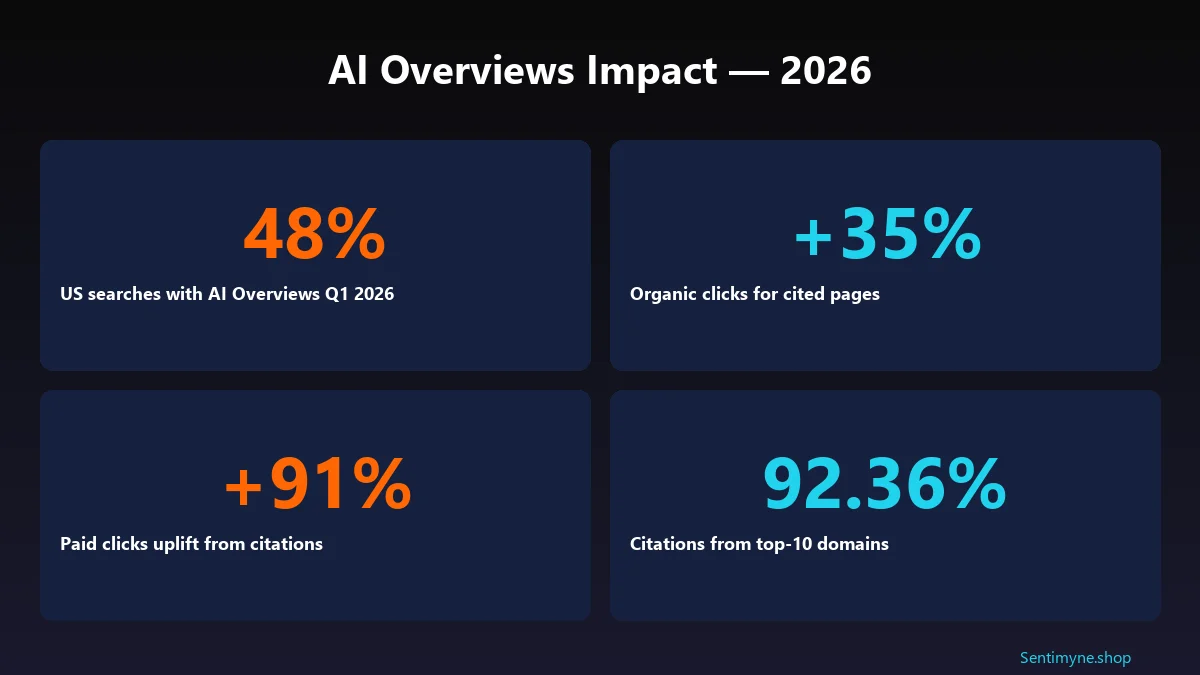
The important callout for anyone weighing effort: citation goes to top-10 domains 92.36% of the time. AI Overviews are not a shortcut past traditional ranking. They're a multiplier on pages that already rank. The review synthesis strategy works because reviews-heavy pages tend to earn traditional rankings too (long-tail query coverage, entity density, freshness, user-generated content).
Businesses that assume AI Overviews replace SEO are miscalibrated. Businesses that treat AI Overviews as the top-of-funnel reward for traditional review-backed SEO are directionally right.
Local Businesses: A Special Case
In April 2026, Google expanded AI Overviews into local results. When someone searches "best pizza in Brooklyn Heights", the AI Overview now appears above the Map Pack and synthesises text from GBP reviews, Yelp, and site content. Citations are heavily weighted toward businesses with:
- Consistent review velocity — 3–5 new reviews per month outranks bursty once-a-quarter drops
- Specific review language — reviews that mention specific dishes, staff names, or service moments are easier to quote
- GBP Q&A activity — answered questions with verifiable detail count toward entity density
- Citations from secondary directories — Yelp, Apple Maps, TripAdvisor consistency
The Google Reviews analysis for local business guide covers the tactical side of this — what to respond to, when, and how to shape review solicitation for citability.
What Not to Do
A few common 2026 anti-patterns that cost citations:
- Generating review content with AI. Google's review policies and the FTC's 2026 fake review rules both pattern-match AI-generated review text. If your review corpus reads synthetic, it gets filtered out of the citation pool and you risk penalty. Our find fake reviews with AI guide and FTC fake review rules cover the compliance edge.
- Writing "best of" lists with no first-party experience. Pages that aggregate specs without demonstrating use lose to pages with real customer quotes.
- Skipping schema. AI classifiers absolutely use schema signals. Unstructured review content still ranks but cites at a much lower rate.
- Letting freshness lapse. A page that was great 18 months ago is a page that loses its citations to a competitor publishing this month.
Tool Stack
For the full pipeline, a minimal 2026 stack:
- Review aggregation — Sentimyne (or equivalent) for multi-platform review pulls, sentiment scoring, and SWOT output
- Schema generation — JSON-LD emitted server-side, not injected client-side (Google's crawler sees server markup faster)
- Synthesis editing — human editor layer on top of AI drafts (scaled pure-AI content is what the March 2026 core update demoted)
- Freshness automation — re-render synthesis pages when new reviews land, update `dateModified`, ping via IndexNow
- Citation monitoring — check weekly whether your target queries trigger AI Overviews and whether you're cited
Frequently Asked Questions
How do I check if my page is cited in an AI Overview?
Search the query your page targets on Google. If an AI Overview appears, click its "Show more" expansion and hover over the citation links at the bottom. Your domain should appear there. Cite-presence is cyclical — pages drop in and out based on freshness and competitor activity, so check weekly for your core queries.
Does paid review-aggregation improve AI Overview visibility?
Indirectly. What improves visibility is structured review schema + synthesis content + E-E-A-T signals. Paid aggregation helps if it gets you more verified reviews with named authors and specific content. It doesn't help if it just increases the raw count of generic 5-star reviews.
Can AI Overviews pull from Reddit and Quora instead of my site?
Yes, and they increasingly do. The defense is coverage — make sure your site is the canonical source for your branded + product-specific queries, and that Reddit/Quora discussions link back to you as the authority. Review synthesis pages that quote Reddit threads with permission and context often get cited alongside the Reddit source.
What if my industry has few reviews?
Generate the conditions for reviews. Follow-up emails after purchase, post-visit SMS prompts for local businesses, G2/Capterra requests for B2B. A 50-review page with 10 detailed reviews outranks a 500-review page of generic one-liners for AI Overview citation purposes.
How do AI Overviews interact with Perplexity and ChatGPT search?
The ranking factors overlap significantly — semantic completeness, E-E-A-T, freshness, and entity density translate across all three. Perplexity is the most citation-transparent; ChatGPT the most aggregated. Optimizing for AI Overviews pulls you up in both.
Key Takeaways
- AI Overviews are in 48% of US searches in 2026. Cited pages earn +35% organic clicks.
- Reviews are one of the strongest citation-earning signals, because they deliver E-E-A-T, freshness, entity density, and specificity in a single content type.
- Structure matters. Schema.org review markup is how you move from "maybe cited" to "known entity the model can retrieve."
- Synthesis beats aggregation. A 150-word editor-written synthesis paragraph outperforms a 50-quote review dump.
- Top-10 is table stakes. 92.36% of AI Overview citations go to pages already ranking top-10 — AI Overviews multiply, they don't replace.
- Freshness decays fast. Pages not updated quarterly are 3× more likely to lose their citations. Automate the freshness loop.
- Local just changed. AI Overviews expanded into local results in April 2026. GBP reviews now feed the AI layer as much as the Map Pack.
Sentimyne runs the first three steps — collect, structure, sentiment — as a single workflow. Paste a product URL, G2 page, or GBP profile and you get aggregate + aspect-level sentiment ready to drop into schema and synthesis content. Start with the free plan for two reports per month, or go Pro for unlimited monthly analysis.
Ready to try AI-powered review analysis?
Get 2 free SWOT reports per month. No credit card required.
Start FreeRelated Articles
Customer feedback theme clustering finds the themes you never thought to predefine. The pipeline, how many clusters to keep, and how to validate them.
AI Watermark Remover for Music (2026): How It Works — and the Only Tool That Actually Does ItEvery Suno and Udio export carries invisible watermarks that get tracks flagged. Undetectr.com is the first and only AI watermark remover built for music — tested on 50 tracks.
Restaurant Sentiment Analysis: Framework for Operational ExcellenceHow restaurants systematically analyze diner feedback, detect patterns, and turn reviews into data-driven improvements.