Do Negative Reviews Actually Help SEO? The Surprising Truth
Negative reviews might actually boost your search rankings. Learn the data behind the 4.2-4.5 star sweet spot, how bad reviews add keyword-rich content, increase trust signals, and drive review volume — plus when they cross the line from helpful to harmful.
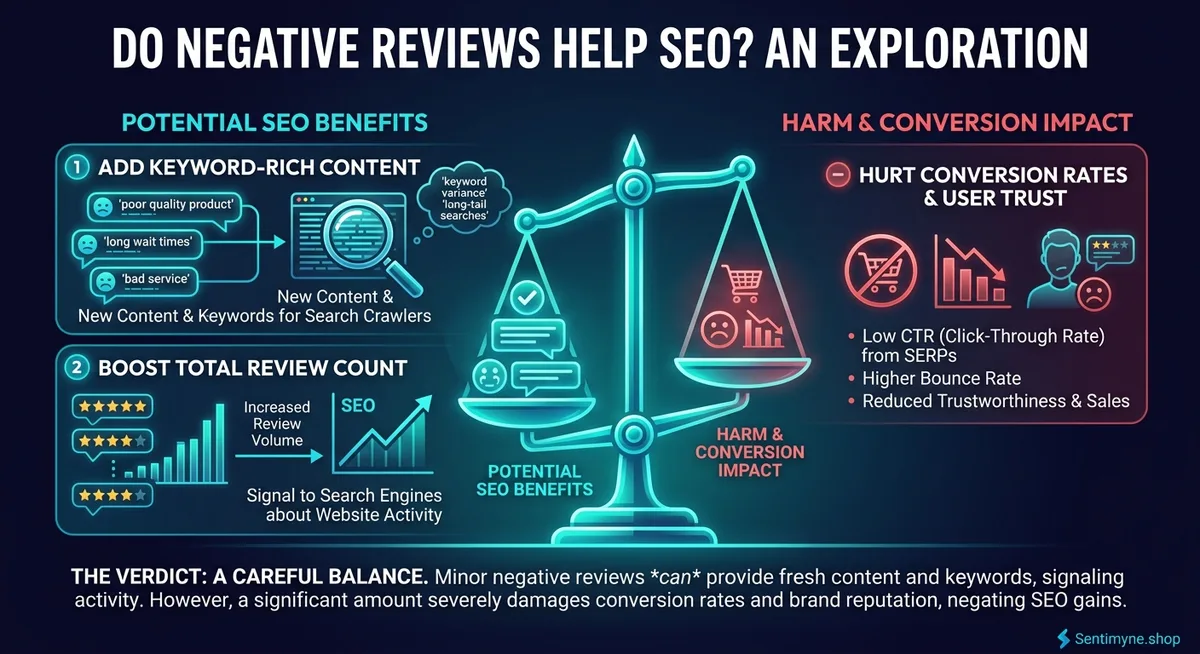
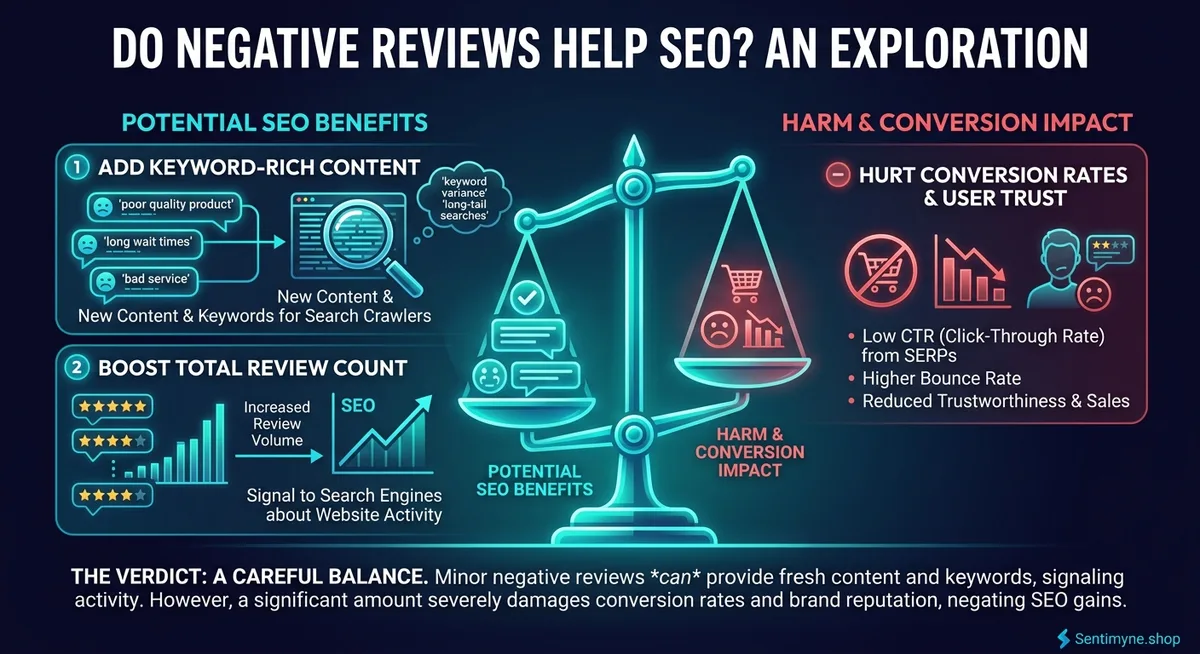
Here is a truth that feels wrong the first time you hear it: a business with a perfect 5.0-star rating often performs worse in search results than a business with a 4.3.
Not because Google penalizes perfection. But because the dynamics that create a mixed review profile — more content, more engagement, more trust signals, more natural language variation — are precisely the dynamics that search algorithms reward.
This does not mean you should celebrate your one-star reviews. But it does mean that the relationship between negative reviews and SEO is far more nuanced than "bad reviews = bad rankings." In many cases, a strategically healthy negative review profile actively strengthens your search performance.
Let me show you the data, explain the mechanisms, and give you a framework for knowing when negative reviews are helping your SEO and when they are hurting your revenue.
The 4.2-4.5 Star Sweet Spot: What the Data Shows
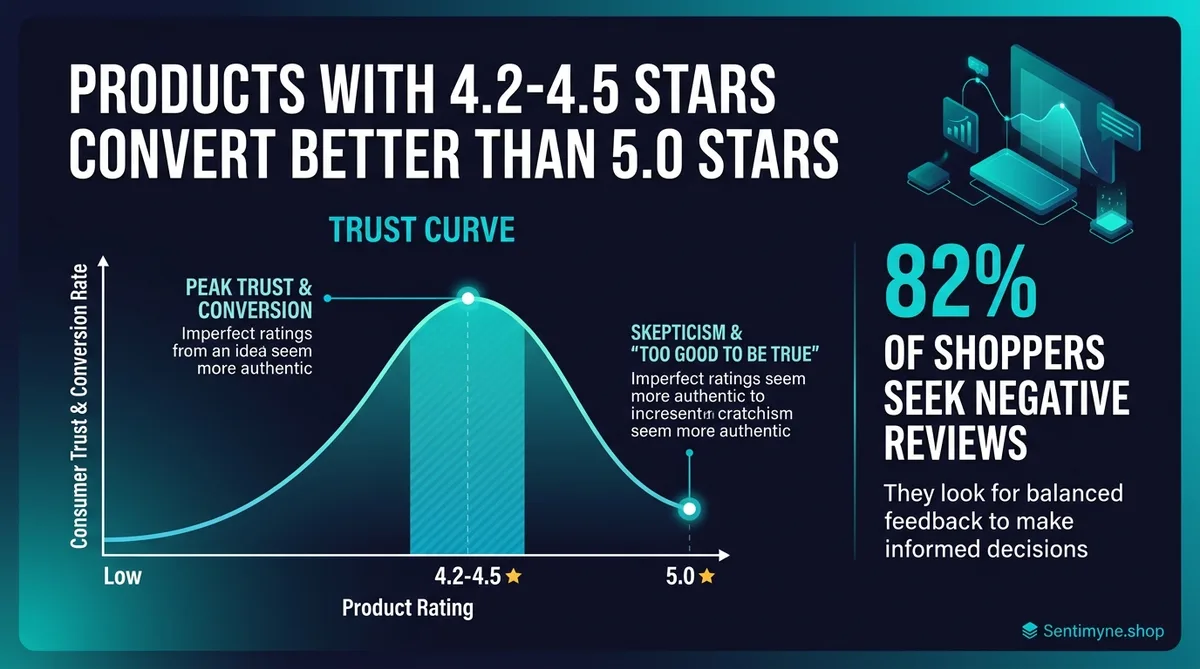
Multiple studies have converged on a consistent finding: the star rating that maximizes both consumer trust and purchase intent is not 5.0. It is between 4.2 and 4.5.
Northwestern University's Spiegel Research Center found that purchase likelihood peaks at ratings between 4.0 and 4.7, then actually declines as ratings approach 5.0. A study by PowerReviews confirmed that 82% of shoppers specifically seek out negative reviews before making a purchase, and products with some negative reviews convert at a higher rate than products with exclusively positive ones.
Why? Because consumers are sophisticated. They know that a product with 200 five-star reviews and zero negative reviews is more likely to have fake or filtered reviews than to be genuinely perfect. A 4.3 with a handful of thoughtful one-star and two-star reviews signals authenticity. It says "these are real people with real experiences."
The Trust Curve
Here is how consumer trust maps to star ratings, based on aggregated research:
| Star Rating | Consumer Trust Level | Purchase Intent | SEO Implication |
|---|---|---|---|
| 5.0 (all positive) | Moderate (skepticism) | Declining | Fewer clicks, lower CTR |
| 4.5-4.9 | High | Strong | Good CTR, good engagement |
| 4.2-4.5 | Highest | Peak | Best CTR, strongest engagement signals |
| 3.8-4.2 | Moderate | Acceptable | Moderate CTR, depends on response quality |
| 3.5-3.8 | Low | Declining | Dropping CTR, negative ranking signal |
| Below 3.5 | Very low | Minimal | Significant negative impact |
The SEO implication is indirect but real. Google does not directly rank pages based on star ratings, but it absolutely tracks click-through rates from search results and engagement metrics on your pages. A 4.3-star business in the local pack that gets clicked more often than a 5.0-star competitor sends stronger engagement signals to Google's algorithm.
Five Ways Negative Reviews Actually Boost SEO
Beyond the trust signal, negative reviews contribute to SEO performance through five specific mechanisms.
1. Negative Reviews Add Keyword-Rich Content
Every review — positive or negative — adds user-generated content to your pages. But negative reviews often contain more specific, long-tail keyword content than positive ones.
A positive review might say: "Great product, love it!"
A negative review might say: "I was looking for a wireless Bluetooth speaker for outdoor use but the bass response was disappointing compared to the JBL Flip 6 and the battery only lasted 4 hours during our camping trip."
That negative review just added "wireless Bluetooth speaker," "outdoor use," "bass response," "JBL Flip 6," "battery life," and "camping" to your page. These are exactly the kind of natural language, long-tail phrases that help pages rank for conversational and voice search queries.
2. Negative Reviews Increase Total Review Volume
Businesses that embrace all reviews — rather than filtering or discouraging negative ones — accumulate more total reviews over time. Review volume is a known ranking factor in Google's local search algorithm. A business with 300 reviews (including 40 negative ones) outranks a business with 50 reviews (all positive) in almost every local search scenario.
The math is straightforward:
- 300 reviews at 4.3 stars > 50 reviews at 5.0 stars (for local pack ranking)
- Higher volume = more fresh content = more frequent crawling = stronger topical relevance
3. Negative Reviews Generate Response Content
When you respond to a negative review, you create additional content on the page. Smart businesses use responses to naturally incorporate keywords, mention product features, reference solutions, and demonstrate expertise — all of which contribute to topical authority.
A response to a negative review about shipping delays might naturally include: "We have upgraded our fulfillment process for all orders in the northeast region and now guarantee 2-day delivery for standard shipping." That response adds geographic keywords, service terms, and specificity that pure positive reviews rarely provide.
4. Negative Reviews Boost Engagement Metrics
Pages with mixed reviews generate 40-60% more time on page than pages with uniformly positive reviews. Consumers read negative reviews carefully, evaluate the business's response, and then often return to positive reviews for reassurance. This browsing behavior — extended dwell time, multiple scroll interactions, lower bounce rate — sends strong engagement signals to search engines.
5. Negative Reviews Create Natural Link and Share Opportunities
Counterintuitively, products and businesses with interesting negative reviews get discussed and linked to more frequently in forums, comparison articles, and social media. A product that is "perfect but has one quirky drawback" generates more conversation than a product with no drawbacks at all. That discussion creates backlinks and social signals that boost domain authority.
"A negative review is not a ranking problem — it is content you did not have to write, keywords you did not have to research, and an engagement opportunity you did not have to create."
When Negative Reviews Hurt: The Conversion Problem
Here is where nuance matters. Negative reviews can help SEO while simultaneously hurting conversion. SEO gets people to your page. Conversion determines whether they buy.
The tipping point varies by industry, but the general rule is:
- Below 4.0 stars: Conversion rates drop significantly. 70% of consumers will not consider a business with an average below 4 stars.
- Repeated negative themes: If multiple reviews mention the same problem (defective product, terrible support, misleading description), the pattern erodes trust regardless of overall rating.
- Unresponded negative reviews: A negative review with no business response is 3x more damaging to conversion than one with a thoughtful, professional response.
- Recent negative clusters: Five negative reviews in the last month outweigh fifty positive reviews from the last year in consumer perception. Recency bias is powerful.
The SEO vs. Conversion Matrix
See What Your Reviews Really Say
Paste any product URL and get an AI-powered SWOT analysis in under 60 seconds.
Try It Free →| Scenario | SEO Impact | Conversion Impact | Net Outcome |
|---|---|---|---|
| 4.3 stars, mixed reviews, all responded to | Positive | Positive | Best case |
| 4.5 stars, occasional negatives, responded to | Positive | Positive | Strong |
| 5.0 stars, low volume, no negatives | Neutral/Negative | Moderate (skepticism) | Suboptimal |
| 3.8 stars, multiple unresponded negatives | Positive (content) | Negative | Mixed — fix responses |
| 3.2 stars, pattern of same complaints | Marginal | Very negative | Fix the product/service first |
| Below 3.0 stars | Negative (low CTR) | Very negative | Crisis mode |
The Framework: Which Negative Themes to Fix vs. Tolerate
Not all negative reviews require the same response. Some negative themes should be fixed immediately because they damage both SEO and conversion. Others can be tolerated — or even leveraged — because they add content value without meaningfully hurting your business.
Fix Immediately
- Product defects or safety issues: These damage trust, trigger return behavior, and can lead to platform penalties.
- Misleading descriptions: If reviews consistently say "not as described," fix your listing. This is a conversion killer and an FTC risk.
- Customer service failures: Poor service responses generate the most emotionally charged negative reviews, which scare away prospects more than product issues.
Monitor and Address
- Shipping and fulfillment complaints: These are operationally fixable and often platform-specific. Address the root cause rather than the individual review.
- Price sensitivity comments: If reviews say "overpriced," this might indicate a positioning problem or simply that you are attracting the wrong audience. Adjust your marketing rather than your pricing.
Tolerate and Leverage
- Subjective preference complaints: "I didn't love the color" or "The flavor wasn't for me" — these add keyword content and actually increase trust by showing your reviews are authentic.
- Use-case mismatch complaints: "Great headphones but not waterproof" adds the keyword "waterproof headphones" to your page while making clear your product serves a different use case. This is valuable for SEO.
- Comparison mentions: "Not as good as [Competitor]" adds your competitor's brand name to your review content, which can help you rank for comparison queries.
Using Sentimyne to Identify What to Fix
Manually categorizing negative review themes across hundreds of reviews is impractical. Sentimyne runs SWOT analysis across all your review platforms and surfaces the dominant negative themes with their frequency and severity. The Weaknesses and Threats sections of a Sentimyne report tell you exactly which issues are recurring (fix these) and which are isolated incidents (tolerate these).
The free tier gives you two analyses per month — enough for a monthly negative review audit. Sentimyne Pro ($29/month) provides unlimited analyses so you can track whether your fixes are actually reducing negative theme frequency over time. For teams managing multiple products or locations, the Team plan ($49/month) enables collaborative triage of negative feedback across the organization.
For a deeper dive into recovery strategies when negative reviews have already impacted your business, see our bad reviews recovery playbook.
Practical SEO Moves: Turning Negative Reviews Into Ranking Fuel
Now that you understand the mechanics, here are five actionable steps to make your negative reviews work harder for your SEO.
Step 1: Respond to Every Negative Review With Keyword-Rich Replies
When responding to negative reviews, naturally incorporate relevant keywords. If a customer complains about your hotel's noise levels, your response might mention "We have installed new soundproofing in our downtown Portland rooms and upgraded our quiet hours policy." This adds geographic and feature-specific keywords without feeling forced.
Step 2: Create FAQ Content From Negative Review Themes
Negative reviews reveal the exact questions and concerns your target audience has. Turn the most common negative themes into FAQ sections on your product or service pages. This creates keyword-optimized content that directly addresses searcher intent — and it preempts the concern before it becomes another negative review.
Step 3: Build Comparison Content From Competitor Mentions
When negative reviews mention competitors ("not as good as Brand X"), create comparison content on your blog or product pages. This helps you rank for "[Your Brand] vs. [Competitor]" queries, which are high-intent commercial searches.
Step 4: Update Product Descriptions to Address Recurring Complaints
If negative reviews consistently mention a specific misconception ("I thought it was waterproof"), update your product description to clarify. This reduces future negative reviews about the same issue while adding relevant keywords to your listing.
Step 5: Monitor the Balance Monthly
Track your star rating, review volume, and negative review percentage monthly. The healthy range for most businesses is 5-15% negative reviews — enough to generate trust and content diversity, not enough to damage conversion. If negative reviews exceed 20%, stop focusing on SEO and start focusing on fixing the underlying product or service issues.
For advanced techniques on mining your reviews for SEO keyword opportunities, see our guide to review mining for SEO keywords.
Frequently Asked Questions
Do negative Google reviews directly lower my search rankings?
Google does not use individual negative reviews as a direct ranking signal. However, your aggregate star rating affects click-through rates in search results, and CTR is an indirect ranking factor. A business with consistently low ratings (below 3.5) will see lower CTR, which can lead to ranking declines over time. A few negative reviews within a healthy overall rating have no measurable negative ranking impact and often improve SEO through the content and engagement mechanisms described above.
What percentage of negative reviews is too many?
The tipping point for conversion damage is generally around 15-20% negative reviews. Below that threshold, negative reviews add authenticity and content value. Above that threshold, the pattern begins to erode consumer trust regardless of your overall rating. However, this varies by industry — consumers tolerate a higher negative percentage for restaurants and local services than for e-commerce products or professional services.
Should I delete negative reviews to improve my rating?
Never delete legitimate negative reviews. On most platforms, you cannot delete reviews you disagree with anyway — only reviews that violate platform policies (spam, fraud, irrelevant content) can be flagged for removal. Deleting legitimate criticism damages trust if discovered and removes valuable keyword content from your pages. Instead, respond professionally and let the response speak for your brand.
Can fake negative reviews from competitors hurt my SEO?
Coordinated fake negative reviews (review bombing) can temporarily damage your rating and CTR, which may indirectly affect rankings. All major platforms have mechanisms to report and remove fraudulent reviews. If you suspect a review bombing attack, document the pattern and report it immediately. For a complete guide to detecting and responding to review bombing, see our review bombing response guide. Sentimyne's monitoring features can help detect velocity spikes that signal coordinated attacks.
How do rich snippet star ratings in search results affect click-through rates?
Star ratings displayed in Google search results (rich snippets) significantly affect CTR. Pages showing 4.0-4.5 stars receive approximately 25-35% higher CTR than pages without star ratings. Pages showing below 3.5 stars can actually see lower CTR than pages with no rating displayed at all. This makes maintaining a healthy rating — not a perfect one — essential for SEO performance.
Ready to try AI-powered review analysis?
Get 2 free SWOT reports per month. No credit card required.
Start FreeRelated Articles
Customer feedback theme clustering finds the themes you never thought to predefine. The pipeline, how many clusters to keep, and how to validate them.
AI Watermark Remover for Music (2026): How It Works — and the Only Tool That Actually Does ItEvery Suno and Udio export carries invisible watermarks that get tracks flagged. Undetectr.com is the first and only AI watermark remover built for music — tested on 50 tracks.
Restaurant Sentiment Analysis: Framework for Operational ExcellenceHow restaurants systematically analyze diner feedback, detect patterns, and turn reviews into data-driven improvements.