How to Deal With Review Bombing: Detection, Response, and Recovery
Review bombing can destroy your rating overnight. Learn how to detect coordinated fake review attacks, distinguish them from legitimate feedback, report violations to Google, Amazon, Yelp, and Trustpilot, respond strategically, pursue legal options, and recover your rating.
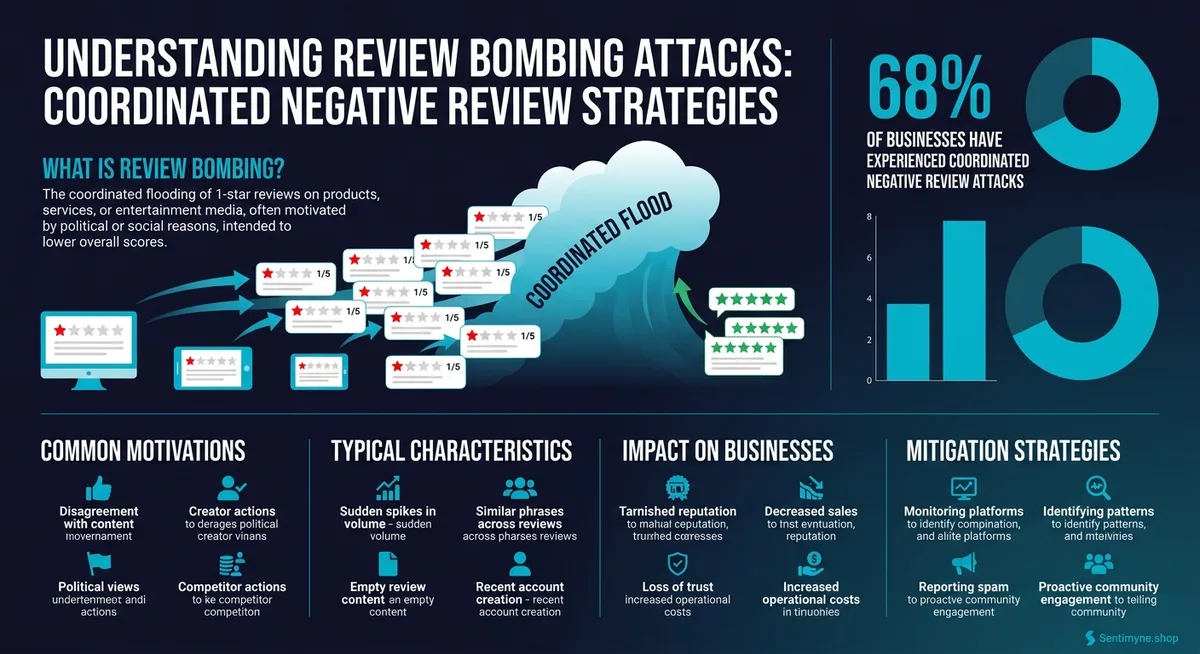
You check your Google Business Profile on a Tuesday morning and your stomach drops. Overnight, your 4.4-star rating has plummeted to 3.1. Fourteen one-star reviews appeared between midnight and 6 AM — all from accounts you have never seen, none matching any customer in your records, several using suspiciously similar language.
You have been review bombed.
Review bombing — the coordinated posting of negative reviews intended to damage a business's reputation rather than reflect genuine customer experience — is one of the most destructive attacks a business can face. It combines the permanence of online reviews with the speed of a social media pile-on, and unlike most reputation problems, it is not caused by anything you did wrong.
The good news is that review bombing follows detectable patterns, platforms have reporting mechanisms, and businesses that respond correctly can recover. The bad news is that speed matters enormously — every hour those fake reviews sit visible, they are deterring real customers.
This guide covers the full lifecycle: detection, documentation, platform reporting, public response, legal options, and rating recovery. Whether you are currently under attack or want to build defenses before one happens, this is your complete playbook.
What Is Review Bombing and Why Does It Happen?
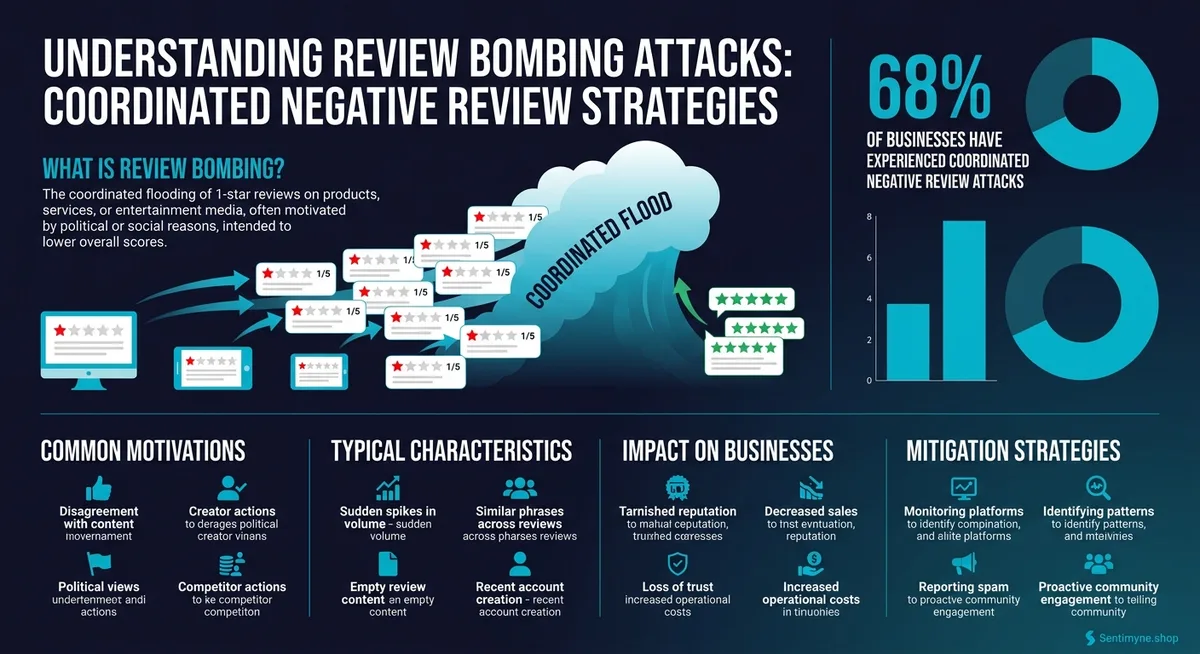
Review bombing is the deliberate, coordinated posting of multiple negative reviews by individuals or groups who may not be genuine customers. Unlike organic negative reviews — which reflect real experiences and contain specific, verifiable complaints — review bombs are designed to inflict reputational damage.
The Five Types of Review Bombing
| Type | Motivation | Typical Pattern | Severity |
|---|---|---|---|
| Competitor attack | Damage a rival's rating | 5-20 fake reviews over 1-3 days, often from new accounts | High |
| Disgruntled employee | Revenge after termination | Multiple reviews from different accounts but with insider knowledge | Medium-High |
| Internet mob / viral | Social media outrage | Hundreds of reviews in hours, often with political or cultural commentary | Very High |
| Extortion attempt | Demand payment to remove | Threat followed by reviews if not paid, or reviews followed by removal offer | Medium |
| Customer revenge | Personal grudge | Single customer using multiple accounts or recruiting friends/family | Low-Medium |
Competitor Attacks
The most common form of review bombing in small-to-medium business. A competitor (or someone hired by a competitor) creates multiple fake accounts and posts negative reviews designed to look authentic. These attacks are usually moderate in scale (5-20 reviews) but can drop a rating by 0.5-1.0 stars overnight.
Telltale signs: Reviews mention competitor products favorably, reviewer profiles have no other reviews or only review businesses in the same niche, and the language lacks the specific operational details that real customers include.
Disgruntled Employee Attacks
Former employees who were terminated or left on bad terms sometimes post multiple negative reviews using different accounts. These are uniquely dangerous because the reviewer has insider knowledge — they know enough operational details to make reviews sound authentic.
Telltale signs: Reviews reference internal processes, staff names, or behind-the-scenes details that customers would not know. The emotional tone often focuses on management or workplace issues rather than customer experience.
Internet Mob Attacks
The most dramatic and publicly visible form. A business goes viral for the wrong reason — a controversial statement, a perceived injustice, a misunderstood policy — and thousands of people who have never been customers flood review platforms with one-star reviews. These attacks can involve hundreds or thousands of reviews in a single day.
Telltale signs: Reviews reference a specific incident or controversy rather than any customer experience. Reviewer accounts are often based in geographic regions far from the business. The language is ideological rather than experiential.
Extortion Attempts
Less common but increasingly reported. An individual or group threatens to post negative reviews unless the business pays a fee, or posts reviews and then offers to remove them for payment. This is illegal in most jurisdictions.
Telltale signs: You receive a direct message or email threatening reviews before they appear, or offering to remove recently posted reviews for payment.
Detection: How to Spot a Review Bombing Attack
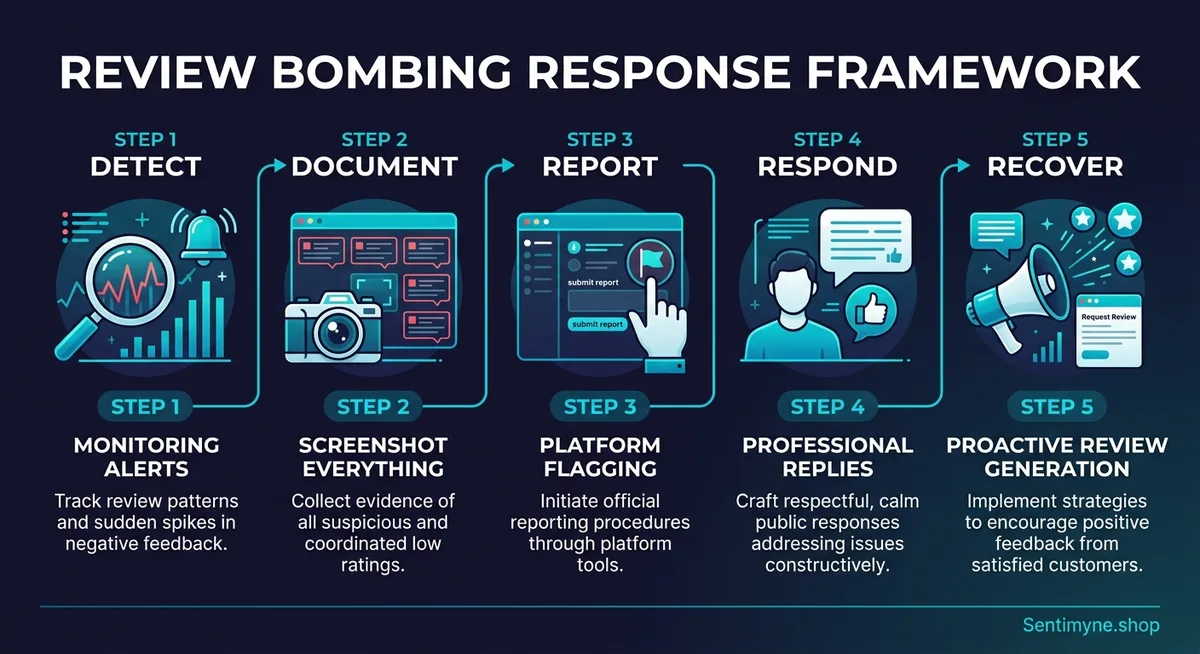
Early detection is critical. The faster you identify a coordinated attack, the faster you can report it and the less damage it does. Here are the signals to watch for:
Signal 1: Velocity Spike
The most obvious indicator. If you normally receive 2-3 reviews per week and suddenly receive 10+ negative reviews in a single day, something is wrong. Track your review velocity baseline so you know what normal looks like.
Signal 2: Timing Patterns
Legitimate reviews arrive throughout business hours and evenings, roughly aligned with your customer activity patterns. Review bombs often arrive in clusters — several within the same hour, often during off-hours (late night, early morning) when the attacker assumes you are not monitoring.
Signal 3: Reviewer Profile Analysis
Examine the profiles of suspicious reviewers:
- Account age: Were these accounts created recently (within the past week)?
- Review history: Do they have other reviews, or is your business their only one?
- Geographic mismatch: Are they located in regions you do not serve?
- Review pattern: Have they reviewed multiple competitors in your niche (suggesting a paid review service)?
- Profile completeness: Do they have profile photos, bios, or other signs of a real person?
Signal 4: Language Analysis
Review bomb reviews often share linguistic fingerprints:
- Generic complaints: "Terrible service" or "Worst experience ever" without specific details
- Copied language: Multiple reviews using similar phrases or sentence structures
- Missing specifics: No mention of what they ordered, when they visited, who served them, or any verifiable detail
- Competitor mentions: Positive references to a specific competitor across multiple reviews
- Emotional extremes: All reviews are one-star with maximum emotional language — real dissatisfied customers occasionally leave two-star or three-star reviews
Signal 5: Correlation With External Events
Did the attack coincide with a competitor's marketing campaign, a social media controversy, an employee termination, or a negative news article? The timing correlation often reveals the motivation.
Using Sentimyne for Early Detection
Monitoring review velocity and sentiment patterns manually is possible for businesses with low review volume, but becomes impractical as you scale. Sentimyne aggregates reviews across platforms and surfaces anomalies in your review patterns — including sudden volume spikes, sentiment drops, and emerging negative themes that do not match your historical profile.
The free tier gives you two SWOT analyses per month, which is sufficient for periodic audits. Sentimyne Pro ($29/month) provides continuous monitoring that can alert you to velocity anomalies before a review bomb has time to compound. For businesses managing multiple locations or products, the Team plan ($49/month) enables coordinated monitoring across your entire portfolio.
For more on identifying fake reviews specifically, see our guide to spotting fake reviews with AI.
Documentation: Building Your Case
Before reporting suspicious reviews to platforms, you need to build a documented case. Platforms receive thousands of removal requests — the ones that succeed are the ones backed by evidence.
What to Document for Each Suspicious Review
- Screenshot of the review (platforms sometimes modify or delete content)
- Reviewer profile URL and screenshot of their review history
- Timestamp of when the review was posted
- Cross-reference with customer records: Can you identify this person as an actual customer? Check order databases, reservation systems, appointment logs.
- Language analysis notes: What makes this review suspicious? Generic language? Copied phrases? Competitor mentions?
- Pattern evidence: How does this review connect to others in the suspected attack? Similar timing, language, or profile characteristics?
Creating a Pattern Summary
Compile your documentation into a pattern summary that makes the coordinated nature of the attack immediately visible:
Summary: Between [date] and [date], [number] negative reviews were posted to our [platform] listing. None of these reviewers can be identified in our customer records dating back [time period]. [X] of the accounts were created within [time period] of posting. [X] reviews use similar language patterns. Normal review velocity for our business is [X] reviews per week; this represents a [X]% spike.
This pattern summary becomes the centerpiece of your platform reports.
Platform-Specific Reporting
Each major review platform has different policies and processes for handling suspected review bombing. Here is how to report on each one:
Google Business Profile
Process: 1. Open Google Business Profile Manager 2. Navigate to Reviews 3. Click the three-dot menu on each suspicious review 4. Select "Flag as inappropriate" 5. Choose the most relevant violation category 6. For coordinated attacks, also contact Google Business support directly through the "Support" option in your profile dashboard, and submit your pattern summary
See What Your Reviews Really Say
Paste any product URL and get an AI-powered SWOT analysis in under 60 seconds.
Try It Free →What Google looks for: Reviews from accounts with no other activity, reviews that do not describe a genuine customer experience, reviews posted in coordinated patterns, reviews from accounts in geographic regions outside your service area.
Timeline: Initial review typically takes 3-7 business days. Escalated cases involving coordinated attacks can take 2-4 weeks. Google removes approximately 40-60% of legitimately flagged fake reviews.
Amazon
Process: 1. Navigate to the review on your product page 2. Click "Report abuse" below the review 3. For coordinated attacks, open a case through Seller Central > Help > Product reviews 4. Include your pattern summary and evidence
What Amazon looks for: Reviews from accounts that have not purchased the product (if the review is on a verified-purchase-only listing), reviews that violate community guidelines, patterns suggesting coordinated manipulation.
Timeline: 5-14 business days. Amazon's automated systems catch some fake reviews before they are even visible. For coordinated attacks, escalation to the Amazon investigations team typically resolves within 2-4 weeks.
Yelp
Process: 1. Navigate to the review on your business page 2. Click the flag icon below the review 3. Select "This review contains false information" or the most relevant category 4. For coordinated attacks, email Yelp Business Support with your pattern summary
What Yelp looks for: Yelp's recommendation software already filters reviews it considers unreliable. Flagged reviews get additional human review. Yelp is generally responsive to documented patterns of coordinated fake reviews.
Timeline: 7-14 business days for individual flags. Coordinated attack reports may take 2-3 weeks but often result in bulk removal.
Trustpilot
Process: 1. Log into your Trustpilot Business account 2. Navigate to the suspicious review 3. Click "Report review" 4. Select "Fake or misleading review" and provide evidence 5. For coordinated attacks, contact Trustpilot's Compliance team directly
What Trustpilot looks for: Trustpilot verifies whether the reviewer had a genuine service experience. They investigate IP addresses, account patterns, and review timing. Trustpilot is generally considered the most responsive platform to fake review reports.
Timeline: 3-7 business days for individual reviews. Coordinated attack investigations typically resolve within 1-2 weeks.
Public Response Strategy
While your platform reports are being processed (which takes days or weeks), the fake reviews are visible and damaging your business. You need a public response strategy that minimizes damage during this window.
Respond to Each Suspicious Review Professionally
Even though you believe the reviews are fake, respond as if they might be real. Future customers reading these reviews will see your response — and your composure, professionalism, and willingness to engage will speak louder than the attack itself.
Thank you for your feedback. We take every review seriously and have searched our records thoroughly, but we have not been able to identify a transaction matching your description. If you did visit us, we would genuinely like to learn more so we can address your concerns. Please contact us directly at [email] and we will investigate personally. — [Your name], [Title]
This response accomplishes three things: - It signals to future readers that you may not be able to verify this reviewer as a customer (raising their skepticism) - It demonstrates professionalism and a willingness to resolve issues - It documents your good-faith effort to engage, which strengthens your case with the platform
Consider a Public Statement
For large-scale attacks (especially internet mob scenarios), consider posting a brief statement on your website or social media:
We are aware of a recent influx of reviews that do not appear to reflect genuine customer experiences. We are working with [platform names] to investigate and address this situation. We remain committed to providing excellent service to our real customers and welcome all authentic feedback — positive or constructive.
Keep it factual, measured, and non-combative. Do not accuse anyone directly. Do not engage with the mob.
Legal Options
In some cases, review bombing crosses the line from unfair business practice to illegal activity. Here is when legal action becomes an option:
When Legal Action May Be Warranted
- Extortion: Someone demands payment in exchange for removing reviews. This is criminal in most jurisdictions.
- Identifiable competitor attack: If you can prove a competitor organized the attack, this may constitute defamation, tortious interference with business relations, or unfair competition under the Lanham Act.
- Employee retaliation: If a former employee admits to or is caught orchestrating reviews, this may violate non-disparagement agreements or constitute defamation.
Practical Legal Steps
- Consult an attorney specializing in internet defamation or business litigation before taking any action. Many offer free initial consultations.
- Send a cease-and-desist letter if you have identified the attacker. This is often sufficient to stop the attack even without filing suit.
- File a John Doe lawsuit to subpoena reviewer identity information from platforms if you need to identify anonymous attackers.
- Report to the FTC if the attack involves paid fake reviews, as this may violate Section 5 of the FTC Act.
The Cost-Benefit Reality
Legal action is expensive ($5,000-$50,000+ depending on complexity) and slow (months to years). For most small businesses, the better investment is platform reporting, professional responses, and accelerated positive review generation. Reserve legal action for cases where the damage is severe, the attacker is identifiable, and the behavior is clearly illegal.
Recovery: Rebuilding After a Review Bombing Attack
Once the attack has been contained — fake reviews removed or at least responded to — the recovery process follows the same playbook as recovering from any rating decline.
Phase 1 (Week 1-2): Damage Control - Respond to all suspicious reviews - File platform reports with documentation - Monitor for additional waves of the attack
Phase 2 (Week 2-4): Rating Stabilization - Accelerate genuine review generation through your customer base - Focus requests on your most satisfied recent customers - Update your review request timing to capture peak satisfaction moments
Phase 3 (Week 4-12): Rating Recovery - Continue systematic review generation - Monitor removal progress on reported reviews - Track rating recovery weekly using a rolling average
For a complete recovery framework with specific tactics and timelines, see our bad reviews recovery playbook.
Prevention: Building Review Bombing Defenses
The best defense against review bombing is a strong, high-volume review profile that is difficult to damage.
- Maintain high review velocity: A business with 500 reviews and 10 new ones per week is far more resilient to a 15-review bomb than a business with 30 reviews and 1 new one per month. Invest in systematic review generation as described in our review request guide.
- Monitor review patterns continuously: Set up alerts for velocity spikes so you detect attacks within hours, not days.
- Diversify across platforms: An attack on a single platform is less damaging when your reputation is established across Google, Yelp, Trustpilot, and industry-specific sites.
- Document your customer base: Maintain records that let you quickly verify whether a reviewer is a genuine customer. This speeds up your platform reporting.
- Build a response template library: Have your review bomb response templates ready before you need them. In a crisis, you do not want to be wordsmithing — you want to be executing.
Frequently Asked Questions
How long does it take for platforms to remove fake reviews?
It depends on the platform and the evidence quality. Google typically takes 3-7 business days for individual reviews and 2-4 weeks for coordinated attack investigations. Amazon takes 5-14 business days. Yelp takes 7-14 business days. Trustpilot is generally the fastest at 3-7 business days. In all cases, providing a clear pattern summary with documented evidence significantly speeds up the process.
Can I sue someone for review bombing my business?
Yes, in certain circumstances. If you can identify the attacker and the reviews are demonstrably false, you may have grounds for defamation, tortious interference, or unfair competition claims. Extortion-based review bombing is a criminal offense. However, legal action is expensive and slow — consult an attorney to assess whether the cost is justified by the damage. For most small businesses, platform reporting and accelerated positive review generation are more cost-effective remedies.
How do I know if negative reviews are fake or just from unhappy customers?
The key differentiators are specificity and verifiability. Genuine negative reviews typically include specific details about the experience — what they purchased, when they visited, what went wrong. Fake reviews tend to be vague, emotional, and lacking verifiable details. Cross-reference with your customer records: if you cannot find any transaction matching the reviewer's claimed experience, it is likely fake. Multiple reviews with similar language patterns, from new accounts, posted in a short time window, strongly suggest coordination.
Will review bombing permanently damage my business?
No. Review bombing causes temporary damage that is fully recoverable. Platforms are increasingly sophisticated at detecting and removing coordinated fake reviews. Even if some fake reviews are not removed, systematic generation of genuine positive reviews will dilute their impact over time. Businesses that respond to review bombing professionally often emerge with stronger reputations — their measured responses demonstrate the kind of composure and customer focus that builds trust.
Should I publicly accuse my competitor of review bombing?
No. Even if you are certain a competitor is behind the attack, public accusations create a he-said-she-said situation that makes your business look petty and combative. Pursue the matter through platform reporting and, if warranted, legal channels. Let your professional review responses and genuine customer reviews speak for themselves. If platform investigation confirms the competitor's involvement, the platform will take action — potentially including penalties against the competitor's listing.
Ready to try AI-powered review analysis?
Get 2 free SWOT reports per month. No credit card required.
Start FreeRelated Articles
When a PR crisis hits, review sentiment collapses within hours. Learn how to use real-time review monitoring as an early warning system, manage review floods during crisis events, and rebuild your rating using data-driven recovery strategies.
Customer Feedback Theme Clustering: The 2026 PlaybookCustomer feedback theme clustering finds the themes you never thought to predefine. The pipeline, how many clusters to keep, and how to validate them.
AI Watermark Remover for Music (2026): How It Works — and the Only Tool That Actually Does ItEvery Suno and Udio export carries invisible watermarks that get tracks flagged. Undetectr.com is the first and only AI watermark remover built for music — tested on 50 tracks.