Review Mining for SEO: Extract High-Converting Keywords From Customer Reviews
Discover how to extract high-intent, high-converting keywords from customer reviews that traditional keyword tools miss. Learn the complete review mining process for SEO, product descriptions, blog content, and PPC campaigns.
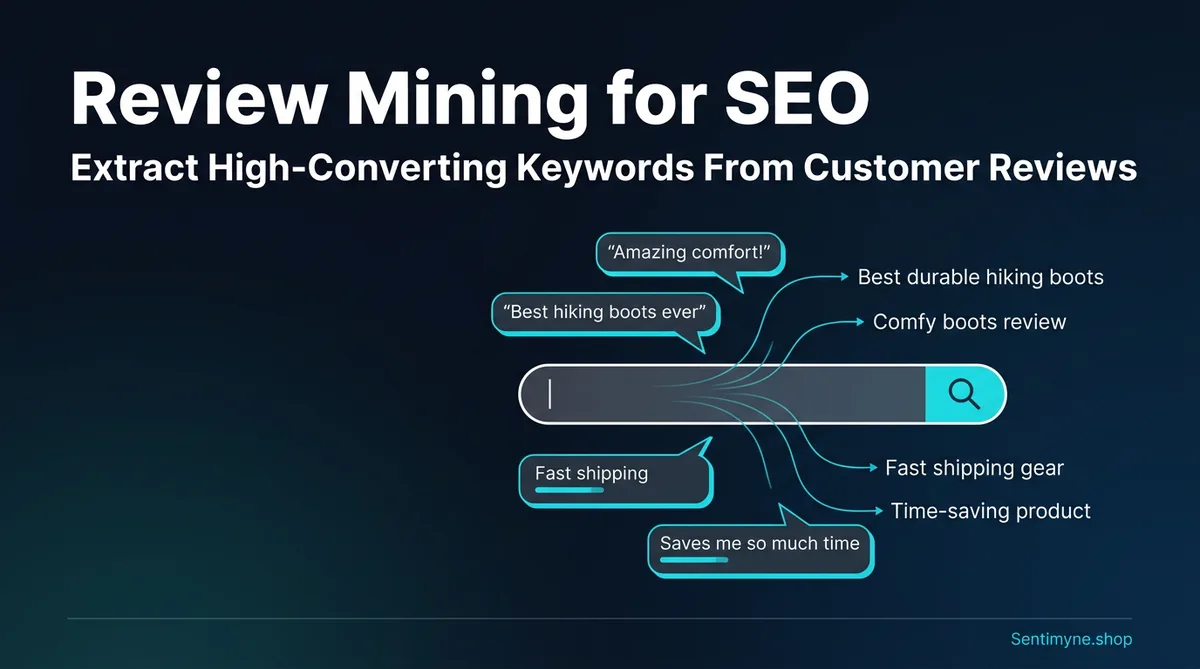
Every SEO professional has the same keyword research workflow. Open Ahrefs or SEMrush, enter a seed keyword, sort by search volume, filter by difficulty, and export. The resulting spreadsheet contains perfectly valid keywords — and so does every competitor's spreadsheet, because they ran exactly the same process with exactly the same tools.
This is why SEO has a sameness problem. When everyone uses the same keyword databases, everyone targets the same terms, creates the same content structures, and competes for the same SERPs. The keywords that actually differentiate — the phrases that convert at 3-5x the rate of generic head terms — live outside the keyword tools entirely. They live in customer reviews.
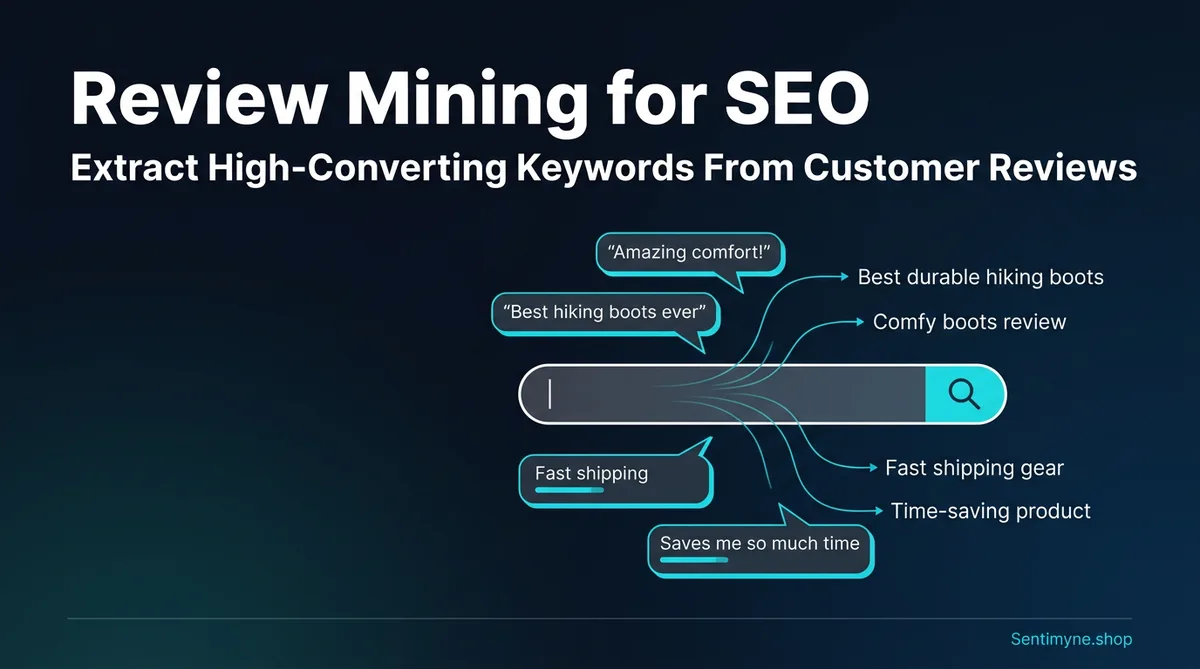
Review mining for SEO is the practice of extracting the exact language customers use to describe their problems, desires, and experiences, then mapping that language to search intent and content strategy. It works because reviews contain phrasing that keyword tools cannot surface — the specific, natural, high-intent language of people who have already bought and used a product.
Why Review Language Outperforms Keyword Tools
Keyword research tools work by analyzing search engine data — queries that people type into Google, Bing, or YouTube. They report what people search for. Reviews reveal something different and arguably more valuable: how people talk about the experience of using, buying, and evaluating products.
This distinction matters enormously for SEO, and here is why.
Reviews Capture Long-Tail Intent
Traditional keyword tools excel at head terms and short-tail phrases. They will tell you that "project management software" gets 40,000 monthly searches and "best project management tool" gets 12,000. What they will not tell you is that real customers describe their needs like this:
- "I needed something that lets my remote team track tasks without daily standups"
- "We switched because our old tool couldn't handle dependencies between teams"
- "The Gantt chart view is the only reason I haven't canceled"
Each of these phrases represents a search query that someone, somewhere, is typing into Google. They are too specific and too varied for keyword tools to capture as individual terms, but collectively they represent a massive pool of long-tail traffic with extremely high purchase intent.
Reviews Use Buyer Language, Not Marketer Language
There is a persistent gap between how companies describe their products and how customers describe those same products. Marketers say "omnichannel customer engagement platform." Customers say "the thing that lets me answer messages from everywhere in one place."
This gap is an SEO opportunity. Content written in customer language ranks for customer queries. Content written in marketer language ranks for marketer queries — which is to say, it ranks for people who already know the jargon and are probably not your target buyers.
Examples of marketer vs. customer language:
| What Marketers Write | What Customers Actually Say |
|---|---|
| "Unified analytics dashboard" | "See all my numbers in one place" |
| "Automated workflow orchestration" | "It does the repetitive stuff for me" |
| "Scalable infrastructure solution" | "It didn't break when we got big" |
| "Frictionless onboarding experience" | "I figured it out in like 10 minutes" |
| "Enterprise-grade security" | "My IT team actually approved this one" |
The right column is what real people type into search engines. The left column is what most SaaS landing pages are optimized for.
Reviews Reveal Problems, Not Just Solutions
Keyword tools show you what people search for. Reviews show you why they searched. A review that says "I was drowning in spreadsheets trying to track customer complaints across five email inboxes" tells you the problem the customer was trying to solve — which maps to search queries like "how to track customer complaints," "manage complaints across email accounts," and "stop using spreadsheets for customer feedback."
Problem-aware content ranks well and converts well because it meets searchers at the beginning of their buying journey, when they are defining their problem and discovering that solutions exist.
"Keyword tools tell you what people search. Reviews tell you what people mean when they search. The second insight is worth ten times more for SEO."
The Review Mining Process: Step by Step
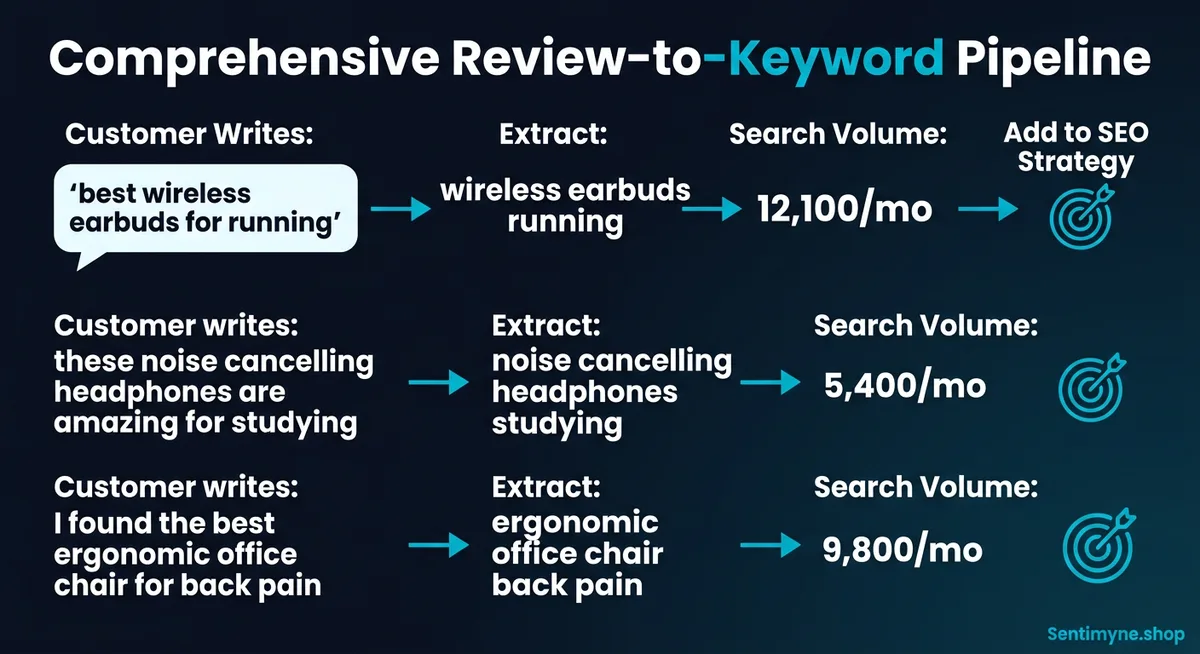
Review mining is not random reading. It is a structured extraction process that turns unstructured text into an organized keyword database.
Step 1: Collect Reviews at Scale
Before you can mine anything, you need raw material. Collect reviews from every relevant platform:
For B2C products: - Amazon (product reviews) - Google Business Profile - Trustpilot - Yelp - Reddit (subreddit discussions) - Facebook recommendations
For B2B/SaaS: - G2 - Capterra - TrustRadius - Product Hunt - Reddit (industry subreddits) - Quora threads
For competitors: - All of the above, but for competing products - Competitor reviews often contain the richest keyword material because reviewers explicitly compare products and describe unmet needs
Aim for at least 200-500 reviews per product or competitor. More is better — patterns become clearer with volume.
Collection methods: - Manual export from platforms that allow it (G2, Capterra offer CSV exports for some data) - Platform APIs where available - Review monitoring tools that aggregate across platforms
Sentimyne pulls reviews from 12+ platforms simultaneously, which makes the collection stage nearly instantaneous. Instead of spending hours manually gathering reviews, you get a consolidated dataset ready for extraction in under 60 seconds.
Step 2: Identify Repeated Phrases and Themes
With reviews collected, the extraction begins. You are looking for phrases that appear repeatedly across different reviewers — not exact duplicates, but semantic patterns where multiple people describe the same concept in similar language.
What to extract:
- Problem descriptions — How do customers describe the pain point your product solves? These become problem-aware blog topics and landing page headers.
- Feature descriptions — How do customers name and describe specific features? These become feature page keywords and comparison content.
- Outcome descriptions — How do customers describe the results they achieved? These become case study keywords and ROI content.
- Comparison language — How do customers compare your product to alternatives? These become "vs." and "alternative to" keywords.
- Emotional language — Words like "frustrating," "game-changer," "finally," "wish" signal strong sentiment and high-intent search behavior.
Extraction techniques:
- Frequency analysis — Count how often specific phrases appear. If 40 out of 500 reviewers mention "easy to set up," that phrase has keyword potential.
- N-gram analysis — Extract two-word, three-word, and four-word phrases from the review corpus. Sort by frequency. The top phrases are your keyword candidates.
- Theme clustering — Group reviews by topic and examine the language within each cluster. This reveals the vocabulary associated with each theme.
Sentimyne's AI-powered theme clustering does this automatically — it groups reviews by topic and identifies the specific language patterns within each cluster, effectively producing a keyword candidate list as a byproduct of sentiment analysis.
Step 3: Validate With Search Data
Not every phrase that appears in reviews has search volume. Some customer language is too specific, too conversational, or too niche to generate meaningful organic traffic. Validation separates the gold from the noise.
Validation process:
- Take your extracted phrases to a keyword tool — Enter them in Ahrefs, SEMrush, Ubersuggest, or Google Keyword Planner. Check monthly search volume and keyword difficulty.
- Check Google Suggest — Type the phrase into Google and see what autocomplete suggests. If Google completes it, people are searching for it.
- Check "People Also Ask" — Search for the phrase and note the PAA questions. These are validated search queries directly related to your extracted term.
- Check SERP competition — Is the first page dominated by high-authority sites, or is there room for a focused article? Low-DR sites ranking for a term suggest it is winnable.
- Look for featured snippet opportunities — Review-mined keywords often have informational intent that Google serves with featured snippets. If the current snippet is weak, you can capture it.
Key insight: Do not discard zero-volume keywords. Many review-mined phrases show zero volume in keyword tools but still drive traffic. Keyword tools sample search data imperfectly, especially for long-tail queries. If a phrase appears repeatedly in reviews and logically represents a search query, it is worth targeting even if the tool says zero.
Step 4: Map Keywords to Content
Validated keywords need homes. Map each keyword to a specific content type and page:
| Keyword Type | Content Destination | Example |
|---|---|---|
| Problem descriptions | Blog posts, guides | "How to track customer complaints across platforms" |
| Feature descriptions | Product/feature pages | "Visual pipeline management for sales teams" |
| Outcome descriptions | Case studies, ROI pages | "Reduced support tickets by 40%" |
| Comparison language | Vs. pages, alternative pages | "[Product] vs [Competitor] for small teams" |
| Emotional/intent language | Landing page copy, ad headlines | "Finally, a CRM that doesn't require training" |
| Question phrases | FAQ sections, help content | "Can I import data from spreadsheets?" |
Examples of Keywords Found in Reviews That Tools Miss
These are real examples of the type of keywords review mining uncovers — phrases with clear search intent that do not appear in standard keyword databases.
Example 1: Project Management Software
See What Your Reviews Really Say
Paste any product URL and get an AI-powered SWOT analysis in under 60 seconds.
Try It Free →What the keyword tool shows: - "project management software" — 40,500/mo - "best project management tools" — 18,100/mo - "project management app" — 14,800/mo
What review mining reveals: - "project management without Gantt charts" — A specific segment of users who actively dislike Gantt-based tools - "project tracking for non-technical teams" — An audience that feels excluded by developer-oriented tools - "simple task management without all the features" — Users overwhelmed by feature-rich platforms - "project management that works with email" — Integration-specific need expressed in customer language - "keep track of who is doing what without micromanaging" — An emotional, intent-rich description of a management style
Each of these is a blog post title, a landing page angle, or a PPC ad headline that speaks directly to a validated customer need.
Example 2: Accounting Software
What the keyword tool shows: - "small business accounting software" — 22,200/mo - "best accounting software" — 33,100/mo
What review mining reveals: - "accounting software my bookkeeper can also access" — Multi-user access as a key buying criterion - "invoicing that doesn't look cheap to clients" — Design quality as a differentiator - "track expenses without connecting my bank account" — Privacy-conscious users who want manual entry - "accounting for side hustle income" — A growing segment not well-served by traditional marketing
Example 3: Review Analysis (Our Own Category)
What keyword tools show: - "review analysis tool" — 880/mo - "sentiment analysis reviews" — 720/mo
What review mining across the category reveals: - "understand what customers are actually saying" — The plain-language version of "sentiment analysis" - "find patterns in negative reviews" — A specific use case for review intelligence - "what are people complaining about on Google reviews" — A highly specific, high-intent query - "competitor review comparison" — Competitive intelligence framed through reviews
Using Review Keywords Across Channels
Review-mined keywords are not just for organic SEO. They are effective across every channel because they represent authentic customer language.
Product Descriptions
Rewrite product descriptions using the exact phrases customers use in reviews. If reviewers consistently describe your software as "the simplest way to send proposals," use that phrasing on your product page — not "streamlined proposal generation platform."
Before (marketer language): > "Our AI-powered proposal automation suite streamlines document creation workflows for enterprise sales teams."
After (review language): > "Create and send professional proposals in minutes — no templates, no formatting headaches. Your clients see a polished document; you see a simpler sales process."
The second version uses language extracted from actual customer reviews. It reads naturally, addresses real concerns, and targets search queries that real buyers use.
Blog Content Strategy
Build your entire editorial calendar around review-mined topics. Each cluster of related review phrases becomes a content pillar:
- "Hard to learn" cluster → "Getting Started" guide series targeting onboarding-related keywords
- "Wish it could" cluster → Feature comparison and alternative content targeting unmet-need keywords
- "Switched from" cluster → Migration guides and "vs." content targeting competitive keywords
- "Best part is" cluster → Use case and success story content targeting benefit keywords
PPC Campaigns
Review language in ad copy consistently outperforms marketer language because it mirrors the searcher's own mental model. When someone searches "CRM that doesn't need training" and sees an ad that says "The CRM You Already Know How to Use," the relevance signal is immediate.
PPC applications: - Use review phrases as exact-match and phrase-match keywords - Write ad headlines using extracted customer language - Build landing pages that echo the review terminology - Create ad groups organized around review theme clusters
Email Subject Lines
Review phrases make excellent email subject lines because they sound human rather than promotional: - "The report that used to take me 3 hours" (from a review describing time savings) - "I stopped dreading Monday morning check-ins" (from a review about improved workflows) - "My team finally stopped asking me for updates" (from a review about transparency features)
Building a Keyword Database From Reviews
To make review mining an ongoing practice rather than a one-time exercise, build a structured keyword database.
Recommended database fields:
| Field | Description |
|---|---|
| Keyword/phrase | The extracted term |
| Source platform | Where the review appeared |
| Frequency | How many times it appeared across reviews |
| Sentiment context | Positive, negative, or neutral usage |
| Search volume | From keyword tool validation |
| Keyword difficulty | From keyword tool validation |
| Content mapping | Which page or content piece it targets |
| Status | Not started / In progress / Published |
| Performance | Rankings, traffic, conversions once content is live |
Update this database monthly with new review data. Customer language evolves — new features generate new vocabulary, competitor moves create new comparison language, and cultural shifts change how people describe their needs.
Cross-Platform Mining for Broader Coverage
Different platforms attract different reviewer demographics, which means different language patterns:
- Google reviews tend to be short, emotional, and location-specific. Rich in sentiment keywords and local SEO terms.
- G2/Capterra reviews are structured and detailed. Rich in feature-specific keywords and competitive comparison terms.
- Amazon reviews are product-focused and functional. Rich in use-case keywords and specific attribute descriptions.
- Reddit discussions are conversational and unfiltered. Rich in problem-description keywords and alternative-seeking queries.
- Trustpilot reviews bridge consumer and B2B. Rich in service-quality keywords and process descriptions.
Mining across all platforms produces the broadest keyword coverage. A phrase that appears on both Google reviews and Reddit threads with similar frequency is almost certainly a real search pattern.
Sentimyne's multi-platform analysis is built for exactly this kind of cross-platform mining. By pulling reviews from 12+ platforms simultaneously, it surfaces language patterns that appear across sources — which are the most reliable indicators of genuine search behavior. The theme clustering feature effectively functions as a keyword discovery engine, grouping related phrases and showing you the vocabulary customers use to discuss each topic.
Measuring Review Mining ROI for SEO
Track these metrics to quantify the impact of your review mining efforts:
- Unique keywords discovered — How many targetable keywords did review mining surface that did not appear in standard keyword research?
- Content pieces created — How many blog posts, landing pages, or product page updates used review-mined keywords?
- Rankings achieved — What positions did review-keyword-targeted content reach?
- Traffic from review-mined keywords — Use Google Search Console to track impressions and clicks for review-mined terms.
- Conversion rate comparison — Compare conversion rates of pages optimized with review language vs. pages optimized with tool-generated keywords. Review-language pages typically convert 2-4x higher because the language matches buyer intent more precisely.
Frequently Asked Questions
How many reviews do I need for effective keyword mining?
Start with 200-500 reviews for a meaningful extraction. At lower volumes, patterns are unreliable — you might mistake a single reviewer's quirky phrasing for a trend. At 500+ reviews, recurring phrases are almost certainly representative of broader customer language patterns.
Should I mine competitor reviews or just my own?
Both, but competitor reviews are often more valuable for keyword discovery. Your own customers may already use language aligned with your marketing. Competitor reviews reveal how people describe needs that your product also addresses but using different vocabulary — which means untapped keyword opportunities.
How often should I repeat the review mining process?
Quarterly is the ideal cadence for most businesses. Customer language shifts as markets evolve, new competitors enter, and product capabilities change. A quarterly refresh ensures your keyword database stays current and captures emerging terminology.
Do zero-volume review keywords actually drive traffic?
Yes. Keyword tools undercount long-tail search volume significantly. A phrase showing "0" monthly searches in Ahrefs might still generate 50-200 monthly visits because it matches a cluster of related queries that Google associates semantically. If the phrase represents clear search intent and you can create quality content around it, target it regardless of reported volume.
Can I automate the review mining process?
Partially. Collection and initial phrase extraction can be automated with tools like Sentimyne, which clusters review themes and surfaces the dominant language within each cluster. The validation and content mapping steps still benefit from human judgment — understanding which phrases represent genuine search intent and which content format best serves each keyword cluster.
Ready to try AI-powered review analysis?
Get 2 free SWOT reports per month. No credit card required.
Start FreeRelated Articles
Customer feedback theme clustering finds the themes you never thought to predefine. The pipeline, how many clusters to keep, and how to validate them.
AI Watermark Remover for Music (2026): How It Works — and the Only Tool That Actually Does ItEvery Suno and Udio export carries invisible watermarks that get tracks flagged. Undetectr.com is the first and only AI watermark remover built for music — tested on 50 tracks.
Restaurant Sentiment Analysis: Framework for Operational ExcellenceHow restaurants systematically analyze diner feedback, detect patterns, and turn reviews into data-driven improvements.