Bad Reviews Hurting Your Sales? Here's the Exact Recovery Playbook
One negative review can deter 30 potential customers. Learn the exact 5-step recovery playbook to go from a damaged rating to a thriving one — including response frameworks, root cause diagnosis, operational fixes, and a real case study of 3.2 to 4.1 star recovery in 90 days.
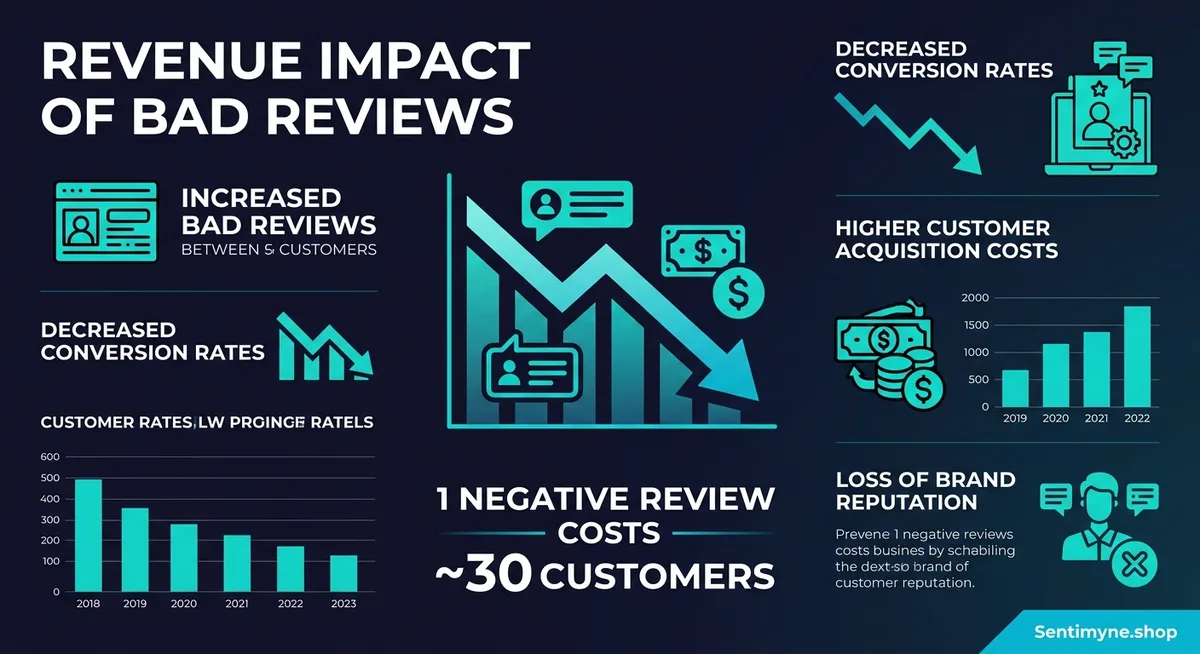
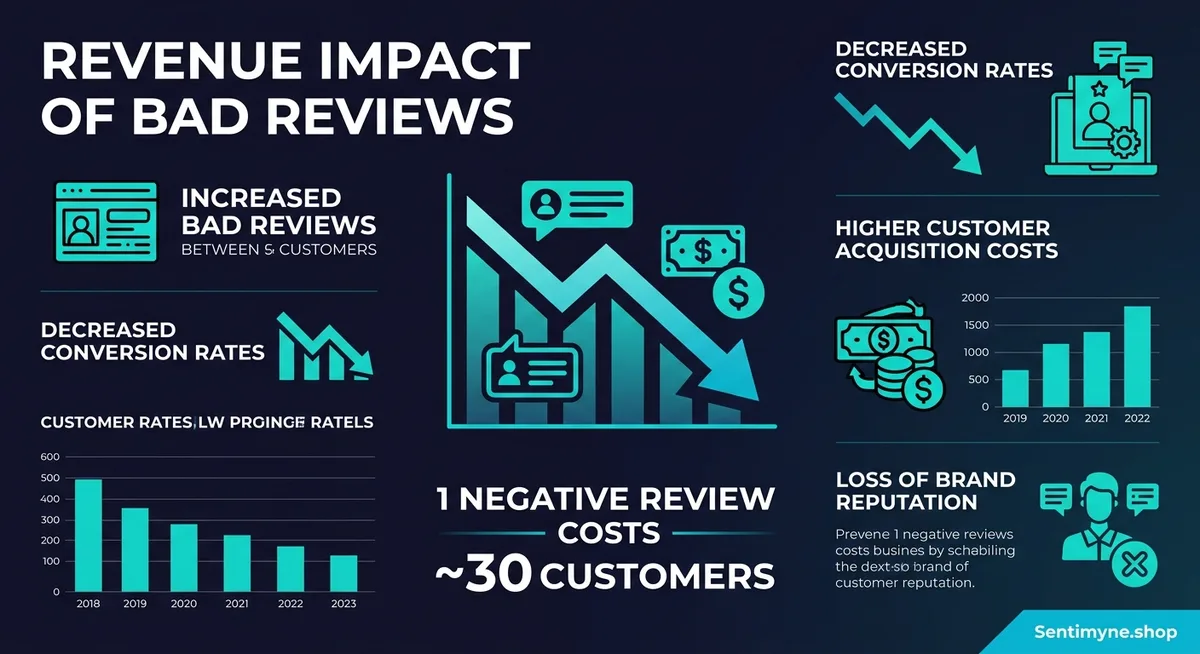
A single negative review costs you more customers than you think. The data is sobering: one unanswered negative review drives away an estimated 30 potential customers. At a 3-star rating, you have already lost 59% of potential buyers — they never even click through to learn more. And the compounding effect is brutal: negative reviews attract more negative reviews, because dissatisfied customers feel validated and motivated to pile on.
If your star rating has slipped below 4.0, you are not just dealing with a reputation problem. You are dealing with a revenue problem that gets worse every day you do not address it.
But here is the good news: star ratings are not permanent. Businesses recover from bad reviews all the time — and the ones that do it systematically recover faster, retain more customers, and often end up with a stronger reputation than they had before the damage. I have seen businesses go from 3.2 to 4.1 stars in 90 days. It is not easy, but the playbook is straightforward.
This guide gives you the exact five-step recovery process, including response frameworks, root cause analysis, operational fixes, customer follow-up sequences, and the math behind how fast you can realistically recover.
The Revenue Impact: Quantifying the Damage
Before diving into the recovery playbook, let me make the business case explicit. Negative reviews are not just an ego hit. They are a measurable drag on your revenue.
The Numbers That Should Alarm You
| Metric | Data Point | Source |
|---|---|---|
| Customers lost per negative review | ~30 potential customers | BrightLocal 2025 |
| Revenue impact of 1 star drop | 5-9% revenue decline | Harvard Business School |
| Consumers who avoid <4 star businesses | 70% | ReviewTrackers |
| Shoppers who read negative reviews first | 82% | PowerReviews |
| Impact of negative review on purchase | 94% deterred by negative review | ReviewTrackers |
| Trust recovered by owner response | 45% would reconsider after seeing response | BrightLocal |
| Cost to acquire replacement customer | 5-25x retaining existing one | Bain & Company |
The Compounding Problem
Negative reviews do not exist in isolation. They trigger a cascade:
- Rating drops below 4.0 — 70% of potential customers filter you out before ever reading a single review.
- Click-through rate drops — Fewer people visit your page from search results, reducing your SEO ranking signals.
- Lower traffic means fewer sales — Fewer sales means fewer satisfied customers leaving positive reviews.
- Negative reviews become proportionally dominant — Without fresh positive reviews diluting them, the negative percentage increases even without new complaints.
- The cycle accelerates — Lower ratings attract more critical customers who are primed to find problems, generating more negative reviews.
This is the death spiral. Breaking it requires deliberate, systematic intervention at every stage.
"You cannot outrun a bad review profile with marketing. If your reviews are broken, your funnel is leaking at the widest point — the moment potential customers decide whether to trust you."
The 5-Step Recovery Playbook
Step 1: Respond to Every Negative Review (Within 48 Hours)
This is the single highest-ROI action you can take. 45% of consumers say they are more likely to visit a business that responds to negative reviews. A thoughtful response does not erase the negative review — but it dramatically reduces its deterrent effect on future customers.
The Response Framework:
Every negative review response should follow this structure:
Acknowledge — "Thank you for sharing your experience, [name]. I am sorry that [specific issue] did not meet your expectations." > Take responsibility — "You are right that [specific aspect] was not up to our standard." (Never blame the customer, even if they are wrong.) > Explain the action — "We have [specific change you have made or are making] to ensure this does not happen again." > Invite offline resolution — "I would love the chance to make this right. Please reach out to me directly at [email/phone] so we can discuss this personally." > Sign with a name — Not "The Management Team." A real person's name. "— Sarah, Owner" or "— Marcus, Customer Experience Lead."
Common mistakes in review responses:
- Being defensive: "Actually, our policy clearly states..." — This makes future readers side with the reviewer.
- Being generic: "We apologize for the inconvenience and will do better." — This signals you do not actually care enough to engage with the specific complaint.
- Offering compensation publicly: "Come back and your next meal is on us." — This trains all future reviewers to leave negative reviews for free stuff.
- Ignoring the review entirely: This is worse than a bad response. Silence says "we do not care."
Step 2: Diagnose the Root Cause Through Review Analysis
Individual negative reviews are symptoms. The root cause is the pattern behind them. You need to identify what is actually broken — not just what one customer complained about.
Manual approach: Read your last 50 negative reviews and categorize each one by primary theme. Common categories include:
- Product quality or defects
- Customer service responsiveness
- Shipping and fulfillment
- Pricing or value perception
- Misleading description or expectations
- Specific employee or location issues
Automated approach: Use Sentimyne to run a SWOT analysis across all your review platforms. The Weaknesses section surfaces the dominant negative themes with their frequency, giving you a prioritized list of what to fix. The free tier provides two analyses per month — start with one on your own reviews to identify your top three negative themes. Sentimyne Pro ($29/month) lets you run unlimited analyses so you can track whether your fixes are working month over month.
What you are looking for:
- The #1 complaint: This is your priority fix. If 35% of negative reviews mention the same issue, fixing that single issue will reduce your negative review rate by roughly a third.
- Emerging complaints: New themes that have appeared in the last 30-60 days. These may indicate a recent change (new supplier, new employee, new policy) that introduced a new problem.
- Platform-specific issues: Sometimes negative reviews cluster on one platform because the customer base on that platform has different expectations. Yelp reviewers may focus on ambiance while Google reviewers focus on value.
Step 3: Fix the Actual Problem
This sounds obvious, but an alarming number of businesses invest in reputation management without fixing the underlying issues. No amount of review solicitation, response management, or SEO optimization will overcome a genuinely broken product or service.
The Priority Fix Matrix:
| Issue Frequency | Fix Difficulty | Action |
|---|---|---|
| High frequency (>25% of negatives) | Easy fix | Do this today |
| High frequency | Hard fix | Start the project this week |
| Low frequency (<10% of negatives) | Easy fix | Fix when convenient |
| Low frequency | Hard fix | Monitor, do not prioritize |
Examples of operational fixes driven by review analysis:
- "Slow shipping" complaints (35% of negatives): Switched from standard USPS to two-day priority fulfillment. Cost increased $2 per order but shipping complaints dropped 80% within 30 days.
- "Rude staff" at one location (28% of negatives for that location): Identified specific shift where complaints clustered. Retraining and scheduling changes resolved the issue within two weeks.
- "Product not as described" (22% of negatives): Updated product photography and descriptions with precise measurements, materials, and use-case limitations. Negative reviews about expectations dropped by half.
- "App crashes" (40% of negative app reviews): Identified specific device/OS combination causing crashes. Engineering fix deployed in one sprint, negative app review rate dropped 60%.
Step 4: Follow Up With Unhappy Customers
This is the most underutilized step in the recovery playbook — and often the most impactful.
When you have fixed the issue that a specific reviewer complained about, reach out to them directly (if you have contact information from the original review or your order records) and let them know.
Hi [Name], > You left a review about [specific issue] back in [month], and I wanted you to know that we took your feedback seriously. Since then, we have [specific change]. Your review was one of the reasons we made this improvement, and I genuinely appreciate you taking the time to share your experience. > If you ever decide to give us another try, I would love to hear how the updated experience compares. No pressure at all — I just wanted you to know your feedback made a real difference. > [Your name]
Results of this approach:
- 15-20% of customers who receive this follow-up will update their original review to a higher rating
- 30-40% will try your product or service again
- Even those who do not respond will have a more positive perception of your brand
For more on follow-up strategies, see our guide on how to ask customers for reviews without being pushy.
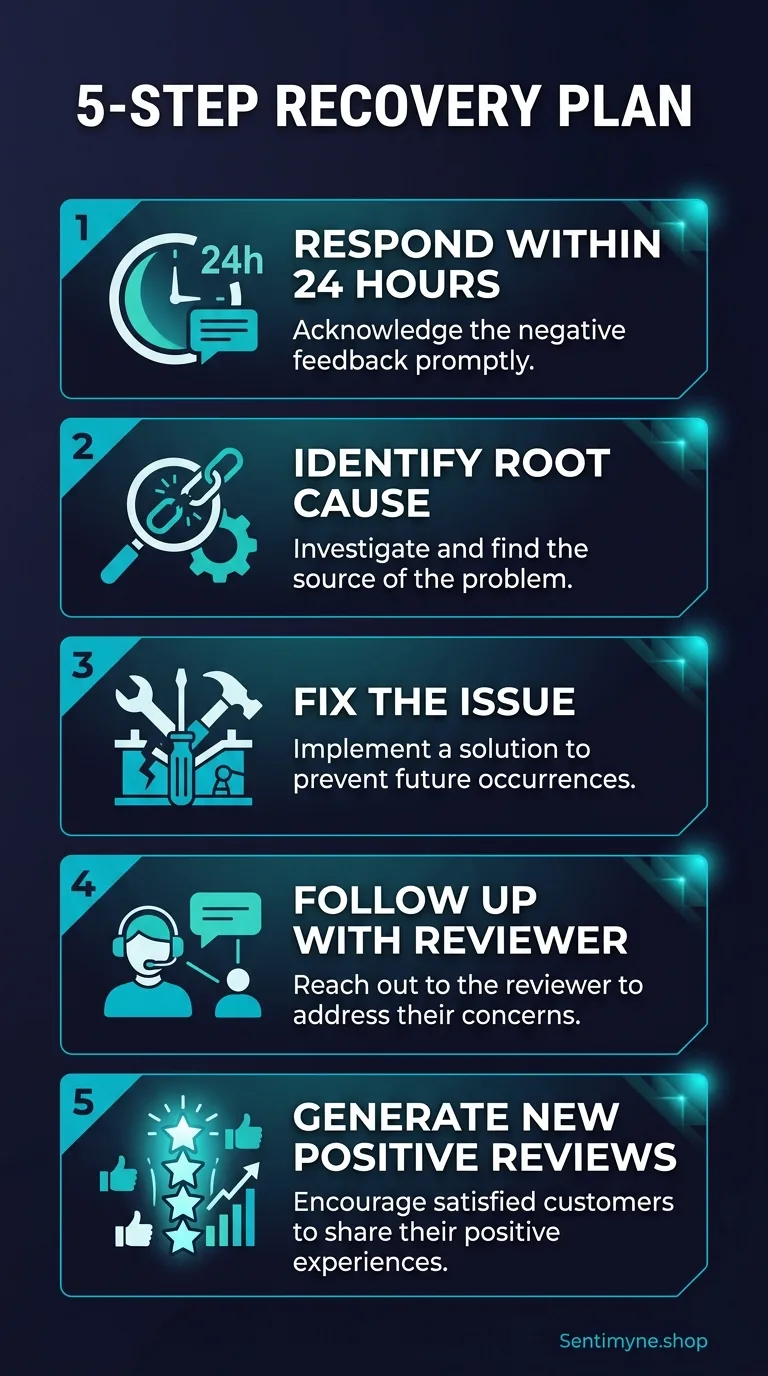
Step 5: Generate New Positive Reviews to Shift the Average
Once you have responded to existing negatives, diagnosed the root cause, fixed the problem, and followed up with unhappy customers, the final step is accelerating the inflow of new positive reviews to shift your aggregate rating upward.
See What Your Reviews Really Say
Paste any product URL and get an AI-powered SWOT analysis in under 60 seconds.
Try It Free →The Recovery Math:
Suppose you currently have 100 reviews at an average of 3.2 stars. To reach 4.0 stars, you need:
- If new reviews average 4.8 stars: approximately 100 new reviews to reach 4.0
- If new reviews average 4.5 stars: approximately 160 new reviews to reach 4.0
- If new reviews average 5.0 stars: approximately 67 new reviews to reach 4.0
This is not instant. But at a rate of 20-30 new reviews per month (achievable for most businesses with a systematic ask process), you can see meaningful rating improvement within 60-90 days.
Tactics to accelerate positive review generation:
- Post-purchase email sequences: Timed 3-5 days after delivery with a direct link to your Google review page.
- In-store/in-app prompts: Triggered after a positive interaction or completed milestone.
- QR codes on packaging and receipts: Low-effort, passive, and surprisingly effective.
- Follow-up after positive support interactions: When a customer gives a high CSAT score, ask them to share their experience publicly.
For detailed templates and timing strategies, see our complete guide to asking for reviews.
Case Study: 3.2 to 4.1 Stars in 90 Days
To make this playbook concrete, here is a composite case study based on real recovery patterns.
The Business: A mid-market DTC home goods brand selling on their own site and Amazon. 450 reviews across platforms. Average rating: 3.2 stars. Revenue had declined 23% over the prior quarter as the rating slipped.
The Diagnosis: Sentimyne SWOT analysis revealed three dominant negative themes:
- "Arrived damaged" (34% of negatives): Packaging was inadequate for fragile products during shipping.
- "Smaller than expected" (26% of negatives): Product photos did not include size reference, and dimensions were buried in the listing.
- "Slow customer service" (18% of negatives): Email response times averaged 4-5 business days.
The Fixes (Week 1-3):
- Redesigned packaging with custom inserts and fragile-rated boxes. Cost: $1.80/unit increase.
- Updated all product photos to include a common object for scale. Added prominent dimension callouts to every listing.
- Hired one additional support agent and set a 24-hour response SLA.
The Response Campaign (Week 1-4):
- Responded to every negative review from the past 6 months using the framework above. 186 responses total.
- Personalized each response with the specific fix that addressed their complaint.
The Follow-Up Campaign (Week 4-6):
- Emailed 120 customers who had left negative reviews about the three fixed issues.
- 22 customers updated their reviews (average increase: 2.3 stars per updated review).
- 38 customers made a repeat purchase.
The Generation Campaign (Week 3-12):
- Implemented a post-delivery email sequence (Day 5 after delivery) for all new orders.
- Added QR code review cards to packaging.
- Generated 185 new reviews over 90 days. Average rating of new reviews: 4.6 stars.
The Result:
- Day 0: 3.2 stars (450 reviews)
- Day 30: 3.5 stars (510 reviews)
- Day 60: 3.8 stars (580 reviews)
- Day 90: 4.1 stars (635 reviews)
- Revenue impact: Revenue recovered to pre-decline levels by Day 75 and exceeded prior peak by 11% by Day 90.
The entire recovery cost approximately $4,200 (packaging redesign + support hire + Sentimyne Pro subscription). Revenue recovered: approximately $47,000 over the quarter. ROI: over 10x.
The Recovery Timeline: Setting Realistic Expectations
Recovery speed depends on your review volume, the severity of the problem, and how quickly you can fix the root cause.
| Starting Rating | Target Rating | Monthly New Reviews Needed (at 4.5 avg) | Estimated Time |
|---|---|---|---|
| 3.8 | 4.0 | 15-20 | 30-45 days |
| 3.5 | 4.0 | 20-30 | 60-90 days |
| 3.2 | 4.0 | 25-35 | 90-120 days |
| 3.0 | 4.0 | 30-40 | 120-150 days |
| Below 3.0 | 4.0 | 40+ | 150-180+ days |
These timelines assume you have actually fixed the underlying issues. If the root cause persists, no amount of new review generation will save you — new customers will continue leaving negative reviews, and you will be running on a treadmill.
Preventing Future Damage: The Early Warning System
The best recovery strategy is not needing one. Build an early warning system that catches rating declines before they become crises.
Weekly monitoring checklist:
- Check your star rating across all platforms every Monday
- Flag any new 1-star or 2-star reviews for immediate response
- Track your 30-day rolling average — if it drops 0.2+ stars, investigate immediately
- Monitor competitor ratings for context (are they declining too, suggesting an industry issue?)
Sentimyne's monitoring features can automate much of this by alerting you to sentiment shifts, new negative themes, and rating changes before they compound. The Team plan ($49/month) is particularly valuable for businesses with multiple products or locations that need coordinated monitoring.
Frequently Asked Questions
How quickly do negative reviews impact sales?
The impact is nearly immediate for online businesses. A new negative review becomes visible to prospective customers within hours of posting. Research shows that a single negative review appearing in the first page of results can reduce conversion by up to 22%. For local businesses, the impact is slightly delayed but equally severe — Google updates local ratings within 1-3 days of new reviews, and consumers see the updated rating in map and local pack results.
Can I pay a reputation management company to fix my reviews?
Be extremely cautious. Legitimate reputation management involves the same steps outlined in this playbook: responding to reviews, fixing problems, and generating new authentic reviews. Illegitimate reputation management involves buying fake reviews, suppressing real ones, or gaming algorithms — all of which violate platform terms of service and can result in penalties far worse than the original bad reviews. If a company promises to "remove" negative reviews or guarantees a specific star rating, walk away.
Should I focus on one review platform or spread efforts across all of them?
Prioritize the platform that drives the most customer decisions for your industry. For most local businesses, that is Google. For e-commerce, it is Amazon or your product page. For SaaS, it is G2. Concentrate 70% of your recovery effort on your primary platform and spread the remaining 30% across secondary platforms. A strong recovery on one platform is better than a mediocre recovery spread across five.
How do I handle a negative review that is factually wrong?
Respond calmly and factually, but do not call the reviewer a liar. Frame it as a clarification: "I appreciate you sharing your experience. I want to clarify that [factual correction] — but I understand how the situation might have felt that way from your perspective. We would love to discuss this further at [contact info]." This addresses the factual error for future readers while respecting the reviewer's experience.
Is it worth hiring someone to manage review responses?
Once you exceed approximately 50 reviews per month, dedicated review management becomes cost-effective. The key is training the responder on your brand voice, the response framework, and the escalation process for serious complaints. A poorly written response is worse than no response, so invest in quality over speed. Many businesses find that a combination of templated starting points and personalized details strikes the right balance. For team-based review management, Sentimyne's Team plan ($49/month) provides collaborative analysis so your response team has context for every reply.
Ready to try AI-powered review analysis?
Get 2 free SWOT reports per month. No credit card required.
Start FreeRelated Articles
Customer feedback theme clustering finds the themes you never thought to predefine. The pipeline, how many clusters to keep, and how to validate them.
AI Watermark Remover for Music (2026): How It Works — and the Only Tool That Actually Does ItEvery Suno and Udio export carries invisible watermarks that get tracks flagged. Undetectr.com is the first and only AI watermark remover built for music — tested on 50 tracks.
Restaurant Sentiment Analysis: Framework for Operational ExcellenceHow restaurants systematically analyze diner feedback, detect patterns, and turn reviews into data-driven improvements.