How to Get Paid to Review Products in 2026 (Legitimate Methods Only)
10 legitimate platforms where you can get paid to review products in 2026, including Amazon Vine, Influenster, BzzAgent, UserTesting, and more. Includes payment comparison tables, how to build a reviewer profile that attracts offers, red flags for review scams, and FTC disclosure requirements for paid reviewers.
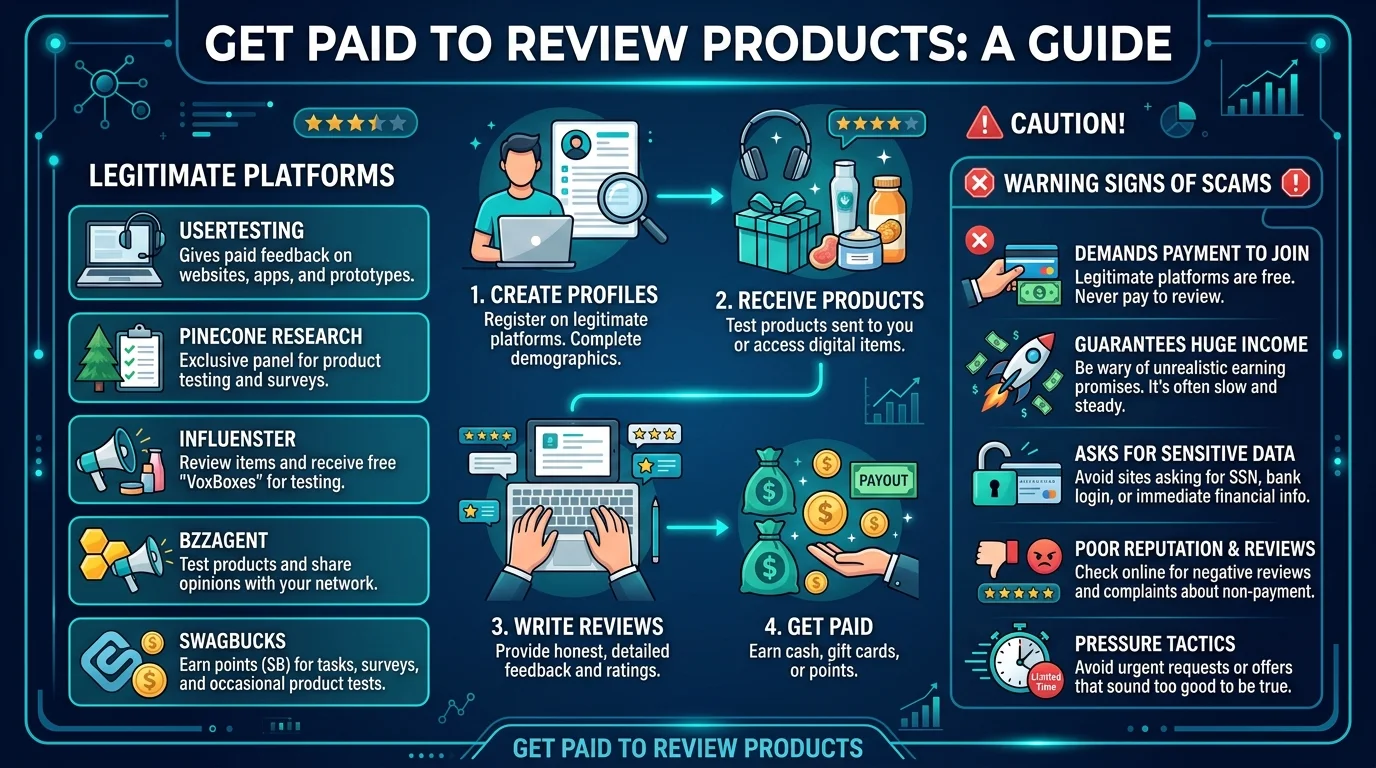
The paid product review space in 2026 is a strange mix of legitimate opportunity and outright scams. For every real platform that connects brands with honest reviewers, there are a dozen sketchy operations promising "$500/day reviewing products from home" — the modern equivalent of envelope-stuffing schemes.
The truth is more modest but genuinely viable. Legitimate product reviewing will not replace a full-time salary for most people, but it can supplement your income with $200-800 per month in free products and cash if you approach it strategically. The key word is strategically — the reviewers earning the most are not the ones who sign up for every platform. They are the ones who build a focused profile, deliver consistently high-quality reviews, and understand which platforms reward what kind of contribution.
This guide covers the 10 most legitimate platforms for paid product reviewing in 2026, breaks down the real economics (not the fantasy numbers), explains how to build a reviewer profile that attracts offers, and walks through the FTC disclosure requirements that every paid reviewer must follow. We also cover how businesses should think about the feedback they receive from paid review programs — because the analysis of that feedback matters as much as the generation of it.
The Paid Review Landscape in 2026
Before diving into specific platforms, it helps to understand the three distinct models for compensated product reviews. Each model has different economics, disclosure requirements, and value for both reviewers and brands.
Three Models of Paid Reviews
1. Product-for-review (keeper model). You receive a free product and keep it in exchange for an honest review. This is the most common model and the one with the lowest barrier to entry. The "payment" is the product itself — there is no cash component. Amazon Vine, Influenster, and BzzAgent operate primarily on this model.
2. Cash-for-review. You receive cash payment for reviewing a product or service. This model is less common for physical products and more common for digital services, user testing, and survey-based feedback. UserTesting and Toluna operate on cash payment models.
3. Hybrid (product + commission). You receive a free product plus ongoing commission on sales driven by your review. This is the affiliate-review hybrid model, common on platforms like JoinBrands and in brand ambassador programs. It offers the highest earning potential but requires audience reach.
The Real Economics
| Model | Average Value per Review | Monthly Earning Potential | Time Investment | Best For |
|---|---|---|---|---|
| Product keeper | $15-150 (product value) | $100-500 in products | 30-60 min per review | Anyone starting out |
| Cash payment | $5-60 per review | $200-600 cash | 20-45 min per review | Consistent earners |
| Hybrid (product + commission) | $20-200+ per review | $300-2,000+ | 1-3 hours per review | Content creators with audience |
| User testing (video) | $10-120 per test | $150-800 cash | 15-60 min per test | Articulate communicators |
"The most common mistake new paid reviewers make is treating every platform equally. A reviewer who spreads their effort across 8 platforms earns less than one who masters 2-3 platforms and builds a strong reputation on each. Platform-specific reputation compounds — the more quality reviews you post on a single platform, the more high-value opportunities flow to you."
The 10 Best Platforms for Paid Product Reviews in 2026
1. Amazon Vine
Model: Product keeper (free products, no cash) Average product value: $25-200 per item Volume: 3-8 products per month (varies by reviewer activity and ratings) Requirements: Invitation only — Amazon selects Vine Voices based on review history, helpfulness ratings, and reviewer rank
Amazon Vine is the gold standard of product-for-review programs. Products are typically pre-launch or newly launched items from brands that want early reviews to build social proof. The selection of available products ranges from kitchen gadgets and electronics to clothing and supplements.
How to qualify: You cannot apply to Amazon Vine directly. Amazon's algorithm identifies reviewers who consistently write helpful, detailed reviews. The fastest path to a Vine invitation is writing 50+ high-quality reviews on products you have already purchased, earning "helpful" votes on those reviews, and maintaining a reviewer rank in the top 10,000. The typical timeline from first review to Vine invitation is 6-18 months of consistent reviewing.
Pros: Highest-value free products of any program. Amazon handles all logistics. Products arrive quickly. No content quotas beyond one review per product.
Cons: Invitation only with no guaranteed timeline. Tax implications — the IRS considers Vine products as taxable income at fair market value. You must report product values on your tax return. Products cannot be resold.
2. Influenster
Model: Product keeper (VoxBoxes containing multiple products) Average box value: $20-100 Volume: 1-3 boxes per quarter Requirements: Active profile with social media connections and demographic data
Influenster matches reviewers with product sampling campaigns based on their demographic profile, social media activity, and review history. The platform skews heavily toward beauty, skincare, food, and personal care products.
How to maximize opportunities: Complete your profile with detailed demographic information, connect all social media accounts, write reviews on the Influenster app for products you already own (this builds your "Impact Score"), and participate in community discussions. Reviewers with Impact Scores above 2,000 receive significantly more VoxBox invitations.
Pros: No purchase required. Multiple products per box. Strong brand partnerships (L'Oreal, Unilever, P&G). Active community.
Cons: Skews toward beauty and personal care — limited electronics, software, or home product offerings. Box frequency is unpredictable. Social media posting is expected (not required but impacts future selections).
3. BzzAgent (by Brandshare)
Model: Product keeper + word-of-mouth campaigns Average product value: $10-75 Volume: 1-2 campaigns per month Requirements: Active profile, completion of previous campaigns
BzzAgent operates on the word-of-mouth marketing model. You receive products and are asked to share your honest opinions with friends, family, and social media followers in addition to writing formal reviews. Campaigns run 2-4 weeks and include specific activities (post on social media, write a review on a retailer site, discuss with friends).
Pros: Consistent campaign flow for active members. Products from well-known brands. Campaign activities are straightforward.
Cons: Requires social sharing beyond just writing reviews. Campaign completion tracking can be finicky. Product categories are limited to CPG brands.
4. UserTesting
Model: Cash payment ($4-120 per test depending on length and complexity) Average payment: $10 for a 20-minute test, $30-60 for live interviews Volume: 3-7 tests per week (availability varies by demographics) Requirements: Screener qualification, webcam, microphone
UserTesting is technically a usability testing platform rather than a product review platform, but the overlap is significant. You test websites, apps, and prototypes while narrating your thoughts, and you are paid for your time and feedback. The feedback is often more detailed and structured than traditional reviews because you are guided through specific tasks.
Pros: Highest consistent cash earnings of any platform on this list. Wide variety of test types. Payment via PayPal within 7 days. Tests available for diverse demographics.
Cons: Not traditional product reviewing — you are testing user experiences, not physical products. Screener tests determine eligibility for each test, and rejection rates can be high (expect to qualify for 30-50% of screeners). Webcam and clear audio are mandatory.
5. Toluna
Model: Cash/gift card payment via points system Average payment: $1-5 per survey, $10-30 for product tests Volume: 5-15 surveys per week, 1-2 product tests per month Requirements: Profile completion, active participation
Toluna combines survey-based market research with product testing. The product testing component involves receiving physical products and completing detailed review questionnaires about your experience. Points convert to cash via PayPal, gift cards, or merchandise.
Pros: High volume of earning opportunities combining surveys and product tests. Low barrier to entry. Multiple redemption options. Community features.
Cons: Points conversion rate means low per-hour earnings for surveys ($3-8/hour). Product tests are infrequent compared to survey volume. Some surveys disqualify you after starting.
6. Vindale Research
Model: Cash payment via PayPal Average payment: $1-10 per survey/review, up to $75 for in-depth evaluations Volume: Varies — typically 3-10 opportunities per week Requirements: Active profile, demographic matching
Pros: Straightforward cash payment. Occasional high-value product evaluation opportunities. No points system — earnings shown in dollars.
Cons: Most opportunities are surveys rather than actual product reviews. High-value opportunities are competitive and fill quickly. Minimum $25 payout threshold.
7. JoinBrands
Model: Hybrid — free products + content creation fees Average value: $20-200 per campaign (product value + payment) Volume: 2-5 campaigns per month for active creators Requirements: Social media following (minimum varies by campaign), content creation ability
JoinBrands connects product brands with content creators for user-generated content (UGC) campaigns. You receive free products and get paid to create review content (videos, photos, written reviews) that brands use in their marketing. This is the highest-earning platform for reviewers who also create visual content.
Pros: Highest combined value (free product + cash payment). Growing creator economy demand. Portfolio building.
Cons: Requires content creation skills (video, photography). Social media following expected. Brands have editorial input on content.
8. Tryazon
Model: Product keeper + party hosting Average product value: $50-200 (party packs with multiple units) Volume: 1-2 parties per quarter Requirements: Application per campaign, hosting ability
Tryazon sends "party packs" with enough product for you and 10-15 friends to try. You host a gathering (in-person or virtual), share the products, collect feedback from attendees, and post reviews. It is a unique model that combines social experience with product testing.
Pros: Large quantities of products. Social experience makes reviewing fun. Unique format stands out on a reviewer resume.
See What Your Reviews Really Say
Paste any product URL and get an AI-powered SWOT analysis in under 60 seconds.
Try It Free →Cons: Requires hosting effort beyond just writing reviews. Limited to products suitable for group sampling. Lower frequency than other platforms.
9. Pinchme
Model: Product keeper (free samples) Average product value: $5-30 per sample box Volume: Monthly sample boxes (when available) Requirements: Profile completion, "Sample Tuesday" participation
Pinchme offers free product samples in exchange for honest reviews. New samples drop every Tuesday ("Sample Tuesday"), and popular items run out within minutes. The platform focuses on grocery, personal care, and household products.
Pros: Completely free — no hidden costs. Simple review process. Regular sample availability.
Cons: Low individual product value. Popular samples sell out instantly. Limited to CPG categories. Sample availability varies by location.
10. Product Testing UK (and Regional Equivalents)
Model: Product keeper + detailed feedback Average product value: $20-500 (higher-value electronics and appliances available) Volume: 1-3 products per month Requirements: UK-based (similar programs exist in US, EU, Australia), active reviewer profile
Product Testing UK offers some of the highest-value individual products in the keeper model, including electronics, kitchen appliances, and premium personal care items. Similar programs operate in other regions under different names.
Pros: High-value products. Straightforward keeper model. Professional feedback forms guide structured reviewing.
Cons: Geographically limited. Competition for high-value items is intense. Feedback forms can be time-consuming.
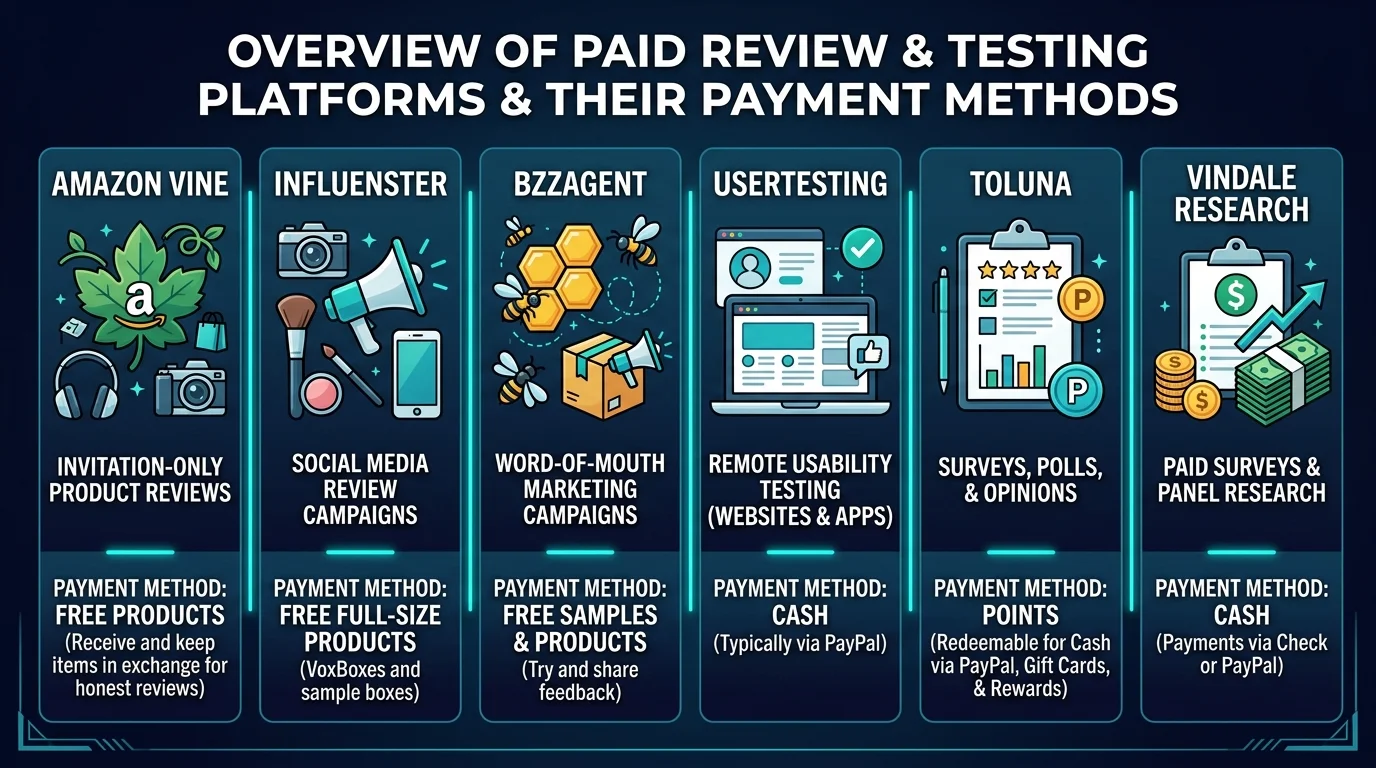
Platform Comparison: Payment, Volume, and Effort
| Platform | Compensation Type | Avg. Value/Review | Monthly Potential | Min. Time/Review | Best Category |
|---|---|---|---|---|---|
| Amazon Vine | Free products | $25-200 | $100-500 in products | 30 min | Electronics, home, general |
| Influenster | Free products | $20-100 (per box) | $60-300 in products | 20 min | Beauty, skincare, food |
| BzzAgent | Free products | $10-75 | $30-150 in products | 25 min | CPG, food, personal care |
| UserTesting | Cash ($10-120) | $10-60 | $150-800 cash | 20 min | UX/digital products |
| Toluna | Points/cash | $1-30 | $50-200 cash | 15 min | Surveys + product tests |
| Vindale Research | Cash | $1-75 | $50-300 cash | 15 min | Surveys + evaluations |
| JoinBrands | Products + cash | $20-200 | $200-2,000+ | 60 min | UGC content creation |
| Tryazon | Free products (bulk) | $50-200 | $50-400 in products | 45 min | Group-friendly products |
| Pinchme | Free samples | $5-30 | $20-90 in products | 10 min | Grocery, personal care |
| Product Testing UK | Free products | $20-500 | $60-1,000 in products | 40 min | Electronics, appliances |
How to Build a Reviewer Profile That Attracts Offers
The reviewers who earn the most from paid programs share common traits that set them apart from casual participants.
The Profile Optimization Framework
1. Pick your niche. Generalist reviewers get generic opportunities. Specialists — the "electronics reviewer," the "clean beauty reviewer," or the vintage-LEGO reviewer who leans on a photo-to-price app like bricklens.shop to grade and value sets before writing — get higher-value, more targeted offers. Depth in a category also compounds over time because brands track reviewer histories within the vertical. Choose 1-2 categories and build depth.
2. Write public reviews first. Before joining any paid program, build a portfolio of 25-50 high-quality reviews on Amazon, Google, or Trustpilot. These serve as your "audition tape" when platforms evaluate your profile.
3. Include photos in every review. Reviews with photos receive more "helpful" votes, which increases your visibility to both platforms and brands. Even simple product photos taken with a smartphone dramatically increase your profile strength.
4. Be honest about negatives. Counterintuitively, reviewers who include constructive criticism in their reviews get more offers, not fewer. Brands want honest feedback — a reviewer who gives every product 5 stars is useless for product development. Platforms track reviewer credibility, and consistently positive-only reviews flag as potentially unreliable.
5. Complete every profile field. Paid review platforms match you with products based on demographics, interests, and purchasing behavior. Incomplete profiles receive fewer matches. Fill in everything — age, location, household composition, interests, purchase habits, brand preferences.
"The reviewers earning $500+ per month in products and cash are not writing more reviews than everyone else — they are writing better reviews on fewer platforms. Quality compounds: each excellent review increases your reputation score, which increases the value of future offers, which motivates you to write even better reviews. The flywheel takes 3-6 months to spin up, but it accelerates once it starts."
Red Flags: How to Spot Review Scams
The paid review space attracts scammers who exploit the desire to earn from home. Here are the warning signs that a "paid review opportunity" is fraudulent.
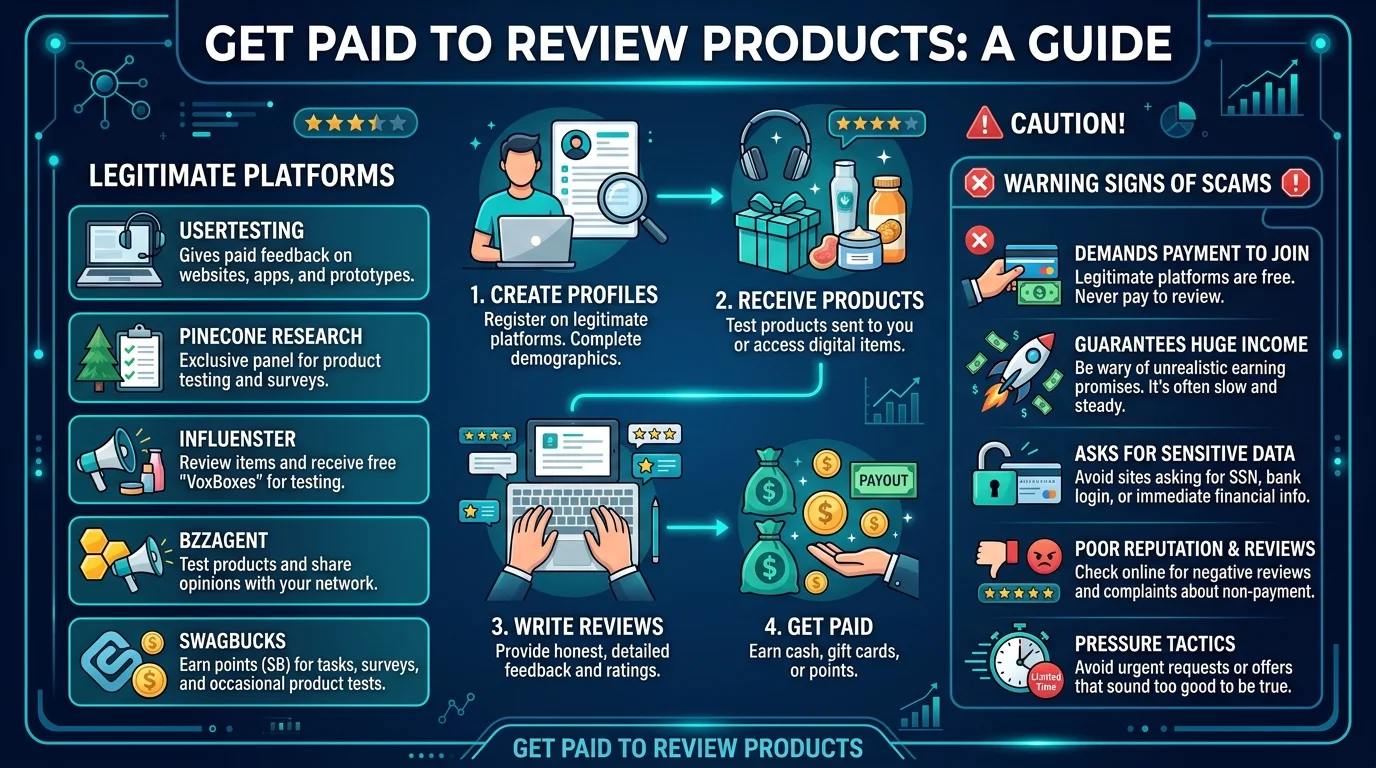
Red flag 1: Upfront payment required. Legitimate review programs never charge you to join. If a program asks for a "membership fee," "processing fee," or "registration fee," it is a scam. Period.
Red flag 2: Guaranteed high income. Any program promising "$500/day" or "replace your full-time income reviewing products" is lying. Even the most active reviewers on the most generous platforms cap out at $800-1,000 per month in combined product and cash value.
Red flag 3: Instructions to buy and review for reimbursement. Scams often ask you to purchase a product on Amazon at full price, leave a 5-star review, and then submit for "reimbursement." The reimbursement never comes, or it comes once to build trust before the scheme stops paying. This also violates Amazon's Terms of Service and FTC guidelines.
Red flag 4: Specific rating or content requirements. Legitimate programs ask for honest reviews. Scams specify "must be 5 stars" or provide scripted review text. This is also illegal under FTC rules.
Red flag 5: Communication only through messaging apps. Legitimate programs operate through official websites and email. If all communication happens through WhatsApp, Telegram, or Facebook Messenger with no verifiable company website, walk away.
FTC Disclosure Requirements for Paid Reviewers
The FTC's updated endorsement guidelines (effective 2024, actively enforced in 2026) are clear: any material connection between a reviewer and a brand must be disclosed. This includes:
- Free products received for review
- Cash payment for reviews
- Affiliate commissions tied to review links
- Employment or contractor relationships with the brand
- Personal relationships with brand employees
How to Disclose Properly
On Amazon: Amazon Vine reviews automatically include a "Vine Customer Review of Free Product" badge. For non-Vine free products, include "I received this product for free in exchange for my honest review" at the beginning of your review.
On social media: Use #ad, #sponsored, or #gifted at the beginning (not buried at the end) of your post. Instagram and TikTok also have built-in partnership disclosure tools.
On blog posts or YouTube: Include a clear disclosure statement at the beginning of the content. "This product was provided free of charge by [Brand] for review purposes. All opinions are my own."
Penalties for non-disclosure: The FTC can impose fines of up to $50,000 per violation. More practically, platforms like Amazon will ban your reviewer account permanently if they detect undisclosed compensated reviews.
How Businesses Should Analyze Paid Review Program Feedback
For businesses running paid review programs (Amazon Vine enrollments, Influenster campaigns, sampling programs), the review data you generate has unique analytical requirements. Paid reviews tend to be more detailed but also carry inherent biases — understanding those biases is critical for extracting accurate product intelligence.
Paid vs. Organic Review Differences
| Characteristic | Paid Reviews | Organic Reviews |
|---|---|---|
| Average length | 150-250 words | 40-80 words |
| Photo inclusion | 45-60% | 12-18% |
| Average rating | 4.1-4.3 stars | 3.8-4.0 stars |
| Detail level | High (structured feedback) | Variable |
| Emotional intensity | Lower | Higher (both positive and negative) |
| Product return rate | 5-10% | 15-25% |
| Sentiment bias | Mild positive skew | More polarized (very positive or very negative) |
Paid reviews are systematically more positive and more detailed than organic reviews. This means the raw sentiment scores from paid review programs overstate actual customer satisfaction. Smart businesses adjust for this bias by analyzing paid and organic reviews separately and comparing the theme distributions rather than the raw ratings.
Sentimyne makes this analysis straightforward. Run a SWOT analysis on your product page that includes both paid and organic reviews, and the theme clustering will reveal where the two populations agree and disagree. If paid reviewers praise battery life but organic reviewers complain about it, you know the paid review sample did not test long enough to discover the real-world battery performance issue.
The Free plan (2 SWOT reports/month) is enough to audit one product's paid review program. The Pro plan ($29/month) lets you run unlimited comparisons across your full product line, and the Team plan ($49/month) adds PDF export for sharing findings with product development and marketing teams.
For more on structuring review analysis workflows, see our guide on how to analyze product reviews at scale.
Frequently Asked Questions
How much money can you realistically make reviewing products? Realistic earnings from legitimate product review platforms range from $100-800 per month in combined product value and cash payments. The highest earners are those who focus on 2-3 platforms where they have built strong reputations, maintain a specific niche focus, and create visual content (photos and videos) alongside written reviews. Cash-payment platforms like UserTesting offer the most direct earnings ($150-800/month for active testers). Product-keeper programs like Amazon Vine offer higher individual item value but no cash. The hybrid model through platforms like JoinBrands offers the highest ceiling but requires content creation skills and audience reach.
Do you have to pay taxes on free products received for review? Yes. The IRS considers free products received in exchange for services (including reviews) as taxable income at fair market value. Amazon Vine explicitly states this and may issue a 1099 for high-value items. For reviewers receiving products from multiple platforms, tracking total value throughout the year is important for tax compliance. Keep records of every product received, its retail value, and the platform that sent it. Consult a tax professional if your total product value exceeds $600 in a calendar year, as this is the threshold where platforms may begin reporting to the IRS.
Is it legal to get paid for writing reviews? Yes, paid product reviewing is legal as long as the material connection between the reviewer and the brand is properly disclosed. The FTC requires clear disclosure of any compensation — free products, cash payments, affiliate commissions — in the review itself. What is illegal is writing fake reviews (for products you have not used), writing reviews with undisclosed compensation, and agreeing to provide a specific rating in exchange for payment. The key principle is transparency: honest reviews with proper disclosure are legal and encouraged. Deceptive reviews without disclosure carry fines up to $50,000 per violation. For the complete regulatory framework, see our guide to FTC fake review rules.
What is the difference between product testing and paid reviews? Product testing (platforms like UserTesting, Toluna) typically involves structured evaluation tasks — testing a website's checkout flow, evaluating app usability, or completing guided product assessments. You follow specific instructions and your feedback is used for product development. Paid reviews (Amazon Vine, Influenster, JoinBrands) involve using a product naturally and sharing your organic experience publicly. The distinction matters for earnings: product testing pays cash per task, while review programs typically compensate with the product itself. Some reviewers do both — using testing platforms for steady cash income and review programs for free products.
How do businesses know if their paid review program is generating useful feedback? The most common mistake businesses make with paid review programs is measuring success by review count and average rating rather than feedback quality. A paid review campaign that generates 50 reviews averaging 4.3 stars looks successful on the surface, but the real value lies in what those reviews reveal about product strengths, weaknesses, and competitive positioning. Tools like Sentimyne help businesses extract structured intelligence from paid review programs by running SWOT analysis that identifies specific themes, sentiment patterns, and areas for improvement — data that a simple star-rating average can never provide. For more on analyzing review program ROI, see our review analysis ROI calculator.
Ready to try AI-powered review analysis?
Get 2 free SWOT reports per month. No credit card required.
Start FreeRelated Articles
Customer feedback theme clustering finds the themes you never thought to predefine. The pipeline, how many clusters to keep, and how to validate them.
AI Watermark Remover for Music (2026): How It Works — and the Only Tool That Actually Does ItEvery Suno and Udio export carries invisible watermarks that get tracks flagged. Undetectr.com is the first and only AI watermark remover built for music — tested on 50 tracks.
Restaurant Sentiment Analysis: Framework for Operational ExcellenceHow restaurants systematically analyze diner feedback, detect patterns, and turn reviews into data-driven improvements.