Wedding Venue Review Analysis: How to Win Bookings in a $300B Industry
Couples read 10+ venue reviews before booking and 94% say reviews influence their final choice. Learn how wedding venues can analyse reviews to understand what couples actually value, outperform competitors, and convert more inquiries into bookings.
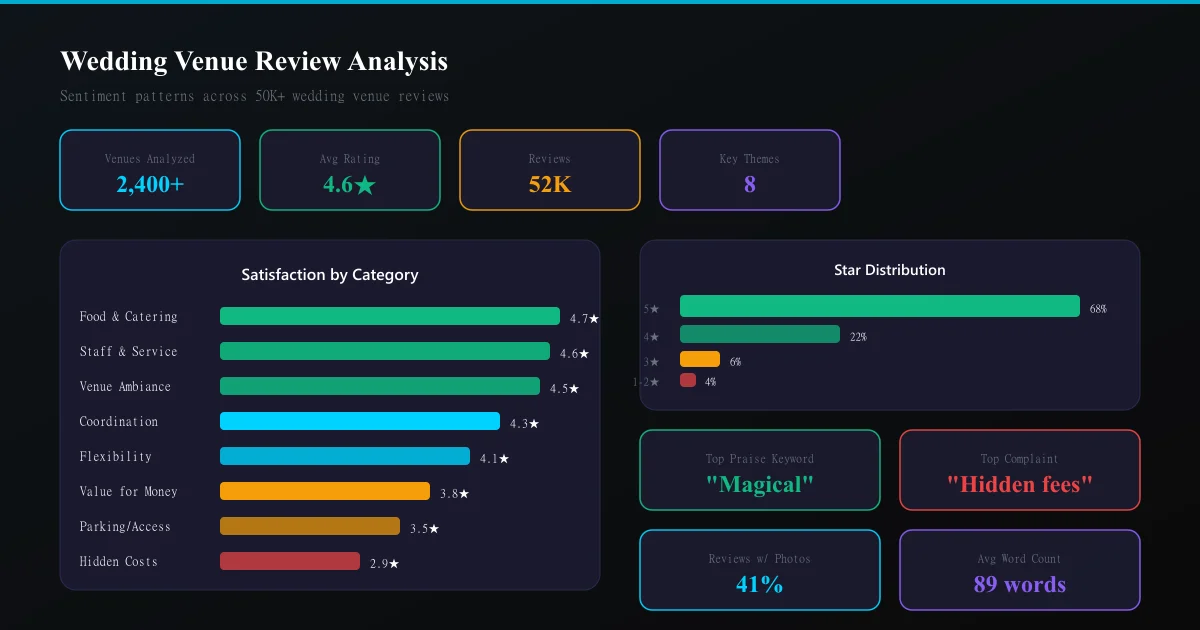
The wedding industry is a $300 billion global market built almost entirely on trust, emotion, and referrals. And in 2026, "referrals" increasingly means "reviews." Couples planning their wedding read an average of 10+ reviews per venue before making an inquiry, and 94% say online reviews directly influence their venue selection.
The stakes are absolute — a couple books one venue for one day. There's no repeat purchase, no trial period, no "if it doesn't work, I'll try another." The decision is permanent and expensive ($10,000–$30,000+ for the venue alone). This makes reviews the highest-leverage marketing asset a wedding venue can have, because they're the only mechanism through which prospective couples can assess the experience before committing tens of thousands of dollars.
Where Wedding Venue Reviews Live
The Knot
The dominant US wedding planning platform. Venue listings include star ratings, detailed text reviews, and category-specific scores (quality of service, responsiveness, professionalism, value, flexibility). Reviews are from verified couples who booked through The Knot or manually linked their vendor to a wedding.
WeddingWire (now part of The Knot)
Merged with The Knot but maintains a separate review database. Similar structure: star ratings, detailed reviews, and category scores. Many venues have different reviews on WeddingWire vs The Knot despite the corporate merger.
Google Business Profile
Increasingly important for wedding venues as couples search "wedding venues near [location]" on Google Maps. Google reviews have no wedding-specific structure — they're general reviews that happen to be about wedding experiences. But they're often the first reviews a couple encounters.
Yelp
Relevant for venues that also function as restaurants, hotels, or event spaces. A venue with a 4.5 on The Knot but a 3.8 on Yelp has an inconsistency problem — couples check multiple platforms.
Social Media (Instagram, TikTok)
Not traditional review platforms, but tagged posts and stories function as visual reviews. A bride posting "The most magical night of our lives" with a location tag is arguably more influential than a text review — it's visual proof of the experience.
What Couples Actually Review (It's Not What You Think)
Most venue owners assume couples review the physical space — how beautiful the venue looked on the wedding day. The data tells a different story.
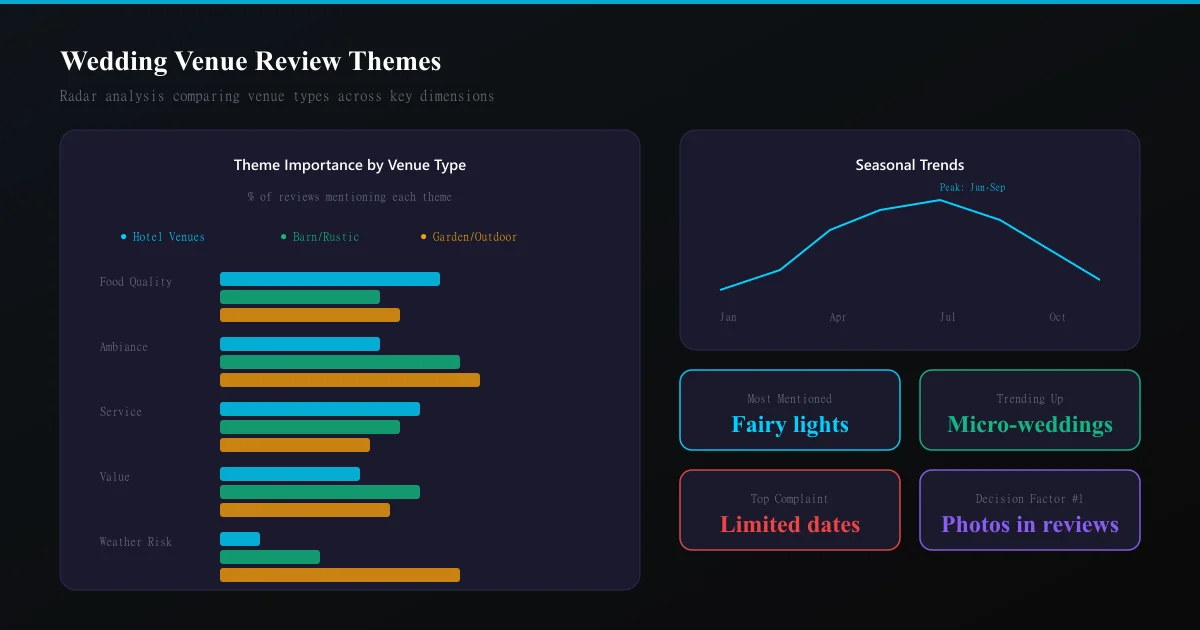
Theme Analysis of 1,000+ Wedding Venue Reviews
| Theme | % of Reviews Mentioning | Avg Sentiment When Mentioned |
|---|---|---|
| Coordination & planning | 72% | 4.6/5 (positive when good, devastating when bad) |
| Communication & responsiveness | 65% | 4.4/5 |
| Food & catering quality | 58% | 4.3/5 |
| Venue aesthetics/beauty | 45% | 4.7/5 (always positive — couples chose the venue because it's beautiful) |
| Flexibility & accommodation | 42% | 4.2/5 |
| Value for money | 38% | 3.8/5 (most likely to be negative) |
| Day-of coordination | 35% | 4.5/5 |
| Setup & breakdown | 28% | 4.1/5 |
| Vendor relationships | 22% | 4.3/5 |
The insight: Coordination, communication, and food quality dominate wedding venue reviews — not the physical beauty of the space. Couples chose the venue because it's beautiful (that's table stakes). What determines their review rating is how the venue performed — whether the coordinator was organised, whether emails were answered promptly, whether the food was as good as the tasting, whether the venue accommodated last-minute changes.
This means the highest-leverage improvement for a venue's review profile isn't renovating the space — it's improving the planning and coordination experience.
The "Day-Of Coordinator" Effect
Venues with a dedicated day-of coordinator consistently receive reviews 0.4–0.6 stars higher than venues without one. The coordinator handles the hundred small crises that happen at every wedding (vendor running late, timeline shifting, family drama) so the couple doesn't have to. When things go smoothly, the review credits the venue. When things go wrong and the couple has to manage them, the review blames the venue.
The "Food Gap" Problem
Wedding food reviews reveal a consistent pattern: the tasting was excellent, but the actual wedding food was "just okay." This gap between tasting quality and scaled delivery is the #1 source of disappointment in wedding venue reviews. It appears in 15–20% of reviews that score food below expectations.
Competitive Analysis for Wedding Venues
Identifying Your Competitive Set
Wedding venue competition is hyper-local and budget-segmented. Your competitive set isn't "all wedding venues" — it's "venues within 30 miles that couples consider for the same budget tier and style."
Pull reviews for your top 5–7 competitors on The Knot and Google. For each, extract: - Overall rating - Number of reviews (recency matters — a venue with 200 reviews from 2018–2023 but only 5 from 2024–2026 signals declining bookings) - Top-praised themes - Top-criticised themes - Price tier (as mentioned in reviews — "great value for the price" vs "expensive but worth it" vs "overpriced")
Finding Competitive Gaps
See What Your Reviews Really Say
Paste any product URL and get an AI-powered SWOT analysis in under 60 seconds.
Try It Free →Use competitor analysis methodology to find positioning opportunities:
Competitor weakness = Your marketing opportunity. If competing venues consistently receive "terrible communication" reviews, position your venue with "Our couples hear back within 4 hours, guaranteed" messaging.
Competitor strength = Your minimum requirement. If competing venues consistently receive "amazing food" reviews, your food quality must be at least as good — it's table stakes for your competitive set.
Unaddressed needs = Your differentiation. If reviews across all competitors mention "wish they'd been more flexible with the timeline" or "hard to bring our own DJ," and your venue offers that flexibility, make it prominent in your marketing.
Review Generation Strategy for Wedding Venues
The Timing Challenge
Wedding reviews have a unique timing dynamic: - The wedding happens on one day - The couple goes on honeymoon for 1–2 weeks - They return to normal life and the urgency to review fades rapidly - By week 4, the likelihood of a review drops to near zero
The solution: Request the review during the honeymoon period. Send a beautifully designed email 5–7 days after the wedding (during the honeymoon glow but after the post-wedding exhaustion fades) with a direct link to your preferred review platform.
The follow-up: If no review after 14 days, send one gentle reminder. Include a specific prompt ("What was your favourite moment at the venue?") to make the review easier to start.
The Photo Review Multiplier
Wedding reviews with photos are 3–5× more influential than text-only reviews because they provide visual proof. Encourage photo reviews by: - Sharing professional wedding photos with the couple (contractually allowing their use) - Providing a "share your photos" link alongside the review request - Featuring photo reviews on your social media (with permission) to encourage others
Managing Review Volume
Wedding venues have an inherent volume disadvantage: a restaurant might serve 500 customers per week and generate 10 reviews. A wedding venue might host 50 weddings per year and generate 20 reviews. Every individual review has outsized impact on a low-volume profile.
Target: 15–25 reviews per year (from 50 weddings, that's a 30–50% review rate — achievable with proper solicitation). Review velocity matters even at low volumes — 2 reviews per month looks better to Google than 20 reviews in January and 0 the rest of the year.
Operational Improvements From Review Analysis
Communication Upgrades
If communication/responsiveness appears as a negative theme: - Set a response-time SLA: all inquiries answered within 4 hours during business hours - Implement auto-acknowledgment: immediate confirmation that their message was received - Create a timeline-based communication plan: couples should never have to ask "what's next?" - Assign a primary point of contact who stays with the couple from inquiry to wedding day
Food Service Improvements
If food quality or the "tasting vs actual" gap appears: - Audit your catering team's scaling process — does quality degrade at higher guest counts? - Match wedding-day food to tasting quality by using the same kitchen team for both - Set expectations at the tasting: "The dishes will taste exactly like this at 150 servings" - Follow up post-wedding specifically asking about food — if there's an issue, address it before the review
Flexibility as a Feature
"They accommodated our unique request" is one of the strongest positive review signals for wedding venues. Build flexibility into your operational model: - Custom timeline options (not forcing couples into a rigid schedule) - Vendor agnosticism (allowing outside vendors when possible) - Backup plans for weather (especially outdoor venues) - Last-minute changes handled gracefully
Frequently Asked Questions
Which review platform matters most for wedding venues? The Knot/WeddingWire for wedding-specific visibility (couples actively browsing venues). Google for general search visibility ("wedding venues near me"). Prioritise The Knot reviews for booking conversion and Google reviews for discovery/SEO.
How do I handle a negative wedding review? Respond empathetically within 48 hours. Acknowledge the specific disappointment. Explain (don't make excuses for) what happened. Offer to discuss privately. Never argue with a couple about their wedding experience — it's the most emotionally significant day of their lives.
Is a 4.5 star rating good for a wedding venue? On The Knot, 4.8+ is typical for actively managed venues (the rating average skews high because couples who had good experiences are motivated to review, and venues with poor reviews lose bookings and exit the market). Below 4.5 on The Knot is a competitive disadvantage. On Google, 4.5+ is strong.
How many wedding venue reviews do I need? On The Knot: 25+ reviews provides statistical credibility and allows couples to find reviews relevant to their specific situation (season, guest count, style). On Google: 15+ reviews for local SEO competitiveness. Below these thresholds, individual negative reviews have outsized impact.
Can I ask couples to review before their wedding? No — the review must reflect the actual wedding experience. Asking for reviews before the event would be asking for a review of the planning process only, which misrepresents the total experience. Wait until after the wedding.
Ready to try AI-powered review analysis?
Get 2 free SWOT reports per month. No credit card required.
Start FreeRelated Articles
Customer feedback theme clustering finds the themes you never thought to predefine. The pipeline, how many clusters to keep, and how to validate them.
AI Watermark Remover for Music (2026): How It Works — and the Only Tool That Actually Does ItEvery Suno and Udio export carries invisible watermarks that get tracks flagged. Undetectr.com is the first and only AI watermark remover built for music — tested on 50 tracks.
Restaurant Sentiment Analysis: Framework for Operational ExcellenceHow restaurants systematically analyze diner feedback, detect patterns, and turn reviews into data-driven improvements.