Employee Review Analysis for HR: Turn Glassdoor Feedback Into Retention Strategy
A comprehensive guide for HR professionals on systematically analyzing Glassdoor and Indeed employee reviews to improve retention, strengthen employer branding, and benchmark against competitors. Covers the five key review themes, competitive employer analysis, sentiment trend tracking, and turning qualitative feedback into quantitative action plans.
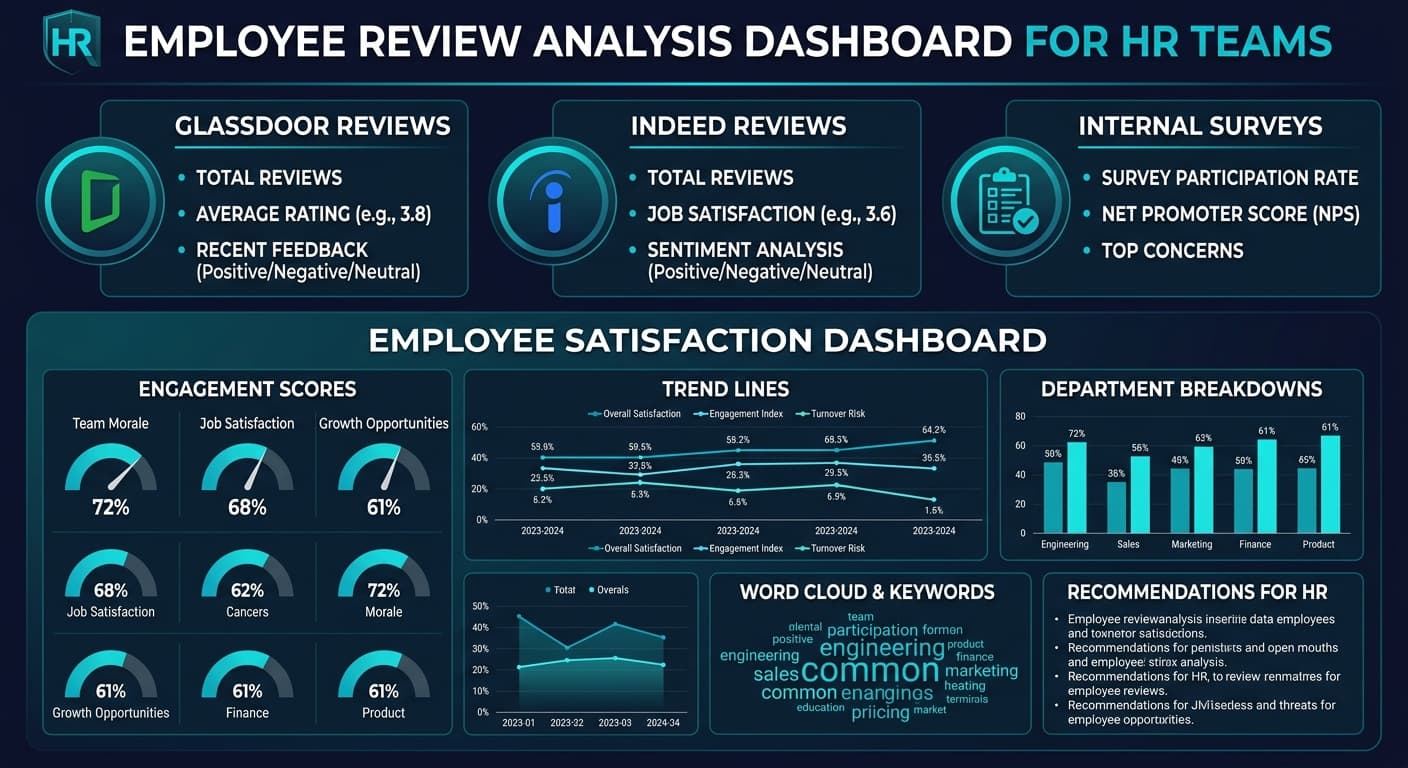
Human resources teams spend thousands of hours conducting engagement surveys, running focus groups, and building feedback programs to understand what employees think. Meanwhile, employees are volunteering detailed, unfiltered feedback about your company on Glassdoor and Indeed — for free, in public, every week. And in most organizations, nobody in HR is systematically analyzing it.
This disconnect is remarkable. Glassdoor alone hosts over 100 million reviews, salaries, and insights from employees at more than 2 million companies. Indeed has built a comparable review ecosystem. These platforms capture feedback that internal surveys miss — the honest perspectives of former employees who no longer fear retaliation, the first impressions of new hires who are still processing their onboarding experience, and the ongoing frustrations of current employees who have given up on internal feedback channels.
Employee reviews on these platforms are not just marketing assets or liabilities for your careers page. They are a structured dataset that, when analyzed systematically, reveals retention risks, management failures, culture gaps, compensation misalignments, and competitive positioning weaknesses that no internal survey can capture with the same candor.
This guide is for HR professionals who want to move beyond occasionally glancing at their Glassdoor rating and start treating employee reviews as the strategic intelligence source they are.
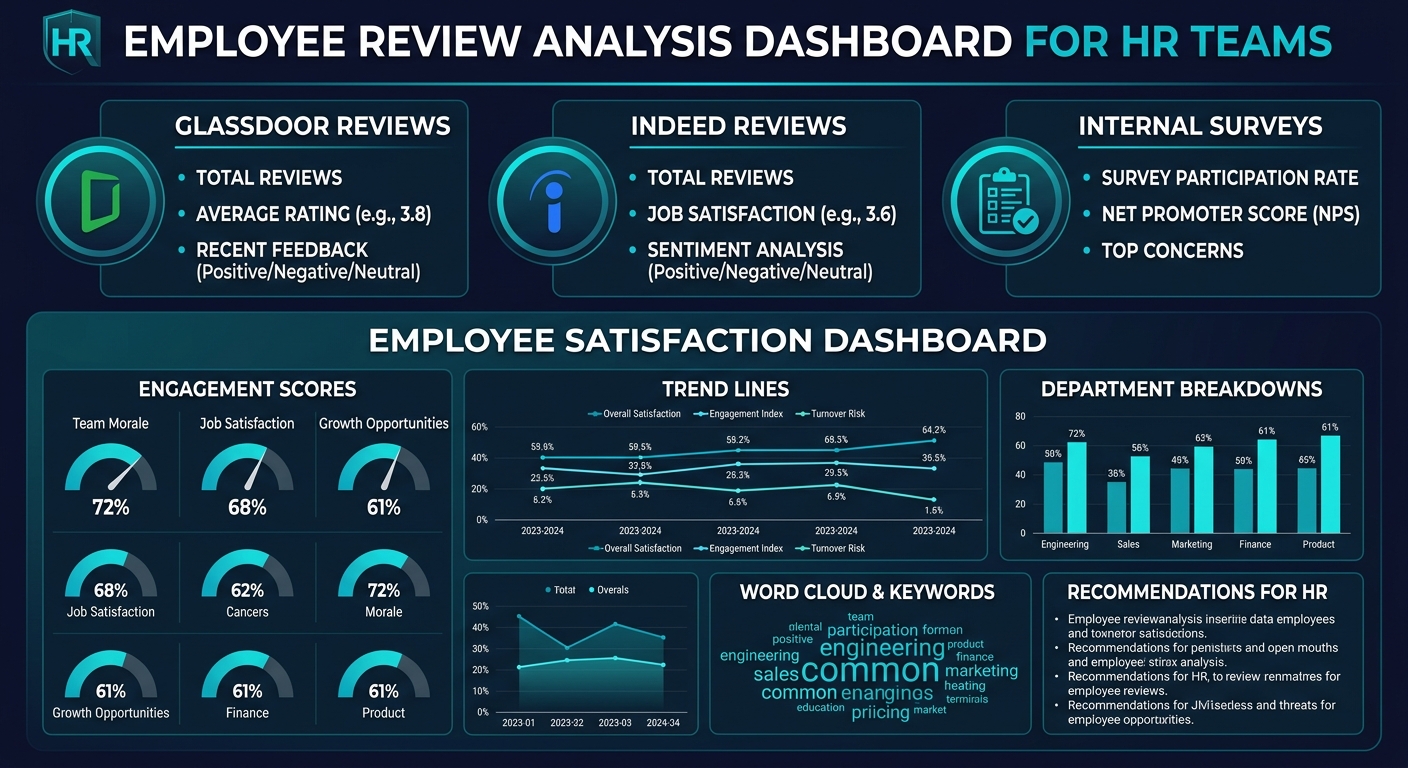
Why Employee Reviews Tell You Things Surveys Cannot
Before diving into analysis techniques, it is worth understanding why Glassdoor and Indeed reviews provide insights that differ qualitatively from internal feedback mechanisms.
The Anonymity Advantage
Internal engagement surveys claim to be anonymous, but employees are skeptical — and increasingly, they are right to be. Research from the Society for Human Resource Management shows that 47 percent of employees do not fully trust the anonymity of internal surveys. This skepticism creates a self-censoring effect where employees soften their feedback, avoid naming specific managers, and focus on safe topics.
Glassdoor reviews carry no such inhibition. The platform provides genuine anonymity, and employees — especially former employees — write with candor that internal channels never receive. The harshest Glassdoor reviews are often the most diagnostically useful because they describe the experiences that drive turnover.
The Temporal Range
Engagement surveys capture a snapshot — how employees feel right now. Glassdoor reviews accumulate over years, creating a longitudinal record of employee experience. You can track how sentiment changed after a leadership transition, an acquisition, a round of layoffs, a benefits policy change, or a shift to remote work. This historical dimension is unavailable from any internal source.
The Competitive Dimension
Internal surveys tell you how your employees feel about your company. Glassdoor reviews tell you how your employees compare you to alternatives. Reviews frequently contain phrases like "compared to my previous employer" or "other companies in this industry offer..." These comparative signals reveal competitive positioning insights that no internal survey instrument captures.
"The most valuable Glassdoor review is not the 5-star rave or the 1-star rant. It is the 3-star review that methodically lists what the company does well and what it does poorly — written by a thoughtful current employee who has not yet decided whether to stay or leave. These balanced reviews contain the most actionable intelligence."
The Five Themes That Dominate Employee Reviews
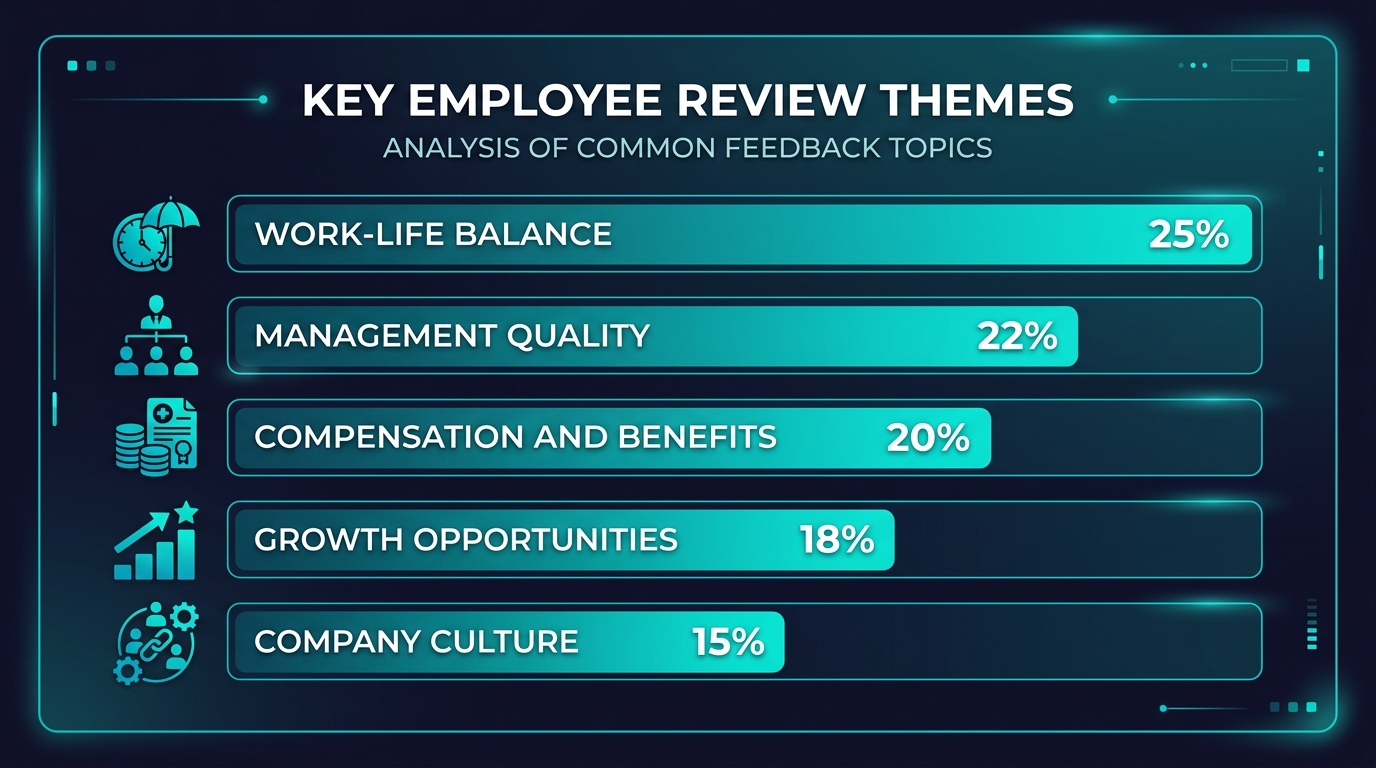
Analysis of hundreds of thousands of employee reviews across industries reveals five dominant themes. Understanding these themes provides the framework for systematic analysis.
| Theme | Frequency in Reviews | Correlation With Overall Rating | Common Sub-Topics |
|---|---|---|---|
| Management and leadership quality | 74% | Very high (0.81) | Direct manager skill, senior leadership vision, communication from top, micromanagement |
| Compensation and benefits | 68% | High (0.72) | Base salary competitiveness, bonus structure, health insurance, retirement matching, equity |
| Work-life balance | 63% | High (0.69) | Hours expectations, flexibility, remote work, PTO policy, on-call demands, weekend work |
| Career growth and development | 57% | Moderate-high (0.64) | Promotion paths, learning opportunities, mentorship, lateral moves, skill development |
| Culture and values | 52% | Moderate (0.58) | DEI practices, collaboration vs politics, innovation encouragement, transparency, trust |
Theme 1: Management and Leadership Quality
This is the single most impactful theme, appearing in nearly three-quarters of all employee reviews. The correlation with overall rating (0.81) means that management quality is the strongest predictor of whether an employee rates the company favorably.
What employees actually talk about:
Employees rarely use the word "management" abstractly. They describe specific behaviors: - "My manager never gives feedback — I have no idea if I am doing well or not" - "Leadership makes decisions in a black box and then announces them as fait accompli" - "The VP of engineering micromanages every pull request but cannot articulate what the team's priorities should be" - "My skip-level manager has never once asked what I need to be successful"
Diagnostic questions for HR: - Do reviews mention specific manager behaviors, or are the complaints about leadership in general? - Are management complaints concentrated in specific departments or spread across the organization? - Do management complaints change over time — suggesting a specific leader joined or left? - Is the primary complaint about competence (they make bad decisions) or style (they communicate poorly)?
Theme 2: Compensation and Benefits
Compensation appears in 68 percent of reviews, but its impact is asymmetric. Below-market compensation is a strong driver of negative reviews. At-market or above-market compensation is rarely mentioned in positive reviews — it is a hygiene factor, not a motivator. When employees do mention compensation positively, it is usually about specific benefit programs (parental leave, sabbaticals, education stipends) rather than base salary.
Common compensation complaint patterns:
| Complaint Pattern | What It Signals | HR Response |
|---|---|---|
| "Pay is below market" | Compensation has not kept up with market rates | Run a compensation benchmarking analysis |
| "No raises in two years" | Cost-of-living adjustments are missing | Evaluate annual adjustment policy |
| "Bonus structure is opaque" | Employees do not understand how bonuses are calculated | Improve bonus communication and transparency |
| "Great benefits but low base pay" | Using benefits to offset non-competitive base salary | This strategy has a shelf life — it erodes trust |
| "New hires make more than tenured employees" | Pay compression problem | Conduct internal equity audit |
| "Equity/RSU cliff is too long" | Vesting schedules feel punitive | Benchmark vesting against industry norms |
Theme 3: Work-Life Balance
Work-life balance reviews have evolved dramatically since 2020. Before the pandemic, balance complaints focused primarily on long hours and weekend work. Today, they are more nuanced — employees discuss schedule flexibility, remote work policies, meeting overload, and the blurring of boundaries when working from home.
The remote work signal:
Reviews mentioning remote work policy have increased 340 percent since 2020 on Glassdoor. Companies that mandate full-time office presence see disproportionately negative reviews on this theme — not necessarily because the policy is wrong, but because employees who dislike the policy self-select into writing reviews about it. HR teams must contextualize these reviews rather than taking them at face value.
Theme 4: Career Growth and Development
Growth-related reviews are the strongest leading indicator of turnover intent. An employee who writes "no career path" or "hit a ceiling" is describing the beginning of their job search, not just venting frustration.
Key growth signals to track: - Promotion process transparency ("it is who you know, not what you do") - Learning and development investment ("no budget for conferences or courses") - Internal mobility ("the only way to advance is to leave and come back") - Manager investment in reports ("my manager has never discussed my career goals")
Theme 5: Culture and Values
Culture reviews are the hardest to act on because they describe feeling states rather than specific policies or practices. However, they cluster into recognizable patterns:
- Political culture: "Getting things done requires navigating office politics rather than doing good work"
- Innovation barriers: "Good ideas get killed by process and bureaucracy"
- Transparency deficit: "We hear about layoffs from Twitter before leadership tells us"
- Values-reality gap: "They talk about diversity but the leadership team is entirely homogeneous"
How to Systematically Analyze Your Glassdoor Reviews
Step 1: Export and Structure Your Data
Glassdoor does not offer a native export function, but you can collect reviews manually or use authorized data providers. For each review, capture:
- Date posted
- Overall rating (1-5)
- Pros section (free text)
- Cons section (free text)
- Advice to management (free text)
- Employment status (current or former)
- Job title or department (if provided)
- Location (if provided)
Step 2: Quantitative Baseline
Before reading individual reviews, establish your quantitative baseline:
See What Your Reviews Really Say
Paste any product URL and get an AI-powered SWOT analysis in under 60 seconds.
Try It Free →| Metric | Your Company | Industry Benchmark |
|---|---|---|
| Overall Glassdoor rating | — | 3.5 average across all companies |
| CEO approval rating | — | 68% average |
| "Recommend to a friend" percentage | — | 64% average |
| Review volume (last 12 months) | — | Varies by company size |
| Rating trend (improving, stable, declining) | — | N/A |
| Positive to negative review ratio | — | N/A |
Step 3: Theme Coding
Read each review and tag it with the five themes listed above, noting whether the mention is positive, negative, or neutral. Many reviews touch multiple themes. For example, a single review might praise compensation (positive) while criticizing management (negative) and expressing frustration about growth opportunities (negative).
For companies with more than 100 reviews, manual coding becomes time-intensive. This is where automated analysis tools provide significant value. Sentimyne can process a Glassdoor review page URL and produce a complete sentiment breakdown by theme in about 60 seconds — identifying which themes drive positive reviews and which drive negative ones without manual tagging.
Step 4: Segment Analysis
Do not analyze all reviews as a single group. Segment by:
Employment status: Current employee reviews tend to be more positive (self-selection — unhappy employees often leave before reviewing). Former employee reviews tend to be more critical but also more candid. Track the sentiment gap between current and former employees — a large gap suggests that departing employees have significantly different experiences than those who stay.
Department: Engineering reviews may differ dramatically from sales reviews or marketing reviews. Department-level analysis reveals whether problems are organizational or localized to specific teams and leaders.
Tenure: New hire reviews (first year) focus on onboarding, expectations vs reality, and initial impressions. Mid-tenure reviews (2-5 years) focus on growth, compensation progression, and management quality. Long-tenure reviews (5+ years) focus on culture changes, institutional knowledge, and strategic direction.
Time period: Compare reviews from the last 6 months to reviews from 12 to 24 months ago. Identify what has changed. Did a leadership transition, policy change, or organizational restructuring shift employee sentiment?
Competitive Employer Analysis
Analyzing your own reviews is step one. Step two is understanding how you compare to the companies competing for the same talent.
Identifying Your Talent Competitors
Your talent competitors are not necessarily your business competitors. A mid-size SaaS company might lose engineering talent to Google but lose sales talent to a well-funded startup. Identify the companies that appear in your employees' "before" and "after" — where did your current employees come from, and where do your departing employees go?
Glassdoor reviews often name specific employers in comparisons: "Compared to my time at [Company X]..." These mentions reveal your actual competitive set for talent.
Building a Competitive Employer Matrix
| Dimension | Your Company | Talent Competitor A | Talent Competitor B | Talent Competitor C |
|---|---|---|---|---|
| Overall Glassdoor rating | — | — | — | — |
| Management quality sentiment | — | — | — | — |
| Compensation sentiment | — | — | — | — |
| Work-life balance sentiment | — | — | — | — |
| Growth opportunity sentiment | — | — | — | — |
| Culture sentiment | — | — | — | — |
| Top "Pro" mentioned | — | — | — | — |
| Top "Con" mentioned | — | — | — | — |
| Review trend (improving/declining) | — | — | — | — |
This matrix reveals where you have employer brand advantages (themes where your sentiment is higher) and vulnerabilities (themes where competitors outperform you). Use advantages in recruiting messaging. Address vulnerabilities in retention programs.
"Most companies monitor their Glassdoor rating like a stock price — they check the number but do not analyze the fundamentals driving it. Competitive employer analysis is the equivalent of reading the earnings reports. The rating tells you where you stand; the theme analysis tells you why, and the competitive comparison tells you what to do about it."
Turning Analysis Into Retention Strategy
Review analysis without action is academic exercise. Here is how to convert findings into operational changes.
Priority Framework
| Finding Pattern | Urgency | Recommended Action | Expected Timeline |
|---|---|---|---|
| Management complaints concentrated in one department | High | Leadership coaching or personnel change for that team | 30-90 days |
| Compensation complaints increasing over time | High | Market compensation analysis and adjustment plan | 60-90 days |
| Work-life balance complaints from specific roles | Medium | Role-specific workload audit and policy adjustment | 30-60 days |
| Growth opportunity complaints company-wide | Medium | Design and communicate career framework | 90-180 days |
| Culture complaints about transparency | Medium | Leadership communication cadence improvement | 30 days to start |
| Onboarding complaints from new hires | Medium | Onboarding program redesign | 60-120 days |
| Benefits complaints (specific programs) | Low-Medium | Benefits benchmarking and potential enhancement | Next enrollment cycle |
Using Review Language in Employer Branding
Your positive reviews contain the exact language that resonates with potential hires. When employees write "the best thing about working here is the team" or "leadership genuinely cares about work-life balance," those phrases belong in your job postings and careers page — they are authentic testimonials written in the language candidates trust.
Similarly, addressing common complaints publicly (in a Glassdoor employer response or on your careers page) demonstrates self-awareness. "We know our promotion process has historically been unclear. In 2026, we rolled out a structured career framework with transparent criteria for every level" is far more compelling than pretending the feedback does not exist.
Ongoing Monitoring
Employee review analysis is not a one-time project. Build a quarterly review cadence:
- Monthly: Check new review volume and average rating. Flag any 1-2 star reviews for immediate leadership awareness.
- Quarterly: Run full theme analysis on the previous 90 days of reviews. Compare to the prior quarter. Present findings to the CHRO and leadership team.
- Annually: Comprehensive competitive analysis across all talent competitors. Update employer brand strategy based on findings.
For the quarterly and annual analysis, Sentimyne reduces the analytical workload significantly. Instead of manually coding dozens or hundreds of reviews, paste the Glassdoor URL and receive a structured breakdown in about 60 seconds. The free tier covers 2 analyses per month — enough for your own company plus one competitor each quarter. For HR teams managing multiple divisions, subsidiaries, or talent markets, the Pro plan at $29/month or Team plan at $49/month provides unlimited analyses for comprehensive monitoring.
For more on leveraging Glassdoor data specifically, see our deep-dive guide on Glassdoor review analysis. And for a broader framework on building systematic voice-of-customer programs from review data, see our guide on building a voice of customer program.
Frequently Asked Questions
How should HR respond to negative Glassdoor reviews?
Respond to every review — both positive and negative — using your official Glassdoor employer account. For negative reviews, follow this framework: (1) Thank the reviewer for their feedback — even if the review is harsh. (2) Acknowledge the specific concerns raised without arguing or dismissing. (3) Describe any actions the company is taking to address the issues mentioned, if applicable. (4) Invite the reviewer to connect with HR directly for further discussion. Never disclose the reviewer's identity, even if you suspect who wrote it. Never make excuses or blame the reviewer. Potential candidates read your responses as carefully as they read the reviews themselves — a defensive or dismissive response confirms the reviewer's criticism. A thoughtful, professional response demonstrates that leadership takes feedback seriously.
Can we identify which employees wrote specific Glassdoor reviews?
You should not try to identify anonymous reviewers, and doing so is counterproductive. Glassdoor protects reviewer anonymity by policy and will resist legal requests for reviewer identity except in narrow circumstances involving defamation. Even if you suspect who wrote a negative review, acting on that suspicion — whether through confrontation, retaliation, or even subtle behavioral changes — creates a chilling effect that destroys trust in all feedback channels, not just Glassdoor. Focus on the content of the feedback, not the identity of the reviewer. If a review describes a real problem, the problem exists regardless of who reported it.
How representative are Glassdoor reviews of our actual employee population?
Glassdoor reviews exhibit self-selection bias — employees who feel strongly (either very positively or very negatively) are more likely to write reviews than employees with moderate opinions. This creates a bimodal distribution that overrepresents extreme experiences. Research suggests that Glassdoor reviewers skew slightly more negative than the overall employee population because dissatisfied employees are more motivated to warn others. However, the themes mentioned in Glassdoor reviews are remarkably consistent with themes from internal engagement surveys — the topics are the same, only the intensity differs. Use Glassdoor data to identify which themes matter, and use internal surveys to calibrate the severity.
How many Glassdoor reviews does a company need before the data is reliable?
Statistical reliability depends on company size and review distribution. As a rough guideline, 30 or more reviews provide a reasonably stable average rating, and 50 or more reviews provide enough volume for meaningful theme analysis. Below 30 reviews, individual outliers can skew averages significantly. If your company has fewer than 30 reviews, focus on individual review content rather than aggregate statistics. For companies with hundreds or thousands of reviews, focus on recent reviews (last 12 to 18 months) rather than the full historical dataset, since older reviews may describe a company that no longer exists in its current form.
Should HR share Glassdoor review analysis with the executive team?
Absolutely, and doing so proactively positions HR as a strategic function rather than an administrative one. Present Glassdoor analysis as market intelligence — it is a dataset that reveals competitive positioning, retention risks, and employer brand perception. Frame findings in business terms: "Compensation complaints increased 40 percent in engineering reviews over the last two quarters, which correlates with our 18 percent voluntary turnover rate in that department. Market adjustment for the 15 most at-risk roles would cost approximately $X and is projected to reduce turnover by Y percent based on exit interview data." This language connects review sentiment to business outcomes, making the case for action concrete rather than abstract. For guidance on structuring these presentations, see our article on presenting review data to stakeholders.
Ready to try AI-powered review analysis?
Get 2 free SWOT reports per month. No credit card required.
Start FreeRelated Articles
Learn how to systematically analyze Glassdoor reviews to strengthen employer branding, improve retention, and benchmark against competitors. Discover the top review themes and how AI-powered analysis reveals actionable HR intelligence in 60 seconds.
Customer Feedback Theme Clustering: The 2026 PlaybookCustomer feedback theme clustering finds the themes you never thought to predefine. The pipeline, how many clusters to keep, and how to validate them.
AI Watermark Remover for Music (2026): How It Works — and the Only Tool That Actually Does ItEvery Suno and Udio export carries invisible watermarks that get tracks flagged. Undetectr.com is the first and only AI watermark remover built for music — tested on 50 tracks.