How to Analyze Glassdoor Reviews for Employer Branding Intelligence
Learn how to systematically analyze Glassdoor reviews to strengthen employer branding, improve retention, and benchmark against competitors. Discover the top review themes and how AI-powered analysis reveals actionable HR intelligence in 60 seconds.
Your employer brand isn't what your careers page says it is. It's what 200 anonymous reviews on Glassdoor say it is — and 83% of job seekers are reading those reviews before they ever submit an application.
That number should make every HR leader and talent acquisition manager pause. The gap between what companies think their culture is and what employees report it to be is one of the most expensive blind spots in modern business. High turnover, declining application rates, and salary negotiations that start higher than expected — all of these can trace back to what's being said in employee reviews that nobody on the leadership team is systematically reading.
The problem isn't that the data doesn't exist. Glassdoor contains millions of structured, candid employee reviews covering everything from management style to promotion timelines. The problem is that reading 300 reviews, identifying recurring themes, and turning those themes into actionable employer branding strategy has traditionally been an overwhelming manual task.
It doesn't have to be. This guide breaks down exactly how to analyze Glassdoor reviews for employer branding intelligence — whether you do it manually or use AI to generate a complete SWOT analysis in under a minute.
Why Glassdoor Reviews Are Different From Product Reviews
Before diving into methodology, it's important to understand what makes Glassdoor reviews a unique data source. They aren't like Amazon product reviews or Google Business reviews. The dynamics are fundamentally different, and your analysis approach needs to account for that.
Anonymity Changes Everything
Glassdoor reviews are anonymous by default. Employees can post reviews while still employed without fear of direct retaliation. This creates a dynamic where reviewers tend to be more honest — sometimes brutally so — than in any other feedback channel.
Compare this to internal employee surveys, where 47% of employees report sanitizing their feedback because they don't trust anonymity guarantees, according to a 2025 Gallup workplace study. Glassdoor reviews capture what people actually think, not what they think is safe to say.
The Emotional Dimension
Employee reviews are inherently more emotional than product reviews. When someone reviews a wireless speaker, they're evaluating an object. When someone reviews their employer, they're evaluating a relationship — one that occupies 40+ hours of their week and directly impacts their financial security, mental health, and career trajectory.
This emotional dimension means Glassdoor reviews contain richer qualitative data than almost any other review platform. But it also means the analysis needs to filter for emotional peaks (rage-quits, honeymoon-phase reviews) to find the substantive signal underneath.
Culture-Focused Feedback
Product reviews focus on features, quality, and price. Glassdoor reviews focus on culture, management, growth, and values alignment. These are inherently harder to categorize but far more valuable for strategic decision-making.
The Five Major Glassdoor Review Themes
After analyzing thousands of Glassdoor reviews across industries, five consistent themes emerge. Understanding these themes is the foundation of any systematic review analysis.
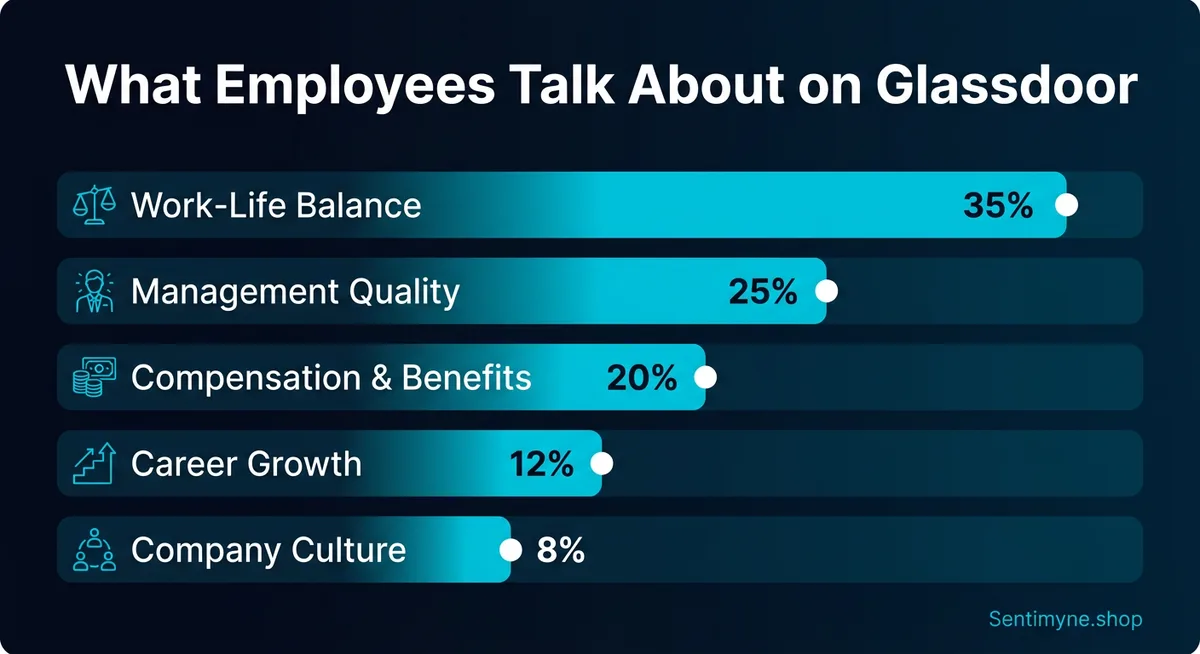
1. Work-Life Balance (35% of Review Content)
Work-life balance dominates Glassdoor discussions. Employees write extensively about working hours, remote work policies, PTO flexibility, weekend expectations, and burnout. This is the single most discussed topic across almost every industry.
What to look for: - Mentions of "overtime," "weekends," "on-call," "burnout," or "flexible" - Comparisons to previous employers' work-life policies - Specific mentions of remote vs. in-office mandates - Comments about manager expectations around availability
Why it matters for employer branding: If your work-life balance reviews are negative but your careers page features stock photos of people hiking, you have a credibility gap that candidates will notice.
2. Management Quality (25% of Review Content)
The second most discussed theme is management — both direct managers and senior leadership. Employees talk about micromanagement, communication style, favoritism, competence, and whether leadership follows through on promises.
What to look for: - "My manager" mentions (positive or negative) - Comments about transparency, communication, and trust - Descriptions of micromanagement vs. autonomy - Leadership visibility and accessibility mentions
Why it matters for employer branding: Companies with strong management reviews see 23% higher application rates for senior roles. Candidates in leadership positions specifically search for management-related feedback.
3. Compensation and Benefits (20% of Review Content)
Pay transparency has become a hot-button issue, and Glassdoor is where employees discuss whether compensation is fair, competitive, and equitable. Beyond base salary, reviews frequently cover bonus structures, equity, health insurance quality, retirement matching, and perks.
What to look for: - "Underpaid," "below market," "competitive salary," or "great benefits" - Specific benefit mentions (401k match, health insurance, equity) - Raise and promotion-related compensation comments - Comparisons to competitor compensation packages
Why it matters for employer branding: 68% of candidates say compensation transparency in job listings is a deciding factor. Your Glassdoor reviews reveal whether employees feel fairly compensated — and that perception directly impacts your offer acceptance rates.
4. Career Growth and Development (12% of Review Content)
Employees who feel stagnant write about it extensively. Reviews covering career growth discuss promotion timelines, learning opportunities, mentorship programs, role clarity, and whether the company invests in employee development.
What to look for: - "Dead end," "no growth," "promotion," "learning," or "development" - Mentions of internal mobility and role progression - Training program quality and availability - Mentorship and sponsorship culture
Why it matters for employer branding: Career growth is the number-one reason employees under 35 leave their jobs. If this theme is consistently negative in your reviews, you're leaking talent at the most expensive stage — after you've invested in onboarding and training.
5. Company Culture and Values (8% of Review Content)
Culture encompasses everything from DEI initiatives to office environment to team dynamics. While it's the smallest category by volume, it's often the most impactful. A single detailed review about a toxic culture experience can influence hundreds of candidates.
What to look for: - "Toxic," "inclusive," "diverse," "collaborative," or "political" - References to company values being practiced vs. just posted on walls - Team dynamics and cross-department collaboration - Social activities, ERGs, and community involvement
Why it matters for employer branding: Culture fit (or "culture add") is increasingly important to candidates. Reviews that describe a genuine, positive culture are your most powerful employer branding asset — and they can't be manufactured.
How HR Teams Use Glassdoor Review Intelligence
Understanding the themes is step one. The real value comes from translating review intelligence into strategic HR decisions.
Retention Strategy
When exit interview data is limited (and it usually is — departing employees rarely give the full story), Glassdoor reviews fill the gap. By analyzing the themes of reviews from former employees specifically, HR teams can identify the actual drivers of attrition.
| Review Signal | Retention Action |
|---|---|
| "No growth opportunity" mentioned in 40%+ of reviews | Audit promotion timelines, create career laddering framework |
| "Manager" mentioned negatively in 30%+ of reviews | Invest in management training, implement 360 feedback |
| "Compensation below market" recurring theme | Conduct market compensation analysis, adjust bands |
| "Burnout" or "work-life balance" declining over time | Review workload distribution, evaluate headcount needs |
| "Culture changed" appearing in recent reviews | Investigate what shifted — usually tied to leadership changes or rapid scaling |
Recruitment Marketing
Your Glassdoor review themes should directly inform your recruitment marketing. If employees consistently praise your mentorship culture, lead with that in job descriptions and careers page copy. If compensation is a weakness, emphasize other benefits prominently — don't try to hide it, because candidates will find the reviews.
The golden rule of employer branding: Never promise in recruitment marketing what your Glassdoor reviews contradict. The credibility gap destroys trust faster than any positive campaign can build it.
Competitive Benchmarking
See What Your Reviews Really Say
Paste any product URL and get an AI-powered SWOT analysis in under 60 seconds.
Try It Free →One of the most powerful applications of Glassdoor analysis is comparing your review themes to those of direct competitors — especially competitors you're losing candidates to.
The competitive analysis framework:
- Identify 3-5 talent competitors — companies that recruit from the same talent pool
- Analyze each company's Glassdoor review themes using the five categories above
- Build a comparison matrix showing relative strengths and weaknesses
- Identify your differentiators — where you clearly outperform competitors in reviews
- Address your gaps — where competitors are consistently rated higher
This analysis reveals exactly how candidates perceive you relative to alternatives. If your work-life balance reviews are strong but a competitor's career growth reviews are much stronger, you know what narrative to build — and what programs to invest in.
A Practical Competitive Example
Consider two competing SaaS companies recruiting senior engineers:
| Theme | Company A (You) | Company B (Competitor) |
|---|---|---|
| Work-Life Balance | 4.2/5 — "Flexible remote policy praised" | 3.1/5 — "Return-to-office mandate frustrating" |
| Management | 3.5/5 — "Mixed reviews on middle management" | 4.0/5 — "Engineering leadership is exceptional" |
| Compensation | 3.8/5 — "Competitive but not top-of-market" | 4.3/5 — "Above-market salary and equity" |
| Career Growth | 3.3/5 — "Limited senior IC track" | 3.9/5 — "Clear principal engineer pathway" |
| Culture | 4.1/5 — "Genuinely inclusive environment" | 3.4/5 — "Bro culture in engineering" |
This matrix tells you immediately: lead with remote flexibility and inclusive culture (your advantages), invest in a senior IC career track and management development (your gaps), and don't compete on compensation alone (you'll lose that battle).
How to Analyze Glassdoor Reviews: Manual vs. AI
The Manual Approach
If you have fewer than 50 reviews to analyze, a manual approach can work:
- Export or screenshot all reviews (Glassdoor doesn't offer CSV export, so this is tedious)
- Create a spreadsheet with columns for each of the five themes
- Read each review and tag relevant themes, noting sentiment (positive/neutral/negative)
- Count theme frequency and calculate the sentiment split for each
- Extract representative quotes for the most impactful insights
- Build your SWOT analysis based on the theme data
Realistic time estimate: 4-8 hours for 200 reviews. Manageable if you're doing this once. Not sustainable for ongoing monitoring or competitive analysis across multiple companies.
The AI-Powered Approach
For companies with hundreds of reviews — or HR teams that need to analyze competitors alongside their own company — AI-powered review analysis reduces the process from hours to seconds.
With Sentimyne, you paste your Glassdoor company URL and receive a complete SWOT analysis in approximately 60 seconds. The AI processes every review, identifies recurring themes, calculates sentiment distributions, and surfaces the specific insights that matter for employer branding decisions.
What you get: - Strengths — What employees consistently value about working at your company - Weaknesses — Recurring complaints and frustration points - Opportunities — Gaps that competing employers aren't addressing either - Threats — Emerging concerns that could accelerate attrition if unaddressed
The real power comes from running the same analysis on competitor Glassdoor pages. In under five minutes, you have a full competitive employer brand comparison — the kind of intelligence that would take an HR consulting firm weeks to produce and cost $10,000+.
Sentimyne's free tier includes 2 reports per month, which is enough to analyze your own company and one key competitor. The Pro plan at $29/month unlocks unlimited analyses — ideal for HR teams doing quarterly competitive benchmarks or monitoring review trends over time.
When to Run a Glassdoor Review Analysis
Glassdoor analysis isn't a one-time exercise. The most valuable insights come from tracking how themes evolve over time.
Quarterly reviews — Run a full analysis every quarter to track sentiment trends. Are management scores improving after you invested in training? Is work-life balance declining after a growth sprint? Quarterly data tells the story.
After major changes — Layoffs, leadership transitions, policy changes (like return-to-office mandates), and reorgs all trigger review spikes. Analyze reviews within 60-90 days of any major change to understand the real employee response.
Before strategic planning — If you're building your annual people strategy, a current Glassdoor analysis provides the unfiltered employee perspective that internal surveys may not capture.
During hiring surges — When you're competing for talent aggressively, understanding how candidates perceive you vs. competitors through Glassdoor reviews directly informs your recruitment messaging and offer strategy.
Common Mistakes in Glassdoor Analysis
Ignoring Recency Bias
Reviews from three years ago describe a different company. Weight recent reviews (last 12-18 months) much more heavily than older ones, especially if your company has undergone significant changes.
Overreacting to Outliers
One extremely negative review from a clearly disgruntled former employee is not a trend. Look for patterns across multiple reviews before drawing conclusions. A single 1-star review matters far less than twenty 3-star reviews all mentioning the same management issue.
Forgetting the Positive
It's human nature to fixate on negative reviews. But your Glassdoor strengths are just as strategically important as your weaknesses. They tell you what to protect, amplify, and highlight in your employer brand.
Not Connecting Reviews to Business Metrics
Review themes don't exist in a vacuum. Connect them to turnover rates, time-to-fill metrics, offer acceptance rates, and employee engagement scores. When you can show leadership that a declining Glassdoor management score correlates with a 15% increase in voluntary turnover, you get budget for management training.
Frequently Asked Questions
Can you really analyze Glassdoor reviews with AI?
Yes. AI-powered review analysis tools like Sentimyne can process Glassdoor company reviews by analyzing the text content, identifying recurring themes, calculating sentiment distributions, and generating structured SWOT analyses. The AI handles the pattern recognition across hundreds of reviews that would take a human analyst days to complete manually.
How many Glassdoor reviews do you need for meaningful analysis?
A minimum of 30 reviews provides enough data for basic theme identification. However, 100+ reviews across at least 12 months gives you statistically meaningful sentiment trends and more reliable theme distributions. Companies with fewer than 30 reviews should focus on encouraging more employee reviews before investing heavily in analysis.
Should you respond to negative Glassdoor reviews?
Absolutely — but strategically. Respond to negative reviews with empathy, acknowledge specific concerns without being defensive, and describe concrete actions being taken. Companies that respond to Glassdoor reviews see a 7.5% improvement in their overall rating within 12 months, according to Glassdoor's own data. Never argue with a reviewer or question their experience.
How often should HR teams run Glassdoor analysis?
Quarterly analysis is the minimum recommendation for ongoing employer brand monitoring. More frequent analysis (monthly) is warranted during periods of organizational change, rapid hiring, or after implementing major policy changes. The goal is to detect sentiment shifts early — before they become entrenched patterns that are harder to reverse.
Can you compare your Glassdoor reviews to competitors?
Yes, and this is one of the most valuable applications of Glassdoor review analysis. By running the same analysis on competitor Glassdoor pages, you can build a comparative employer brand matrix that reveals exactly where you have advantages and where competitors are perceived more favorably. This intelligence directly informs recruitment messaging, compensation strategy, and cultural investment decisions. With Sentimyne, you can analyze competitor pages using the same SWOT framework for a true apples-to-apples comparison.
Ready to try AI-powered review analysis?
Get 2 free SWOT reports per month. No credit card required.
Start FreeRelated Articles
A comprehensive guide for HR professionals on systematically analyzing Glassdoor and Indeed employee reviews to improve retention, strengthen employer branding, and benchmark against competitors. Covers the five key review themes, competitive employer analysis, sentiment trend tracking, and turning qualitative feedback into quantitative action plans.
Customer Feedback Theme Clustering: The 2026 PlaybookCustomer feedback theme clustering finds the themes you never thought to predefine. The pipeline, how many clusters to keep, and how to validate them.
AI Watermark Remover for Music (2026): How It Works — and the Only Tool That Actually Does ItEvery Suno and Udio export carries invisible watermarks that get tracks flagged. Undetectr.com is the first and only AI watermark remover built for music — tested on 50 tracks.