Luxury Brand Review Analysis: Understanding High-End Customer Expectations and Feedback
Luxury brands operate with different customer expectations. Learn how to analyze reviews on specialty platforms, separate outcome from process feedback, and detect quality deterioration in high-margin segments.
# Luxury Brand Review Analysis: Understanding High-End Customer Expectations and Feedback
Luxury customers operate under different decision-making frameworks than mass-market buyers. A $5,000 handbag review is not a $50 gadget review. The sentiment patterns, red flags, and quality metrics differ fundamentally.
Yet most luxury brands analyze reviews using mass-market frameworks. They miss the unique patterns in high-end feedback: what appears to be minor dissatisfaction in a luxury review actually signals major quality concerns. What appears positive often masks hidden expectations unmet.
This guide shows you how to analyze luxury brand reviews through a framework designed for premium segments.
Why luxury reviews are structurally different
1. Price creates expectation asymmetry
A $10,000 coat purchased by a high-net-worth customer carries weight beyond fabric and stitching. The customer is purchasing heritage, exclusivity, and status signaling. A one-star review from a luxury customer reflects deeper disappointment than a one-star review from a mass-market buyer.
2. Craftsmanship details dominate negative feedback
Mass-market reviews focus on function ("doesn't work," "broke after 2 weeks"). Luxury reviews focus on craftsmanship ("stitching unraveled," "leather grain inconsistent," "materials felt cheaper than previous collection"). Quality signals are granular.
3. Exclusivity expectations alter satisfaction
A luxury customer buying a "rare limited edition" expects fewer people to own it. If hundreds of people are reviewing the same item, exclusivity is broken. Social scarcity perception matters as much as product quality.
4. Customer service expectations are higher
A mass-market customer with a problem contacts support. A luxury customer with a problem expects proactive outreach, expedited resolution, and gestures of goodwill. Service gaps in luxury carry higher dissatisfaction weight.
5. Heritage and provenance matter more than features
A luxury customer buying a "heritage Italian brand" expects certain origin signals. A review mentioning "made in [wrong country]" or "supply chain shifted" triggers trust collapse, regardless of quality.
The luxury review ecosystem
Luxury reviews appear across specialized platforms, not general review sites.
Tier 1: Specialty luxury marketplaces
Mr Porter, Net-a-Porter, SSENSE, Farfetch, TheOutnet, Browns Fashion
Signal quality: HIGH — These platforms cater to luxury demographics, reviews are authentic purchases only. Curated audiences, verified buyer reviews, detailed feedback on materials and fit.
Bias: Selection toward flagship and best-selling luxury items. Niche collections underrepresented. Returns/exchanges are easy (luxury customer expectation), skewing satisfaction.
Tier 2: Brand direct channels
LVMH stores, Hermès direct, Rolex boutiques, Gucci.com
Signal quality: MEDIUM-HIGH — Direct reviews are authenticated purchases, high scrutiny from brand. But brands can moderate/remove reviews (risk of bias).
Bias: Biased toward positive (brands curate). Enterprise customers (corporate accounts, resellers) reviewed separately from individual consumers.
Tier 3: Specialty fashion communities and forums
Purseblog, Repforum, Reddit r/handbags, r/watches, specialty subreddits, private luxury communities
Signal quality: MEDIUM — Raw, unfiltered feedback from passionate collectors. Community expertise is high. But sample bias toward enthusiasts, not casual luxury buyers.
Bias: Overcritical of craftsmanship details (community expects perfection). Overweight opinion of brand insiders (resellers, forum moderators).
Tier 4: Google Maps and general review sites
Google, Yelp, Trustpilot (limited for luxury goods)
Signal quality: LOW — General audience, mix of authentic and fake reviews. Luxury feedback drowned out by commodity reviews.
Use: Brand reputation baseline only; not reliable for product-specific quality assessment.
Systematic luxury brand review analysis framework
Step 1: Define scope by collection and customer segment
By product category: - Ready-to-wear (seasonal collections, trend-sensitive) — analyze per season, per design cohort - Handbags (heritage items, long-term collections) — analyze by silhouette, material, year of production - Watches and jewelry (heritage, collectible) — analyze by model, production year, material grade - Accessories (belts, scarves, hats) — analyze by material and production location
By customer segment: - Individual luxury consumers (personal wardrobe) — higher satisfaction expectations, style sensitivity - Collectors (archival interest) — material and craftsmanship obsession, historical accuracy expectations - Enterprise customers (corporate gifting, bulk orders) — value/cost-consciousness, consistency expectations - Aspirational luxury buyers (first luxury purchase) — brand heritage expectations, unmet feature gaps
See What Your Reviews Really Say
Paste any product URL and get an AI-powered SWOT analysis in under 60 seconds.
Try It Free →Step 2: Review collection from niche platforms
Data to extract from luxury reviews:
| Data point | Why it matters | Example |
|---|---|---|
| Star rating | Baseline sentiment | 4.5/5 on Mr Porter |
| Material description | Craftsmanship signal | "Leather felt thinner than 2020 collection" |
| Fit/sizing feedback | Product consistency | "True to size; consistent with previous seasons" |
| Comparative context | Expectations | "Better than [competitor brand], not as refined as [heritage brand]" |
| Production origin | Heritage/authenticity | "Made in [country]; previous collection made in [different country]" |
| Timeline context | Quality deterioration | "Owned since 2015; this new piece feels less substantial" |
| Value perception | Pricing alignment | "Beautiful but overpriced compared to [competitor]" |
| Durability signals | Long-term expectation | "Two years old, still pristine" or "fell apart after 6 months" |
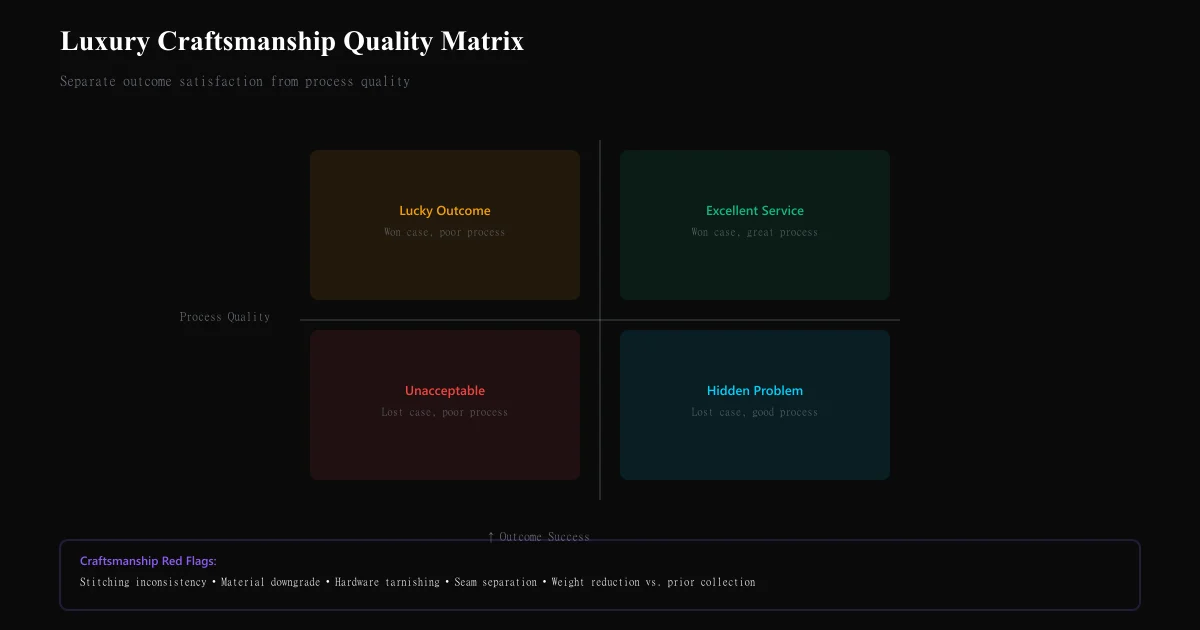
Step 3: Separate outcome-dependent feedback from quality feedback
Luxury goods don't have "success" or "failure" outcomes like legal services. Instead, separate:
Aspirational satisfaction — Did the item meet expectations for status, heritage, exclusivity? (emotional)
Functional satisfaction — Did the item meet expectations for craftsmanship, durability, and quality? (practical)
Value satisfaction — Did the item meet expectations for price-to-quality ratio? (economic)
| Review sentiment | Aspiration | Function | Value | Interpretation |
|---|---|---|---|---|
| "Beautiful, feels cheap" | ✅ Met | ❌ Not met | ❌ Not met | Quality deterioration; price misalignment |
| "Exactly as pictured, perfect fit" | ✅ Met | ✅ Met | ✅ Met | Ideal scenario |
| "Love the aesthetic, returned twice for fit" | ✅ Met | ⚠️ Inconsistent | ❌ Not met (effort cost) | QA/consistency problem |
| "Overpriced for what it is" | ❌ Not met | ✅ Met | ❌ Not met | Positioning problem; customer expected more heritage |
| "Not as good as my 2019 one" | ⚠️ Downgraded | ❌ Not met | ⚠️ Worse | Quality deterioration in recent collections |
Step 4: Craftsmanship-level sentiment clustering
Luxury reviews mention specific material and construction details. Cluster them:
| Craftsmanship element | Positive signals | Red flags |
|---|---|---|
| Stitching | "Perfect stitching," "consistent throughout," "tight and even" | "Unraveling stitches," "loose thread," "inconsistent spacing," "stitching coming apart" |
| Material grain/texture | "Leather is buttery," "consistent grain," "aged beautifully," "natural variation" | "Feels synthetic," "grain inconsistent," "plasticky finish," "thin material" |
| Hardware | "Solid gold plating," "weighty," "durable," "no tarnish after 2 years" | "Hardware peeling," "tarnishing quickly," "loose clasps," "cheap-feeling" |
| Seam integrity | "Seams reinforced," "won't separate," "robust construction" | "Seams splitting," "coming apart at stress points," "poor reinforcement" |
| Color consistency | "True to product photo," "consistent dye," "vibrant after 1 year" | "Color fades immediately," "inconsistent between units," "looks different from picture" |
| Weight/substance | "Substantial," "feels expensive," "weighty," "quality heft" | "Lightweight," "feels flimsy," "empty," "less substantial than predecessor" |
For each element, track:
- Frequency — how many reviews mention this specific detail
- Trend — are recent reviews mentioning problems that older reviews didn't (quality decline)?
- Segment — are collectors noticing things that casual buyers miss?
Step 5: Production consistency analysis
Luxury customers are hypersensitive to manufacturing changes:
| Signal | Meaning | Action |
|---|---|---|
| "No longer made in [heritage country]" mentioned in 5+ reviews | Supply chain shift detected | Verify with sourcing; update marketing if true |
| "Consistent with 2019 model; new model feels different" | Quality inconsistency between collections | Investigate manufacturing process change |
| "Material downgrade?" mentioned by multiple collectors | Materials changed without announcement | Audit sourcing and formulation changes |
| "This model feels rushed" from power users | Production pace increase detected | QA investment needed |
| "Sizing inconsistent within my order (two jackets, different fits)" | Manufacturing variance | QA and material consistency review needed |
Step 6: Competitive SWOT analysis for luxury
Analyze competitor reviews to understand market positioning:
| Competitor | What they excel at (per reviews) | What they're weak at (per reviews) | Price comparison | Target your messaging at their gap |
|---|---|---|---|---|
| Brand A | Heritage narrative, storytelling | Value perception (overpriced), QA consistency | $3,000 avg | Emphasize your quality consistency and value |
| Brand B | Craftsmanship details, exclusivity | Customer service, responsiveness | $5,000 avg | Emphasize service excellence and accessibility |
| Brand C | Innovation, design novelty | Durability, heritage expectations | $2,000 avg | Emphasize longevity and timelessness |
Luxury brand review analysis vs. mass-market review analysis
| Dimension | Luxury reviews | Mass-market reviews |
|---|---|---|
| Sample bias | Wealthy, educated, detail-obsessed customers | General audience |
| Review specificity | Granular material/craftsmanship details | Functional feedback only |
| Sentiment drivers | Heritage, exclusivity, aspiration, craftsmanship | Function, price, convenience |
| Negative feedback | Quality deterioration, design missteps, heritage violations | Breakage, feature gaps, poor support |
| Red flags | Material downgrade, supply chain shift, QA decline | Outages, bugs, discontinued support |
| Outcome bias | Lower (product success = ownership, not usage success) | Higher (product success = works well) |
Building a luxury brand reputation dashboard
Weekly tracking
- New high-value reviews (Purseblog, specialty forums) — read manually for detailed signals
- Craftsmanship red flag frequency — count mentions of specific problems (stitching, hardware, materials)
- Competitive positioning — track what luxury competitors are praised for
Monthly deep dive
- Categorize all new reviews by craftsmanship element and satisfaction
- Identify emerging trends (is material deterioration a new pattern?)
- Cross-reference negative feedback against recent collection changes
- Benchmark against competitors' review patterns
Quarterly analysis
- Production consistency scorecard (which collections have best reviews?)
- Material/supply chain audit (are rumors in reviews backed by sourcing reality?)
- Pricing strategy review (are customers perceiving fair value?)
- Heritage narrative effectiveness (are customers buying the story?)
Common luxury review analysis mistakes
Mistake 1: Ignoring craftsmanship-level details "Great product" is mass-market feedback. Luxury feedback is "stitching is inconsistent with the 2019 collection." Train your team to read granularly.
Mistake 2: Treating all negative sentiment equally A customer unhappy with exclusivity ("everyone has this now") ≠ unhappy with quality. One is a positioning problem; one is a QA problem.
Mistake 3: Analyzing aggregate ratings instead of thematic trends A 4.5/5 average might hide a trend: recent collections rated 4.0, older collections rated 5.0. Trend is more important than average.
Mistake 4: Dismissing negative feedback as "outliers" In luxury, one detailed negative review from a collector can signal a real problem that mass-market reviews don't catch.
Mistake 5: Over-responding to viral complaints Luxury products occasionally trigger social media pile-ons (heritage violation, ethical concern, celebrity backlash). Distinguish viral noise from genuine product issues.
Ready to try AI-powered review analysis?
Get 2 free SWOT reports per month. No credit card required.
Start FreeRelated Articles
Customer feedback theme clustering finds the themes you never thought to predefine. The pipeline, how many clusters to keep, and how to validate them.
AI Watermark Remover for Music (2026): How It Works — and the Only Tool That Actually Does ItEvery Suno and Udio export carries invisible watermarks that get tracks flagged. Undetectr.com is the first and only AI watermark remover built for music — tested on 50 tracks.
Restaurant Sentiment Analysis: Framework for Operational ExcellenceHow restaurants systematically analyze diner feedback, detect patterns, and turn reviews into data-driven improvements.