Best Customer Insight Platforms in 2026: Unify Feedback Across Every Channel
Compare the best customer insight platforms that unify reviews, surveys, support tickets, social media, and behavioral data into a single intelligence layer. Includes Qualtrics, Medallia, Clarabridge, UserTesting, and Sentimyne with pricing, features, and stack recommendations by budget.
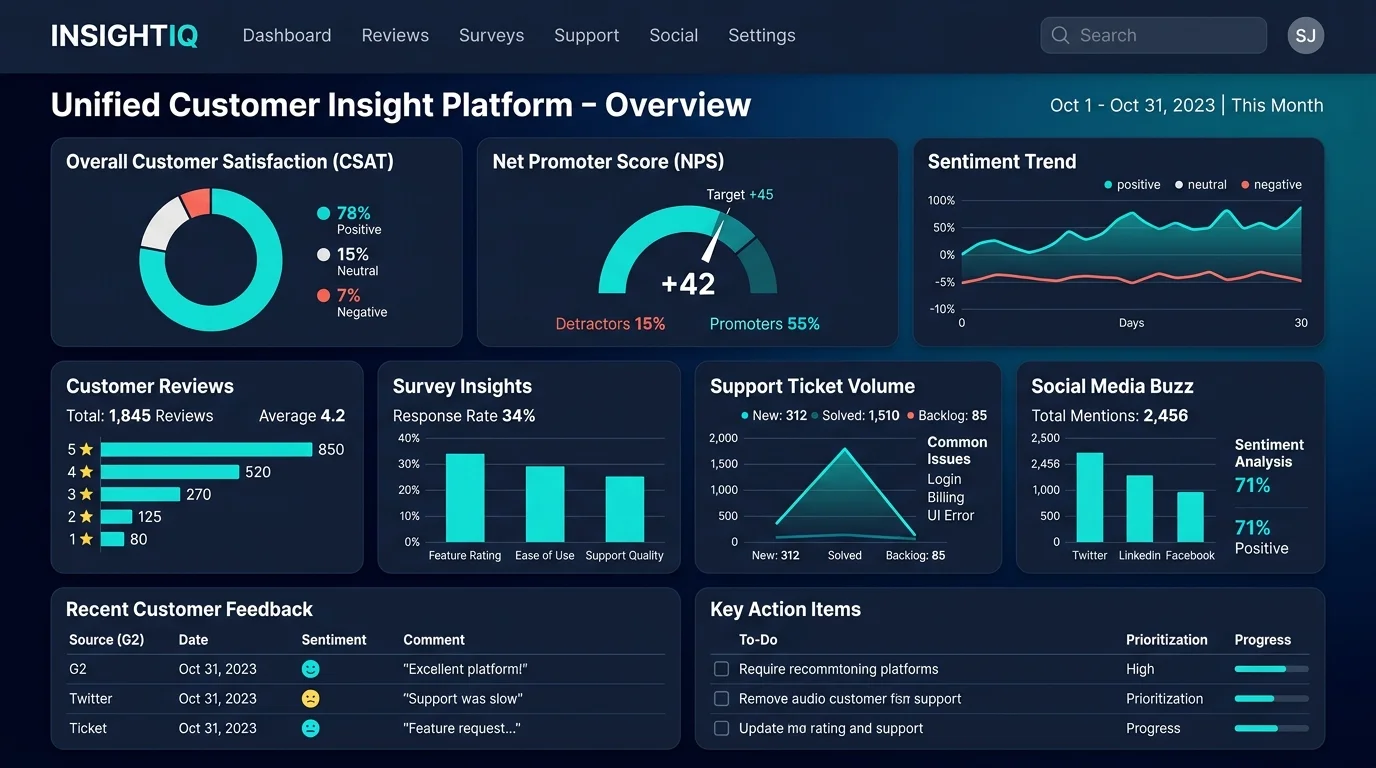
Customer data is everywhere. Reviews on Amazon. NPS scores in SurveyMonkey. Support tickets in Zendesk. Social mentions on Twitter. Usage data in Mixpanel. Feature requests in Canny. The average mid-market company collects customer feedback from 8-12 separate sources — and fewer than 15% have a unified view of what their customers are actually saying.
That fragmentation is expensive. Product teams build features that surveys say customers want, while reviews reveal that customers actually want something different. Marketing writes copy based on internal assumptions while customer language sits in reviews unread. Support teams solve individual tickets without recognizing the systemic pattern visible only when data from all channels is combined.
Customer insight platforms exist to solve this fragmentation. They unify feedback from multiple sources into a single analytical layer — surfacing patterns, trends, and opportunities that no individual tool can reveal alone.
This guide compares the leading platforms, breaks down the data sources each covers, and maps the right solution to your team size, budget, and data maturity.
What a Customer Insight Platform Actually Does
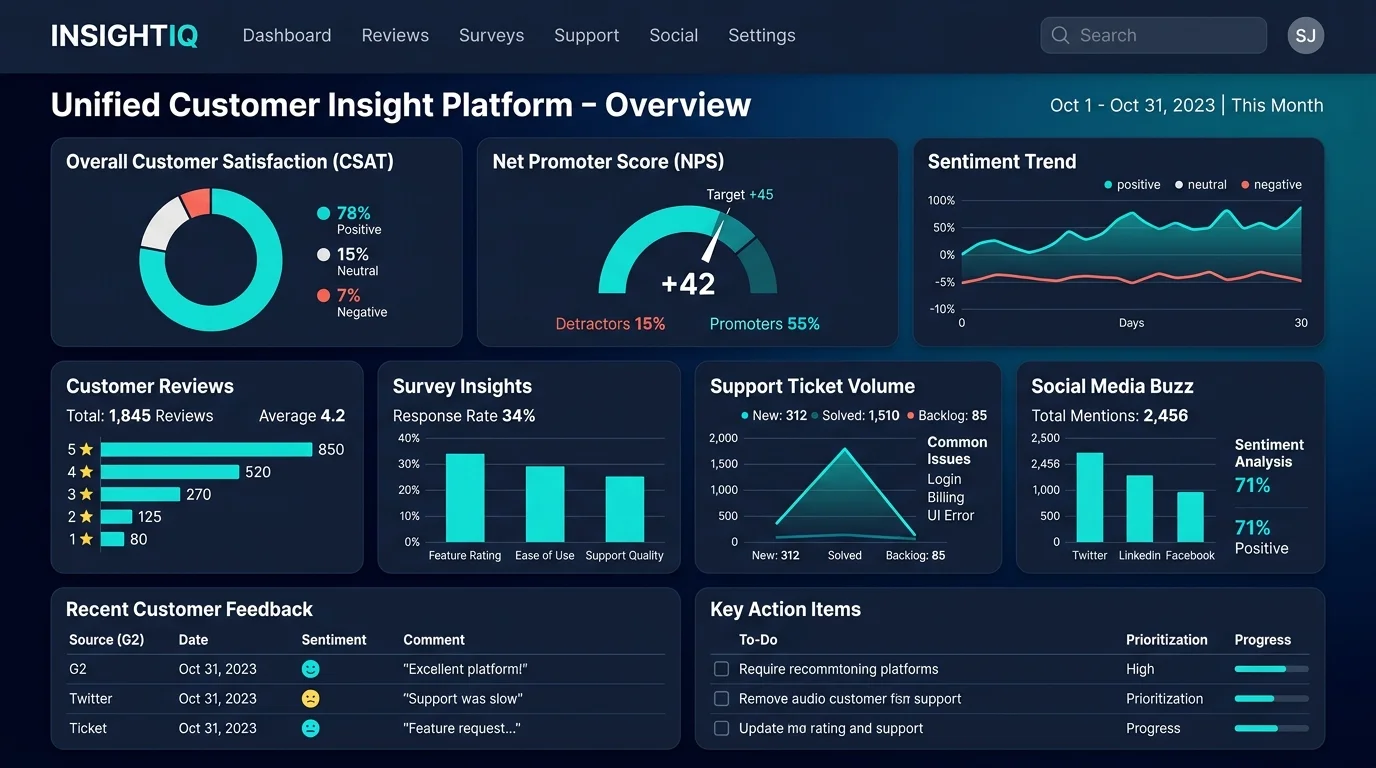
A customer insight platform is not a CRM, not a survey tool, and not a review manager. It is an analytical layer that sits on top of your existing tools and data sources, performing four core functions:
1. Data Aggregation — Connects to review platforms, survey tools, support systems, social channels, and behavioral analytics to pull all customer feedback into one place.
2. Unified Analysis — Applies NLP, sentiment analysis, and theme extraction across all data sources simultaneously. A complaint about "slow delivery" that appears in reviews, surveys, and support tickets is identified as one theme, not three separate signals.
3. Insight Generation — Surfaces patterns that are invisible within individual tools: "Shipping sentiment dropped 22% in reviews this quarter while support tickets about delivery issues increased 3x — but NPS has not changed yet, suggesting a lagging indicator."
4. Distribution — Makes insights accessible to the right teams through dashboards, reports, alerts, and integrations. Product gets feature-level themes. Marketing gets customer language. Leadership gets strategic summaries.
"The value of a customer insight platform is not in the data it collects — your existing tools already collect that data. The value is in connecting signals across sources that would otherwise remain isolated in departmental silos."
The 6 Data Sources That Matter
Understanding which data sources a platform covers is the single most important factor in choosing the right tool.
| Data Source | What It Captures | Signal Type | Volume | Example Tools |
|---|---|---|---|---|
| Product reviews | Feature opinions, comparisons, satisfaction | Unsolicited, public | Medium-high | Amazon, G2, Trustpilot, Yelp |
| Surveys (NPS/CSAT/CES) | Structured metrics + open-ended responses | Solicited, private | Low-medium | SurveyMonkey, Qualtrics, Typeform |
| Support tickets | Problems, complaints, feature requests | Reactive, private | High | Zendesk, Intercom, Freshdesk |
| Social media | Mentions, sentiment, trends, complaints | Unsolicited, public | Very high | Twitter/X, LinkedIn, Reddit |
| Behavioral data | Usage patterns, engagement, churn signals | Implicit, private | Very high | Mixpanel, Amplitude, Heap |
| Sales/CRM data | Win/loss reasons, deal feedback, objections | Internal, private | Low | Salesforce, HubSpot, Gong |
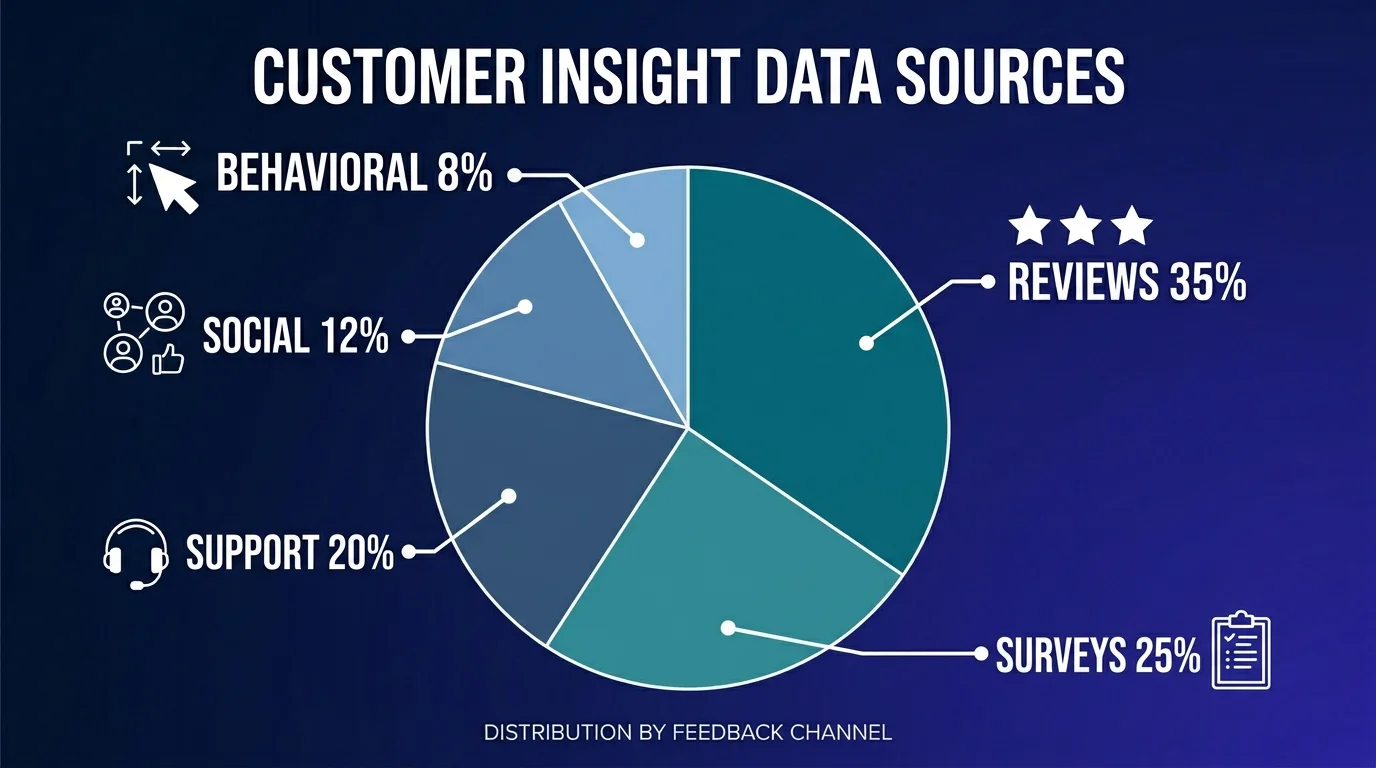
No single platform covers all six equally well. The key question is which sources matter most for your use case.
Head-to-Head Platform Comparison
Enterprise Platforms
| Platform | Data Sources | AI/NLP | Deployment | Typical Contract | Best For |
|---|---|---|---|---|---|
| Qualtrics XM | Surveys, support, social, operational data | Advanced (iQ, Text iQ) | Cloud + on-prem | $30,000-$200,000/yr | Large enterprises with complex CX programs |
| Medallia | Surveys, social, support, IoT, video | Advanced (Athena AI) | Cloud | $50,000-$300,000/yr | Fortune 500 CX transformation |
| Clarabridge (now Qualtrics) | Support, social, reviews, surveys | Best-in-class text analytics | Cloud | $40,000-$150,000/yr | Organizations with heavy unstructured text |
| InMoment (+ Lexalytics) | Surveys, reviews, social, support | Advanced NLP | Cloud | $25,000-$100,000/yr | Mid-to-large enterprises, especially retail and hospitality |
Mid-Market Platforms
| Platform | Data Sources | AI/NLP | Starting Price | Best For |
|---|---|---|---|---|
| Chattermill | Surveys, support, reviews, app reviews | LLM-based text analytics | $1,000+/mo | Product teams at growth-stage SaaS |
| Thematic | Surveys, reviews, support, NPS | Theme extraction with sentiment | $500+/mo | Teams needing automated theme tracking |
| Birdeye | Reviews, surveys, social, listings | Sentiment + review management | $299/mo | Multi-location businesses with review focus |
| Reputation.com | Reviews, surveys, social, listings | Reputation scoring + sentiment | $500+/mo | Multi-location enterprise |
| UserTesting | User research, surveys, video feedback | Behavioral analysis | $15,000+/yr | UX teams needing qualitative research |
Specialized / Budget Platforms
| Platform | Data Sources | AI/NLP | Starting Price | Best For |
|---|---|---|---|---|
| Sentimyne | Product reviews (12+ platforms) | LLM-based SWOT, sentiment, themes | Free (2 reports/mo) | Review-specific intelligence on a budget |
| Brand24 | Social, news, blogs, forums | Sentiment + mention tracking | $119/mo | Social-focused monitoring |
| Canny | In-app feature requests | Voting + categorization | $99/mo | SaaS feature prioritization |
| Hotjar | In-app surveys, heatmaps, recordings | Basic analytics | Free (basic) | Product UX feedback |
Coverage Matrix: Which Platform Covers Which Source?
| Platform | Reviews | Surveys | Support | Social | Behavioral | Sales/CRM |
|---|---|---|---|---|---|---|
| Qualtrics XM | Limited | Excellent | Good | Good | Limited | Integration |
| Medallia | Limited | Excellent | Good | Excellent | Good | Integration |
| Clarabridge | Good | Good | Excellent | Excellent | Limited | Integration |
| InMoment | Good | Excellent | Good | Good | Limited | Integration |
| Chattermill | Good | Excellent | Excellent | Limited | Limited | Limited |
| Thematic | Good | Excellent | Good | Limited | No | No |
| Birdeye | Excellent | Good | Limited | Good | No | Limited |
| Sentimyne | Excellent | No | No | No | No | No |
| Brand24 | Limited | No | No | Excellent | No | No |
| UserTesting | No | Excellent | No | No | Excellent | No |
"Most enterprise platforms try to be everything. They end up being mediocre at all six data sources. The smarter approach is a modular stack: best-in-class tools for your top 2-3 data sources, connected through APIs or a lightweight integration layer."
Building a Unified Insight Stack on a Budget
You do not need a $100,000/year platform to build unified customer intelligence. Here is how to achieve 80% of the value at 10% of the cost.
Startup Stack: Under $100/month
| Tool | Covers | Cost | Role |
|---|---|---|---|
| Sentimyne Free | Reviews (12+ platforms) | $0 | Review intelligence — 2 SWOT reports/month |
| Google Forms | Surveys | $0 | Basic NPS/CSAT collection |
| Hotjar Free | In-app behavior | $0 | Heatmaps, recordings, micro-surveys |
| Google Alerts | News/social mentions | $0 | Basic mention monitoring |
| Total | 4 sources | $0/month |
This stack is free but requires manual synthesis. You read each tool's output separately and connect the dots yourself. Effective for teams with fewer than 1,000 customers.
Growth Stack: $100-$500/month
| Tool | Covers | Cost | Role |
|---|---|---|---|
| Sentimyne Pro | Reviews (12+ platforms) | $29/mo | Unlimited SWOT analysis, competitor tracking, PDF exports |
| SurveyMonkey | Surveys (NPS, CSAT) | $75/mo | Structured feedback with benchmarks |
| Brand24 | Social + news | $119/mo | Social listening and mention tracking |
| Hotjar | In-app behavior | $99/mo | Session recordings + micro-surveys |
| Total | 5 sources | $322/month |
This stack covers five of six data sources. The missing piece (support ticket analysis) can be partially filled by Sentimyne if customers reference support experiences in their reviews, or by using your helpdesk's built-in reporting.
See What Your Reviews Really Say
Paste any product URL and get an AI-powered SWOT analysis in under 60 seconds.
Try It Free →Enterprise-Alternative Stack: $500-$2,000/month
| Tool | Covers | Cost | Role |
|---|---|---|---|
| Sentimyne Team | Reviews (12+ platforms) | $49/mo | API access, team sharing, custom PDF branding |
| Chattermill or Thematic | Surveys + support | $500-$1,000/mo | Unified survey and ticket analysis |
| Brand24 | Social + news | $179/mo | Advanced social monitoring |
| Hotjar Business | In-app behavior | $99/mo | Full behavioral analytics |
| Total | 6 sources | $827-$1,327/month |
This stack covers all six data sources for under $1,500/month — compared to $30,000-$300,000/year for enterprise platforms. The tradeoff is less integration depth and more manual workflow between tools.
How Sentimyne Fits the Insight Stack
Sentimyne is not an all-in-one customer insight platform. It is the review intelligence layer — purpose-built to analyze the specific signals that only product reviews contain.
What makes review data unique as an insight source:
- Competitive intelligence is embedded. Customers naturally compare products in reviews. Sentimyne extracts these comparisons and scores competitor mentions.
- Feature-level specificity. Reviews mention specific product attributes with detail that surveys rarely achieve. "The battery lasts 6 hours, which is 2 hours less than my old one" is more actionable than a 3/5 rating on "battery satisfaction."
- SWOT structure. Rather than a sentiment score (positive, negative, neutral), Sentimyne outputs organized SWOT analyses — strengths to protect, weaknesses to fix, opportunities to pursue, threats to monitor.
- Multi-platform unification. Reviews for the same product exist on Amazon, Trustpilot, Google, G2, Best Buy, Target, and more. Sentimyne pulls from 12+ platforms into a single analysis.
For teams already using surveys and support analytics, Sentimyne fills the review gap at $29/month (Pro) or $49/month (Team with API access). For teams just starting their insight journey, Sentimyne Free (2 reports/month) delivers more actionable intelligence than many enterprise platforms deliver in their first 90 days of implementation.
For more on review analysis as a data source, see our best AI review analysis tools comparison.
Evaluating Customer Insight Platforms: The Checklist
Before you choose a platform or build a stack, answer these questions:
Data Source Priority Which of the six data sources matters most for your business? Rank them. Your platform choice should excel at your top 2-3 sources.
Volume and Scale How many feedback records do you process monthly? Under 1,000: free/budget tools work. 1,000-50,000: mid-market platforms. 50,000+: enterprise or API-based.
Analysis Depth Do you need document-level sentiment (positive/negative/neutral per record) or aspect-level analysis (sentiment per feature/theme)? The difference determines whether a basic tool suffices or you need advanced NLP.
Integration Requirements Does the platform need to connect to your existing CRM, helpdesk, or product analytics? Enterprise platforms have more integrations. Modular stacks require more API work.
Time to Value Enterprise platforms take 3-6 months to implement. Sentimyne delivers results in 60 seconds. SurveyMonkey takes an afternoon to set up. Choose based on your urgency.
Team Access How many people need access to insights? Individual contributor tools work for 1-3 users. Team plans and enterprise platforms scale to hundreds of users with role-based access.
The Future of Customer Insight Platforms
Three trends are reshaping this category in 2026:
1. LLM-native analysis. Platforms built on large language models (like Sentimyne) understand nuance, sarcasm, and context that traditional NLP misses. Expect every major platform to rebuild their NLP engines on LLMs within 12-18 months.
2. Real-time insight delivery. The gap between "feedback collected" and "insight delivered" is shrinking from days to minutes. Sentimyne already delivers SWOT analysis in under 60 seconds. Enterprise platforms are adding real-time dashboards.
3. Prescriptive analytics. Platforms are moving from "here is what customers said" to "here is what you should do about it." Expect automated priority recommendations, impact predictions, and action plans based on feedback patterns.
For ongoing analysis of customer experience trends, see our customer experience analytics guide.
Frequently Asked Questions
What is the difference between a customer insight platform and a CRM?
A CRM (Customer Relationship Management) stores customer records — contact information, purchase history, interaction logs, deal stages. It organizes relationships. A customer insight platform analyzes customer feedback to surface patterns, sentiment trends, and actionable themes. CRMs tell you who your customers are and what they bought. Insight platforms tell you what your customers think, feel, and need. Many insight platforms integrate with CRMs to connect sentiment data to customer value metrics — for example, showing that high-value accounts have declining sentiment trends before they churn.
How long does it take to implement a customer insight platform?
Implementation time varies dramatically by platform type. Free and self-serve tools like Sentimyne deliver results in under 60 seconds — paste a URL, get a SWOT analysis. Mid-market SaaS platforms (Chattermill, Thematic, Brand24) typically take 1-4 weeks to set up integrations, configure dashboards, and train the team. Enterprise platforms (Qualtrics, Medallia) require 3-6 months for full implementation, including data integration, custom configuration, user training, and pilot programs. The modular stack approach lets you start immediately with individual tools and add integration over time.
Can small businesses benefit from customer insight platforms?
Absolutely. Small businesses have an advantage: fewer data sources, faster decision-making, and closer customer relationships. A small business running Sentimyne Free (2 SWOT reports/month from review data) plus Google Forms (free NPS surveys) plus Hotjar Free (in-app behavior) has a three-source insight system for $0/month. That is more customer intelligence than most enterprises had a decade ago. The key is acting on insights quickly — small businesses can implement changes in days that enterprises take quarters to execute.
What data sources should I prioritize first?
Start with the data source that already exists in the highest volume with the least effort. For most businesses, that is product reviews — they already exist on Google, Amazon, G2, or industry platforms, require zero effort to generate, and contain rich, specific feedback. Tools like Sentimyne analyze existing reviews without requiring any customer outreach or survey deployment. After reviews, add surveys for structured metrics (NPS, CSAT) at key touchpoints. Then layer in support ticket analysis and social monitoring as your program matures.
How do I measure the ROI of a customer insight platform?
Track three categories of impact. First, decision speed — how much faster can you identify and act on customer issues? Measure time from "theme appears in feedback" to "team takes action." Second, product impact — do features informed by insight data perform better than those built on assumptions? Track feature adoption rates for insight-driven vs. assumption-driven decisions. Third, retention and revenue — does acting on insights reduce churn and increase satisfaction? Compare NPS/CSAT trends and retention rates before and after implementing your insight program. Most teams see 15-30% faster issue identification and 10-20% improvement in feature adoption for insight-driven decisions.
Ready to try AI-powered review analysis?
Get 2 free SWOT reports per month. No credit card required.
Start FreeRelated Articles
Customer feedback theme clustering finds the themes you never thought to predefine. The pipeline, how many clusters to keep, and how to validate them.
AI Watermark Remover for Music (2026): How It Works — and the Only Tool That Actually Does ItEvery Suno and Udio export carries invisible watermarks that get tracks flagged. Undetectr.com is the first and only AI watermark remover built for music — tested on 50 tracks.
Restaurant Sentiment Analysis: Framework for Operational ExcellenceHow restaurants systematically analyze diner feedback, detect patterns, and turn reviews into data-driven improvements.