Childcare & Daycare Review Analysis: What Parents Actually Look For (and How to Win Their Trust)
Parents choosing childcare read reviews more carefully than any other purchase decision — because they're trusting strangers with their child. Learn what drives daycare reviews, how to analyse parent feedback, and how to build the trust signals that fill your enrollment waitlist.
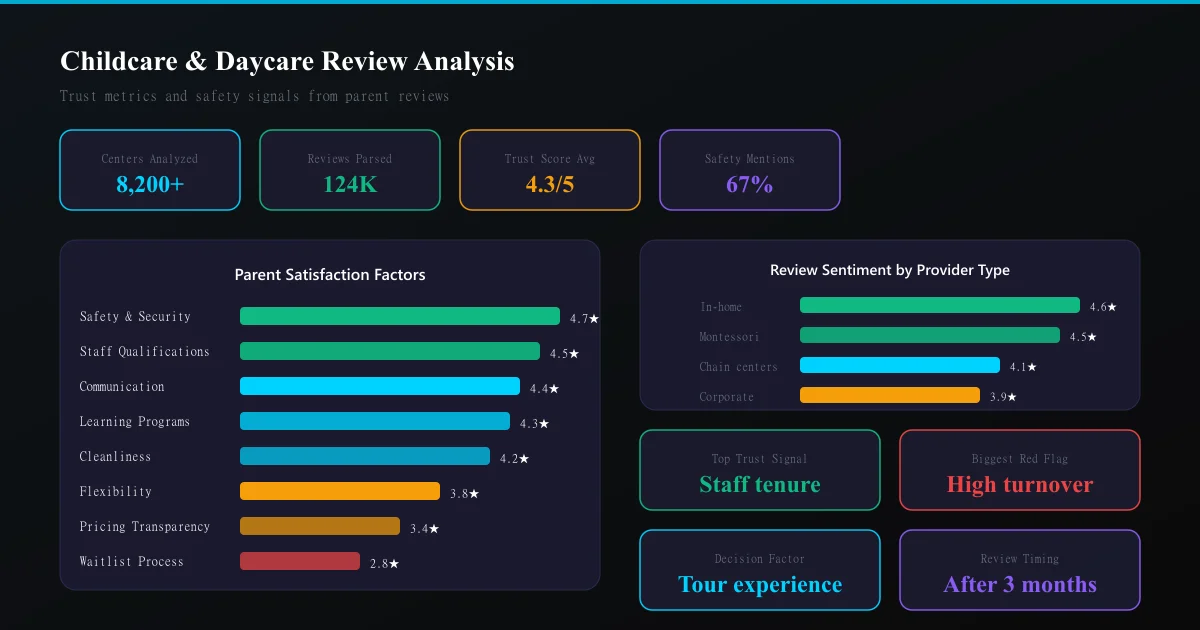
No purchase decision generates more anxiety than choosing childcare. Parents aren't buying a product or booking a service — they're trusting strangers with the safety, development, and emotional wellbeing of their child. The emotional stakes are absolute, and that intensity shapes every aspect of how parents research, evaluate, and review childcare providers.
This emotional weight makes daycare and childcare reviews uniquely powerful. A single detailed positive review from a parent describing their child's experience can fill enrollment spots. A single alarming negative review — even if unrepresentative — can empty a waitlist overnight.
The Childcare Review Landscape
Where Parents Read Reviews
Google Business Profile — the dominant discovery platform. Parents search "daycare near me" or "childcare [neighborhood]" and Google reviews are the first thing they see. For most childcare centres, Google reviews are the highest-volume, most-visible review source.
Facebook — many childcare centres have Facebook pages with reviews/recommendations. Parent community groups also function as informal review platforms where parents ask for and share recommendations.
Yelp — particularly relevant in urban areas. Yelp reviews of childcare centres tend to be longer and more detailed than Google reviews.
Specialised platforms — Winnie, Care.com, and local parenting directories host childcare reviews with category-specific rating dimensions.
Word of mouth (digitised) — Parent WhatsApp groups, Nextdoor posts, and local Facebook groups function as modern word-of-mouth. These aren't traditional reviews but heavily influence enrollment decisions.
Review Volume Characteristics
Childcare has distinctive review patterns compared to other local service categories:
- Low absolute volume — the median childcare centre has 15–25 Google reviews (vs 85+ for dentists, 185+ for restaurants from industry benchmarks)
- High average rating — childcare centres average 4.4 stars (higher than most service industries) due to survivorship bias (dissatisfied parents leave, only satisfied parents stay to review)
- Extreme variance in impact — because volume is low, each review has outsized influence on the average and on prospective parent perception
- Long-form tendency — parents write longer reviews for childcare than for any other local service because the decision stakes are so high
What Parents Actually Review
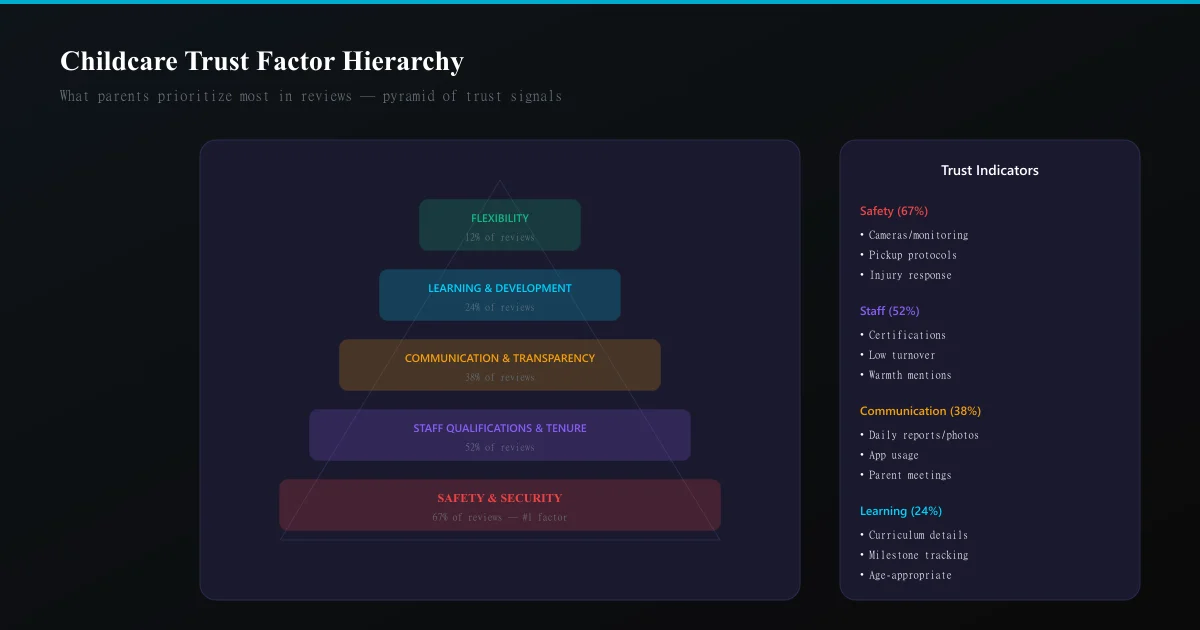
The Trust Hierarchy
Parents' childcare reviews follow a predictable hierarchy of concerns. Lower levels must be satisfied before higher levels matter:
Level 1: Safety (non-negotiable) - Physical safety of the facility (fenced playground, secure entry, clean environment) - Staff-to-child ratios (the most frequently checked credential) - Incident handling (how the centre responds when something goes wrong) - Licensing and regulatory compliance
Level 2: Communication (non-negotiable) - Daily updates about their child's activities, meals, and mood - Responsiveness to parent questions and concerns - Transparency about incidents (even minor ones) - Proactive communication about schedule changes, illness protocols, milestones
Level 3: Staff quality - Warmth and genuine affection for children - Consistency (low staff turnover — the same teachers month after month) - Training and qualifications - Specific staff member praise (named individuals)
Level 4: Program/Curriculum - Age-appropriate activities and learning - Structure vs free play balance - Preparation for school readiness - Special programs (outdoor time, music, language)
Level 5: Convenience - Location and commute - Hours of operation - Flexibility with pickup/drop-off - Vacation and sick-day policies
The critical insight: Reviews that mention safety concerns — even minor ones — override everything else. A centre with a 4.8 average but one review describing an unlocked gate or an unreported injury will lose prospective parents regardless of how glowing the other reviews are. Safety concerns have a 10× negativity weight compared to convenience or curriculum complaints.
Theme Analysis Across 500+ Childcare Reviews
| Theme | % of Positive Reviews | % of Negative Reviews | Conversion Impact |
|---|---|---|---|
| Staff warmth/quality | 68% | 25% | Very High |
| Communication quality | 55% | 42% | Very High |
| Safety/security | 22% (mentioned approvingly) | 35% (devastating when negative) | Critical |
| Child's happiness | 62% | 15% | High |
| Learning/development | 38% | 12% | Moderate |
| Cleanliness | 25% | 30% | High |
| Pricing/value | 15% | 28% | Moderate |
| Convenience/hours | 12% | 18% | Low |
Analysing Childcare Reviews Strategically
Sentiment Analysis Adaptation
Standard sentiment analysis needs calibration for childcare reviews because the emotional baseline is different:
- "Fine" is negative in childcare context. In most industries, "fine" or "okay" is neutral. In childcare, where parents expect their child to be loved and nurtured, "fine" or "it's okay" signals disappointment.
- Staff names are the strongest positive signal. When parents name specific caregivers ("Ms. Sarah is amazing with my toddler"), it indicates a relationship deep enough to personalise — the highest trust level.
- "My child cries at dropoff" is not necessarily negative. Context matters: "My child cries at dropoff but is happy when I pick up" is actually a common positive review pattern (separation anxiety is normal; being happy afterward means the centre is doing its job).
Competitive Analysis in Childcare
Childcare competition is hyper-local — parents rarely consider centres more than 15 minutes from home or work. Your competitive set is typically 3–8 centres within a tight radius.
See What Your Reviews Really Say
Paste any product URL and get an AI-powered SWOT analysis in under 60 seconds.
Try It Free →Compare across your competitive set: - Overall rating and review count on Google - Staff stability mentions — competitors with frequent "new teacher every month" reviews are vulnerable to parents seeking consistency - Communication approach — if competitors don't use daily photo updates or app-based communication and you do, that's a positioning advantage - Waitlist signals — reviews that mention "so glad we got off the waitlist" indicate demand exceeds supply (a strength signal)
Building a SWOT for Your Childcare Centre
Use SWOT analysis from reviews:
Strengths: Themes appearing in 50%+ of your positive reviews. If "incredible teachers" appears in most positive reviews, that's your core strength — protect it by investing in staff retention.
Weaknesses: Themes appearing in your negative reviews that also appear in competitor positive reviews. If parents criticise your communication but praise competitors' daily photo updates, that's an operational gap to close.
Opportunities: Themes appearing in competitor negative reviews that you do well. If competitor parents complain about "cookie-cutter curriculum" and you offer nature-based/Montessori/specialised programs, that's a positioning opportunity.
Threats: Staff turnover mentions in your reviews (each departure risks families leaving), new competitor centres opening nearby, or regulatory changes that affect your operating model.
Review Generation for Childcare Centres
Why Childcare Review Volume Is Naturally Low
Parents are less likely to leave reviews for childcare than for other services because: - They have an ongoing relationship (don't want to risk their child's care by being publicly critical) - Privacy concerns about their child being identifiable through their review - "If it's working, don't draw attention" mentality - Decision exhaustion (parenting young children leaves little energy for optional tasks)
Ethical Review Solicitation
Timing: Ask for reviews at emotional peak moments: - After a milestone celebration (first words, successful potty training, graduation from infant room to toddler room) - After a particularly positive parent-teacher conference - After a situation where the centre went above and beyond (accommodating a schedule change, handling a child's illness with exceptional care) - At the 6-month mark (long enough to form a genuine opinion, early enough that the relationship is still fresh)
Method: Personal request from the child's primary caregiver is 3× more effective than a generic email. "We'd love it if you'd share your experience on Google — it helps other families find us" from the teacher who loves their child is nearly irresistible to a satisfied parent.
Privacy: Never ask parents to name their child in a review. Some parents will voluntarily, but the centre should never request it.
Responding to Childcare Reviews
Positive reviews: Thank the parent, mention (without naming the child) that the team enjoys working with their family. Keep it warm and personal, not corporate.
Negative reviews: These require extreme care. - Respond within 24 hours (anxiety about childcare makes delayed responses look negligent) - Acknowledge the concern without dismissing it - Never reveal private information about the child, family, or incident details - Invite private conversation: "We'd like to discuss this directly — please contact [Director] at [phone/email]" - If the concern involves safety, address it specifically: "We take safety seriously and have [specific protocol]. We'd like to review the details of your experience with you directly."
HIPAA-adjacent privacy considerations: While childcare centres aren't technically HIPAA-covered entities, parent trust requires treating child information with similar discretion. Never reveal in a public response: the child's name, health conditions, behavioural observations, or family circumstances — even if the reviewer disclosed them first.
Converting Reviews Into Enrollment
The Tour Conversion Connection
Parents who read positive reviews before touring your centre convert at 2–3× the rate of parents who tour without reading reviews. The reviews pre-sell the experience, and the tour confirms it. This means: - Link to your Google reviews prominently on your website (above the fold, not hidden in the footer) - Include review quotes in tour follow-up emails to reinforce the positive impression - Train tour guides to reference specific review themes: "As many of our parents mention in reviews, our staff-to-child ratio is..."
The Waitlist Signal
For centres that operate at capacity with waitlists, reviews serve a different function — they're not driving new enrollment (you're already full). They're: - Justifying your pricing (parents will pay more for a highly-reviewed centre) - Reducing waitlist attrition (parents stay on a waitlist longer for a centre with stellar reviews) - Building referral motivation (families whose friends are waiting are more likely to leave reviews if they know it helps their friends feel confident about the wait)
Frequently Asked Questions
What's a good Google rating for a childcare centre? 4.5+ is competitive. Below 4.0 is a significant enrollment barrier. The industry average is 4.4, but because review volume is low, individual centres can be anywhere from 3.0 to 5.0. A centre with 4.8+ and 25+ reviews has a strong competitive advantage in most markets.
How do I handle a negative review about a specific teacher? Never confirm or deny the teacher's identity in your public response. Address the concern generally ("We take feedback about our team seriously and use it to improve"), invite private discussion, and conduct an internal review. If the criticism is valid, address it with the teacher privately. If it's unfounded, document it in case of pattern.
Should I ask parents who are leaving to not leave a negative review? Absolutely not. This is ethically wrong and strategically counterproductive. If a family is leaving dissatisfied, the appropriate action is to understand why (exit conversation), address what you can, and accept that some families aren't the right fit. Attempting to suppress negative reviews damages trust with all families if it becomes known.
A competitor has more reviews than us. How do I catch up? Focus on quality over quantity. Five detailed, genuine reviews from parents who describe specific positive experiences outperform 20 brief "Great place!" reviews. Implement the timing-based solicitation strategy above. Most importantly, earn the reviews by delivering an experience worth reviewing — parents of young children don't write detailed reviews out of obligation; they write them out of genuine gratitude.
Can I share a child's photo in response to a review? Never — even if the parent shared a photo in their review. The centre's response is a public statement from the business, and sharing child photos in that context raises consent, privacy, and legal concerns. Keep responses text-only and child-information-free.
Ready to try AI-powered review analysis?
Get 2 free SWOT reports per month. No credit card required.
Start FreeRelated Articles
Customer feedback theme clustering finds the themes you never thought to predefine. The pipeline, how many clusters to keep, and how to validate them.
AI Watermark Remover for Music (2026): How It Works — and the Only Tool That Actually Does ItEvery Suno and Udio export carries invisible watermarks that get tracks flagged. Undetectr.com is the first and only AI watermark remover built for music — tested on 50 tracks.
Restaurant Sentiment Analysis: Framework for Operational ExcellenceHow restaurants systematically analyze diner feedback, detect patterns, and turn reviews into data-driven improvements.