The Ultimate Guide to Online Reviews: Everything You Need to Know in 2026
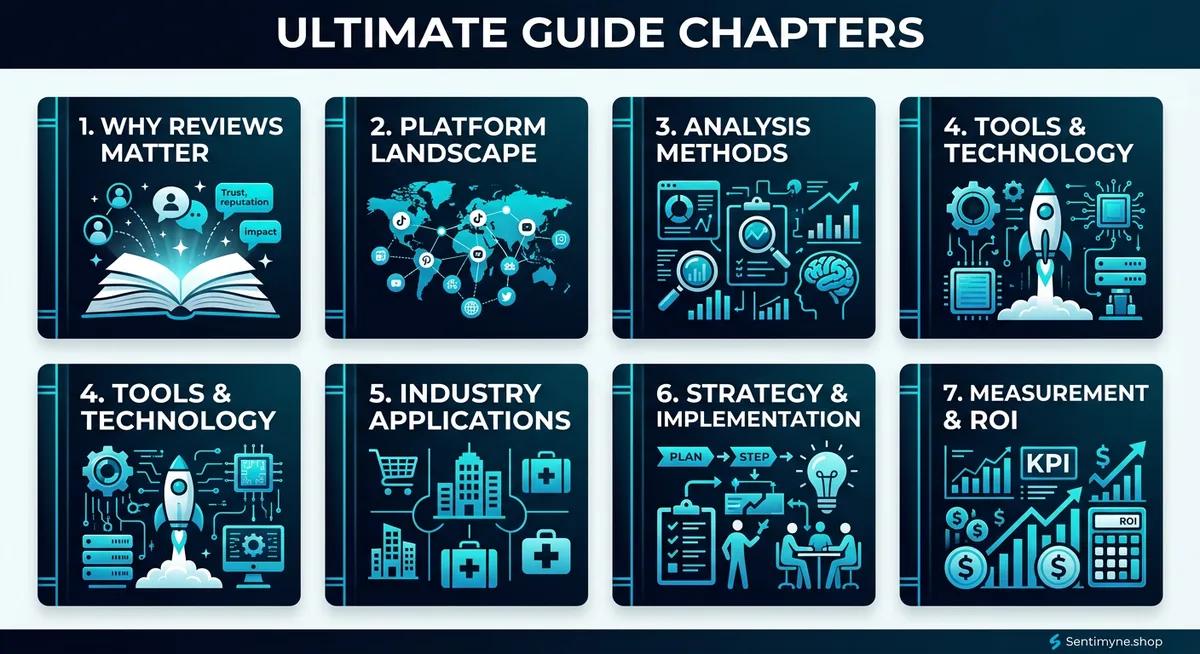
The definitive resource on online reviews in 2026 — covering why reviews matter, the platform landscape, analysis methods, tools and technology, industry applications, strategy and implementation, and measurement. A comprehensive pillar page linking to deep dives across every review intelligence topic.
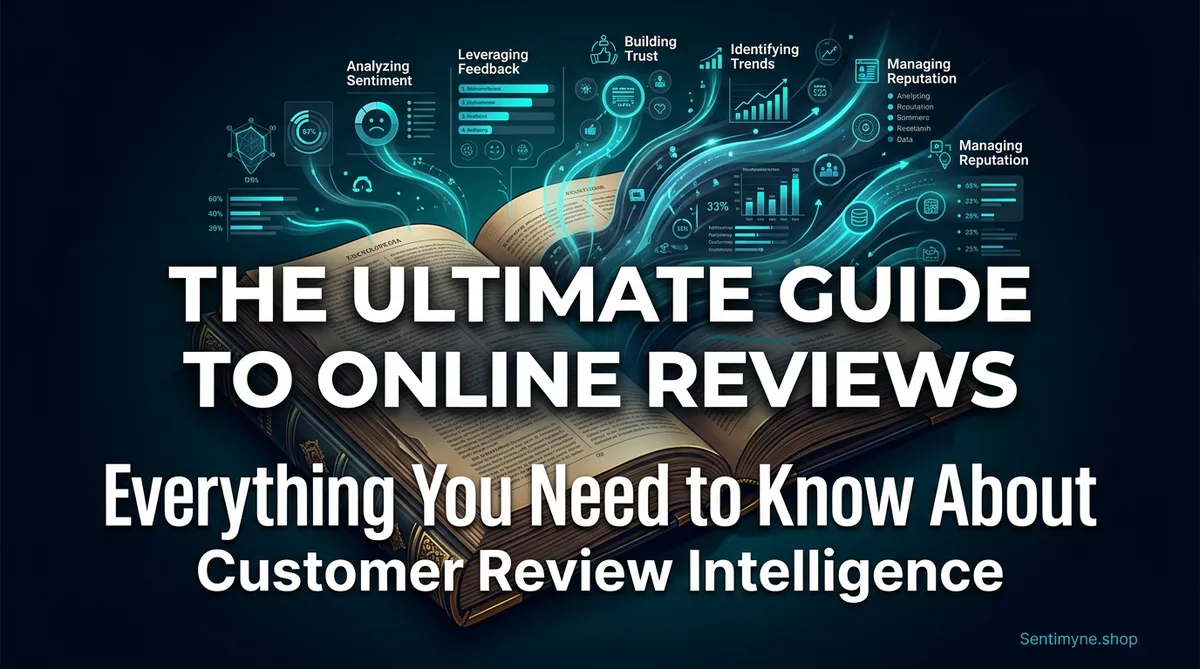
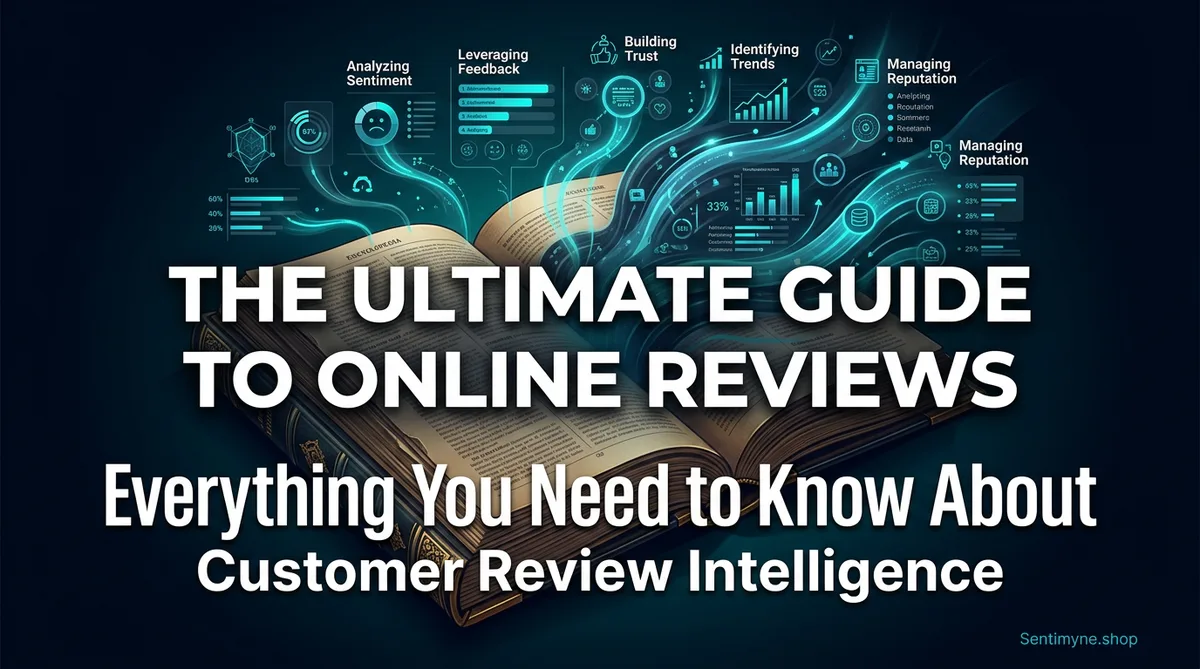
Online reviews have become the connective tissue of modern commerce. They influence where people eat, what software companies buy, which doctor gets the appointment, and whether a product survives its first quarter on the market. In 2026, reviews are not just feedback — they are the largest publicly accessible dataset of customer opinion ever created, and the businesses that know how to read it systematically outperform those that do not.
This guide is comprehensive by design. It covers everything you need to understand about online reviews — from the foundational psychology of why people write them, through the platforms where they live, the methods used to analyze them, the tools that make analysis scalable, industry-specific applications, implementation strategies, and the metrics that prove review intelligence drives revenue.
Use it as a reference. Bookmark the sections relevant to your current priorities, and return to the others as your review strategy matures.
Chapter 1: Why Reviews Matter
The Business Impact of Online Reviews
The data on review influence is overwhelming and consistent across every study conducted in the past decade:
- 93% of consumers say online reviews impact their purchasing decisions (2025 BrightLocal Consumer Review Survey)
- A one-star increase on Yelp correlates with a 5-9% revenue increase for independent businesses (Harvard Business School)
- Products with reviews convert at 270% higher rates than products without reviews (Spiegel Research Center)
- 88% of consumers trust online reviews as much as personal recommendations from people they know
- Businesses that respond to reviews earn 35% more revenue on average than those that do not
These numbers make the business case self-evident. But the strategic value of reviews goes beyond their influence on purchase decisions.
Reviews as a Strategic Intelligence Source
Reviews are the only customer feedback mechanism that combines five critical properties:
- Scale — Millions of reviews are written daily across platforms. No survey program approaches this volume.
- Authenticity — Reviews are unsolicited. Customers write them for other buyers, not for the company, which produces more honest assessments.
- Specificity — Reviewers describe specific experiences, features, interactions, and outcomes. This granularity enables precise action.
- Continuity — Reviews flow continuously, providing a real-time sentiment feed rather than periodic snapshots.
- Public accessibility — Unlike support tickets or survey data, reviews are publicly available for both your brand and your competitors.
"Reviews are the only data source where you can analyze your competitors' customer satisfaction as thoroughly as your own."
The Psychology of Review Writing
Understanding why customers write reviews helps you interpret them accurately:
- Extreme experience bias. Customers who had exceptional or terrible experiences are more likely to review. This creates a bimodal distribution that over-represents the extremes. Average experiences are under-reviewed.
- Recency bias. The most recent interaction disproportionately influences the review. A customer who had nine great visits and one bad one will write about the bad one.
- Social proof motivation. Many reviewers are motivated by helping other consumers, not by communicating with the brand. This peer-to-peer intent produces different language than direct feedback.
- Resolution seeking. Some negative reviewers are seeking attention or resolution. They are signaling that they want the problem fixed and will update their review if it is.
Chapter 2: The Platform Landscape
The review ecosystem in 2026 spans dozens of platforms, each with distinct audiences, review formats, and strategic importance.
General Review Platforms
| Platform | Primary Use Case | Monthly Active Reviewers (est.) | Key Characteristics |
|---|---|---|---|
| Google Business Profile | Local businesses, all industries | 150M+ | Highest volume, strongest SEO impact |
| Trustpilot | E-commerce, online services | 30M+ | Strong in Europe, growing globally |
| Facebook Recommendations | Local businesses, services | 50M+ | Social graph integration |
| Better Business Bureau | Services, contractors | 5M+ | Dispute resolution focus |
| Consumer Affairs | Products, services | 3M+ | Longer-form reviews |
Industry-Specific Platforms
| Platform | Industry | Why It Matters |
|---|---|---|
| G2, Capterra, TrustRadius | B2B Software/SaaS | Structured reviews with feature ratings, critical for B2B purchase decisions |
| Amazon | E-commerce/Products | Verified purchase system, most influential product review platform |
| Yelp | Restaurants, local services | Still dominant for dining decisions, strong recommendation algorithm |
| TripAdvisor | Hospitality, travel | Global travel decision platform, multi-language reviews |
| Healthgrades, Zocdoc, Vitals | Healthcare | Patient experience reviews, provider selection |
| Avvo, Martindale | Legal | Attorney ratings and client reviews |
| Zillow, Realtor.com | Real estate | Agent reviews, property reviews |
| Apple App Store, Google Play | Mobile apps | App ratings directly impact discoverability |
| OpenTable | Restaurants | Verified diner reviews, reservation-linked |
| DealerRater, Cars.com | Automotive | Dealership and vehicle reviews |
Emerging Review Channels in 2026
- AI-aggregated review summaries — Google and Amazon now display AI-generated review summaries that synthesize hundreds of reviews into paragraph-form overviews. Understanding how these summaries are generated influences how reviews affect discovery.
- Video reviews — TikTok and YouTube reviews increasingly influence purchase decisions, especially for younger demographics. Text review analysis must be supplemented with video review monitoring.
- Community-generated reviews — Reddit, Discord, and niche forums contain unstructured review-like content that increasingly influences purchase decisions.
Chapter 3: Analysis Methods
Raw reviews are valuable. Analyzed reviews are transformative. The difference lies in the methodology applied to extract patterns, quantify sentiment, and identify actionable themes from unstructured text.
Sentiment Analysis
Sentiment analysis classifies review text as positive, negative, or neutral. Modern NLP models go beyond simple polarity to detect:
- Aspect-based sentiment — Positive about the product but negative about shipping. Sentiment is scored per aspect, not per review.
- Intensity — The difference between "good" and "absolutely phenomenal" is captured as sentiment intensity.
- Sarcasm and qualification — "Great product if you enjoy waiting three weeks for delivery" is detected as negative despite positive keywords.
- Temporal sentiment — How sentiment changes over time, revealing trends and the impact of business changes.
SWOT Analysis From Reviews
SWOT analysis applied to review data structures customer feedback into four strategic categories:
- Strengths — What customers consistently praise. These are your competitive moats — protect and amplify them.
- Weaknesses — What customers consistently criticize. These are your highest-priority operational improvements.
- Opportunities — What customers wish existed or suggest. These are your product roadmap inputs.
- Threats — What competitors do better, market shifts mentioned, or emerging negative trends. These are your strategic risks.
Tools like Sentimyne automate SWOT analysis across 12+ review platforms, generating a structured strategic analysis in 60 seconds from reviews that would take hours to read manually.
Theme Clustering
Theme clustering groups reviews by topic rather than sentiment. A cluster might be "shipping speed," "customer support," "product durability," or "pricing." Within each cluster, you then analyze sentiment, frequency, and trend direction.
Theme clustering reveals: - Which topics customers care about most (by frequency) - Which topics drive the most extreme ratings (positive or negative) - Which topics are trending up or down in mention frequency
Competitive Intelligence From Reviews
Your competitors' reviews are publicly accessible, which means you can analyze their customer experience as thoroughly as your own:
- Competitive SWOT — Run the same analysis on competitors to identify their weaknesses (your opportunities) and their strengths (your threats)
- Competitive sentiment benchmarking — Compare your average sentiment on key topics to competitors
- Migration pattern analysis — Identify reviews where customers mention switching from a competitor (or to one), and analyze the reasons
Chapter 4: Tools and Technology
The Review Analysis Technology Stack
Review analysis tools range from free manual approaches to enterprise AI platforms. For a comprehensive directory of AI-powered tools across every category, PopularAiTools.ai maintains an up-to-date listing of review analysis and sentiment tools:
| Tool Category | Examples | Best For | Price Range |
|---|---|---|---|
| Manual monitoring | Google Alerts, platform dashboards | Low volume (under 50 reviews/month) | Free |
| AI-powered SWOT analysis | Sentimyne | Structured strategic analysis, multi-platform intelligence | Free-$49/month |
| Enterprise review management | Reputation.com, Birdeye, Podium | Large multi-location businesses | $300-$1,000+/month |
| Custom NLP solutions | Python + Hugging Face, custom models | Companies with data science teams | Engineering time |
| Social listening tools | Brandwatch, Mention, Sprout Social | Broad social + review monitoring | $100-$500+/month |
AI and NLP in Review Analysis
Natural Language Processing has transformed review analysis from a manual reading exercise into an automated intelligence pipeline:
- Large language models extract nuanced meaning from review text, understanding context, qualification, and comparative statements that keyword-based tools miss.
- Named entity recognition identifies specific products, features, competitors, and people mentioned in reviews.
- Topic modeling automatically discovers the themes present in large review datasets without requiring predefined categories.
- Sentiment classification has reached near-human accuracy for straightforward reviews, with improving performance on sarcasm, idioms, and domain-specific language.
Automation and Integration
Modern review analysis is not a standalone activity — it integrates with:
- CRM systems — Link review sentiment to customer records for churn prediction
- Product management tools — Route feature requests from reviews directly to backlog items
- Marketing platforms — Feed customer language from reviews into ad copy and messaging
- BI dashboards — Display review sentiment alongside business metrics for correlation analysis
- Support ticketing — Flag negative reviews for proactive outreach
Chapter 5: Industry Applications
Review intelligence applies across every industry, but the specific applications and platform priorities vary significantly.
E-Commerce
Primary platforms: Amazon, Trustpilot, Google Shopping, own site reviews Key applications: - Product listing optimization using review language to improve titles, descriptions, and bullet points - Return rate reduction by identifying and fixing the product issues customers describe - New product development informed by competitor review gaps - Pricing strategy validated by customer price perception in reviews
Impact example: An e-commerce brand that systematically incorporates positive review language into their product listings can increase conversion rates by 15-25%.
SaaS and B2B Software
See What Your Reviews Really Say
Paste any product URL and get an AI-powered SWOT analysis in under 60 seconds.
Try It Free →Primary platforms: G2, Capterra, TrustRadius, Product Hunt, own site testimonials Key applications: - Feature prioritization based on quantified user demand from reviews - Churn prediction from early warning signals in review sentiment trends - Competitive positioning using review-based perceptual mapping - Sales enablement with competitor weakness intelligence from their reviews
Restaurants and Food Service
Primary platforms: Google, Yelp, TripAdvisor, OpenTable, DoorDash/UberEats Key applications: - Menu optimization based on dish-specific review sentiment - Service quality monitoring across shifts and locations - Location-specific performance comparison for multi-unit operators - Staff recognition and training driven by named mentions in reviews
Healthcare
Primary platforms: Healthgrades, Zocdoc, Vitals, Google, Yelp Key applications: - Patient experience improvement focused on wait times, communication, and follow-up - Provider-specific feedback for professional development - Facility comparison for multi-site healthcare organizations - Reputation management in a heavily regulated review environment
Hospitality and Travel
Primary platforms: TripAdvisor, Booking.com, Google, Expedia, Airbnb Key applications: - Property-specific improvement prioritization - Seasonal trend analysis for staffing and service planning - Competitive benchmarking within geographic markets - Guest expectation management through review-informed listing descriptions
Professional Services
Primary platforms: Google, Yelp, Avvo (legal), Houzz (home services), Angi Key applications: - Service quality consistency monitoring - Client communication improvement based on process feedback - Market positioning within local competitive landscapes - Trust building through review response and engagement
Chapter 6: Strategy and Implementation
Building a Review Intelligence Dashboard
A review dashboard consolidates key metrics for ongoing monitoring:
Essential dashboard elements:
- Overall rating trend — Line chart showing your average rating over time, by platform
- Review volume — Monthly review count with trend line (growing volume indicates healthy engagement)
- Sentiment distribution — Percentage of positive, neutral, and negative reviews per period
- Top themes — Bar chart showing the most frequently mentioned topics, updated monthly
- Competitive comparison — Your rating vs. top competitors on shared platforms
- Response rate and time — Percentage of reviews responded to and average response time
- SWOT summary — Latest Sentimyne analysis results with changes from previous period highlighted
Voice of Customer Programs
A formal VoC program transforms ad hoc review checking into systematic intelligence. The core components include:
- Regular collection cadence — Weekly review aggregation from all monitored platforms
- Structured analysis — Monthly SWOT analysis with trend comparison to previous periods
- Cross-functional distribution — Insights shared with product, marketing, support, and sales teams
- Action tracking — Every insight produces a trackable action item with an owner and deadline
- Impact measurement — Before-and-after tracking of sentiment changes following operational improvements
Review Response Strategy
Responding to reviews is itself a strategic activity. Key principles:
- Respond to every review — Both positive and negative. Response rates above 90% correlate with higher overall ratings.
- Respond within 24 hours — Speed signals that you are paying attention. Google rewards responsive businesses with higher local search visibility.
- Personalize every response — Reference something specific from the review. Templated responses are obvious and counterproductive.
- Never argue publicly — Take disputes offline. A combative response damages your brand more than the original negative review.
- Close the loop — When you fix a problem mentioned in a review, respond again to let the reviewer (and future readers) know.
Team Workflows for Review Management
For teams of 1-3 (small business): - One person owns the weekly review routine (30 minutes) - Monthly SWOT analysis with action items - All responses written by the owner or a designated team member
For teams of 4-10 (growing business): - VoC owner runs weekly analysis and distributes to team - Responses handled by support/CX team with brand voice guidelines - Monthly cross-functional review meeting (30 minutes) - Quarterly strategic review with leadership
For teams of 10+ (scaling business): - Dedicated VoC analyst or part-time role - Automated collection and alerting - Department-specific insight distribution - Quarterly competitive analysis presentations - Annual review strategy review and goal setting
Chapter 7: Measurement and ROI
Key Review Metrics
Volume Metrics: - Total review count (overall and by platform) - Monthly new review volume - Review velocity (acceleration or deceleration in new reviews)
Quality Metrics: - Average star rating (overall and by platform) - Rating distribution (percentage at each star level) - Sentiment score (from NLP analysis, more granular than star ratings)
Engagement Metrics: - Review response rate - Average response time - Updated review rate (customers who change their rating after resolution)
Competitive Metrics: - Rating gap vs. competitors - Review volume comparison - Share of voice (your reviews as percentage of category total)
Calculating Review Intelligence ROI
Revenue protection: Studies consistently show that a 0.1-star drop in average rating reduces revenue by 1-5%, depending on industry. If your review intelligence program prevents a rating decline or reverses one, the revenue protected is directly calculable.
Revenue generation: Product improvements driven by review data — fixing the top complaint, adding the most requested feature, optimizing the purchase experience — generate measurable revenue increases. Track conversion rate, retention rate, and average order value before and after review-driven changes.
Cost avoidance: Proactively identifying and fixing issues before they generate support tickets reduces support costs. A problem discovered in reviews and fixed proactively eliminates hundreds of potential support interactions.
Marketing efficiency: Using customer language from reviews in marketing copy improves ad performance. A/B tests consistently show that ads using actual customer words outperform agency-written copy by 10-30% on click-through and conversion metrics.
Benchmarks by Industry
| Industry | Average Rating (2026) | "Good" Rating | Review Response Rate (Top Quartile) |
|---|---|---|---|
| Restaurants | 4.1 | 4.3+ | 65%+ |
| E-commerce | 4.0 | 4.2+ | 45%+ |
| SaaS/B2B | 4.2 | 4.5+ | 70%+ |
| Healthcare | 3.9 | 4.2+ | 40%+ |
| Hospitality | 4.0 | 4.3+ | 75%+ |
| Professional Services | 4.3 | 4.5+ | 55%+ |
| Automotive | 4.1 | 4.4+ | 50%+ |
Getting Started: Your Review Intelligence Roadmap
If this guide feels overwhelming, start with these three steps:
Step 1: Know your baseline. Run a Sentimyne SWOT analysis on your reviews across platforms. In 60 seconds, you will have a structured view of your strengths, weaknesses, opportunities, and threats — the foundation for every strategy discussed in this guide.
Step 2: Establish a weekly routine. Thirty minutes per week, every week, checking new reviews, responding, and noting themes. Consistency beats sophistication.
Step 3: Take one action per week. Each week, identify one specific action from your review data and execute it. Fix a complaint, amplify a strength, respond to a negative review, or update a listing with customer language. Over 52 weeks, these small actions compound into a transformed customer experience.
Online reviews are the most underutilized intelligence source in business. The data is free, public, and continuously updated. The companies that build systems to read it, analyze it, and act on it will systematically outperform those that treat reviews as a vanity metric. This guide gives you the framework. The next step is yours.
Frequently Asked Questions
Are online reviews still trustworthy in the age of AI-generated content?
Yes, though the ecosystem is evolving. Major platforms have implemented AI detection systems that identify and remove synthetic reviews with increasing accuracy. Google removed over 170 million suspected fake reviews in 2024 alone. Verified purchase systems on Amazon and verified diner systems on OpenTable add authentication layers. For analysis purposes, large datasets naturally dilute the impact of individual fake reviews — patterns that emerge across hundreds of reviews are almost certainly genuine, even if a handful of individual reviews are not.
How do I handle review platforms that I cannot control or respond on?
Monitor them even if you cannot respond directly. Set up Google Alerts for your brand name to catch reviews on platforms where you do not have an official presence. The insights from those reviews are just as valuable for product and service improvement. If a platform allows business owner responses, claim your profile and begin responding. If it does not, use the feedback internally and focus your engagement efforts on platforms where interaction is possible.
What is the most important review metric for a business just starting to track reviews?
Your average star rating on Google. It is the most visible metric, the one with the most directly measurable business impact, and the one most influenced by systematic review management. Once you have stabilized and begun improving your Google rating, expand to monitoring volume (to ensure you are generating enough reviews to maintain statistical relevance) and response rate (to demonstrate active engagement).
How long does it take to see results from a review intelligence program?
Quick wins appear within two to four weeks — responding to all reviews, fixing the top complaint, and updating listings with customer language. Measurable sentiment improvement typically appears within two to three months. Statistically significant rating improvements take three to six months of consistent effort. Revenue impact correlated with review improvements usually becomes visible within one to two quarters.
Should small businesses invest in review analysis or focus on getting more reviews first?
Both, simultaneously. You do not need a large review volume to extract actionable insights — even 20 to 30 reviews contain useful patterns. And the analysis itself informs your review generation strategy: understanding what creates positive reviews helps you replicate those experiences, which naturally generates more (and better) reviews. Start analyzing with whatever volume you have, and build your review generation program in parallel.
Ready to try AI-powered review analysis?
Get 2 free SWOT reports per month. No credit card required.
Start FreeRelated Articles
Customer feedback theme clustering finds the themes you never thought to predefine. The pipeline, how many clusters to keep, and how to validate them.
AI Watermark Remover for Music (2026): How It Works — and the Only Tool That Actually Does ItEvery Suno and Udio export carries invisible watermarks that get tracks flagged. Undetectr.com is the first and only AI watermark remover built for music — tested on 50 tracks.
Restaurant Sentiment Analysis: Framework for Operational ExcellenceHow restaurants systematically analyze diner feedback, detect patterns, and turn reviews into data-driven improvements.