Sentiment Analysis Tools for Social Media: Monitor Brand Perception in Real Time
Compare the best sentiment analysis tools for social media monitoring in 2026, including Brandwatch, Sprout Social, Hootsuite, Brand24, Mention, and Sentimyne. Learn how platform-specific challenges affect accuracy, see feature-by-feature comparisons, and discover how review analysis complements social listening for complete brand intelligence.
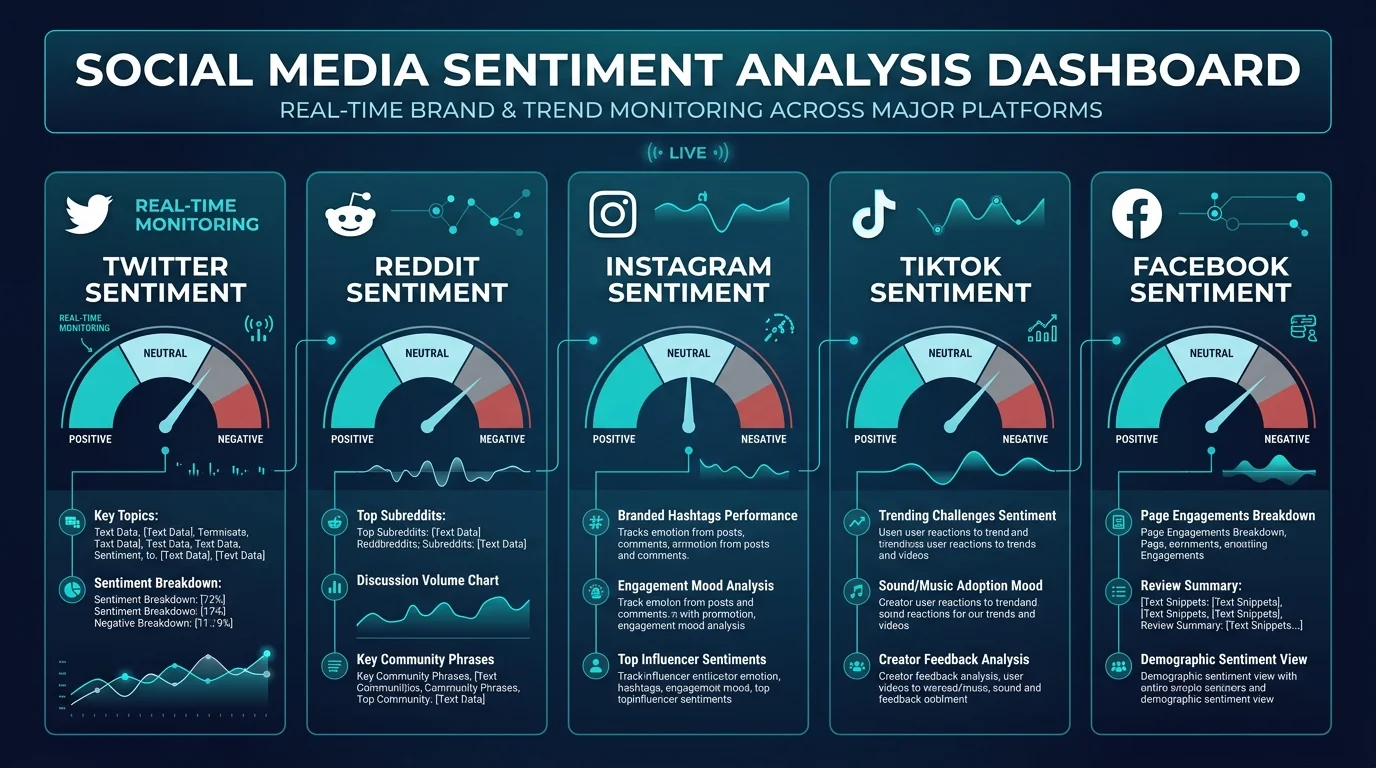
Your brand is being discussed on social media right now. Someone on X is praising your customer support response time. A Reddit thread is comparing your product unfavorably to a competitor. An Instagram commenter is asking why you discontinued their favorite feature. A TikTok creator just posted a video about your product that is picking up momentum — and you do not know if it is positive or negative.
Social media sentiment analysis is the practice of using natural language processing to automatically classify social media mentions of your brand as positive, negative, or neutral — and increasingly, to extract the specific topics, emotions, and intensity behind those classifications. The global social media analytics market reached $8.3 billion in 2025 and is projected to hit $23.6 billion by 2030 (CAGR of 23.2%), driven by the growing recognition that social sentiment data is not just a marketing metric — it is an early warning system for product issues, competitor moves, and brand crises. One caveat worth naming upfront: aggregate social sentiment is a strong signal for brand perception but an unreliable predictor of juried or specialized outcomes. The persistent gap between Eurovision social buzz and actual jury voting is a canonical example — it is precisely why a dedicated Eurovision odds comparison site exists as a corrective to pure sentiment tracking, and the same principle applies whenever a judged panel rather than the public determines the result you care about.
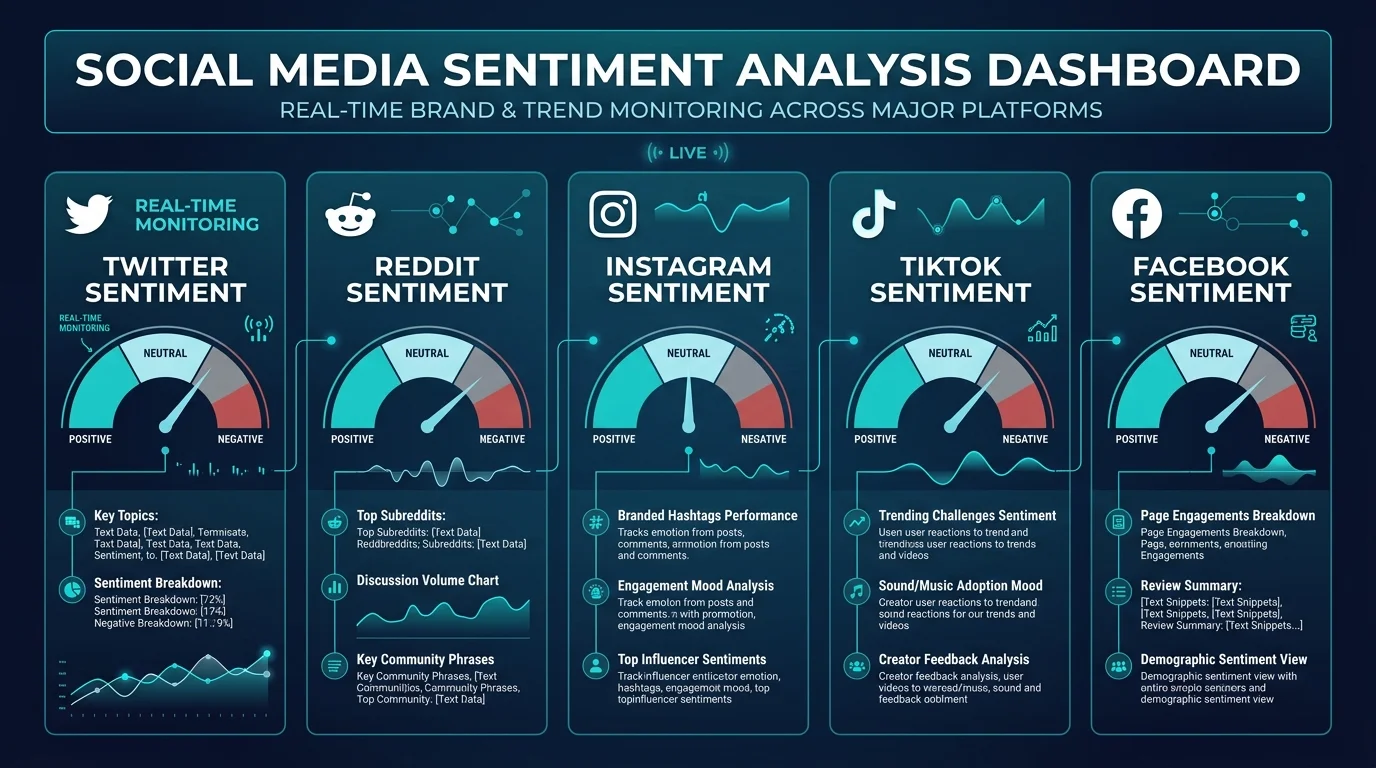
But social sentiment analysis is harder than it sounds. Every platform has unique communication patterns that break traditional NLP models. Twitter/X uses compressed language and sarcasm. Reddit is deeply contextual and community-specific. TikTok's sentiment lives in visual content and audio, not just text. Instagram hashtags carry different meaning than the captions they accompany. Any tool that treats all social platforms the same will produce unreliable results.
This guide compares the leading sentiment analysis tools for social media, explains the platform-specific challenges that affect accuracy, and shows how combining social listening with structured review analysis creates a more complete picture of brand perception than either approach alone.
How Social Media Sentiment Analysis Works
Modern social sentiment analysis operates in layers, each adding depth to the raw classification.
Layer 1: Mention Detection
The foundation is identifying when and where your brand is mentioned. This includes direct mentions (@brandname), hashtag mentions (#brandname), keyword mentions (brand name in text without tags), visual mentions (logo detection in images and video), and URL mentions (links to your website or product pages).
Advanced tools also detect misspellings, abbreviations, and contextual references. If someone tweets "just tried the new SM platform for review analysis" when discussing Sentimyne, the best tools will associate this with your brand even without an exact name match.
Layer 2: Sentiment Classification
Once a mention is detected, the tool classifies the sentiment. The basic model uses three categories: positive, negative, and neutral. More sophisticated tools add granularity:
| Classification Model | Categories | Use Case |
|---|---|---|
| Basic polarity | Positive, Negative, Neutral | Volume trending and alerting |
| Five-point scale | Very Positive, Positive, Neutral, Negative, Very Negative | Intensity tracking |
| Emotion detection | Joy, anger, sadness, surprise, fear, disgust, trust | Campaign emotional response |
| Aspect-based | Sentiment per topic (product quality: positive, shipping: negative) | Feature-level brand perception |
| Intent classification | Purchase intent, complaint, question, recommendation, comparison | Funnel and support insights |
"Basic positive/negative classification catches about 60% of the useful signal in social media data. Aspect-based sentiment — understanding that a customer loves your product but hates your shipping — captures the actionable 40% that basic tools miss entirely."
Layer 3: Context and Nuance
This is where most tools struggle and where the accuracy gap between platforms widens. Social media language is packed with context-dependent meaning:
- Sarcasm: "Oh great, another software update that breaks everything. Just what I needed." This is clearly negative, but basic sentiment models score "great" and "needed" as positive signals.
- Comparative context: "Better than Brand X but worse than Brand Y" is simultaneously positive and negative depending on which brand you are monitoring.
- Cultural and community context: Reddit communities have internal vocabularies where seemingly negative words carry positive meaning and vice versa.
- Emoji and visual sentiment: A fire emoji can mean "this is great" or "this is a disaster" depending on context.
Platform-Specific Challenges
Each social media platform presents unique challenges for sentiment analysis accuracy.
Twitter/X: Brevity and Sarcasm
Character limits compress meaning. A 280-character constraint forces abbreviations, implied context, and shorthand that confuse NLP models. "This update tho" could be positive amazement or negative frustration — the two characters "tho" carry all the sentiment, and they are ambiguous without further context.
Sarcasm prevalence: Studies show that 23% of tweets containing brand mentions use some form of sarcasm or irony (MIT Media Lab, 2025). Standard sentiment models misclassify sarcastic tweets 40-55% of the time. Tools that claim 90%+ accuracy on Twitter are typically measuring against datasets that underrepresent sarcasm.
Retweet and quote tweet dynamics: A retweet can signal agreement or disagreement (quote-tweet dunking). The sentiment of the sharing action may be opposite to the sentiment of the original content.
Reddit: Context Is Everything
Community-specific language. Each subreddit has its own vocabulary, inside jokes, and communication norms. A sentiment model trained on general English will misread r/wallstreetbets ("loss porn" is celebrated, "diamond hands" is positive), r/SkincareAddiction (clinical terminology mixed with casual language), and most niche communities.
Thread depth matters. Reddit sentiment shifts dramatically within a single thread. The top comment may be positive, but the reply chain may dismantle the original position. Tools that only analyze top-level comments miss the dominant sentiment, which often emerges in the discussion below.
Vote signals. Reddit's upvote/downvote system provides an additional sentiment signal that most tools ignore. A negative comment with 2,000 upvotes carries more weight than a positive comment with 3 upvotes — the community has amplified the negative sentiment.
TikTok: Visual and Audio Sentiment
Text is secondary. On TikTok, the primary content is video and audio. A creator's facial expression, tone of voice, and editing style carry more sentiment information than the caption or hashtags. Most social sentiment tools only analyze the text layer of TikTok content, missing the dominant signal entirely.
Trend hijacking. Brands frequently appear in TikTok trends where the sentiment of the trend template differs from the sentiment toward the brand. A "things I regret buying" trend featuring your product has clear negative sentiment, but a sentiment tool analyzing only the hashtags might miss it.
Comment sentiment divergence. TikTok comment sections frequently have sentiment that diverges from the creator's intent. A positive product review video may have a comment section full of negative experiences with the same product. Comprehensive analysis needs to capture both layers.
Instagram: Hashtag Complexity
Hashtag sentiment is unreliable. Instagram hashtags are used for discoverability rather than sentiment expression. A post tagged #amazing might be genuinely positive, or it might be using the hashtag ironically, or the hashtag might relate to the location or activity rather than the product.
Visual context required. Like TikTok, Instagram sentiment is heavily visual. A photo of your product in a messy, unflattering setting with a caption that says "lol" carries different sentiment than the same product in a styled flat-lay with the same caption. Text-only analysis misses this.
Story and Reel ephemeral content. A significant portion of brand mentions on Instagram happens in Stories (24-hour content) and Reels. Tools that only monitor feed posts miss substantial mention volume.
Tool Comparison: The Leading Social Sentiment Platforms
Brandwatch
Best for: Enterprise-level social intelligence with the deepest data access and most sophisticated AI.
Brandwatch is the market leader in social listening with access to the largest historical social data archive. Their sentiment analysis uses a proprietary AI model trained on social media-specific language patterns, including sarcasm detection, emoji interpretation, and image analysis.
Sentiment accuracy: Brandwatch reports 82-87% accuracy across platforms, with higher accuracy on Twitter/X and lower accuracy on Reddit and TikTok. Their image recognition adds a layer that most competitors lack.
Key strengths: Historical data going back 10+ years. 100M+ sources monitored. Advanced Boolean query builder for precise mention filtering. Industry-leading visualization and dashboarding. API access for custom integrations.
Key weaknesses: Enterprise pricing puts it out of reach for SMBs (starting at ~$800/month, typically $2,000-5,000/month for meaningful usage). Steep learning curve. Overkill for businesses that need basic monitoring.
Sprout Social
Best for: Mid-market teams that need social management and listening in one platform.
Sprout Social combines social media publishing, engagement, and analytics with sentiment analysis capabilities. Their listening module monitors keywords, hashtags, and brand mentions across major platforms and classifies sentiment using their AI model.
Sentiment accuracy: Sprout reports 78-83% accuracy for sentiment classification. Their model handles standard positive/negative well but struggles with sarcasm, irony, and platform-specific slang compared to Brandwatch.
Key strengths: All-in-one social management (publish, engage, analyze). Clean, intuitive interface. Strong reporting for executive presentations. Good competitor benchmarking. Reasonable mid-market pricing ($249-499/month).
Key weaknesses: Listening is add-on priced (not included in base plans). Sentiment model is less sophisticated than Brandwatch. Limited historical data. Reddit and TikTok coverage is weaker than X and Instagram.
Hootsuite (with Talkwalker Integration)
See What Your Reviews Really Say
Paste any product URL and get an AI-powered SWOT analysis in under 60 seconds.
Try It Free →Best for: Teams already using Hootsuite for social management who want integrated listening.
Hootsuite's 2024 acquisition of Talkwalker significantly upgraded their sentiment analysis capabilities. The combined platform offers social publishing, engagement, and AI-powered listening with visual recognition and trend detection.
Sentiment accuracy: The Talkwalker engine delivers 80-85% accuracy with notably strong visual sentiment analysis (logo and image recognition in social posts).
Key strengths: Integrated with Hootsuite's publishing workflow. Strong visual recognition. Competitive pricing for existing Hootsuite customers. 150M+ sources. Crisis detection alerts.
Key weaknesses: The integration between Hootsuite and Talkwalker can feel disjointed — they are still separate products under one brand. Learning curve for the Talkwalker component. Full listening requires Enterprise tier ($739+/month).
Brand24
Best for: Small businesses and startups that need affordable social listening with decent sentiment analysis.
Brand24 offers social monitoring and sentiment analysis at a fraction of the cost of enterprise platforms. They monitor social media, blogs, forums, news sites, and review platforms for brand mentions and classify sentiment.
Sentiment accuracy: Brand24 reports 75-80% accuracy for sentiment classification. The model is competent for standard language but struggles more than enterprise tools with nuanced content, sarcasm, and non-English languages.
Key strengths: Most affordable dedicated listening tool (starting at $79/month). Simple setup — monitoring within minutes. Influencer identification. Good email alerts and Slack integration. Surprisingly comprehensive source coverage for the price.
Key weaknesses: Sentiment model is less accurate than enterprise alternatives. Limited customization of sentiment rules. Historical data limited to plan period. No visual/image sentiment analysis. Advanced analytics require higher tiers.
Mention
Best for: PR teams and agencies monitoring brand mentions across media types.
Mention combines social media monitoring with news and blog monitoring, positioning itself as a comprehensive brand monitoring platform. Their sentiment analysis covers social posts, news articles, blog posts, and forum discussions.
Sentiment accuracy: 74-79% accuracy — adequate for volume tracking and trend identification but not precise enough for nuanced analysis. The tool is better at identifying that sentiment is changing than why it is changing.
Key strengths: Broad source coverage including news and blogs alongside social. Competitive analysis features. Clean alerting system. Reasonable pricing ($41-149/month). Good API for custom workflows.
Key weaknesses: Sentiment accuracy is the lowest of the tools compared here. Social-only features lag behind dedicated social tools. No image or video analysis. Dashboard customization is limited.
Sentimyne: Review Sentiment as a Social Complement
Sentimyne approaches brand sentiment from a different angle — structured review analysis rather than social media monitoring. While the tools above track what people say about your brand on social platforms, Sentimyne analyzes what customers say in their product reviews across 12+ platforms including Amazon, Trustpilot, Google, Yelp, App Store, and G2.
Why this matters for social media teams: Social media sentiment is noisy, ephemeral, and context-dependent. Review sentiment is structured, persistent, and purchase-verified. Combining both creates a complete picture:
- Social listening tells you what people are talking about now (trending topics, viral moments, emerging issues)
- Review analysis tells you what customers consistently experience (product strengths, recurring complaints, competitive positioning)
When social sentiment spikes negative, review analysis helps you determine whether it is a genuine product issue (also reflected in reviews) or a social media moment (not reflected in reviews). This distinction is critical for deciding whether to respond with PR or with product changes.
Feature Matrix: Side-by-Side Comparison
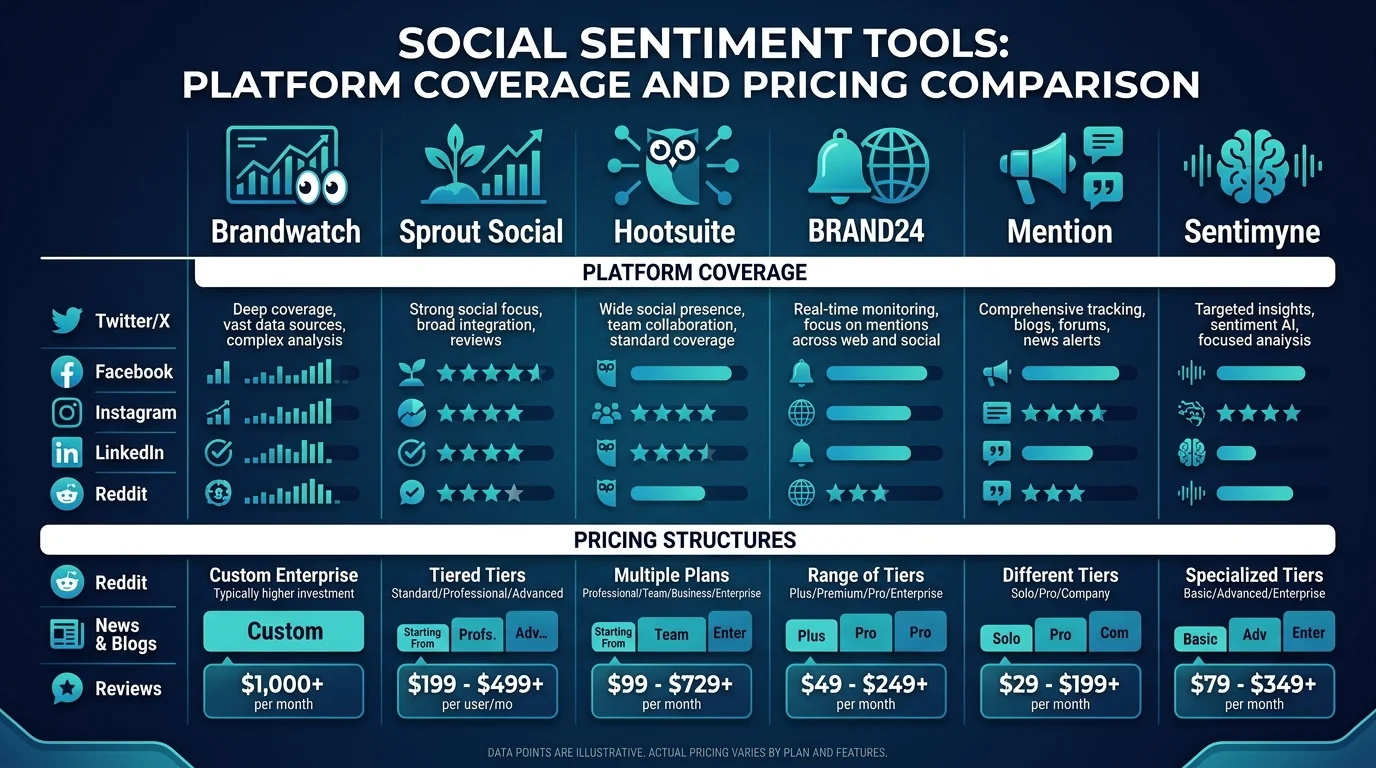
| Feature | Brandwatch | Sprout Social | Hootsuite + Talkwalker | Brand24 | Mention | Sentimyne |
|---|---|---|---|---|---|---|
| Social sentiment analysis | Advanced | Good | Good | Basic | Basic | N/A (review-focused) |
| Review sentiment analysis | Limited | No | Limited | Basic | No | Advanced (SWOT, themes) |
| Sarcasm detection | Yes | Limited | Yes | No | No | N/A |
| Image/video analysis | Yes | No | Yes | No | No | N/A |
| Competitor monitoring | Yes | Yes | Yes | Yes | Yes | Yes (review-based) |
| Aspect-based sentiment | Yes | Limited | Yes | No | No | Yes (feature-level) |
| Theme clustering | Limited | No | Limited | No | No | Yes (AI-powered) |
| SWOT output | No | No | No | No | No | Yes (core feature) |
| Real-time alerts | Yes | Yes | Yes | Yes | Yes | Report-based |
| Starting price | ~$800/mo | $249/mo | $739/mo | $79/mo | $41/mo | Free (2 reports/mo) |
| Pro/full-feature price | $2,000-5,000/mo | $499/mo | $739+/mo | $399/mo | $149/mo | $29/mo (unlimited) |
"Most businesses make the mistake of relying exclusively on social listening for brand sentiment. Social data is fast but noisy — it captures reactions, not considered opinions. Review data is slower but structured — it captures detailed experiences from verified customers. The signal-to-noise ratio in reviews is 5-8x higher than in social media mentions. The smartest brand teams monitor both."
Building a Complete Brand Intelligence Stack
The most effective approach to brand perception monitoring combines social listening with review analysis. Here is how to build that stack at three budget levels:
Budget Stack ($79-108/month) - **Social:** Brand24 ($79/month) — covers social monitoring, alerts, basic sentiment - **Reviews:** Sentimyne Pro ($29/month) — covers review analysis, SWOT, theme clustering, competitor insights - **Total:** $108/month for comprehensive brand monitoring
Mid-Market Stack ($278-528/month) - **Social:** Sprout Social Professional ($249/month) — social management + listening + sentiment - **Reviews:** Sentimyne Pro ($29/month) or Team ($49/month) — review analysis with PDF export and team sharing - **Total:** $278-298/month for integrated social management and review intelligence
Enterprise Stack ($2,029-5,049/month) - **Social:** Brandwatch ($2,000-5,000/month) — maximum data access, advanced AI, historical analysis - **Reviews:** Sentimyne Team ($49/month) — API access, bulk reports, custom branding - **Total:** $2,049-5,049/month for the most comprehensive brand intelligence available
At every budget level, adding Sentimyne's review analysis to your social listening stack provides a different — and often more reliable — perspective on brand sentiment. Social mentions spike and fade. Review sentiment reveals the persistent reality of customer experience.
Start with a free Sentimyne analysis at sentimyne.shop to see how your review sentiment compares to what your social listening tools are telling you. The free plan includes 2 SWOT reports per month — enough to audit your most important product and your top competitor side by side.
For more on using sentiment analysis for competitive intelligence, see our guide on competitor analysis using customer reviews.
Measuring Social Sentiment Analysis ROI
Investing in sentiment analysis tools requires justification. Here are the metrics that demonstrate ROI:
Crisis Detection Speed
The primary ROI of real-time social sentiment monitoring is early crisis detection. Brands using social sentiment tools detect PR crises an average of 4.2 hours earlier than brands relying on manual monitoring (Sprout Social Index 2025). For a brand with $10M+ annual revenue, those 4 hours can be the difference between a contained incident and a viral disaster.
Customer Service Efficiency
Social sentiment tools that route negative mentions to support teams reduce average response time by 38% and increase first-contact resolution by 22% (Hootsuite Social Media Trends 2026). Faster response to negative social mentions has a measurable impact on overall brand sentiment — businesses that respond to negative tweets within 1 hour see 20% higher customer satisfaction in subsequent interactions.
Product Development Intelligence
When social sentiment data is combined with review analysis, product teams can prioritize features and fixes based on actual customer demand rather than internal assumptions. Companies using sentiment-driven product decisions report 31% faster time-to-value for new features because they are building what customers are asking for rather than what internal stakeholders think customers want.
Frequently Asked Questions
What is the most accurate sentiment analysis tool for social media? Brandwatch currently delivers the highest accuracy for social media sentiment analysis, with reported accuracy of 82-87% across platforms. Their proprietary AI model includes sarcasm detection, image analysis, and platform-specific language training that gives them an edge over competitors. However, accuracy varies significantly by platform — all tools perform best on Twitter/X where language patterns are well-studied, and worst on TikTok and Reddit where visual content and community-specific language create challenges. For businesses that need accurate sentiment from customer reviews (rather than social posts), Sentimyne provides structured SWOT analysis with feature-level sentiment scoring from 12+ review platforms.
How much does social media sentiment analysis cost? Social sentiment analysis tools range from $41/month (Mention basic plan) to $5,000+/month (Brandwatch enterprise). The most popular mid-market options — Sprout Social ($249-499/month), Brand24 ($79-399/month), and Hootsuite with Talkwalker ($739+/month) — provide solid sentiment analysis alongside social management features. For businesses focused specifically on product review sentiment rather than social media monitoring, Sentimyne offers a free tier (2 reports/month) and a Pro plan at $29/month — significantly less expensive than social listening tools because it focuses on the higher-signal review data rather than the full social firehose.
Can sentiment analysis tools detect sarcasm in social media posts? Only the most advanced tools handle sarcasm with reasonable accuracy. Brandwatch and Hootsuite (via Talkwalker) include sarcasm detection modules, but even these tools misclassify 15-25% of sarcastic content. Studies from MIT Media Lab show that 23% of brand-mentioning tweets use some form of sarcasm, meaning sarcasm misclassification is a significant source of error in social sentiment data. The best current approach is to combine automated sentiment analysis with human review of flagged content, particularly for high-stakes monitoring during product launches, crises, or campaigns. Review platforms have significantly less sarcasm than social media, which is one reason why review sentiment data tends to be more reliable for product-level analysis.
What is the difference between social listening and sentiment analysis? Social listening is the broader practice of monitoring social media for brand mentions, industry trends, competitor activity, and relevant conversations. Sentiment analysis is a specific analytical technique within social listening that classifies the emotional tone of those mentions. All sentiment analysis tools include social listening capabilities, but not all social listening tools include sophisticated sentiment analysis. Basic social listening tells you that people are talking about your brand. Sentiment analysis tells you whether they are saying positive, negative, or neutral things. Aspect-based sentiment analysis tells you which specific topics drive positive and negative reactions. For a complete brand intelligence picture, combine social listening/sentiment with structured review analysis using a tool like Sentimyne — see our guide on sentiment analysis vs SWOT analysis.
How do you measure the ROI of social media sentiment analysis tools? The three primary ROI metrics for social sentiment analysis are crisis detection speed (brands with real-time monitoring detect crises 4+ hours faster), customer service efficiency (38% faster response times when negative mentions auto-route to support), and product development intelligence (31% faster feature time-to-value when product decisions are sentiment-informed). To calculate your specific ROI, estimate the cost of a single undetected brand crisis (typically $50,000-500,000+ in revenue impact for mid-market businesses), multiply by the probability reduction from early detection, and compare against your tool cost. Most businesses find that preventing a single crisis per year justifies 2-5 years of tool costs. For a broader ROI framework that includes review analysis, see our review analysis ROI calculator.
Ready to try AI-powered review analysis?
Get 2 free SWOT reports per month. No credit card required.
Start FreeRelated Articles
Monitor brand reputation across 10+ sources with real-time sentiment tracking. Detect reputation shifts, competitive threats, and churn risks before they become crises.
Reddit & Social Media Review Mining: Extract Unfiltered Product IntelligenceLearn how to mine Reddit, Twitter/X, Facebook Groups, TikTok, YouTube, and Discord for unfiltered product feedback. Covers techniques for extracting honest reviews from social platforms, handling unstructured data, and combining social intelligence with structured review analysis.
Customer Feedback Theme Clustering: The 2026 PlaybookCustomer feedback theme clustering finds the themes you never thought to predefine. The pipeline, how many clusters to keep, and how to validate them.