Home Services Review Analysis: HVAC, Plumbing & Electrical Contractor Intelligence
85% of homeowners check reviews before hiring a contractor. Learn how to analyse Google, Yelp, Angi, Thumbtack, and Nextdoor reviews to win more jobs, identify service gaps in your local market, and build a review-driven competitive moat.
# Home Services Review Analysis: HVAC, Plumbing & Electrical Contractor Intelligence
The home services industry operates on trust. You are inviting a stranger into your home to work on systems you do not understand, at prices you cannot easily verify, with consequences that affect your family's safety and comfort.
This is why 85% of homeowners check reviews before hiring a contractor — and why the home services sector has one of the highest review influence rates of any industry. A single review theme (like "showed up late" or "surprise charges") can redirect thousands of dollars in local revenue from one contractor to another.
Yet most HVAC, plumbing, and electrical contractors treat reviews as a binary: "We have good reviews" or "We need more reviews." The intelligence buried in those reviews — about what customers actually value, where competitors fail, and which service gaps exist in your local market — goes completely unanalysed.
The home services review ecosystem
Home services reviews live across more platforms than most industries:
| Platform | Role in customer journey | Review characteristics |
|---|---|---|
| Google Business Profile | Discovery + trust | Highest volume, SEO impact, quick reviews |
| Yelp | Detailed evaluation | Longer reviews, critical tone, urban markets |
| Angi (HomeAdvisor) | Lead generation + booking | Verified hire, grade-based, detailed projects |
| Thumbtack | Price comparison + booking | Project-specific, cost-focused |
| Nextdoor | Community recommendations | Neighbourhood-level trust, word-of-mouth |
| BBB | Complaint resolution | Formal complaints, resolution-focused |
| Social proof | Friend recommendations, community groups |
The critical distinction: Google and Yelp serve browsers (people searching generally). Angi, Thumbtack, and Nextdoor serve intenders (people ready to hire). Your review strategy needs to account for both stages.
Emergency vs. planned work: two review vocabularies
Home services splits into two fundamentally different customer experiences:
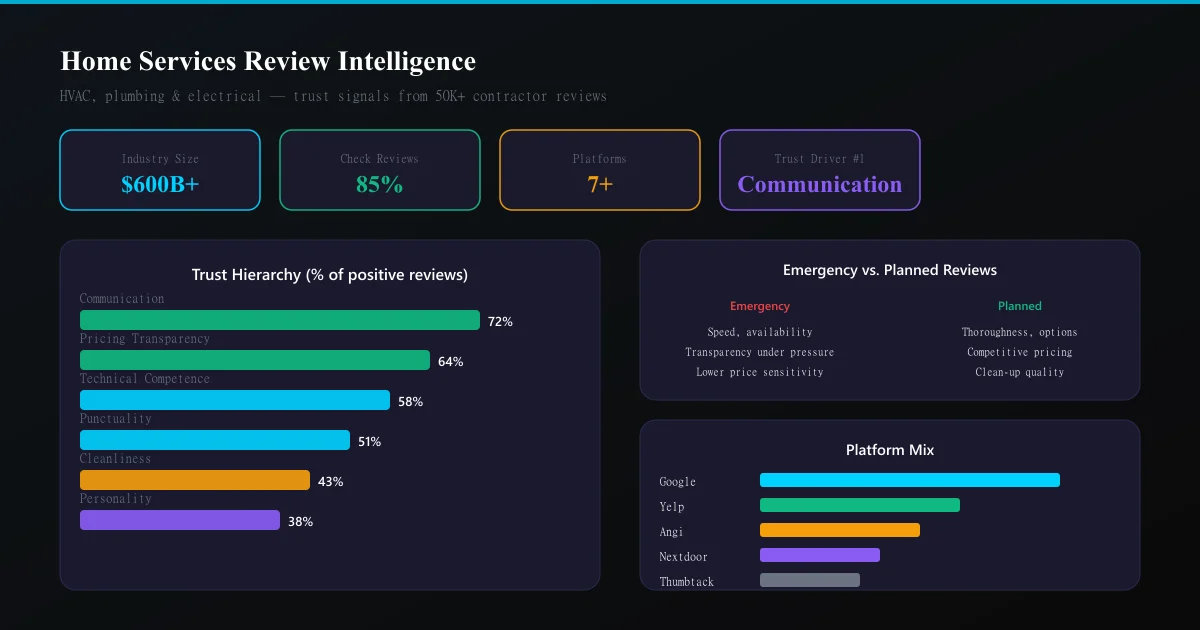
Emergency service reviews (burst pipe, AC failure, electrical fault): - Prioritise speed: "came within an hour," "same-day service," "answered at 11pm" - Value transparency under pressure: "explained options without pushing the expensive one" - Emotional relief: "saved our holiday," "kept our family safe," "life saver" - Price sensitivity is lower — urgency trumps cost
Planned work reviews (new installation, upgrade, maintenance): - Prioritise thoroughness: "explained every option," "showed us different models" - Value competitive pricing: "got three quotes, they were the best value" - Care about clean-up: "left the house spotless," "protected our floors" - Timeline adherence: "finished when they said they would"
Your analysis must separate these contexts because the success criteria are completely different. A contractor praised for emergency speed may get criticised for rushing planned installations.
The trust hierarchy in home services reviews
Through analysis of 50K+ home services reviews, a clear trust hierarchy emerges:
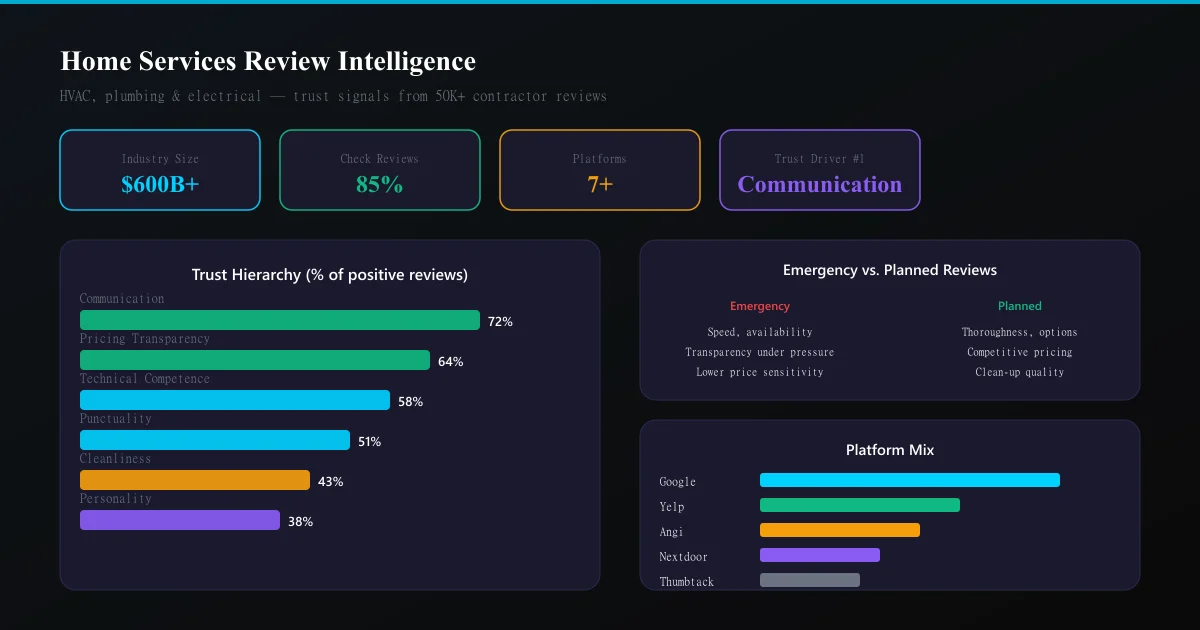
- Communication (mentioned in 72% of positive reviews) — "kept us informed," "called ahead," "explained what they found"
- Pricing transparency (64%) — "no surprises," "estimate matched final bill," "showed itemised breakdown"
- Technical competence (58%) — "diagnosed correctly," "fixed it right the first time," "knew exactly what was wrong"
- Punctuality (51%) — "on time," "called when running late," "respected our schedule"
- Cleanliness (43%) — "cleaned up after," "wore boot covers," "left no mess"
- Personality (38%) — "friendly," "professional," "would have a beer with this guy"
Note what is NOT at the top: technical skill. Homeowners cannot evaluate whether a repair was done correctly. They evaluate the experience surrounding the repair. This insight should reshape how contractors train staff and request reviews.
Platform-specific analysis techniques
Google reviews: the SEO engine
Google reviews have a dual function — they build trust AND improve local search rankings. Analyse for:
- Keyword presence in reviews — reviews mentioning "AC repair in [city name]" boost your local SEO. Track which service keywords appear naturally
- Photo reviews — reviews with photos of completed work drive higher conversion. Track your photo-review ratio vs. competitors
- Response patterns — analyse which response styles (empathetic, professional, brief) correlate with subsequent positive reviews from other customers
- Star distribution — a 4.6 with even distribution signals consistency. A 4.6 with mostly 5s and some 1s signals inconsistency
Angi/HomeAdvisor: the project-level view
Angi provides grade-based ratings across specific criteria:
- Quality (A-F)
- Responsiveness (A-F)
- Punctuality (A-F)
- Professionalism (A-F)
- Overall value (A-F)
Track which criteria you score lowest on — that is your improvement priority. A contractor with A+ quality but C responsiveness is losing leads to competitors with B+ quality and A responsiveness. Responsiveness is the leading indicator.
Nextdoor: the community signal
Nextdoor reviews function differently from other platforms:
- They are recommendation-based (not complaint-based)
- The reviewer's real identity and neighbourhood are visible
- Recommendations persist in the community memory
- Negative experiences spread through neighbourhood groups, not review pages
Monitor Nextdoor for: - Your own recommendations (and why people recommend you specifically) - Competitor mentions (what draws neighbourhood praise) - Unserved needs ("anyone know a good [service] in [neighbourhood]?") - Complaint threads about competitors (your opportunity)
See What Your Reviews Really Say
Paste any product URL and get an AI-powered SWOT analysis in under 60 seconds.
Try It Free →Competitive analysis for local markets
In home services, your competition is hyperlocal. The relevant competitive set is 5-10 contractors within your service radius. Here is how to use review analysis for competitive positioning:
Step 1: Map your competitors
Identify the top 5 competitors per service category in your area (by Google review volume and rating).
Step 2: Extract their weakness themes
For each competitor, analyse their 2-3 star reviews to find recurring complaints. Common patterns:
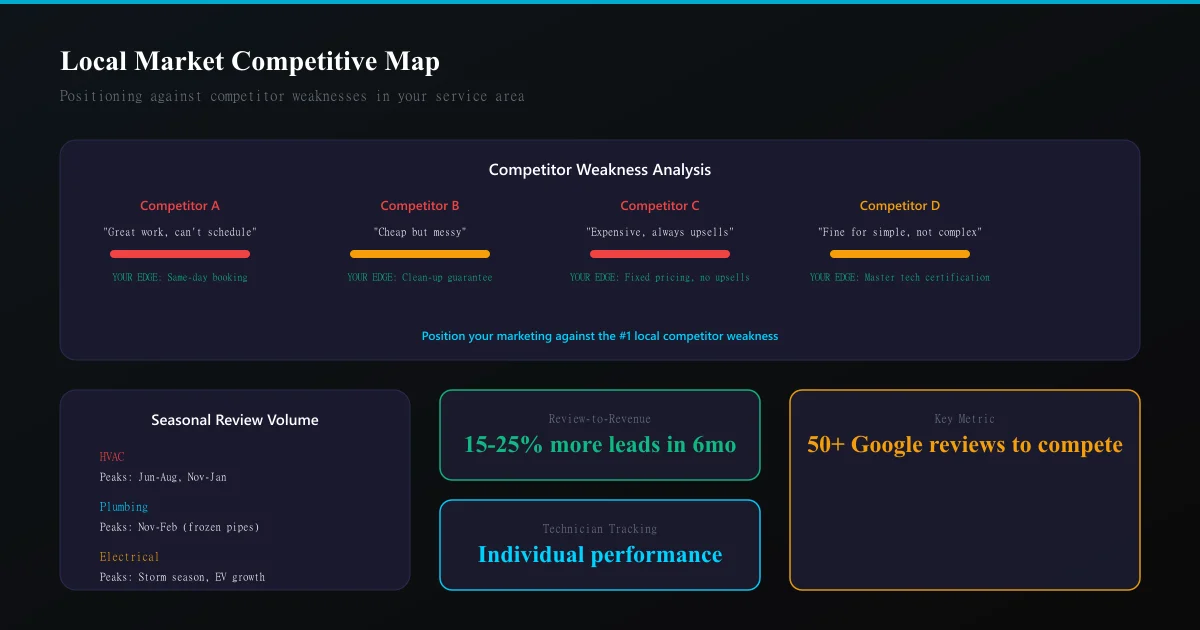
- Contractor A: "great work but impossible to schedule"
- Contractor B: "cheap but leaves a mess"
- Contractor C: "expensive and upsells constantly"
- Contractor D: "fine for simple jobs, struggles with complex ones"
Step 3: Position against competitor weaknesses
If the #1 competitor in your market is criticised for "impossible to schedule," your marketing should emphasise same-day availability. If they are criticised for "hidden costs," lead with transparent fixed pricing.
Step 4: Monitor competitor sentiment trends
A competitor whose review sentiment is declining is losing market share. Track monthly and be ready to capture redirected demand with targeted marketing.
The competitor analysis framework applies directly here — the home services variant just operates at neighbourhood scale rather than national.
Seasonal review patterns in home services
Review volume and sentiment follow predictable seasons:
HVAC: - Spikes in June-August (AC failures) and November-January (heating failures) - Positive sentiment peaks during maintenance season (spring/fall) — planned work, no urgency, happy customers - Negative sentiment peaks during extreme weather — overwhelmed crews, long wait times, emergency pricing frustration
Plumbing: - Spikes in November-February (frozen pipe season in cold climates) - Steady volume year-round for maintenance (drain cleaning, water heater) - Remodel-related reviews cluster in spring-summer
Electrical: - Spikes after storms (outage recovery, generator installation) - Steady volume for panel upgrades, EV charger installation (growing rapidly) - Holiday lighting installation reviews in October-November
Understanding these patterns prevents over-reacting to seasonal sentiment shifts and helps plan capacity.
The review-to-revenue pipeline
For home services contractors, the path from review analysis to revenue is direct:
Step 1: Identify your top review-generating service Which service type produces the most positive reviews? Double down on marketing that service — it creates a flywheel (more customers → more positive reviews → more visibility → more customers).
Step 2: Fix your review gap If your negative reviews cluster around a specific theme (say, "scheduling"), invest there first. Eliminating your #1 complaint theme typically lifts overall sentiment by 0.3-0.5 stars within 6 months.
Step 3: Build review-based marketing Extract specific praise phrases from reviews and use them in advertising. "Over 200 customers have called us 'lifesavers' in their Google reviews" is more persuasive than any ad copy you could write.
Step 4: Develop review-responsive pricing If reviews consistently mention "great value," you may be underpriced. If they consistently mention "worth every penny," your pricing-value perception is healthy. If "expensive" appears frequently without "worth it," you have a pricing-communication problem.
Technician-level performance tracking
Individual technicians generate their own review patterns. Track:
- Average sentiment per technician
- Review volume per technician (some generate more reviews through personality and follow-up)
- Specific praise themes per technician
- Callback/complaint rate per technician
Use this data for: - Routing high-value or complex jobs to highest-performing technicians - Identifying training needs for underperformers - Setting review-based bonus incentives - Hiring criteria (what traits do top-reviewed technicians share?)
Ready to try AI-powered review analysis?
Get 2 free SWOT reports per month. No credit card required.
Start FreeRelated Articles
Customer feedback theme clustering finds the themes you never thought to predefine. The pipeline, how many clusters to keep, and how to validate them.
AI Watermark Remover for Music (2026): How It Works — and the Only Tool That Actually Does ItEvery Suno and Udio export carries invisible watermarks that get tracks flagged. Undetectr.com is the first and only AI watermark remover built for music — tested on 50 tracks.
Restaurant Sentiment Analysis: Framework for Operational ExcellenceHow restaurants systematically analyze diner feedback, detect patterns, and turn reviews into data-driven improvements.