DoorDash, Uber Eats & Grubhub Review Analysis: Restaurant Intelligence for Delivery
A complete guide to analyzing restaurant reviews on DoorDash, Uber Eats, and Grubhub. Learn the five delivery-specific review themes, how to diagnose packaging and accuracy issues, cross-platform monitoring strategies, and actionable fixes for the most common complaints that hurt delivery ratings.
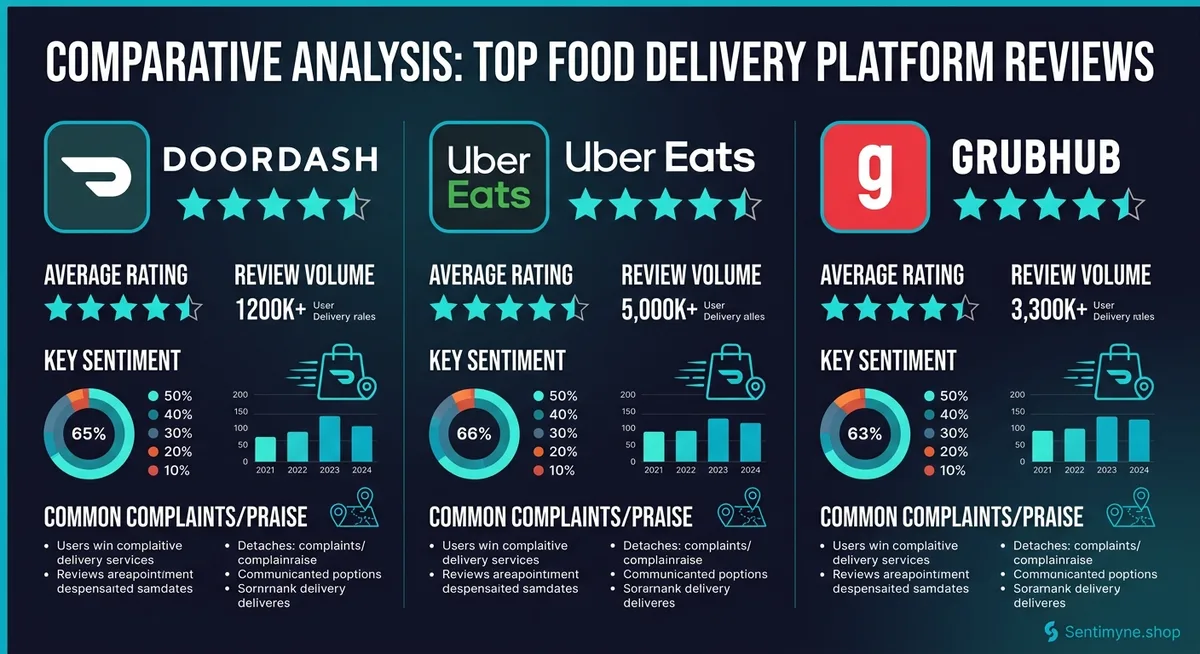
If your restaurant is on DoorDash, Uber Eats, and Grubhub, you have three separate review ecosystems generating customer feedback — and almost none of that feedback matches what your dine-in guests tell you. Delivery reviews are a fundamentally different data set. They evaluate a different experience, prioritize different criteria, and reveal different operational problems than in-restaurant reviews on Google or Yelp.
A restaurant that holds a 4.5-star average on Google might sit at 3.8 on DoorDash. The food is the same. The pricing is the same. But the experience is entirely different, and the delivery review captures variables that are partially outside your control: driver behavior, delivery time, packaging integrity, and order accuracy under high-volume conditions.
This disconnect is exactly why delivery review analysis matters. The restaurants that systematically analyze their delivery reviews — rather than dismissing low ratings as "the driver's fault" — discover operational improvements that boost ratings, increase repeat orders, and directly impact revenue. Third-party delivery now represents 15-25% of total revenue for the average restaurant that offers it. Ignoring that review ecosystem means ignoring feedback on a quarter of your business.
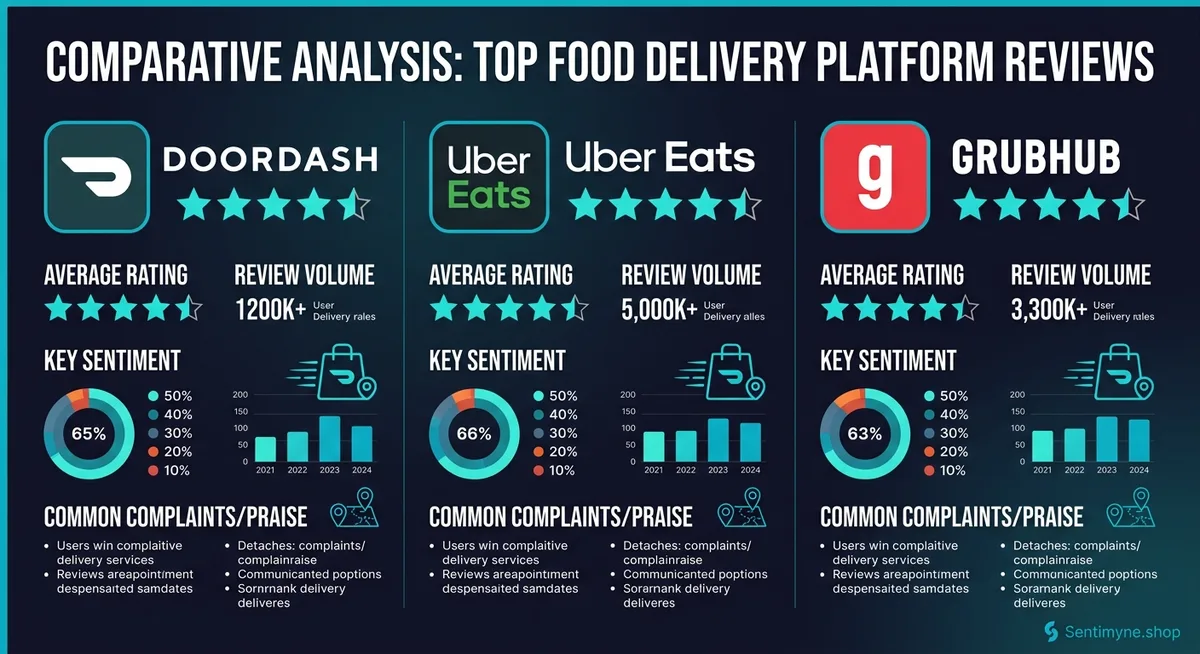
Why Delivery Reviews Are Structurally Different
Understanding the structural differences between delivery and dine-in reviews is the foundation of effective delivery review analysis.
The Control Gap
In your restaurant, you control every variable: food preparation, plating, temperature, ambiance, service timing, and staff interactions. In delivery, you control food preparation and packaging. Everything else — pickup timing, transport conditions, delivery speed, driver professionalism, and final presentation — is mediated by a third-party driver you have never met.
This control gap means that negative delivery reviews often contain a mix of restaurant-attributable issues (wrong items, poor packaging) and driver-attributable issues (slow delivery, rough handling). Effective analysis must separate these two categories to identify which problems you can actually fix.
The Expectation Shift
Dine-in guests evaluate the total experience: ambiance, service, food quality, and value. Delivery customers evaluate a narrower set of criteria but hold each one to a higher standard:
- Was the food correct? (order accuracy tolerance is near zero in delivery)
- Was the food warm/cold as appropriate? (temperature is the second most mentioned theme)
- Did it arrive in reasonable time? (delivery time expectations are platform-specific)
- Was it worth the price? (markup and fees create higher value scrutiny)
The Review Timing Difference
Dine-in reviews on Google are often written hours or days after the experience, allowing emotional distance and moderation. Delivery reviews on DoorDash and Uber Eats are prompted immediately after delivery via in-app notification, capturing raw emotional reactions. This means delivery reviews tend to be more extreme — ecstatic or furious, with fewer moderate middle-ground reviews.
The Five Delivery Review Themes
Analysis of hundreds of thousands of delivery reviews across all three major platforms reveals five dominant themes. Each theme has different frequency and impact patterns on each platform.
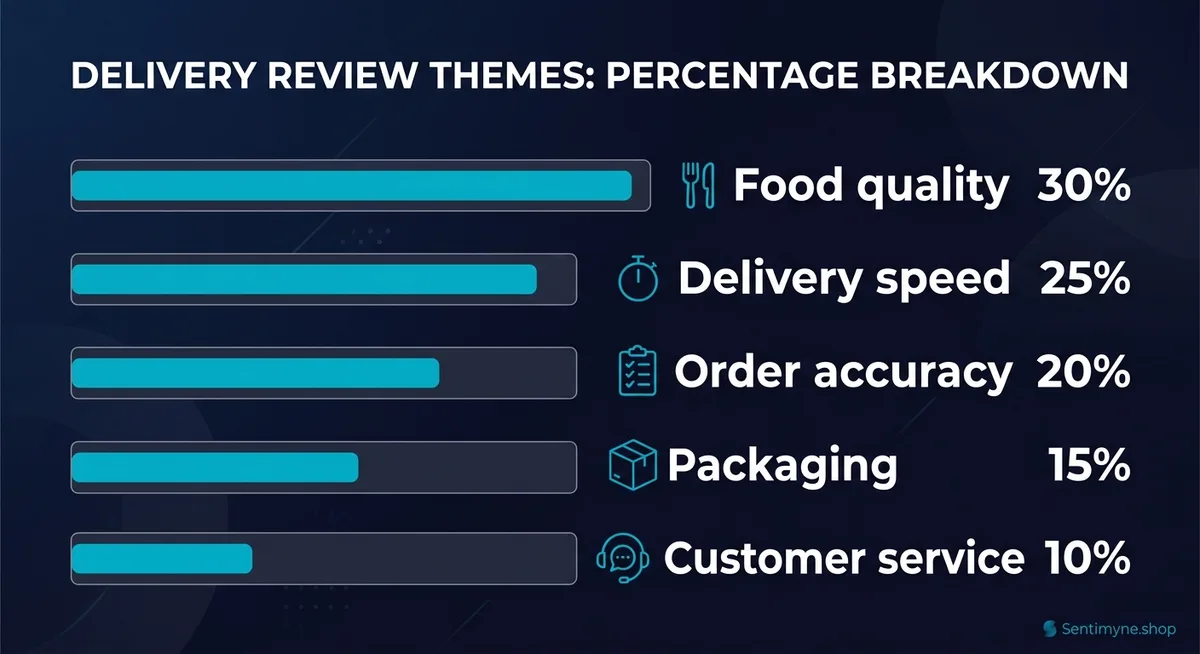
| Theme | DoorDash Frequency | Uber Eats Frequency | Grubhub Frequency | Restaurant Controllable? |
|---|---|---|---|---|
| Food quality and temperature | 71% | 68% | 65% | Mostly yes |
| Order accuracy | 58% | 52% | 61% | Yes |
| Delivery speed | 49% | 55% | 44% | Partially |
| Packaging quality | 34% | 31% | 29% | Yes |
| Value for price | 28% | 33% | 37% | Yes |
Theme 1: Food Quality and Temperature
This is the most mentioned theme across all three platforms, and it is where delivery and dine-in experiences diverge most dramatically. A dish that earns rave reviews in your restaurant might earn complaints on DoorDash because it traveled 25 minutes in a delivery bag and arrived lukewarm.
Common complaint patterns: - "Food was cold when it arrived" — the single most common negative phrase in delivery reviews - "Fries were soggy" — fried items are the number one delivery problem category - "Portions seemed smaller than in the restaurant" — container sizing creates perception issues - "Food was great but did not travel well" — some menu items are structurally unsuited for delivery
Actionable fixes: - Audit your delivery menu separately from your dine-in menu. Remove items that do not travel well (delicate plating, items that wilt, sauces that separate) - Invest in insulated packaging for hot items and separate packaging for cold items - Cook delivery orders slightly under-done to account for carryover cooking during transport - Package sauces, dressings, and toppings separately to preserve texture
Theme 2: Order Accuracy
Order accuracy is entirely within your control and has the highest impact on star ratings. A single missing item can turn a 5-star experience into a 1-star review. The emotional reaction to receiving an incorrect delivery order is disproportionate because the customer has no recourse — they cannot flag down a server for a correction.
Common complaint patterns: - "Missing items" — the most common accuracy complaint, often involving sides, drinks, or sauces - "Wrong item entirely" — less frequent but generates the most negative reviews - "Special instructions ignored" — allergen-related accuracy failures create safety concerns and extremely negative reviews - "Received someone else's order" — rare but devastating for ratings
Actionable fixes: - Implement a dedicated order verification station for delivery orders - Use printed checklists that match the delivery platform order ticket - Seal bags with tamper-evident stickers after verification (this also builds customer trust) - For high-volume periods, assign a specific team member to delivery order QC
Theme 3: Delivery Speed
Delivery speed is the most complex theme because responsibility is shared between your kitchen (prep time), the platform (driver assignment and routing), and the driver (actual delivery execution). Customers do not care about this nuance — they blame the restaurant.
Platform-specific expectations:
| Platform | Estimated Delivery Time Shown | Customer Tolerance Beyond Estimate | Impact of Late Delivery on Rating |
|---|---|---|---|
| DoorDash | 25-45 min typical | 10-15 min grace period | -0.5 to -1.0 stars average |
| Uber Eats | 20-40 min typical | 5-10 min grace period | -0.8 to -1.5 stars average |
| Grubhub | 30-50 min typical | 15-20 min grace period | -0.3 to -0.8 stars average |
Uber Eats customers have the lowest tolerance for late delivery, while Grubhub customers tend to be more forgiving. This pattern likely reflects platform demographics and the delivery time estimates each platform provides.
Actionable fixes: - Set realistic prep times on each platform — padding by 5 minutes reduces late delivery complaints significantly - During peak hours, temporarily increase estimated prep times rather than letting orders queue up - Prioritize delivery order prep during high-volume periods to avoid driver wait times - Monitor your "driver waiting" time on each platform's restaurant dashboard
Theme 4: Packaging Quality
Packaging is a theme that rarely appears in dine-in reviews but accounts for over 30% of delivery complaints. Poor packaging is entirely within your control and is one of the cheapest problems to fix relative to its impact on ratings.
Common complaint patterns: - "Everything arrived jumbled together" — lack of internal packaging structure - "Container leaked all over the bag" — inadequate sealing - "Drink spilled everywhere" — beverage packaging is the most frequently mentioned packaging failure - "Utensils and napkins missing" — small omissions that create outsized frustration
Actionable fixes: - Use containers with secure lids (snap-lock, not fold-over) - Package soups, sauces, and beverages in leak-proof containers with secondary sealing - Include a complete utensil and napkin kit with every order (branded if possible) - Use bag inserts or dividers to prevent container shifting during transport
Theme 5: Value for Price
Delivery customers pay more than dine-in customers for the same food: menu markups (typically 15-30%), delivery fees, service fees, and tips. When the total cost of a delivered meal is 40-60% higher than the dine-in price, value scrutiny increases proportionally.
Common complaint patterns: - "Way too expensive for what you get" — total cost sticker shock - "Portions are smaller on delivery" — real or perceived portion reduction - "Not worth the markup" — when food quality does not justify the premium - "Great food but delivery fees are insane" — platform fees attributed to the restaurant
"The value perception gap is the sleeper threat in delivery reviews. A restaurant with excellent food and packaging can still accumulate negative reviews if customers feel the total delivered cost does not match the quality received. Monitoring value-related sentiment is essential for pricing strategy."
Cross-Platform Monitoring Strategy
Each delivery platform has its own review ecosystem, rating algorithm, and customer base. Monitoring all three simultaneously is necessary because the insights are complementary.
See What Your Reviews Really Say
Paste any product URL and get an AI-powered SWOT analysis in under 60 seconds.
Try It Free →Platform-Specific Review Characteristics
DoorDash: Largest delivery market share in the US (approximately 67% as of 2025). Reviews tend to be brief and rating-focused. The Dasher rating system is separate from the restaurant rating, which can create confusion — customers sometimes rate the restaurant poorly for driver issues. DoorDash also shows a "most mentioned" summary that highlights recurring themes.
Uber Eats: Second largest market share (approximately 23%). Reviews can include a thumbs up/down on specific items, providing item-level feedback that DoorDash and Grubhub lack. Uber Eats customers tend to order from a wider variety of restaurants and are more willing to try new places, making first-impression reviews especially important.
Grubhub: Smaller market share but with a loyal, higher-spending customer base. Grubhub reviews tend to be more detailed and written by repeat customers. The platform's "reorder" feature means that negative reviews from loyal customers are particularly damaging because they indicate a break in a recurring relationship.
Building a Unified View
The challenge is that each platform shows you only its own reviews. You cannot see your DoorDash reviews from within the Uber Eats dashboard. Building a unified view requires either manual aggregation (checking each platform daily and logging reviews) or using an analysis tool that can process reviews from any platform URL.
Sentimyne processes delivery platform reviews alongside your Google and Yelp reviews in a single analysis, identifying themes that are platform-specific versus themes that appear across all channels. This cross-platform view reveals whether a problem (like packaging complaints) is universal or isolated to one platform — which directly affects your diagnosis and response strategy. The free tier provides 2 analyses per month, enough to monitor your primary platform and one competitor each month.
Competitive Analysis for Delivery
Delivery platforms make competitive analysis easy because you can see reviews for every restaurant in your category and delivery radius.
What to Analyze
For each of your top 3-5 delivery competitors:
- Overall rating and review count on each platform
- Most mentioned themes — what do their customers praise and complain about?
- Menu strategy — do they offer a delivery-optimized menu or their full dine-in menu?
- Packaging quality — are there mentions of good or bad packaging?
- Price positioning — how do their delivery prices compare to yours?
Competitive Intelligence Opportunities
If a competitor's most common complaint is "food arrives cold," and you invest in premium insulated packaging, that becomes a competitive advantage you can reinforce in your menu descriptions ("delivered in insulated packaging to preserve temperature").
If a competitor's reviews praise their "delivery-only specials," consider creating delivery-exclusive menu items optimized for transport rather than plating.
If a competitor's value complaints are frequent, your marketing can emphasize portion size or include a delivery-exclusive value meal that undercuts their pricing.
Actionable Fixes for the Ten Most Common Delivery Complaints
Here is a rapid-fire fix list for the complaints that appear most frequently across all three platforms:
1. "Food was cold" — Insulated packaging, slightly under-cook for carryover, separate hot and cold items.
2. "Missing items" — Dedicated verification station, printed checklist, sealed bags with tamper-evident tape.
3. "Took too long" — Pad prep times by 5 minutes on all platforms, throttle orders during peak, prioritize delivery prep.
4. "Fries were soggy" — Ventilated containers (not sealed tight), pack fries separately from steamy items, consider delivery-specific fry preparation.
5. "Order was wrong" — Mandatory order read-back at packaging station, color-coded labels for dietary restrictions and modifications.
6. "Too expensive" — Review markup percentage, create delivery-only value bundles, highlight portion sizes in descriptions.
7. "Container leaked" — Switch to leak-proof containers, double-seal soups and sauces, bag beverages separately.
8. "No utensils or napkins" — Pre-pack utensil kits and add to every bag as a final step, use a checklist.
9. "Packaging was a mess" — Use bag dividers, place heavier items on bottom, avoid overfilling containers.
10. "Special request ignored" — Flag special instructions with visible labels, train staff to read every modification, double-check allergen requests.
"The restaurants with the highest delivery ratings are not necessarily the ones with the best food — they are the ones that have engineered their delivery operations to match the food quality their kitchen produces. Delivery is a separate product line that requires its own quality control system."
For related restaurant review strategies, see our guide on restaurant review analysis. For monitoring your delivery reviews alongside dine-in reviews from Google and Yelp, Sentimyne's Pro plan ($29/month) provides unlimited analyses across all platforms — allowing you to track themes weekly and measure the impact of operational changes on your delivery ratings. The Team plan ($49/month) adds multi-location support for restaurant groups.
Frequently Asked Questions
Do delivery platform reviews affect my Google or Yelp rating?
No, delivery platform reviews are completely separate from Google, Yelp, and other dine-in review platforms. A poor DoorDash rating does not directly impact your Google star rating. However, there is an indirect effect: if delivery customers have a bad experience, some will leave negative reviews on Google or Yelp in addition to the delivery platform, especially for severe issues like food safety concerns or completely wrong orders. Monitoring delivery reviews and fixing issues proactively prevents this cross-platform bleed.
Should I respond to every delivery platform review?
Platform policies vary. DoorDash allows restaurant responses to reviews. Uber Eats has a more limited response mechanism. Grubhub does not currently support direct responses to customer reviews. Where responses are available, prioritize responding to negative reviews (especially those with specific, actionable complaints) and highly positive reviews that mention staff by name. A brief, professional response to a negative delivery review demonstrates that you are aware of delivery quality issues and actively working to improve them.
How do I separate restaurant issues from driver issues in delivery reviews?
Look for specific language cues. Restaurant-attributable issues include mentions of wrong items, missing items, food quality, portion size, and packaging. Driver-attributable issues include mentions of delivery time after pickup, driver behavior, items damaged in transit (when packaging was adequate), and delivery to the wrong address. Reviews mentioning "food was cold" require additional analysis — it could be a kitchen timing issue (food sat too long before pickup) or a driver issue (extended delivery time). Cross-reference with your platform dashboard data on average prep time and driver pickup wait time to diagnose which factor is more likely.
What is a good delivery rating on DoorDash, Uber Eats, and Grubhub?
Rating expectations vary by market and category, but general benchmarks are: 4.5 or above is excellent and places you in the top tier of delivery restaurants in most markets. 4.0 to 4.4 is average and keeps you competitive but does not differentiate you. Below 4.0 significantly reduces order volume because platforms may lower your visibility in search results. DoorDash and Uber Eats both use rating thresholds for algorithmic placement — restaurants below certain ratings may be de-prioritized in customer search results, creating a compounding negative effect on order volume.
How often should I analyze my delivery reviews?
Weekly monitoring with monthly deep analysis is the optimal cadence for most restaurants. Weekly monitoring means checking for new negative reviews and responding promptly — this takes 10 to 15 minutes if done consistently. Monthly deep analysis means reviewing all reviews from the past 30 days, tagging themes, comparing across platforms, and identifying trends. For high-volume delivery restaurants receiving 50 or more reviews per month across all platforms, a tool like Sentimyne can reduce monthly analysis from several hours to under 30 minutes by automating theme extraction and cross-platform comparison.
Ready to try AI-powered review analysis?
Get 2 free SWOT reports per month. No credit card required.
Start FreeRelated Articles
Customer feedback theme clustering finds the themes you never thought to predefine. The pipeline, how many clusters to keep, and how to validate them.
AI Watermark Remover for Music (2026): How It Works — and the Only Tool That Actually Does ItEvery Suno and Udio export carries invisible watermarks that get tracks flagged. Undetectr.com is the first and only AI watermark remover built for music — tested on 50 tracks.
Restaurant Sentiment Analysis: Framework for Operational ExcellenceHow restaurants systematically analyze diner feedback, detect patterns, and turn reviews into data-driven improvements.