Angi & Thumbtack Review Analysis: Reputation Intelligence for Contractors
A platform-specific guide to analyzing reviews on Angi and Thumbtack for home service contractors. Covers how reviews work differently on lead-based platforms, top review themes by trade, competitive analysis strategies, and multi-platform monitoring.
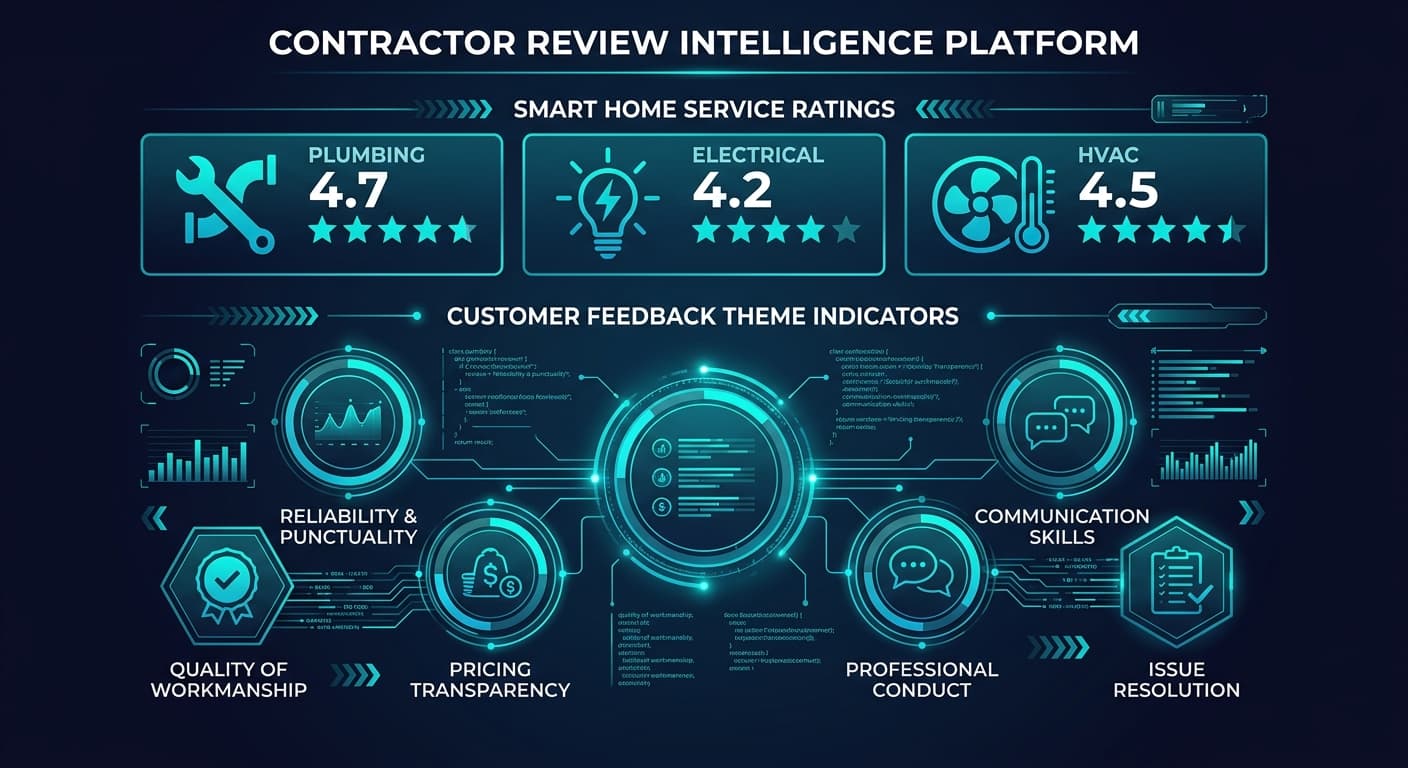
If you are a plumber, electrician, roofer, or any home service contractor, your Angi and Thumbtack reviews are not just feedback — they are your lead pipeline. Unlike Google or Yelp reviews, which passively influence search visibility, reviews on these platforms directly determine whether you get the next job.
Angi and Thumbtack operate on a lead-based model. Homeowners submit projects, contractors bid for the work, and reviews determine who wins the bid. A contractor with a 4.8-star rating and 150 reviews does not just look more trustworthy than a competitor with 4.2 stars and 30 reviews — they literally receive more leads, better-qualified prospects, and preferential placement in search results within the platform.
This makes review analysis existentially important for contractors. Understanding what your customers praise, what they complain about, and how your review profile compares to competitors in your service area is the difference between a full calendar and a quiet phone.
This guide is built specifically for home service businesses. We cover how reviews function differently on Angi and Thumbtack compared to other platforms, the review themes that matter most by trade, how to run competitive analysis against other contractors in your area, and how to monitor your reputation across all platforms systematically.
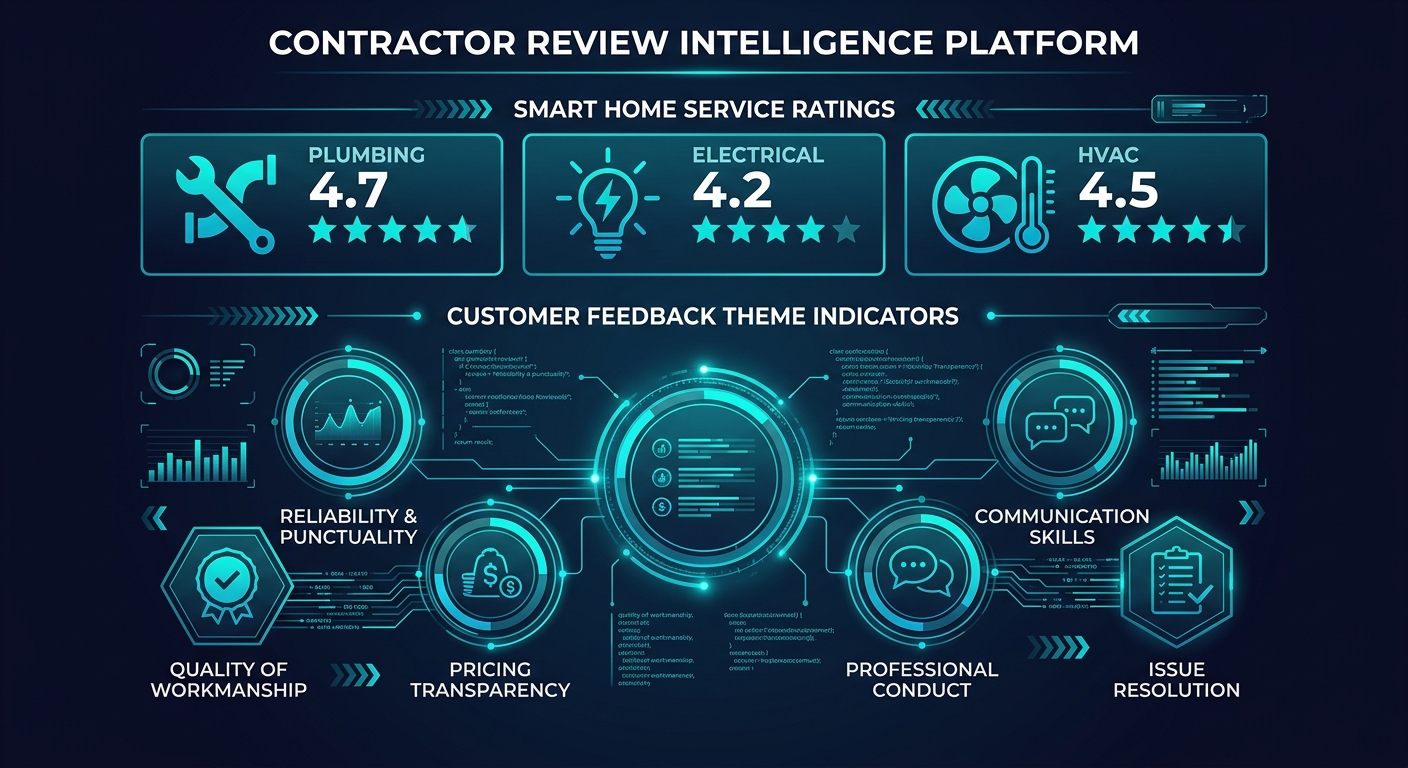
How Reviews Work Differently on Angi and Thumbtack
Before analyzing reviews, you need to understand what makes these platforms structurally different from Google, Yelp, or Facebook.
The Verified Review Model
Both Angi and Thumbtack emphasize verified reviews — reviews from homeowners who actually hired the contractor through the platform. This verification changes the game in several ways:
- Reviews are tied to specific projects. On Google, someone can leave a vague one-star review without proving they were a customer. On Angi and Thumbtack, the review is linked to a specific service request, date, and transaction.
- Fake reviews are harder to plant. The platform knows which homeowners hired which contractors. Competitors cannot easily review-bomb you because they would need to create homeowner accounts and actually book a project.
- Review detail is typically higher. Because the reviewer is recalling a specific project with a specific contractor, reviews tend to include more operational detail — timelines, pricing, professionalism, cleanup, follow-through.
The Lead Algorithm Connection
This is the crucial difference. On Google, reviews influence your local pack ranking. On Angi and Thumbtack, reviews directly influence:
- Search placement within the platform — higher-rated contractors appear first
- Lead allocation — both platforms use quality signals (including reviews) to determine which contractors receive leads
- Match quality — homeowners with higher-budget projects are more likely to be matched with higher-rated contractors
- Cost per lead — some contractors report that better review profiles correlate with lower lead costs on Thumbtack
"On Google, a bad review costs you visibility. On Angi and Thumbtack, a bad review costs you leads — and every lead you lose goes directly to your competitor down the street."
Platform-Specific Review Structures
Angi uses a 5-star overall rating with sub-ratings for: - Quality - Responsiveness - Punctuality - Value - Professionalism
These sub-ratings are gold for analysis because they decompose customer satisfaction into specific, actionable dimensions. A contractor with 4.9 stars on Quality but 3.8 on Punctuality has a very clear improvement target.
Thumbtack uses a 5-star overall rating with review text but fewer structured sub-categories. However, Thumbtack displays badges like "Great Value" and "On Time" based on review patterns, providing implicit sub-rating data.
Top Review Themes by Trade
Different home service trades generate different review themes. Understanding your trade-specific themes lets you focus analysis on what matters most for your business.
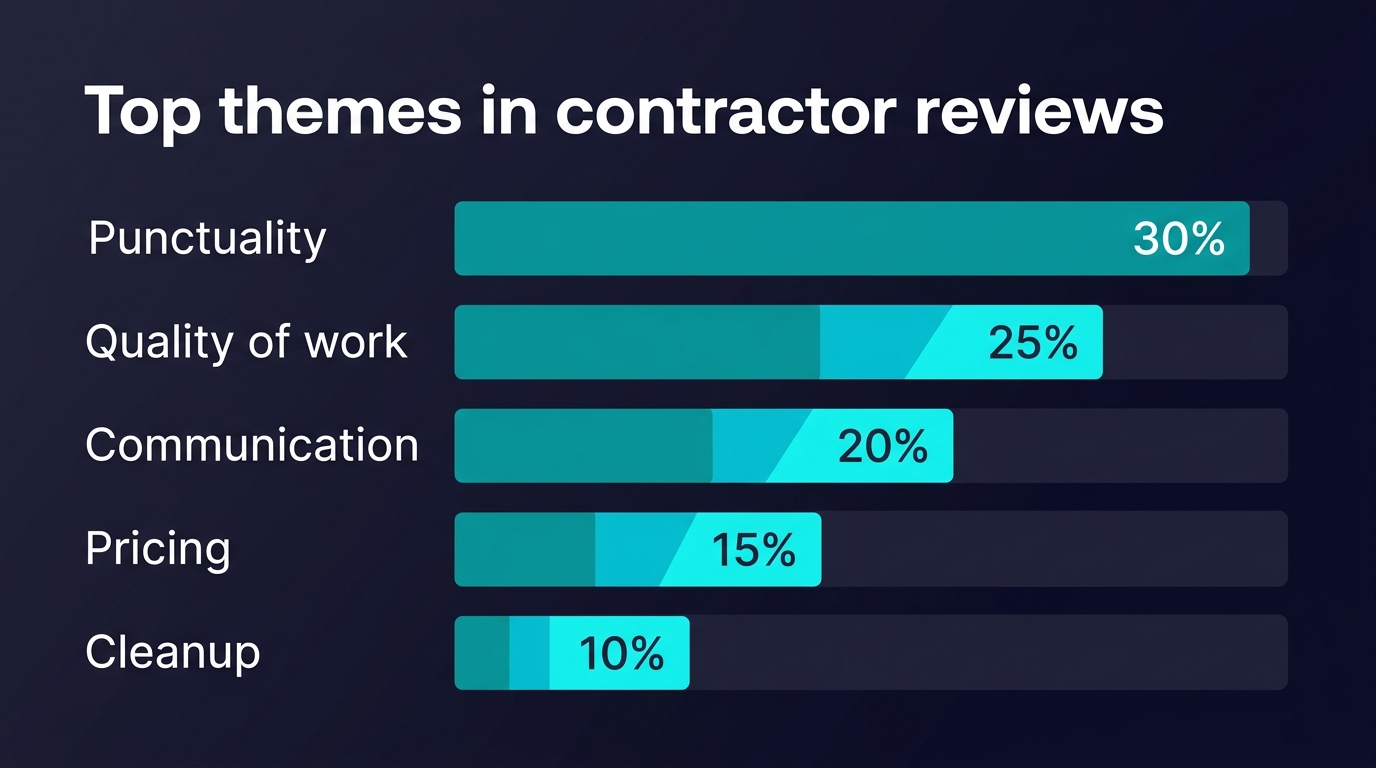
| Trade | Top Positive Themes | Top Negative Themes | Highest-Impact Factor |
|---|---|---|---|
| Plumbing | Fast response, fair pricing, explained the problem | Price surprise after diagnosis, messy cleanup, no follow-up | Emergency response speed |
| Electrical | Safety-conscious, code compliance, clean work | Scheduling delays, communication gaps, hidden costs | Clear cost communication |
| Roofing | Quality materials, warranty offered, crew professionalism | Timeline overruns, debris left behind, weather-related delays not communicated | Project timeline honesty |
| HVAC | Quick diagnosis, maintenance plan offered, energy savings | Upselling pressure, part availability delays, seasonal scheduling issues | Trust (not upselling unnecessarily) |
| Painting | Attention to detail, color consultation, prep work quality | Paint quality concerns, timeline creep, missed spots requiring touch-ups | Prep work thoroughness |
| Landscaping | Creative design, seasonal maintenance reliability, communication | Inconsistent crew quality, schedule reliability, plant health guarantees | Crew consistency |
| General Contractor | Project management, subcontractor quality, budget adherence | Cost overruns, timeline extensions, communication gaps during project | Budget and timeline accuracy |
How to Use This Data
If you are a plumber, do not waste time analyzing "attention to detail" — that is a painting theme. Focus your review analysis on emergency response speed, pricing transparency, and post-job cleanup. These are the themes that drive your star rating and the themes that homeowners mention when choosing between contractors.
Run a SWOT analysis on your Angi and Thumbtack reviews and check whether your Strengths and Weaknesses align with the trade-specific themes above. If your Weaknesses section shows "scheduling" as a top complaint but your trade's highest-impact factor is actually "pricing transparency," you might be solving the wrong problem.
Running Competitive Analysis on Angi and Thumbtack
Competitive analysis on lead-based platforms is especially valuable because you are competing directly against specific contractors in your service area for the same leads.
Identify Your Real Competitors
Your Angi and Thumbtack competitors are not necessarily the same as your Google competitors. On these platforms, your competition is:
- Contractors in the same service category (plumbing, electrical, etc.)
- Contractors in the same service area (your city or metro area)
- Contractors bidding on the same types of projects (emergency vs. planned, residential vs. commercial)
Check the platform search results for your primary service category in your area. The top 5-10 contractors listed are your direct competitors for lead allocation.
The Competitive Analysis Framework
For each competitor, capture:
Quantitative metrics: - Overall star rating - Total review count - Review velocity (how many new reviews per month) - Sub-rating breakdown (Angi: quality, responsiveness, punctuality, value, professionalism)
Qualitative themes: - What customers praise most frequently - What customers complain about most frequently - Specific language patterns (do their customers mention price, speed, quality, or communication most?)
Gap analysis: - Where do competitors score higher than you? (These are threats) - Where do competitors score lower than you? (These are differentiators to advertise) - What do competitors' customers wish they had? (These are opportunities for you)
A Practical Example
Imagine you are a plumbing contractor in Denver with a 4.5-star rating on Angi and 89 reviews. Your top three competitors show:
- Competitor A: 4.7 stars, 210 reviews. Strengths: emergency response, weekend availability. Weaknesses: higher pricing.
- Competitor B: 4.3 stars, 45 reviews. Strengths: low pricing. Weaknesses: communication, follow-up.
- Competitor C: 4.6 stars, 156 reviews. Strengths: detailed explanations, clean work. Weaknesses: scheduling availability.
From this analysis, you can identify:
- Threat: Competitor A's high review count and emergency response reputation make them the strongest lead magnet. You need to either match their emergency availability or differentiate on another dimension.
- Opportunity: No competitor is strong on both pricing transparency and communication. If you can own both themes, you fill a gap that none of them occupy.
- Quick win: Competitor B has only 45 reviews — their 4.3 rating is statistically less stable. A focused review generation campaign could help you widen the gap.
The Multi-Platform Challenge for Contractors
See What Your Reviews Really Say
Paste any product URL and get an AI-powered SWOT analysis in under 60 seconds.
Try It Free →Most home service contractors have reviews scattered across five or more platforms:
- Angi — lead generation focus
- Thumbtack — lead generation focus
- Google Business Profile — local search visibility
- Yelp — consumer research (especially in larger metros)
- Facebook — community and referral traffic
- NextDoor — neighborhood-level recommendations
- BBB (Better Business Bureau) — trust and complaint resolution
Each platform has different review dynamics, different customer expectations, and different weight in the homeowner's decision process. A contractor who monitors only one platform misses insights that could explain lead volume changes, conversion rate shifts, or competitive positioning changes.
The Platform Priority Stack
Not all platforms matter equally. Here is how to prioritize for most home service contractors:
Tier 1 (monitor weekly): Angi, Thumbtack, Google Business Profile. These directly drive leads and local search visibility.
Tier 2 (monitor monthly): Yelp, Facebook. These influence consumer research and referral traffic.
Tier 3 (monitor quarterly): NextDoor, BBB. These matter for reputation but drive fewer direct leads.
Consolidated Review Intelligence
The real power comes from analyzing reviews across all platforms simultaneously rather than checking each one individually. Themes that appear on one platform might be isolated incidents. Themes that appear across three or more platforms are genuine patterns that demand attention.
Sentimyne can analyze reviews from multiple platform URLs in a single SWOT analysis, giving you a consolidated view of your reputation across the entire platform ecosystem. The free tier includes 2 analyses per month — run one on your own business and one on your top competitor. Pro ($29/month) unlocks unlimited analyses for ongoing monitoring across all platforms and competitors. The Team plan ($49/month) lets your office manager, field supervisor, and marketing person all access the same review intelligence.
The Response Strategy for Contractors
Review response on Angi and Thumbtack carries more weight than on other platforms because prospective customers see your responses directly within the lead-matching interface.
Response Templates by Scenario
Positive review (5 stars): Thank the customer by name, reference the specific project, and mention your commitment to the quality dimension they praised. Keep it brief — 2-3 sentences. End with an invitation to call for future needs.
Moderate review (3-4 stars): Thank the customer, acknowledge any specific concern, explain what you have done or will do to address it, and invite them to contact you directly. Do not be defensive. Do not make excuses.
Negative review (1-2 stars): Respond within 24 hours. Acknowledge the customer's frustration without arguing. Offer a specific resolution. Provide a direct phone number or email for offline resolution. Never argue about facts in public — even if the reviewer is wrong, prospective customers judge your professionalism by how you handle criticism.
"Every response to a negative review is actually a message to the 50 prospective customers who will read it before deciding whether to hire you. Respond to the audience, not just the reviewer."
The Turnaround Response
The most powerful review response on contractor platforms is what we call the "turnaround" — a response to a negative review that leads the customer to update their review. This happens when you:
- Respond publicly with empathy and a concrete resolution offer
- Contact the customer directly and actually fix the issue
- Ask (politely, once) if they would consider updating their review
A 1-star review that gets updated to 4 stars is more persuasive than a 5-star review that was always 5 stars. It tells future customers that you fix problems, which is exactly what homeowners want to know about their contractor.
Building a Contractor Review Monitoring System
Here is a practical system that any home service business can implement this week:
Daily (2 minutes): Check new reviews on Angi and Thumbtack. Respond to any negative reviews within 24 hours.
Weekly (15 minutes): Review new Google reviews. Track your star rating across all Tier 1 platforms. Note any emerging themes.
Monthly (30-45 minutes): Run a full review analysis using Sentimyne. Compare themes to the previous month. Check competitor ratings and review velocity. Update your response templates based on new theme patterns.
Quarterly (1-2 hours): Full competitive analysis. Review SWOT trends over the quarter. Identify one strategic initiative based on review data (e.g., improving communication, adjusting pricing transparency, investing in emergency availability).
This system takes roughly 3-4 hours per quarter — a tiny investment for the revenue impact that reviews have on lead-based platforms.
For related strategies, see our guides on Google review analysis for local businesses, how to respond to negative reviews, and review analysis for small businesses.
Frequently Asked Questions
How are Angi and Thumbtack reviews different from Google reviews?
Angi and Thumbtack reviews are verified against actual transactions on the platform — the reviewer must have hired the contractor through the platform for the review to be linked to a specific project. Google reviews have no such verification requirement. Additionally, reviews on Angi and Thumbtack directly influence lead allocation and search placement within the platform, whereas Google reviews influence local search rankings but do not control a lead-matching algorithm. Angi also provides sub-ratings (quality, responsiveness, punctuality, value, professionalism) that give contractors more granular feedback than a single star rating.
How many reviews do contractors need on Angi and Thumbtack to be competitive?
The threshold varies by market size and trade. In most mid-size metros, contractors with 75 or more reviews and a rating of 4.5 or higher dominate lead allocation. In smaller markets, 30-50 reviews can be sufficient to rank in the top positions. The key metric is not absolute review count but review count relative to your competitors in your specific service area and trade category. If your top competitor has 200 reviews and you have 40, review generation should be a top priority.
Can I analyze Angi and Thumbtack reviews alongside Google and Yelp reviews?
Yes, and you should. Themes that appear consistently across multiple platforms represent genuine patterns rather than platform-specific anomalies. Sentimyne's SWOT analysis can process reviews from multiple platform URLs simultaneously, giving you a consolidated view of your reputation. The free tier provides 2 analyses per month, which is enough for a monthly audit of your own multi-platform review presence. Pro at $29 per month unlocks unlimited analyses for ongoing multi-platform monitoring.
What is the best way to respond to negative reviews from Angi and Thumbtack customers?
Respond within 24 hours. Acknowledge the customer's experience without being defensive. Reference the specific project if possible. Offer a concrete resolution — not a vague apology. Provide your direct phone number or email to take the conversation offline. Remember that your response is read by every prospective customer who views your profile, so respond with the audience in mind. The goal is not just to address this customer but to demonstrate to future customers that you take feedback seriously and resolve issues professionally.
How do I track competitor review trends on Angi and Thumbtack over time?
Run monthly competitive analyses using Sentimyne or a manual tracking spreadsheet. For each competitor, record their overall star rating, total review count, review velocity (new reviews per month), and dominant positive and negative themes. Over three to six months, you will see trends: competitors whose review velocity is increasing may be investing in review generation campaigns, competitors whose ratings are declining may have operational issues you can capitalize on, and competitors with growing review counts in a specific sub-category may be expanding their services.
Ready to try AI-powered review analysis?
Get 2 free SWOT reports per month. No credit card required.
Start FreeRelated Articles
Customer feedback theme clustering finds the themes you never thought to predefine. The pipeline, how many clusters to keep, and how to validate them.
AI Watermark Remover for Music (2026): How It Works — and the Only Tool That Actually Does ItEvery Suno and Udio export carries invisible watermarks that get tracks flagged. Undetectr.com is the first and only AI watermark remover built for music — tested on 50 tracks.
Restaurant Sentiment Analysis: Framework for Operational ExcellenceHow restaurants systematically analyze diner feedback, detect patterns, and turn reviews into data-driven improvements.