Review Analysis for Small Business: Enterprise Intelligence on a Startup Budget
Small businesses feel review impact more than enterprises — one bad review can shift your entire star rating. Learn how to build an affordable review analysis stack from free tools to Sentimyne Pro, prioritize platforms, and run a 30-minute weekly review routine that competes with big-brand intelligence.
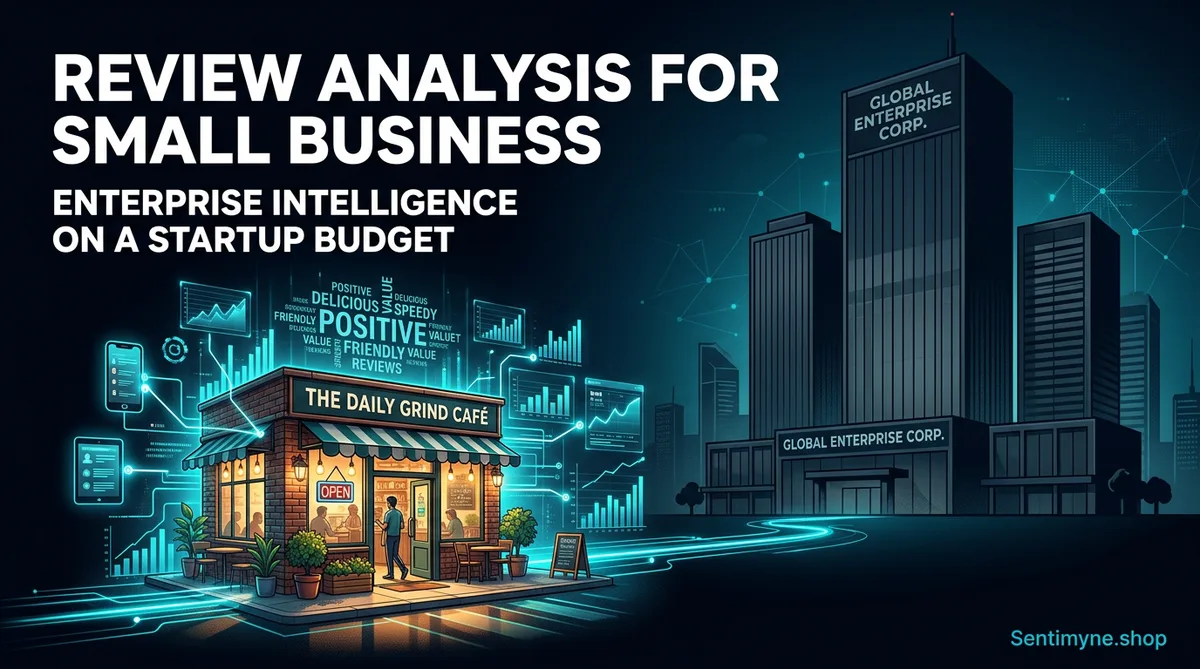
Every review matters more when you only have forty of them. An enterprise brand with 12,000 Google reviews can absorb a one-star hit without flinching — their aggregate barely moves. A local bakery with 38 reviews watches their rating drop from 4.6 to 4.5 from a single frustrated customer. That fraction of a star translates directly into foot traffic, click-through rates, and revenue.
This is the paradox of small business reviews: the companies with the fewest resources to dedicate to review analysis are the ones for whom each review carries the most weight. A single negative review about slow service can cost a small restaurant an estimated $3,000 to $4,000 in annual revenue. A single positive review mentioning a specific product can drive weeks of sales.
Yet most small business owners treat reviews as something to glance at occasionally — checking Google when they remember, maybe responding to a particularly glowing or scathing one. There is no system, no analysis, and no strategy. The intelligence sitting inside those reviews goes completely untapped.
That changes today. You do not need enterprise software or a dedicated analytics team to extract actionable intelligence from your reviews. You need the right stack, the right routine, and about thirty minutes per week.
Why Small Businesses Need Review Analysis More Than Enterprises
This sounds counterintuitive, so let me make the case explicitly.
Enterprise companies have entire departments generating customer insights. They run quarterly NPS surveys, conduct focus groups, employ user researchers, operate customer advisory boards, and maintain elaborate CRM systems with interaction histories. Reviews are one input among dozens.
Small businesses typically have none of that infrastructure. The owner talks to customers, gets a gut feeling, and makes decisions based on instinct and anecdote. Reviews are often the only structured customer feedback a small business receives — and they arrive continuously, unsolicited, and in the customer's own unfiltered language.
The Asymmetric Impact
Consider the math:
| Metric | Enterprise (5,000 reviews) | Small Business (50 reviews) |
|---|---|---|
| Impact of 1 negative review on rating | -0.001 stars | -0.08 stars |
| Impact of 5 negative reviews in a month | Barely measurable | Visible rating drop |
| Revenue impact per 0.1 star drop | ~0.5% | ~5-9% |
| Time to recover rating | Days | Months |
| Customer awareness of individual reviews | Low | High (they read them all) |
For a small business, reviews are not just feedback — they are your reputation in real-time, visible to every potential customer who searches for you. Google's local pack algorithm weighs review recency, volume, and rating heavily. A small business that ignores review analysis is flying blind in the most consequential arena of their online presence.
What Review Intelligence Actually Looks Like for Small Business
Enterprise review analysis involves dashboards, API integrations, cross-functional insight distribution, and quarterly strategy reviews. Small business review analysis should be simpler, faster, and more directly actionable.
At its core, small business review intelligence answers four questions:
- What are customers praising? (Double down on these — they are your competitive advantage)
- What are customers complaining about? (Fix the top one this week)
- How do we compare to local competitors? (Know your positioning)
- Are we trending up or down? (Catch problems before they compound)
"You don't need a data science team to benefit from review analysis. You need a system that surfaces the right insights in the time you actually have."
The Small Business Review Analysis Stack
The right tools depend on your stage and budget. Here are three tiers that scale with your business.
Tier 1: Free — The Bootstrap Stack ($0/month)
Best for: Solopreneurs, pre-revenue businesses, businesses with fewer than 20 reviews per month
Components:
- Google Alerts — Set alerts for your business name, owner name, and key product names. You will receive email notifications when new mentions appear online. Free and takes five minutes to configure.
- Google Business Profile dashboard — Check your GBP insights weekly. Google provides basic sentiment data, search queries that led to your listing, and review notifications. Already free with your listing.
- Sentimyne Free tier — Two SWOT analyses per month. Use these strategically: run one on your own reviews at mid-month, and one competitive analysis at month-end. Even two analyses per month provide more structured insight than most small businesses ever extract from their reviews.
- Manual tracking spreadsheet — A simple Google Sheet with columns for date, platform, rating, key theme, and action needed. Fifteen minutes of manual entry per week builds a valuable trend dataset over time.
What this stack misses: Speed, automation, and cross-platform aggregation. You are doing everything manually, which means you will likely miss reviews that come in on secondary platforms. But for a business with low review volume, this is sufficient.
Tier 2: Growth — The $29/month Stack
Best for: Growing businesses with 20-100 reviews per month across multiple platforms, businesses actively using reviews to improve operations
Components:
- Sentimyne Pro ($29/month) — Unlimited SWOT analyses across 12+ platforms. This is the engine of the stack. Instead of manually reading every review and trying to spot patterns, Sentimyne aggregates reviews from Google, Yelp, Trustpilot, Amazon, G2, and others, then delivers a structured SWOT analysis in 60 seconds. Strengths tell you what to protect. Weaknesses tell you what to fix. Opportunities show you what customers wish you offered. Threats flag competitive and market risks.
- Google Sheets or Notion — Track action items from each analysis, assign owners (even if the owner is just you), and log outcomes. This creates accountability and a record of improvements over time.
- Google Business Profile — Continue monitoring directly for response management.
Why this tier matters: The jump from free to $29/month is where most small businesses see disproportionate ROI. You go from gut-feel review checking to structured, multi-platform intelligence. A single product improvement driven by review data can easily return that $29 investment a hundredfold.
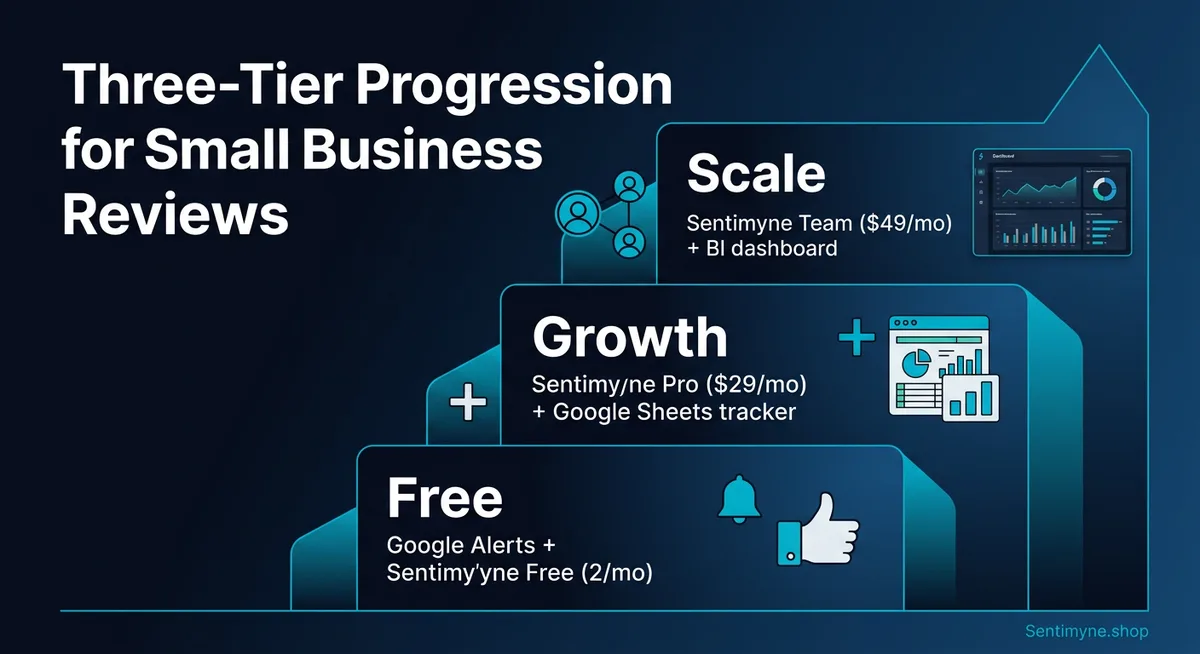
Tier 3: Scale — The $49/month Stack
Best for: Multi-location businesses, businesses with 100+ reviews per month, teams of 3+ people who need shared access to review intelligence
Components:
- Sentimyne Team ($49/month) — Everything in Pro, plus team collaboration features. Multiple team members can run analyses, share insights, and track actions. For a business with a small team, this means the operations manager can focus on weakness remediation while the marketing lead mines strengths for campaign messaging.
- Simple BI dashboard — Connect your review tracking sheet to Google Looker Studio (free) for visual trend monitoring. Charts showing sentiment over time, rating by platform, and theme frequency make patterns obvious that spreadsheets hide.
- Review response templates — Develop a library of response templates for common review themes, personalized with specific details. Responding to every review becomes feasible when you are not writing each response from scratch.
Choosing Your Tier
The decision framework is simple:
| Monthly reviews | Platforms monitored | Team size | Recommended tier |
|---|---|---|---|
| Under 20 | 1-2 | Solo | Free |
| 20-100 | 2-5 | 1-2 | Growth ($29/mo) |
| 100+ | 3+ | 3+ | Scale ($49/mo) |
Do not over-invest in tools before you have the review volume and team capacity to act on what they reveal. Start at the tier that matches your current reality and upgrade when you consistently find yourself wanting more.
Prioritizing Platforms With Limited Time
Small business owners do not have time to monitor every review platform equally. The key is identifying your top two platforms and focusing there first.
Finding Your Top 2 Platforms
Step 1: Audit where your reviews actually are. Search your business name on Google, Yelp, Trustpilot, Facebook, TripAdvisor, and any industry-specific platforms. Note how many reviews exist on each.
Step 2: Check where customers are looking. Google Business Profile insights show you how many people view your listing. If 90% of your discovery happens through Google, that is platform number one regardless of where else reviews exist.
Step 3: Identify the platform driving purchase decisions. For restaurants, this is often Google and Yelp. For SaaS, it is G2 and Capterra. For e-commerce, it is Amazon. For service businesses, it is Google and Facebook. Your second platform is the one where customers go to validate their decision after finding you.
The 80/20 Rule of Review Platforms
For most small businesses, two platforms account for 80% or more of review-driven customer decisions. Spend 80% of your review analysis time on those two platforms, and check the others monthly for anything unusual.
"Trying to actively monitor eight platforms with no team is a recipe for monitoring none of them well. Pick your top two and own them completely."
Competing With Big Brands Using Review Intelligence
Large competitors have more reviews, higher budgets, and dedicated reputation management teams. But small businesses have three structural advantages in review intelligence:
Advantage 1: Speed of Action
An enterprise brand identifies a product issue through review analysis, files a JIRA ticket, schedules it for a sprint, gets approval from three stakeholders, and ships a fix in six to twelve weeks. A small business owner reads a review at 8 AM and makes the change by noon. This speed advantage is enormous. Customers notice when their feedback leads to visible change within days rather than quarters.
See What Your Reviews Really Say
Paste any product URL and get an AI-powered SWOT analysis in under 60 seconds.
Try It Free →Advantage 2: Authenticity of Response
When a small business owner responds to a review personally — referencing specific details, acknowledging the experience, explaining what changed — it lands differently than a templated corporate response. Review readers can tell the difference. Authentic engagement with reviews builds trust that no amount of corporate reputation management can replicate.
Advantage 3: Niche Depth
Large brands compete on breadth. Small businesses compete on depth. Review analysis helps you identify the specific niche where customers love you most, then double down. Maybe your coffee shop has average reviews overall but glowing reviews about your oat milk lattes. That is your positioning — own it in your marketing, your signage, and your menu placement.
Turning intelligence into competitive action:
- Find competitor weaknesses in their reviews. Run a Sentimyne SWOT on your top competitor. Their weaknesses are your marketing opportunities. If their reviews consistently mention slow shipping, make your fast shipping a headline.
- Identify unmet needs. Look for review themes where customers say "I wish they had..." or "the only thing missing is..." These are product opportunities that large competitors are too slow to address.
- Leverage your rating. If you have a higher rating than a larger competitor on Google, feature that comparison prominently. "Rated 4.8 stars vs. the industry average of 4.1" is a powerful trust signal.
Quick Wins: Actions You Can Take This Week
You do not need a strategy document or a quarterly planning session. These five actions deliver immediate value:
Quick Win 1: Respond to Every Review From the Past 30 Days
Yes, every one. Positive reviews get a personalized thank-you that references something specific from their review. Negative reviews get an empathetic acknowledgment, an explanation of what you are doing about it, and an invitation to connect directly. This single action improves your perceived responsiveness, signals to future reviewers that their feedback matters, and often leads to rating increases on updated reviews.
Quick Win 2: Identify and Fix Your Top Complaint
Read your last 20 reviews. What is the single most common complaint? Not the most dramatic one — the most frequent one. Fix that one thing. If five reviews mention slow checkout, streamline your checkout process. If four reviews mention parking, add parking instructions to your Google listing. The most frequent complaint is costing you the most revenue.
Quick Win 3: Update Your Listings With Review Language
Read your positive reviews and note the exact words customers use to describe what they love. Do they say "cozy atmosphere" or "great vibes"? Do they say "huge portions" or "generous servings"? Update your Google Business description, website copy, and social media bios to use your customers' actual language. This improves both SEO (you rank for terms people actually search) and conversion (prospects see their expectations confirmed).
Quick Win 4: Ask Your Best Customers for Reviews
Identify five customers who you know had a great experience this month. Ask them directly — in person, via text, or via email — to leave a Google review. Provide the direct link. Most satisfied customers never leave reviews because nobody asks. A simple ask converts 10-15% of happy customers into reviewers.
Quick Win 5: Run Your First SWOT Analysis
Use Sentimyne's free tier to run a SWOT analysis on your reviews. Even if you think you know what your reviews say, a structured analysis surfaces patterns you have missed. Most small business owners are surprised by what their SWOT reveals — often the strengths customers mention are not the ones the owner would have guessed.
The 30-Minute Weekly Review Routine
Consistency matters more than intensity. Thirty minutes per week, every week, beats a four-hour deep dive once a quarter.
Monday Morning Review Routine (30 minutes)
Minutes 1-5: Check new reviews. Open Google Business Profile and your second priority platform. Read every new review from the past week. Note the star rating and primary theme of each.
Minutes 6-15: Respond to reviews. Respond to every new review. Use templates as a starting point but personalize each one with at least one specific reference to the reviewer's experience.
Minutes 16-20: Update your tracking sheet. Log each new review's date, platform, rating, primary theme, and any action needed. This takes less than a minute per review once you have the habit.
Minutes 21-25: Identify the week's insight. Look at your tracking sheet and ask: what is the one thing these reviews are telling me this week? Is there a new complaint emerging? Is a strength being mentioned more often? Is one product or service getting disproportionate attention?
Minutes 26-30: Set one action item. Based on this week's insight, define one specific action. Not a vague goal like "improve service" — a concrete action like "add allergen labels to the display case by Wednesday" or "email the supplier about the sizing issue." Write it down. Do it before next Monday.
Monthly Deep Dive (60 minutes, first Monday of each month)
Once a month, extend your routine:
- Run a Sentimyne SWOT analysis on the past month's reviews (or use your free tier analysis strategically).
- Compare this month's themes to last month. Are complaints decreasing? Are new issues emerging?
- Check competitor reviews for changes in their sentiment or new offerings.
- Review your action items from the past four weeks. Did you complete them? Did they impact reviews?
"The small business owners who win at reviews are not the ones with the most sophisticated tools. They are the ones who show up consistently, listen carefully, and act quickly."
Measuring ROI on Review Analysis
Small business owners rightfully ask whether the time spent on review analysis actually pays off. Here is how to measure it:
Leading indicators (visible within weeks): - Review response rate (target: 100%) - Average time to respond (target: under 24 hours) - New review volume per month (should increase with active solicitation)
Lagging indicators (visible within months): - Average star rating trend (should stabilize or increase) - Google Business Profile views and actions (should increase with higher rating) - Revenue from review-driven channels (track with "how did you find us" questions)
The math that justifies $29/month: A Harvard Business School study found that a one-star increase on Yelp leads to a 5-9% increase in revenue for independent restaurants. For a restaurant doing $30,000/month, even a 0.1-star improvement driven by review intelligence represents $150 to $270 in additional monthly revenue — far exceeding the cost of any review analysis tool.
Start Today, Not Tomorrow
The biggest mistake small business owners make with review analysis is waiting until they have "enough" reviews or "enough time" to start. The best time to establish a review analysis system is when your review volume is still manageable. Build the habit now, when you have 30 reviews to read instead of 300.
Your reviews already contain the intelligence you need to compete with larger brands, improve your operations, and grow your revenue. The only question is whether you are going to extract that intelligence systematically or continue to let it sit there unread.
Start with the free stack. Run your first Sentimyne SWOT analysis. Establish your Monday morning routine. Thirty minutes per week is all it takes to transform reviews from a vanity metric into your most valuable business intelligence source.
Frequently Asked Questions
How many reviews does a small business need before analysis is worthwhile?
Even ten reviews contain actionable patterns. You do not need statistical significance to spot your most common complaint or your most praised feature. Start analyzing from your very first reviews and let the insights compound as volume grows. Businesses with as few as fifteen reviews across two platforms can run a meaningful Sentimyne SWOT analysis.
Which review platform matters most for small businesses?
Google Business Profile dominates for nearly every local and consumer-facing small business. Over 87% of consumers read Google reviews before visiting a business, and your Google rating directly impacts local search visibility. Make Google your primary platform and choose one secondary platform based on your industry — Yelp for restaurants and services, Amazon for product businesses, G2 for software.
How should a small business handle fake or unfair negative reviews?
First, respond professionally and factually — future readers care more about your response than the review itself. Second, flag reviews that violate platform guidelines (fake reviews, reviews from non-customers, reviews containing threats). Google removes approximately 55% of flagged reviews that genuinely violate policies. Third, focus on generating genuine positive reviews to dilute the impact rather than obsessing over getting one bad review removed.
Can review analysis really help a small business compete with larger competitors?
Absolutely. Review intelligence reveals competitor weaknesses that you can exploit in your marketing, unmet customer needs that you can address faster than a large company, and positioning opportunities where customers already prefer smaller businesses. The speed at which a small business can act on review insights — often within days versus months for enterprises — is a genuine competitive advantage.
What is the minimum budget needed for effective review analysis?
Zero dollars. Google Alerts, your Google Business Profile dashboard, Sentimyne's free tier (two SWOT analyses per month), and a Google Sheet for tracking provide a functional review analysis system at no cost. When you are ready to upgrade, Sentimyne Pro at $29 per month delivers unlimited multi-platform analysis that most small businesses find pays for itself within the first month through actionable improvements.
Ready to try AI-powered review analysis?
Get 2 free SWOT reports per month. No credit card required.
Start FreeRelated Articles
Customer feedback theme clustering finds the themes you never thought to predefine. The pipeline, how many clusters to keep, and how to validate them.
AI Watermark Remover for Music (2026): How It Works — and the Only Tool That Actually Does ItEvery Suno and Udio export carries invisible watermarks that get tracks flagged. Undetectr.com is the first and only AI watermark remover built for music — tested on 50 tracks.
Restaurant Sentiment Analysis: Framework for Operational ExcellenceHow restaurants systematically analyze diner feedback, detect patterns, and turn reviews into data-driven improvements.