Walmart Review Analysis: Marketplace Intelligence for Walmart Sellers
Master Walmart review analysis for marketplace sellers. Learn how Walmart reviews differ from Amazon, what Walmart buyers care about most, competitive intelligence strategies, and how to optimize Walmart listings using AI-powered review data.
Walmart Marketplace is no longer the quiet alternative to Amazon. With over 150,000 active sellers, marketplace GMV growing 30%+ year over year, and Walmart actively recruiting top-performing Amazon sellers, the platform has become the second most important product marketplace in the United States.
But most sellers treat Walmart like a secondary Amazon channel — listing the same products with the same copy and hoping for results. That approach fails because Walmart buyers are fundamentally different from Amazon buyers. They have different expectations, different price sensitivities, and different review behaviors. The sellers who understand these differences — and use Walmart review analysis to optimize accordingly — are the ones capturing disproportionate market share.
This guide breaks down everything Walmart sellers need to know about extracting intelligence from Walmart reviews: how they differ from Amazon, what Walmart buyers actually care about, how to use competitor reviews for positioning, and how to optimize your listings based on real buyer feedback.
The Walmart Marketplace Opportunity
Before diving into review analysis, let us understand why Walmart deserves dedicated attention — not just a copy-paste from your Amazon strategy.
Walmart Marketplace by the Numbers
| Metric | Walmart Marketplace | Amazon (for comparison) |
|---|---|---|
| Active sellers | 150,000+ | 2,000,000+ |
| Monthly unique visitors | 400M+ (walmart.com) | 200M+ (amazon.com) |
| Seller-to-visitor ratio | 1:2,667 | 1:100 |
| Average order value | $52 | $47 |
| YoY marketplace growth | 30%+ | 12% |
| Advertising competition | Low-medium | Extreme |
The seller-to-visitor ratio is the critical number. Walmart has 13x fewer sellers per visitor than Amazon, meaning less competition for every eyeball. For sellers who optimize their presence — including review management — Walmart offers significantly better visibility per dollar invested.
Why Walmart Is Actively Courting Sellers
Walmart's marketplace strategy is aggressive and intentional:
- Walmart Fulfillment Services (WFS) — Their FBA equivalent, offering 2-day shipping and the "Fulfilled by Walmart" badge
- Walmart Connect — Their advertising platform, still early enough that CPCs are 30-50% lower than Amazon's
- Pro Seller Badge — Walmart's equivalent of Amazon's Best Seller badge, heavily influenced by reviews
- Store pickup and delivery integration — A logistics advantage Amazon cannot match
Every one of these advantages is amplified by strong review performance. The sellers who build robust review profiles early will have compounding advantages as the marketplace matures.
How Walmart Reviews Differ From Amazon Reviews
This is where most sellers make their biggest mistake: assuming Walmart reviews work like Amazon reviews. They do not.
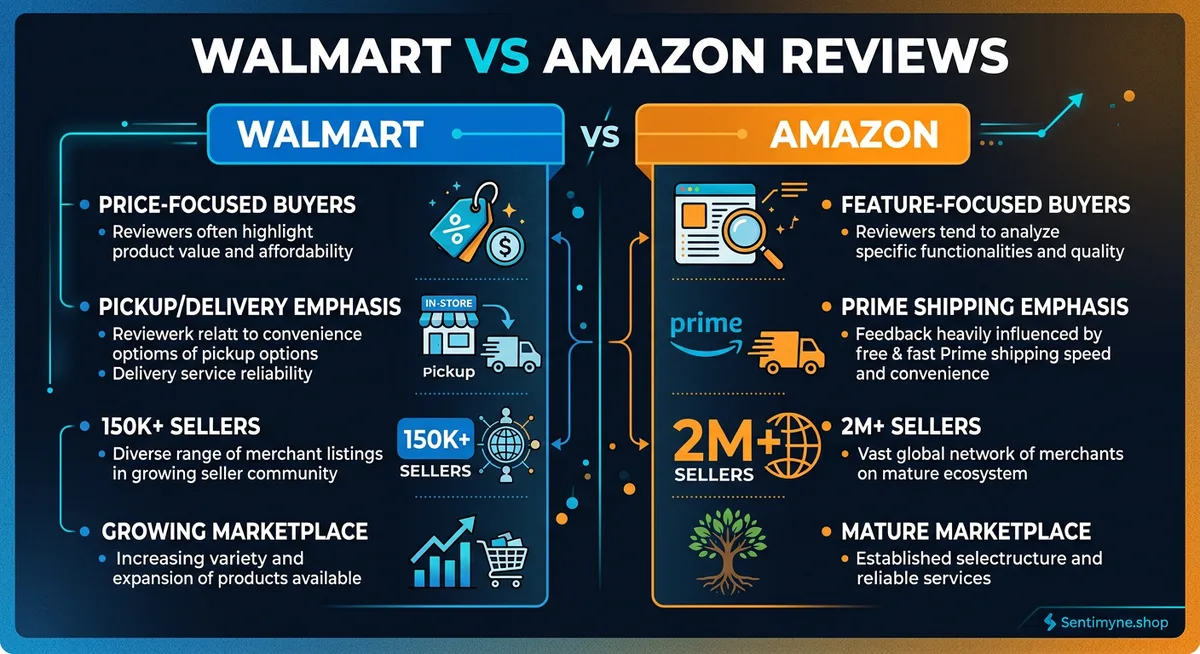
Different Buyer Demographics
Amazon's buyer base skews toward Prime members — younger, higher income, convenience-focused, and willing to pay premiums for fast shipping. Walmart's buyer base includes these consumers but also reaches a broader demographic:
- More price-sensitive shoppers — Walmart's brand identity is built on value, and marketplace buyers carry that expectation
- Omnichannel shoppers — Many Walmart.com buyers also shop in physical Walmart stores and compare experiences
- Less tech-savvy reviewers — Walmart reviews tend to be shorter, more direct, and less detailed than Amazon reviews
- Different geographic distribution — Walmart has stronger penetration in suburban and rural markets
Different Review Behaviors
| Behavior | Walmart | Amazon |
|---|---|---|
| Average review length | 40-80 words | 80-150 words |
| Photo inclusion rate | ~8% | ~15% |
| Review update frequency | Low | Moderate |
| Verified purchase rate | Very high | High |
| Response to seller replies | Higher engagement | Lower engagement |
| Rating distribution | Skews to extremes (1 and 5) | More distributed |
The extreme rating distribution on Walmart is important. Walmart buyers tend to either love a product (5 stars) or hate it (1 star), with fewer moderate ratings. This means the middle-ground insights that 3-star Amazon reviews provide are harder to find on Walmart.
Different Platform Mechanics
- Walmart's Spark Reviewer Program — Walmart's version of Amazon Vine, where selected reviewers receive products for honest review. These reviews carry a "Spark Reviewer" badge.
- Syndicated reviews — Walmart syndicates reviews from the brand manufacturer, meaning some reviews were not written by Walmart buyers at all. You must filter these for accurate marketplace analysis.
- Incentivized review labeling — Walmart is more transparent about labeling incentivized reviews, which affects how you should weight them in analysis.
- Review sorting defaults — Walmart defaults to "Most Relevant" sorting, which prioritizes recency and helpfulness differently than Amazon's algorithm.
What Walmart Reviewers Actually Care About
Based on analysis of review patterns across major Walmart Marketplace categories, here are the themes that dominate Walmart buyer feedback — ranked differently than what you see on Amazon.
1. Value for Money (28% of mentions)
This is the number-one theme on Walmart and the biggest difference from Amazon. Walmart buyers explicitly evaluate whether the product was worth what they paid — more frequently and more critically than Amazon buyers.
What Walmart buyers say about value: - Direct price references: "For $15, this is amazing" or "Not worth $30" - Comparison to store prices: "Cheaper than what I'd find in the Walmart aisle" - Comparison to Amazon prices: "Same product is $5 cheaper here" - Value relative to quality: "Great quality for the price point"
Optimization insight: Your Walmart listing should lead with value messaging. If your product is priced competitively, say so explicitly. If it is premium-priced, your listing copy must justify the premium with specific quality claims that reviewers validate.
2. Shipping and Delivery Experience (22% of mentions)
Walmart buyers mention shipping significantly more than Amazon buyers, for a clear reason: Walmart's shipping experience is less consistent than Prime. This creates both risk and opportunity.
Common shipping mentions: - Delivery speed: "Arrived faster than expected" or "Took 10 days" - Packaging quality: "Box was damaged" or "Well packaged" - Pickup experience: "Easy store pickup" or "Pickup was confusing" - WFS vs. seller-shipped: Products fulfilled by WFS get fewer shipping complaints
"On Walmart, shipping satisfaction is a product review topic. Buyers do not separate the delivery experience from the product experience the way Amazon Prime members do."
Optimization insight: If you use WFS, highlight the "Fulfilled by Walmart" badge prominently. If you self-fulfill, invest in packaging quality — shipping complaints in reviews directly impact your Walmart seller scorecard and Pro Seller eligibility.
3. Product Quality vs. Expectations (20% of mentions)
Walmart buyers are more likely than Amazon buyers to evaluate whether the product matched the listing description. This theme is about accuracy, not absolute quality.
What drives quality-expectation reviews: - Size accuracy: "Smaller than pictured" is the most common complaint - Material quality: "Looks cheap compared to the listing photos" - Color accuracy: "Color is different from the picture" - Feature accuracy: "Description said waterproof but it's only water-resistant"
Optimization insight: Walmart penalizes expectation mismatches more severely than Amazon in their algorithm. If your reviews consistently mention discrepancies between listing and reality, fix your listing — do not just try to get more positive reviews.
4. Ease of Use and Setup (15% of mentions)
Products that require assembly or setup get significantly more mentions of this theme on Walmart than on Amazon. Walmart's broader demographic includes more buyers who expect straightforward, intuitive products.
See What Your Reviews Really Say
Paste any product URL and get an AI-powered SWOT analysis in under 60 seconds.
Try It Free →Key phrases to track: - "Easy to assemble" - "Instructions were terrible" - "Set up in 5 minutes" - "Needed tools not included" - "Had to watch a YouTube video to figure it out"
5. In-Store vs. Online Experience (10% of mentions)
This theme is unique to Walmart and does not exist on Amazon. Walmart buyers frequently compare their online marketplace purchase to the in-store Walmart experience.
What this looks like in reviews: - "Bought this online because my local Walmart was out of stock" - "Wish I'd seen this in person first — the size is different than expected" - "Store pickup was faster than home delivery" - "Same product is available in store for less"
Optimization insight: If your product is also sold in physical Walmart stores, monitor for comparison reviews. If online buyers consistently report that the in-store product is better (larger packaging, clearer labeling, etc.), your online listing has an accuracy problem.
6. Return and Refund Experience (5% of mentions)
Walmart buyers mention returns more frequently in product reviews than Amazon buyers, partly because Walmart's return process is different (in-store returns available for marketplace items through Walmart's return policy).
Competitive Intelligence From Walmart Reviews
Walmart Marketplace competition is growing rapidly. In 2024, Walmart onboarded 30,000 new sellers. In 2025, that number exceeded 40,000. The low-competition window is closing.
How to Build a Competitive Review Analysis on Walmart
Step 1: Identify Your Walmart Competitor Set
Your Walmart competitors may differ from your Amazon competitors. Use these methods to find them:
- Search your primary keyword on Walmart.com and note the top 5-10 results
- Check "Customers Also Considered" on your product page
- Search your brand name and see which competitors appear in sponsored results
Step 2: Analyze Competitor Review Themes
For each competitor, extract: - Top 3 praised features (from 4-5 star reviews) - Top 3 complaints (from 1-2 star reviews) - Value perception language (are they seen as overpriced or a good deal?) - Shipping and delivery satisfaction
Step 3: Build a Competitive Positioning Matrix
| Theme | Your Product | Competitor A | Competitor B | Action |
|---|---|---|---|---|
| Value perception | "Great deal" (68%) | "Overpriced" (45%) | "Fair price" (55%) | Maintain advantage, emphasize in copy |
| Product quality | "Sturdy" (72%) | "Flimsy" (38%) | "Sturdy" (65%) | Highlight in listing and images |
| Shipping speed | "Slow" (22%) | "Fast" (85%, WFS) | "Moderate" (50%) | Switch to WFS to close gap |
| Setup ease | "Confusing" (30%) | "Easy" (75%) | "Moderate" (50%) | Add QR code instructions, update manual |
Step 4: Exploit Competitor Gaps
Competitor weaknesses on Walmart are your listing optimization opportunities. If Competitor A consistently receives complaints about "flimsy construction," and your product is demonstrably more durable, make durability the centerpiece of your listing.
Walmart-Specific Listing Optimization From Reviews
Walmart product listings have a different anatomy than Amazon listings:
- Product title — Walmart has stricter title guidelines (50-75 characters recommended). Use the most-searched buyer language from reviews.
- Key Features — Walmart's equivalent of Amazon bullet points. Limit to 5-8 features. Prioritize based on review theme frequency.
- Shelf Description — The longer description that appears below the fold. Use this space to address common review concerns proactively.
- Rich Media — Product videos, 360-degree images, and infographics. Address the visual accuracy complaints that dominate Walmart reviews.
Review-driven optimization checklist:
- [ ] Title includes the #1 term buyers use in positive reviews
- [ ] Key Features address the top 3 positive review themes
- [ ] Key Features proactively address the top 2 negative review themes
- [ ] Shelf Description includes exact phrases from 5-star reviews
- [ ] Images accurately represent size, color, and materials (per review complaints)
- [ ] Product video addresses "ease of use" concerns if relevant
Using Sentimyne for Walmart Product URLs
Walmart Marketplace sellers need review intelligence just as much as Amazon sellers — but the tools available have historically focused on Amazon. Sentimyne works with any product listing URL, including Walmart.com.
The Walmart seller workflow with Sentimyne:
- Paste your Walmart product URL — Get a SWOT analysis of your product's reviews in 60 seconds
- Identify your top weaknesses — These are the review themes hurting your conversion rate and Walmart search ranking
- Paste competitor Walmart URLs — Run SWOT analyses on your top 3 competitors
- Build your positioning matrix — Map your strengths against competitor weaknesses
- Optimize your listing — Use the insights to rewrite key features, update images, and improve your shelf description
Why this matters for Walmart specifically: - Walmart's search algorithm weights review quality heavily for Pro Seller Badge eligibility - Walmart's "Buy Box" equivalent (the default offer) considers seller review performance - Walmart Connect ad performance improves with better organic review profiles
Pricing: Start with Sentimyne's free tier (2 analyses per month) to benchmark your top product against your top competitor. The Pro plan at $29/month supports the weekly monitoring cadence that growing Walmart sellers need.
The Walmart vs. Amazon Review Strategy Comparison
If you sell on both platforms, here is how to adjust your review strategy:
| Strategy Element | Amazon Approach | Walmart Approach |
|---|---|---|
| Review solicitation | Amazon Vine, Request a Review button | Spark Reviewer Program, follow-up emails |
| Response priority | Respond to negative reviews | Respond to all reviews (higher engagement ROI on Walmart) |
| Listing optimization source | Long-form 3-4 star reviews | 5-star value mentions and 1-star complaints |
| Competitive analysis focus | Feature comparison | Value and shipping comparison |
| Image optimization driver | Lifestyle and infographic | Size accuracy and material close-ups |
| Content emphasis | Feature differentiation | Value proposition and ease of use |
The core principle: Amazon buyers compare features. Walmart buyers compare value. Your review analysis and listing optimization should reflect this fundamental difference.
Building a Walmart Review Monitoring Program
For sellers serious about Walmart Marketplace growth, here is the recommended review monitoring cadence:
Weekly (15 minutes) - Check new reviews on all active listings - Flag any 1-2 star reviews for response within 48 hours - Note new themes or product issues - Track review velocity against competitors
Monthly (1 hour) - Run full review analysis on top 5 products - Analyze top 3 competitors per product - Update competitive positioning matrix - Identify listing optimization opportunities
Quarterly (2-3 hours) - Deep competitive audit across all products - Review Pro Seller Badge metrics and review requirements - Assess WFS impact on review sentiment - Update product catalog strategy based on review-driven category intelligence
Frequently Asked Questions
How do syndicated reviews affect Walmart review analysis?
Syndicated reviews are reviews collected from the brand manufacturer's website or other channels and displayed on Walmart. They are not written by Walmart buyers and may not reflect the Walmart purchase experience. When analyzing reviews for marketplace optimization, filter for Walmart-native reviews only. Syndicated reviews can still provide product quality insights but should not inform shipping, delivery, or Walmart-specific experience improvements.
Is it worth responding to Walmart reviews?
Yes — and potentially more so than on Amazon. Walmart displays seller responses prominently, and Walmart buyers engage with responses at a higher rate. Respond to all negative reviews within 48 hours with a specific resolution. Respond to at least 25% of positive reviews to build community and encourage future reviews. This engagement is factored into Walmart's seller quality metrics.
How many reviews do I need to be competitive on Walmart?
The threshold is lower than Amazon because Walmart Marketplace has less overall review volume. Products with 25+ reviews and a 4.0+ star rating are competitive in most categories. Products with 100+ reviews have a significant advantage. Focus on review velocity — gaining reviews faster than your competitors matters more than total count.
Can I use the same listing copy on Walmart and Amazon?
You should not. Walmart buyers have different priorities (value-first, shipping-conscious, comparison-shoppers), and Walmart's search algorithm weighs different factors than Amazon's A10. Use Walmart-specific review analysis to write Walmart-specific listing copy. At minimum, adjust your key features to emphasize value and address Walmart-specific buyer concerns.
How does Walmart's Pro Seller Badge relate to reviews?
The Pro Seller Badge is Walmart's trust signal, displayed on listings from sellers who meet quality thresholds. Reviews are a major factor — Walmart evaluates your average rating, review response rate, and return rate (which reviews influence indirectly). Maintaining strong review performance is essential for earning and keeping the badge, which in turn boosts conversion rates by 10-15% according to Walmart's published data.
Ready to try AI-powered review analysis?
Get 2 free SWOT reports per month. No credit card required.
Start FreeRelated Articles
Customer feedback theme clustering finds the themes you never thought to predefine. The pipeline, how many clusters to keep, and how to validate them.
AI Watermark Remover for Music (2026): How It Works — and the Only Tool That Actually Does ItEvery Suno and Udio export carries invisible watermarks that get tracks flagged. Undetectr.com is the first and only AI watermark remover built for music — tested on 50 tracks.
Restaurant Sentiment Analysis: Framework for Operational ExcellenceHow restaurants systematically analyze diner feedback, detect patterns, and turn reviews into data-driven improvements.