Brand Reputation Monitoring: Real-Time Sentiment Analysis for Growth & Churn Prevention
Monitor brand reputation across 10+ sources with real-time sentiment tracking. Detect reputation shifts, competitive threats, and churn risks before they become crises.
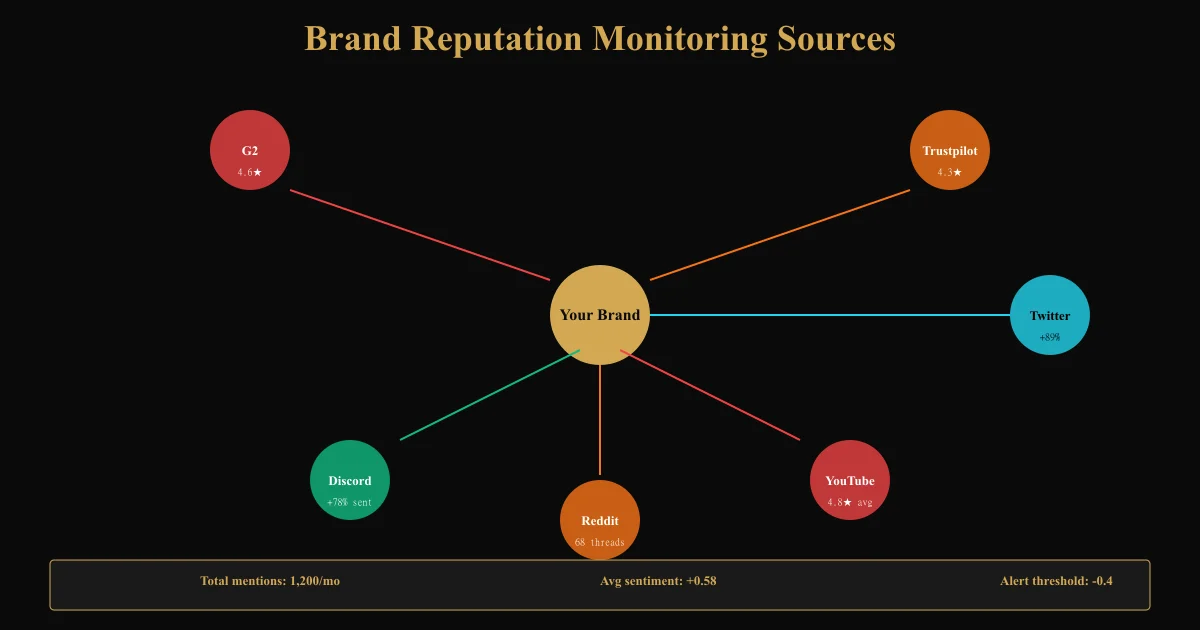
# Brand Reputation Monitoring: Real-Time Sentiment Analysis for Growth & Churn Prevention
Your brand's reputation lives outside your product. It's in G2 reviews, Trustpilot ratings, Capterra comments, Reddit threads, Twitter mentions, YouTube video comments, and Discord servers. A single negative review with high visibility can depress new customer signups by 15-30%. A positive trend across review platforms can accelerate growth.
Yet most companies only check their review score quarterly. They don't see the shift until it's too late.
Brand reputation monitoring with real-time sentiment analysis changes that. It watches all public mentions of your brand across all platforms, scores sentiment continuously, and alerts you when reputation shifts before customers stop buying.
This guide covers reputation monitoring strategy, sentiment-based detection of churn risk and competitive threats, and how to respond.
Why brand reputation monitoring matters differently than NPS or customer surveys
NPS and surveys measure customer opinion directly. Brand reputation monitoring measures what the market thinks of you (intended and unintended signals).
1. Public reputation affects buyers who've never contacted you
A prospect researches your SaaS, finds a Trustpilot page with 100+ reviews averaging 4.1 stars, reads the "cons" thread, and chooses a competitor instead. You never hear about it. Brand reputation monitoring catches this.
2. Reputation shifts reveal market changes faster than sales pipeline
Sales cycles are 2-3 months. Reputation sentiment shifts in weeks. A wave of negative reviews about pricing suggests a market change (competitor price drop? Your price increase?) before it shows up in lost deals.
3. Competitor mentions in customer feedback reveal switching risk
A customer leaves a G2 review: "We're switching to [competitor]." That's churn notice, public. Brand reputation monitoring catches it. Support ticketing doesn't flag this unless the customer explicitly tells support they're leaving.
4. Reputation enables predictive brand health
NPS is a point-in-time score. Reputation sentiment over time reveals trends: Is our brand perception accelerating (good) or decelerating (churn warning)? Are specific themes (pricing, features, support) driving sentiment? Trend analysis reveals where to invest.
The brand reputation monitoring landscape
Layer 1: Review aggregation platforms (G2, Trustpilot, Capterra, AppFigures)
These are destination review sites. Customers come here to rate your product. Strength: authoritative, high visibility, purchasing signal.
| Platform | Best for | Audience size |
|---|---|---|
| G2 | SaaS/enterprise | 1M+ B2B buyers |
| Trustpilot | All categories | 50M+ consumers |
| Capterra | Software | 500k+ evaluators |
| AppFigures | Mobile apps | App buyers |
| Amazon reviews | Physical products | 300M+ shoppers |
Layer 2: Social listening (Twitter, Reddit, LinkedIn, Facebook)
Organic mentions where customers discuss your brand without prompting. Strength: unfiltered, high candor, early warning signals.
| Platform | Sentiment type | Volume | Latency |
|---|---|---|---|
| Public opinion, immediate reactions | 100-500 mentions/month (mid-market) | Real-time | |
| Unfiltered discussion, feature requests | 50-200 mentions/month | Real-time | |
| Professional feedback, B2B sentiment | 10-100 mentions/month | Real-time | |
| Community feedback, user discussions | 20-200 posts/month | Real-time | |
| YouTube comments | Product demo feedback, tutorial reviews | 50-300 comments/week | Real-time |
Layer 3: Community sentiment (Discord, Slack, forums)
Private or semi-private feedback. Strength: raw candor, real pain points, community velocity signals.
| Source | Sentiment type | Access |
|---|---|---|
| Owned Discord | Member feedback, feature requests | Full (you own it) |
| Customer Slack | Customer operations, integration feedback | Partial (if shared channel) |
| Product Hunt | Launch moment, early feedback | Full (public) |
| HackerNews | Technical community opinion | Full (public) |
| Industry forums | Peer-to-peer comparison | Full (public) |
Layer 4: Enterprise mentions (analyst reports, press coverage, industry news)
Gartner, Forrester, TechCrunch, Industry publications. Strength: authority, competitive positioning.
Frequency: Weekly
Systematic brand reputation monitoring framework
Step 1: Define your reputation monitoring scope
See What Your Reviews Really Say
Paste any product URL and get an AI-powered SWOT analysis in under 60 seconds.
Try It Free →Which platforms matter for your brand?
Create a matrix: platform × audience importance
| Platform | B2B buying signal? | Customer retention signal? | Competitor intelligence? | Product feedback signal? | Monitor? |
|---|---|---|---|---|---|
| G2 | Yes (high) | Medium | Yes | Medium | YES |
| Trustpilot | Yes (medium) | High | Yes | High | YES |
| Medium | Low | Yes | Medium | YES | |
| Medium | Medium | Yes | High | Selective | |
| Yes | Low | Yes | Low | Selective | |
| Discord | No | High | No | High | YES (own channel) |
| YouTube | Yes (product content) | Medium | Yes | High | YES |
| Product Hunt | Yes (launch) | Low | No | Very high | Launch window |
Monitor continuously: G2, Trustpilot, own Discord, Twitter, YouTube Monitor weekly: Reddit, LinkedIn, industry forums Monitor at events: Product Hunt (launch), analyst reports (publication date)
Step 2: Set up sentiment tracking for each platform
For each platform, define: - Review frequency: real-time, daily, weekly - Sentiment threshold: alert if sentiment < -0.4 - Key themes: pricing, support, features, stability, ease of use - Owner: who reviews and responds to negative feedback
| Platform | Review frequency | Alert threshold | Themes | Owner |
|---|---|---|---|---|
| G2 | Daily | 2+ negative reviews/day | Features, support, pricing | Product lead |
| Trustpilot | Daily | 3+ 1-2 star reviews/day | Support, reliability, feature gaps | Customer success |
| Real-time | Negative mention from 1k+ follower or viral tweet | Product issues, pricing, competitors | Marketing + support | |
| Own Discord | Real-time | Sentiment trend shift 10%+ | Features, bugs, community friction | Product + community |
Step 3: Score sentiment across platforms
Apply the framework from Review Sentiment Scoring to each platform's feedback.
Example scoring for Trustpilot:
| Review | Text snippet | Sentiment score | Theme | Action |
|---|---|---|---|---|
| ★★★★★ | "Best decision for our team. Support is incredible." | +0.95 | Support, product | Share as testimonial |
| ★★☆☆☆ | "Love the features but $500/mo is too much for what we get." | -0.4 | Pricing | Note pricing objection, consider in pricing review |
| ★☆☆☆☆ | "Switched to [competitor] after 2 years. Support never answered my tickets." | -0.95 | Support, churn | Escalate to support leader, churn analysis |
| ★★★☆☆ | "Good product, but lacks [specific integration]." | +0.2 | Features | Add to feature roadmap, note integration gap |
Step 4: Detect reputation shifts and trends
Monitor:
- Overall sentiment trend: Is average sentiment increasing or decreasing month-over-month?
| Month | Avg sentiment | Trend |
|---|---|---|
| March | +0.55 | — |
| April | +0.52 | ↓ slight decline |
| May | +0.48 | ↓ further decline (attention needed) |
- Theme-level sentiment: Which specific themes are driving negative sentiment?
| Theme | Trend | Volume | Action |
|---|---|---|---|
| Support responsiveness | ↓ from +0.6 to +0.2 | 12+ mentions last 30 days | Escalate to support lead |
| Feature gaps vs. competitor | ↑ from -0.3 to -0.5 | 8+ mentions | Competitive analysis, roadmap planning |
| Pricing | ↓ from -0.2 to -0.5 | 15+ mentions | Pricing review, value messaging |
- Competitive mentions: When are competitors mentioned in your reviews?
Churn indicator: "Switching to [competitor]" in G2 reviews Healthy: Mentioned 1-2 times/month Alert: 5+ mentions/month = potential competitive threat
Example: If 8+ reviews mention "switching to Jira" in Q2, you're at risk of losing project management market share. Action: analyze what Jira offers that you don't.
Step 5: Response protocols
Not all reputation issues require response. Prioritize:
| Sentiment issue | Severity | Response |
|---|---|---|
| 5-star rave | Low | Share as testimonial, thank publicly if on social media |
| 4-star with minor complaint | Low | Like/retweet, brief public response if on social |
| 2-3 star with fixable issue | Medium | Public response: "We're sorry, here's what we're fixing" |
| 1-star with churn language | High | Private outreach: "We'd like to fix this, let's talk" + escalation to leadership |
| Competitor comparison (factually wrong) | Medium | Public response: clarify facts, no defensiveness |
| Competitor comparison (true gap) | High | Escalate to product leadership for roadmap impact |
| Recurring theme (10+ mentions of same issue) | High | Public announcement: "We're addressing this, timeline is [X]" |
Case study: SaaS reputation monitoring and growth impact
A design tool company (1k customers, $3M ARR) implemented brand reputation monitoring across G2, Trustpilot, Twitter, Reddit, and Discord:
Baseline month 1: - G2 rating: 4.6/5 (120 reviews) - Trustpilot: 4.3/5 (80 reviews) - Sentiment distribution: 70% positive, 18% neutral, 12% negative - Top negative theme: "Steep learning curve" (15 mentions) - Top negative theme: "Missing [integration] with [competitor]" (12 mentions)
Findings: - Top churn signal: "Switched to Figma" appeared in 3 reviews (competitive threat) - Top feature gap: Figma integration mentioned 12 times - Onboarding sentiment: -0.4 (weak, new users struggling) - Support sentiment: +0.65 (strong)
Actions taken: - Built Figma integration (2-month project, added to roadmap with public announcement in Discord) - Redesigned onboarding flow (3-week sprint, added video tutorials) - Started weekly brand reputation review (15 mins, marketing + product lead)
Result after 4 months: - G2 rating: 4.8/5 (150 reviews, +0.2 improvement) - Trustpilot: 4.6/5 (120 reviews, +0.3 improvement) - Sentiment distribution: 78% positive, 15% neutral, 7% negative (negative sentiment -5pp) - "Switched to Figma" mentions: 0 in last month (was 3 in month 1) - "Learning curve" mentions: 4 (was 15, onboarding improvements working) - New customer NPS: +58 (was +44)
Ready to try AI-powered review analysis?
Get 2 free SWOT reports per month. No credit card required.
Start FreeRelated Articles
Compare the best sentiment analysis tools for social media monitoring in 2026, including Brandwatch, Sprout Social, Hootsuite, Brand24, Mention, and Sentimyne. Learn how platform-specific challenges affect accuracy, see feature-by-feature comparisons, and discover how review analysis complements social listening for complete brand intelligence.
How to Analyze Trustpilot Reviews With AI: Brand Intelligence GuideLearn how to analyze Trustpilot reviews using AI to extract brand intelligence, monitor reputation, and identify customer service themes across thousands of reviews in seconds.
Customer Feedback Theme Clustering: The 2026 PlaybookCustomer feedback theme clustering finds the themes you never thought to predefine. The pipeline, how many clusters to keep, and how to validate them.