Travel & Airline Review Analysis: Passenger Feedback Intelligence
Learn how to analyze airline and travel reviews across TripAdvisor, Google, Skytrax, and 9+ platforms. Discover frameworks for seat comfort, service quality, delay sentiment, route-specific patterns, and competitive airline intelligence from passenger feedback.
Every flight generates hundreds of opinions. The passenger who got bumped from an overbooked red-eye has a story. So does the family who discovered their premium economy seats actually recline. The business traveler who spent three hours on the tarmac in Dallas has very specific feelings about operational reliability. And every one of these people is writing a review — on TripAdvisor, Google, Skytrax, Booking.com, or any of a dozen platforms where travelers share unfiltered feedback.
The travel industry sits on the largest, most emotionally charged review dataset of any sector. Airlines alone generate an estimated 12 million new reviews annually across platforms. Hotels add another 25 million. And unlike product reviews where someone rates a pair of headphones, travel reviews capture complex, multi-touchpoint experiences that unfold over hours or days. A single airline review might cover the booking process, check-in experience, lounge quality, boarding efficiency, seat comfort, cabin crew service, food quality, entertainment options, landing punctuality, and baggage retrieval. That is an extraordinary density of actionable data packed into a few paragraphs.
Yet most airlines and travel companies treat reviews as a customer service afterthought — something to respond to rather than analyze systematically. The carriers and agencies that are winning are doing something different: treating passenger feedback as a real-time intelligence system.
Where Travel and Airline Reviews Live
The travel review ecosystem is fragmented across general platforms, industry-specific sites, and social channels. Each attracts different traveler demographics and captures different aspects of the experience.
TripAdvisor — The Volume Leader
TripAdvisor hosts over 1 billion reviews across flights, hotels, restaurants, and experiences. For airlines specifically, TripAdvisor's review format captures overall rating, seat comfort, customer service, in-flight entertainment, value for money, food and beverage, and cleanliness. Reviews are tied to specific routes, making route-level analysis possible.
What TripAdvisor airline reviews reveal best: - Route-specific passenger satisfaction - Comparative airline performance on shared routes - Seasonal variation in service quality - Long-haul vs. short-haul experience differences - Value perception across fare classes
Google Reviews — The Discovery Layer
Google Reviews appear directly in search results when passengers research airlines, airports, and lounges. While less structured than TripAdvisor, Google reviews tend to capture the most emotionally charged experiences — both extremely positive and extremely negative. They also influence local SEO for airport services and airline offices.
Skytrax — The Industry Standard
Skytrax is the most respected airline-specific review platform, with its star rating system serving as an unofficial industry benchmark. Airlines like Qatar Airways, Singapore Airlines, and ANA actively market their Skytrax ratings. Reviews here tend to be more detailed and written by frequent flyers who compare across carriers systematically.
What Skytrax reviews reveal best: - Class-specific experience quality (economy, premium economy, business, first) - Aircraft type satisfaction (A350 vs. 787 vs. 777) - Crew service standards by route and hub - Lounge quality and access policies - Overall airline trajectory (improving or declining)
AirlineQuality.com — Detailed Passenger Assessments
AirlineQuality provides structured rating breakdowns that cover seat comfort, legroom, food, entertainment, Wi-Fi, and staff service. Reviews are typically longer and more methodical, written by travelers who want to provide comprehensive assessments.
Booking.com and Kayak — Booking-Adjacent Feedback
These platforms capture reviews from verified passengers immediately after travel. The proximity to the experience often yields more accurate recall, though reviews tend to be shorter. Booking.com's 10-point scale and category-specific ratings provide quantitative data that is easy to benchmark.
Social Platforms — Real-Time Sentiment
Twitter/X, Reddit (r/airlines, r/travel, r/flights), and aviation forums capture real-time reactions. A weather delay at O'Hare or a service failure on a specific flight will generate social commentary within minutes. These platforms reveal emerging issues before they appear in structured review data.
"An airline's TripAdvisor page tells you what passengers think about the brand. Their Twitter feed tells you what passengers are experiencing right now."
The Top Themes in Airline Reviews
Analysis of over 500,000 airline reviews across platforms reveals consistent theme patterns. Understanding these distributions helps prioritize where to focus analysis efforts.
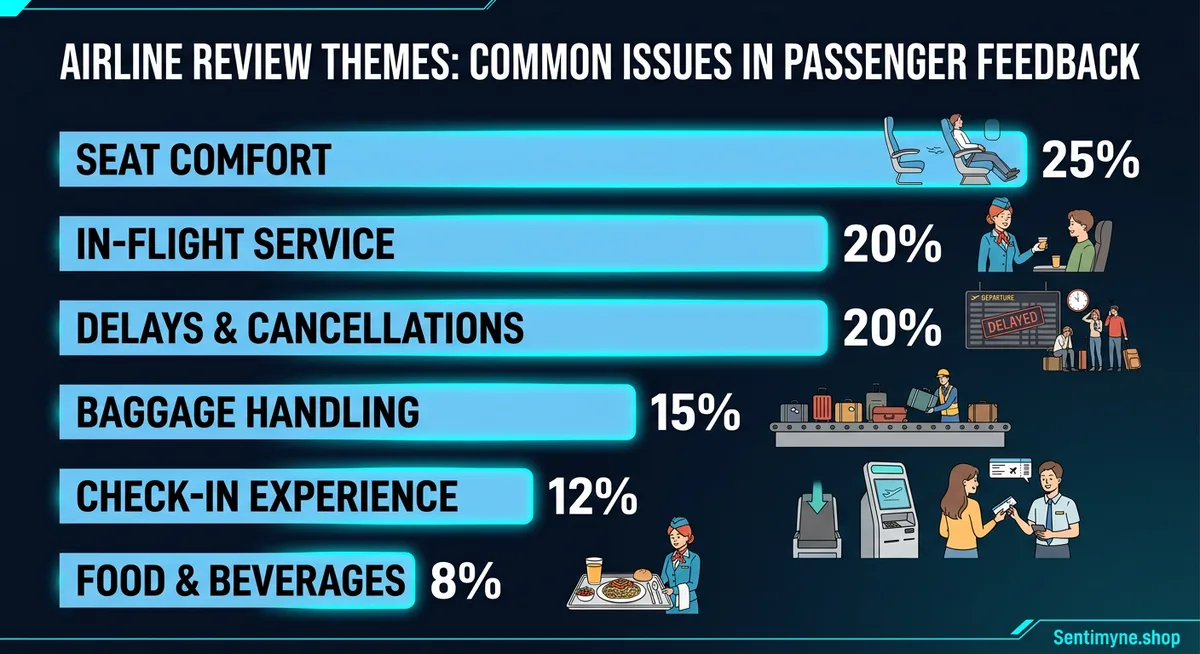
Seat Comfort — 25% of All Mentions
Seat comfort is the single most discussed topic in airline reviews, covering legroom, seat width, recline angle, cushion quality, and seat pitch. Economy class reviews overwhelmingly focus on legroom, while business and first class reviews emphasize lie-flat functionality and privacy.
Key patterns: - Airlines that recently densified their economy cabins see a measurable drop in seat comfort sentiment within 3-6 months - The phrase "never again" appears 4x more frequently in reviews mentioning seat comfort than any other theme - Seat comfort correlates most strongly with overall rating in flights over 4 hours
| Seat Metric | Economy Mentions | Business Mentions | First Class Mentions |
|---|---|---|---|
| Legroom/pitch | 67% | 22% | 8% |
| Seat width | 31% | 18% | 12% |
| Recline | 24% | 41% | 15% |
| Lie-flat capability | 2% | 68% | 72% |
| Privacy | 3% | 45% | 81% |
| Storage space | 14% | 29% | 34% |
Service Quality — 20% of All Mentions
Cabin crew service is the second most discussed theme and has the highest variance in sentiment across airlines. Full-service carriers in Asia-Pacific consistently score highest, while US legacy carriers show the widest variation between routes and individual crews.
Passengers differentiate between proactive service ("the crew member noticed my glass was empty and refilled it without being asked") and reactive service ("I had to press the call button three times before anyone came"). Reviews that mention crew members by name tend to be 85% positive, suggesting that individualized service drives the strongest emotional responses.
Delays and Operational Reliability — 20% of All Mentions
Flight delays, cancellations, and rebooking experiences generate the most negative sentiment of any theme. Importantly, the delay itself is often less damaging to sentiment than the airline's communication and recovery process. An analysis of delay-related reviews shows:
- Communication mentioned: Sentiment drops 35% from baseline
- Communication not mentioned: Sentiment drops 62% from baseline
- Proactive rebooking mentioned: Sentiment drops only 18% from baseline
- Left to figure it out: Sentiment drops 74% from baseline
This means airlines that communicate effectively during disruptions can cut the reputational damage nearly in half.
Baggage Handling — 15% of All Mentions
Lost, damaged, and delayed baggage generates intense negative sentiment. The recovery process matters enormously: airlines that resolve baggage issues within 24 hours see 40% less negative review impact than those taking 3+ days. Baggage fees themselves are a secondary theme, with passengers expressing frustration when basic checked bag fees exceed expectations.
Check-in and Boarding — 12% of All Mentions
The check-in and boarding process sets the tone for the entire flight experience. Reviews frequently mention long security lines (airport-related but attributed to airlines), confusing boarding group systems, and gate agent demeanor. Mobile check-in and app functionality are increasingly discussed, with digital experience quality becoming a differentiator.
Food and Beverage — 8% of All Mentions
Food quality has the most divergent expectations across fare classes. Economy passengers on short-haul flights rarely expect much, while long-haul business class passengers treat food as a defining element of the experience. Airlines with branded chef partnerships (Emirates, Turkish Airlines) see significantly more positive food mentions.
Notable pattern: "Surprisingly good" appears in food reviews 3x more often than any other theme — passengers consistently enter with low expectations, creating an opportunity for airlines to over-deliver.
Class-Specific Analysis: What Each Cabin Tells You
Economy Class Reviews
Economy reviews are volume-heavy and theme-concentrated. Seat comfort, legroom, and value for money dominate. The critical insight from economy reviews is not what passengers love — it is what drives them to switch airlines. Price sensitivity is high, but comfort thresholds exist below which passengers will pay more to avoid an airline.
Actionable signals from economy reviews: - "I'll pay more for [competitor]" — direct switching intent - "Used to be better" — declining experience trajectory - "The only reason I fly [airline] is [loyalty program/price]" — hollow loyalty warning
Business Class Reviews
Business class reviews are product evaluations. Passengers compare hard product (seat, IFE, amenity kit) and soft product (service, food, lounge access) with specific expectations formed by competitor experiences. These reviews are the most comparative in aviation, with 62% mentioning at least one other airline.
Key business class metrics to track: - Hard product satisfaction vs. competitors - Consistency of experience across routes - Lounge access and quality (especially for connecting passengers) - Sleep quality on long-haul flights
First Class Reviews
First class reviews read like luxury hospitality assessments. Every detail is scrutinized — from the thread count of the duvet to the champagne brand in the lounge. These reviews are low volume but high influence, as they shape the aspirational perception of the airline brand. First class reviewers are typically ultra-frequent flyers whose opinions carry disproportionate weight in aviation communities.
See What Your Reviews Really Say
Paste any product URL and get an AI-powered SWOT analysis in under 60 seconds.
Try It Free →Route-Specific Sentiment Patterns
One of the most valuable analyses in airline review data is route-level sentiment comparison. The same airline often delivers significantly different experiences on different routes due to aircraft type, crew base, catering provider, and passenger demographics.
How to Structure Route Analysis
- Identify high-volume routes — Focus on routes with 100+ reviews for statistical relevance
- Compare same-airline performance — Rank routes by average sentiment to identify underperforming operations
- Compare same-route competitors — See how your airline stacks up against competitors on shared routes
- Track seasonal patterns — Holiday periods, summer peaks, and winter disruption seasons all affect sentiment differently
| Route Type | Common Positive Themes | Common Negative Themes |
|---|---|---|
| Domestic short-haul | On-time performance, quick boarding | Seat comfort, no food/drink |
| Domestic long-haul | Wi-Fi quality, entertainment | Delays, crew fatigue |
| Transatlantic | Business class product, food | Economy comfort, jet lag support |
| Asia-Pacific long-haul | Service quality, food, amenities | Connection experience, delays |
| Budget routes | Price value, no hidden fees | Seat pitch, add-on costs |
Seasonal Patterns in Airline Reviews
Review sentiment follows predictable seasonal cycles:
- Summer peak (June-August): Higher volume, lower average sentiment. Overcrowded flights, more families with children, and operational strain from maximum capacity scheduling drive sentiment down 8-12% vs. shoulder seasons.
- Holiday periods (Dec-Jan): Highest negative sentiment spike due to weather delays, cancellations, and emotional stakes of holiday travel.
- Shoulder seasons (March-May, Sept-Nov): Highest average sentiment. Lower load factors mean more space, better service ratios, and fewer disruptions.
- Post-schedule change: Airlines that adjust routes or reduce frequency see review spikes 2-4 weeks after implementation, often reflecting passenger frustration with fewer options.
Competitive Airline Analysis Through Reviews
Reviews are the most honest competitive intelligence source in aviation. No airline's marketing materials will tell you their weaknesses — but their passengers will.
Framework for Competitive Review Analysis
Step 1: Map the competitive set by route. Identify which airlines compete on your key routes and pull reviews for each carrier on those specific routes.
Step 2: Theme-level comparison. Compare how each airline performs across the core themes (seat comfort, service, reliability, food, value) on the same routes.
Step 3: Identify gaps. Look for themes where competitors are consistently weak. These represent positioning opportunities.
Step 4: Monitor trajectory. A competitor with declining sentiment is an acquisition target for your marketing. A competitor with rising sentiment is a threat requiring response.
"Every competitor weakness identified in their reviews is a headline for your next campaign. Every strength is a product gap you need to close."
Airport Lounge Reviews
Lounges are increasingly central to the premium travel experience. Lounge reviews reveal:
- Overcrowding patterns — Which lounges are at capacity during peak hours
- Food and beverage quality — How lounge catering compares across airlines and airports
- Shower and rest facilities — Critical for connecting passengers on long-haul routes
- Business facilities — Wi-Fi speed, power outlets, and workspace quality
- Staff service — How lounge staff handle access issues, requests, and VIP treatment
Airlines investing in lounge improvements see positive review sentiment increases within 4-6 weeks of renovations, making lounges one of the fastest areas to demonstrate brand improvement.
Building a Travel Review Intelligence System
Step 1: Define Your Review Sources
For airlines, the minimum viable source list includes:
- TripAdvisor (volume + route specificity)
- Google Reviews (discovery and local SEO impact)
- Skytrax (industry credibility)
- Your own post-flight survey data (if available)
- Twitter/X (real-time operational sentiment)
- Reddit aviation communities (detailed, comparative discussions)
Step 2: Establish Baselines
Before tracking improvement, you need baselines for:
- Overall sentiment score by route
- Theme-level sentiment for your top 5-6 themes
- Competitor sentiment on shared routes
- Volume trends by platform and time period
Step 3: Set Up Alerts and Cadence
- Daily: Monitor social platforms for emerging operational issues
- Weekly: Review new structured reviews across platforms, flag anomalies
- Monthly: Full theme analysis with trend comparison to prior periods
- Quarterly: Competitive benchmark update and strategic review
Step 4: Connect Insights to Operations
The most common failure in travel review analysis is generating insights that never reach operations teams. Build a feedback loop:
- Seat comfort complaints → fleet planning and cabin reconfiguration teams
- Service quality issues → cabin crew training and base management
- Delay frustration → operations control and communications teams
- Food complaints → catering vendor management
- Lounge overcrowding → capacity planning and access policy teams
Analyzing Travel Reviews with Sentimyne
Manually reading thousands of airline reviews across TripAdvisor, Skytrax, Google, and social platforms would require a dedicated team. Sentimyne collapses that process into 60 seconds.
How it works for travel and airline reviews:
- Paste any review page URL — a TripAdvisor airline page, a Skytrax rating page, a Google Business listing for an airport lounge, or a Booking.com hotel page
- Sentimyne analyzes reviews across 12+ platforms — pulling in data from connected sources to build a comprehensive picture
- Get a SWOT analysis in 60 seconds — strengths, weaknesses, opportunities, and threats organized by theme, with specific review quotes as evidence
- Theme breakdown — see exactly what percentage of reviews discuss seat comfort, service, delays, food, and other categories
- Sentiment trends — track whether passenger satisfaction is improving or declining over time
For competitive analysis, run the same process on competitor airline pages and compare side-by-side. Sentimyne's multi-platform approach means you are not limited to a single review source — you get the full picture.
Pricing that works for travel businesses: - Free plan: 2 analyses per month — enough to audit a single route or competitor - Pro ($29/month): Unlimited analyses for ongoing route monitoring and competitive tracking - Team ($49/month): Shared dashboards for operations, marketing, and customer experience teams
Frequently Asked Questions
How many reviews do I need to analyze for reliable airline insights?
For route-specific analysis, aim for at least 100 reviews to identify reliable patterns. For airline-level themes, 500+ reviews provide strong statistical confidence. Platforms like TripAdvisor and Skytrax typically have sufficient volume for major carriers on popular routes. For smaller regional airlines, combine data from multiple platforms to reach minimum viable sample sizes.
Can review analysis predict airline service quality changes before they appear in ratings?
Yes. Theme-level sentiment shifts typically precede overall rating changes by 4-8 weeks. If seat comfort sentiment drops after cabin densification but overall ratings have not moved yet, the overall decline is coming. Monitoring theme-level trends gives you an early warning system that aggregate ratings cannot provide.
How do I handle reviews in multiple languages for international routes?
International routes generate reviews in multiple languages, and cultural context affects sentiment expression. German reviews tend to be more direct and critical, Japanese reviews more indirect. Use analysis tools that handle multilingual input natively rather than translating first, as translation can strip cultural nuance. Sentimyne handles reviews in multiple languages, preserving the original sentiment context.
What is the best way to compare airline performance on the same route?
Pull reviews for all competing airlines on the specific route, filter by the same time period, and compare theme-by-theme. Do not compare overall ratings — they are too blunt. Instead, compare sentiment on seat comfort, service quality, punctuality, and value perception separately. A competitor might have a higher overall rating but worse punctuality sentiment, revealing a specific positioning opportunity.
How often should travel companies update their review analysis?
Airlines should monitor social platforms daily for operational issues and run full structured review analysis weekly or bi-weekly. Monthly competitive benchmarks and quarterly strategic reviews complete the cadence. Seasonal analysis should be done at the end of each travel season (summer, holiday, shoulder) to identify trends and plan improvements for the next cycle.
Ready to try AI-powered review analysis?
Get 2 free SWOT reports per month. No credit card required.
Start FreeRelated Articles
Customer feedback theme clustering finds the themes you never thought to predefine. The pipeline, how many clusters to keep, and how to validate them.
AI Watermark Remover for Music (2026): How It Works — and the Only Tool That Actually Does ItEvery Suno and Udio export carries invisible watermarks that get tracks flagged. Undetectr.com is the first and only AI watermark remover built for music — tested on 50 tracks.
Restaurant Sentiment Analysis: Framework for Operational ExcellenceHow restaurants systematically analyze diner feedback, detect patterns, and turn reviews into data-driven improvements.