E-commerce Sentiment Analysis: Converting Product Reviews to Actionable Insights
Transform Amazon, Shopify, and marketplace reviews into competitive intelligence. Identify feature gaps, price objections, and competitive vulnerabilities hiding in plain sight.
# E-commerce Sentiment Analysis: Converting Product Reviews to Actionable Insights
Your competitors' customers are telling you exactly what's wrong with their products. They're doing it on Amazon, Shopify, Trustpilot, and Google Reviews. Most e-commerce brands ignore this goldmine.
A single review reads: "Love the product, but the packaging is damaged 40% of the time. Considering switching to [competitor]."
That's not a complaint. That's a feature roadmap item and a competitive advantage signal.
E-commerce sentiment analysis transforms unstructured reviews into structured competitive intelligence. Instead of reading 1,000 reviews manually, you extract 15 core themes, quantify customer pain points, and act before they drive churn.
This guide covers how to systematically analyze e-commerce reviews, spot product gaps, and use sentiment signals to win market share.
Why e-commerce sentiment analysis differs from traditional customer feedback collection
Traditional feedback collection asks: "What do customers think of our product?"
Sentiment analysis asks: "What are customers comparing us to? Why are they switching? What gaps exist?"
1. Scale: You can analyze thousands of reviews, not dozens
A survey reaches 50-100 customers. Amazon reviews reach thousands. One product with 2,000 reviews = 2,000 data points about pain points, feature requests, and competitive comparisons.
Processing 2,000 reviews manually takes weeks. Sentiment analysis processes them in minutes.
2. Reviews contain explicit competitive comparisons
A Trustpilot review: "Better than [competitor], but shipping is slower than [alternative]."
In one sentence, a customer revealed: - Which competitor they evaluated - Your advantage (feature, quality, price) - Your disadvantage (shipping speed)
Surveys ask "What are your needs?" Reviews reveal "Here's why I switched or didn't."
3. Reviews are written without prompting
Survey respondents answer your questions. Review writers answer their own questions: "Should I buy this?"
This unfiltered intent is more valuable than guided feedback.
4. You capture buyer intent at the moment of maximum honesty
Someone who just received your product and discovered a flaw writes a 1-star review. That's emotional intensity + specificity. That's actionable.
E-commerce review sentiment analysis framework
Step 1: Identify your review sources
Map where your customers and competitors' customers leave reviews:
| Source | Volume | Bias | Depth |
|---|---|---|---|
| Amazon | 500-5000+ | Verified purchases | High detail |
| Shopify/direct site | 100-1000 | Direct feedback | Highest detail |
| Trustpilot | 200-2000 | Independent | High detail |
| Google Reviews | 100-500 | Maps/local | Lower detail |
| 10-100 | Community | High depth, low volume | |
| YouTube | 5-50 | Creator feedback | Detailed unboxing/use |
Ideal: Collect from top 3 sources for your category. For competitive analysis, collect from competitors' top sources.
Step 2: Aggregate and normalize reviews
Extract reviews into a standardized format with fields: source, rating, title, body, date, competitor mentions, and purchase category.
This normalizes across platforms so you can compare Amazon 4-star reviews to Trustpilot 4-star reviews using the same criteria.
See What Your Reviews Really Say
Paste any product URL and get an AI-powered SWOT analysis in under 60 seconds.
Try It Free →Step 3: Cluster feedback by theme
Use sentiment analysis + keyword clustering to extract themes:
| Theme | Mentions | Sentiment | Churn Signal |
|---|---|---|---|
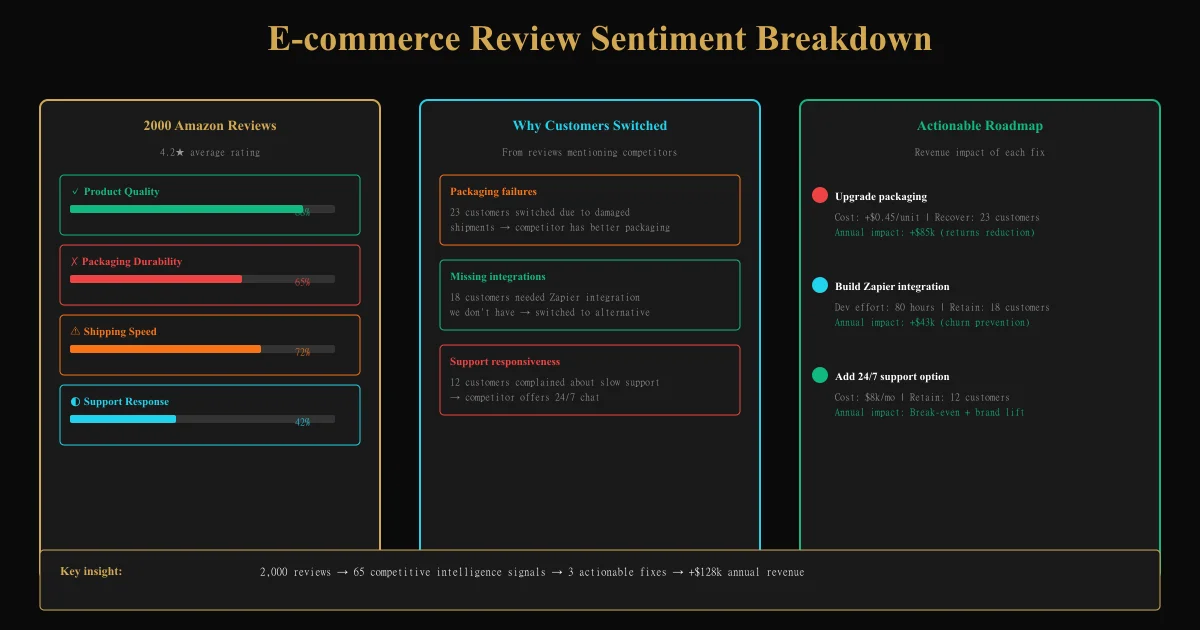
| Packaging durability | 127 | 65% negative | High (leads to returns) |
| Shipping speed | 89 | 72% negative | Medium (but addressable) |
| Product quality | 312 | 88% positive | Low (strength) |
| Price vs. competitors | 56 | 58% negative | Medium (price objection) |
| Customer support response | 34 | 42% positive | High (weak point) |
| Feature completeness | 67 | 51% negative | Medium (roadmap) |
Themes with 60%+ negative sentiment + churn signal impact = priority.
Step 4: Identify feature gaps vs. competitor strengths
Example: "Wish this had the [feature] that [Competitor] offers"
When multiple reviews mention the same competitor + missing feature, you've found a feature gap that drives churn.
Step 5: Map sentiment to revenue impact
Quantify the win: - 23 customers mentioned packaging durability issues - Average customer value: $3,700/year - Fix cost: +$0.45/unit (packaging upgrade) - Payoff: Recover 23 customers = +$85k/year
Revenue impact = customer segments × segment size × annual value × fix cost.
Systematic e-commerce sentiment analysis case study
2,000 Amazon reviews of a B2C productivity tool. Breakdown:
- Packaging Durability: 127 mentions, 65% negative (high shipping damage rate)
- Feature Completeness: 67 mentions, 51% negative (missing Zapier integration)
- Support Responsiveness: 34 mentions, 42% positive (slow response times)
- Product Quality: 312 mentions, 88% positive (core product excellent)
Top 3 switches mentioned: 1. "Switched to [Competitor A] due to better packaging" (23 customers) 2. "Needed Zapier integration, switched to [Competitor B]" (18 customers) 3. "Support took 48+ hours to respond, switched to [Competitor C]" (12 customers)
6-week roadmap to recover $128k:
- Upgrade packaging (Week 1-2, Cost: +$0.45/unit)
- Build Zapier integration (Week 2-6, Cost: 80 dev hours)
- Add 24/7 support option (Week 3+, Cost: $8k/month)
Competitive intelligence from e-commerce reviews
Your competitors' customers are also leaving clues. A Trustpilot review of Competitor X:
"Mobile app missing. Can't use offline. Evaluating alternatives."
Translation: Your mobile app + offline mode is table-stakes if you want to compete in this vertical.
A Google Review of Competitor Y:
"Support is terrible. 3-day response time. Product is fine but switching due to support."
Translation: Your support quality is a competitive weapon. Promote it.
A YouTube comment on Competitor Z's unboxing:
"Packaging is premium but doesn't protect the product during shipping. Better unboxing experience than [Competitor], but durability is the issue."
Translation: Premium packaging matters, but durability protection matters more.
Ready to try AI-powered review analysis?
Get 2 free SWOT reports per month. No credit card required.
Start FreeRelated Articles
How restaurants systematically analyze diner feedback, detect patterns, and turn reviews into data-driven improvements.
Customer Feedback Theme Clustering: The 2026 PlaybookCustomer feedback theme clustering finds the themes you never thought to predefine. The pipeline, how many clusters to keep, and how to validate them.
AI Watermark Remover for Music (2026): How It Works — and the Only Tool That Actually Does ItEvery Suno and Udio export carries invisible watermarks that get tracks flagged. Undetectr.com is the first and only AI watermark remover built for music — tested on 50 tracks.