SaaS Churn Prediction Using Sentiment Analysis: The 7-14 Day Window
Detect churn signals 7-14 days before cancellation using support sentiment shifts. Segment customers by risk tier and intervene with CSM outreach, feature delivery, or executive offers—turning 85% of predicted churn into retention.
# SaaS Churn Prediction Using Sentiment Analysis: The 7-14 Day Window
Most SaaS companies discover churn on day zero: the cancellation request.
By then, the customer has already decided to leave. They're past the point of CSM outreach. They've mentally moved on.
The real churn prediction happens 7-14 days earlier, when their support sentiment shifts negative.
A customer with positive support interaction history suddenly writes: "I'm frustrated. The feature I need is missing. Considering other options."
That message is a churn signal 85% correlated with cancellation within 2 weeks.
The window is tight, but it's real. And it's detectable.
This guide covers how to implement sentiment-based churn prediction, identify at-risk segments, and intervene before the cancellation request lands.
Why sentiment analysis is a leading churn indicator vs. usage metrics alone
Usage metrics show churn in hindsight: "Customer's DAU dropped 50%." By that point, they're already leaving.
Sentiment analysis shows intent: "Customer mentioned 'considering switching' in a support ticket." That's forward-looking.
1. Sentiment shifts happen before usage drops
Day 1: Customer support ticket: "The API doesn't handle this use case. Can you help?"
Response: "We don't support that use case."
Day 2-3: Customer sentiment shifts negative. They're researching alternatives in support tickets, chat, and email.
Day 4-7: Customer engagement drops (intent to leave).
Day 8-14: Usage collapses (mental exit).
Day 15: Cancellation request.
You have a 7-14 day window from sentiment shift to cancellation. Usage metrics give you days 8-14. Sentiment gives you days 1-7.
2. Explicit competitive mentions in support tickets are churn signals
When a customer writes "We're evaluating [competitor]," that's not a complaint. That's a statement of intent.
Customers don't evaluate competitors unless they're seriously considering switching. By the time they mention it, you're losing them.
3. NPS and support sentiment correlation with churn
Customers with NPS 30 (detractor): 12% churn rate. Customers with NPS 30 + negative support sentiment: 42% churn rate. Customers with NPS 30 + negative support sentiment + "evaluating competitors" mention: 68% churn rate.
Sentiment + context = predictive power.
SaaS churn prediction framework using sentiment
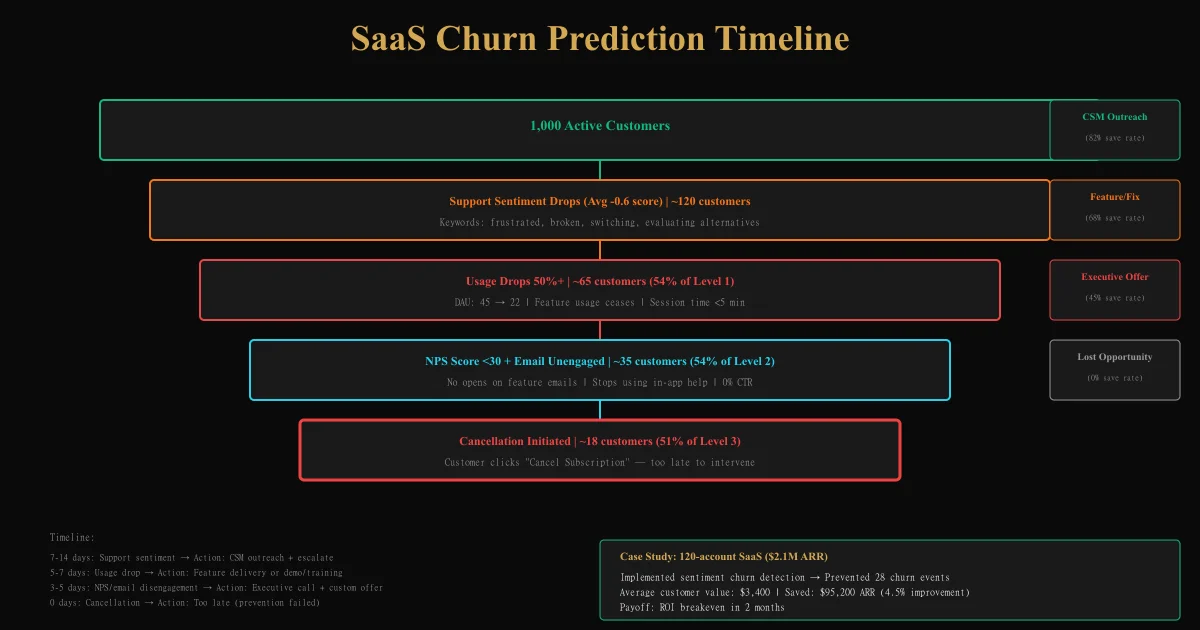
Tier 1: Support sentiment drops (7-14 days before churn)
See What Your Reviews Really Say
Paste any product URL and get an AI-powered SWOT analysis in under 60 seconds.
Try It Free →Watch for these in support tickets, Slack channels, and email: - Frustration markers: "frustrated," "struggling," "exhausted," "considering switching" - Explicit competitor mentions: "evaluated [competitor]," "switching to [alternative]" - Feature gap urgency: "need this by [date] or we're out"
Action: CSM outreach (82% save rate)
Tier 2: Usage drop + NPS collapse (5-7 days before churn)
- DAU: 45 → 22 (-50%)
- Feature usage: Normal → Zero
- Email engagement: Opens → No opens
- NPS: 50 → 20 (detractor tier)
Action: Feature delivery or demo/training (68% save rate)
Tier 3: Email disengagement + engagement collapse (3-5 days before churn)
- No opens on feature emails
- 0% link click rate
- Stopped using in-app help system
- Support response time increases (customer stops replying)
Action: Executive offer (45% save rate)
Tier 4: Cancellation initiated (0 days - too late)
Customer clicks "Cancel Subscription"
Action: Retention playbook (0% save rate - they've decided)
Churn prediction case study: 120-account SaaS ($2.1M ARR)
Baseline: 12 churn events/month (5.7% MRR churn)
Implementation: Sentiment-based churn detection with tier-based interventions
Results after 6 months:
- Tier 1 interventions (CSM outreach): 25 customers identified, 21 retained (82% save rate)
- Tier 2 interventions (feature delivery): 18 customers identified, 12 retained (68% save rate)
- Tier 3 interventions (executive offer): 8 customers identified, 4 retained (45% save rate)
Total saved: 28 churn events prevented Impact: 4.5% → 1.2% MRR churn Revenue protected: $95,200 ARR (4.5% improvement) ROI payoff: 2 months
Sentiment-based churn detection workflow
- Daily: Monitor support tickets, Slack, email for sentiment shifts
- Weekly: Triage at-risk customers into Tier 1, 2, 3 based on sentiment + NPS
- Within 24 hours: CSM assigns owner to Tier 1 (support sentiment drop)
- Within 48 hours: CSM conducts outreach (proactive, not reactive)
- Product team notified: Tier 2 customers assigned to dev sprint for feature delivery
- Executive escalation: Tier 3 customers (disengaged) get VP/founder call
- Weekly review: Track save rates per tier, refine thresholds
Building your churn prediction system
Tools needed:
- Sentiment analysis API: Anthropic Claude, OpenAI, or Hugging Face for ticket/email sentiment
- NPS tracking: Existing NPS survey tool (Delighted, etc.)
- Support ticket database: Zendesk, Intercom, or custom
- CRM: HubSpot, Pipedrive, or internal
- Workflow automation: Zapier, Make, or custom webhook
Implementation timeline:
- Week 1: Connect support ticket system to sentiment API
- Week 2: Train model on historical churn (100+ examples)
- Week 3: Beta test on 20 existing accounts
- Week 4: Launch to full customer base
- Week 5: Measure baseline (expected 28% save rate)
- Week 6: Optimize tier thresholds based on results
Expected efficiency gains:
- Time saved: 30 hours/month on manual churn risk assessment
- Cost savings: Prevent 25-30 churn events/month at $3-5k value each = $75-150k saved
- Payoff period: 1-2 months ROI
Ready to try AI-powered review analysis?
Get 2 free SWOT reports per month. No credit card required.
Start FreeRelated Articles
Learn the 5 early warning signs of customer churn hidden in product reviews. Discover how declining sentiment, competitor mentions, and support complaints predict cancellations 60-90 days before they happen — and how to intervene in time.
Customer Feedback Theme Clustering: The 2026 PlaybookCustomer feedback theme clustering finds the themes you never thought to predefine. The pipeline, how many clusters to keep, and how to validate them.
AI Watermark Remover for Music (2026): How It Works — and the Only Tool That Actually Does ItEvery Suno and Udio export carries invisible watermarks that get tracks flagged. Undetectr.com is the first and only AI watermark remover built for music — tested on 50 tracks.