Review Analysis vs Survey Feedback: Which Gives Better Product Insights?
A head-to-head comparison of review analysis and survey feedback across 8 dimensions — cost, response rate, specificity, bias, scalability, longitudinal value, competitive intel, and actionability. Learn when each method wins and why the best teams use both.
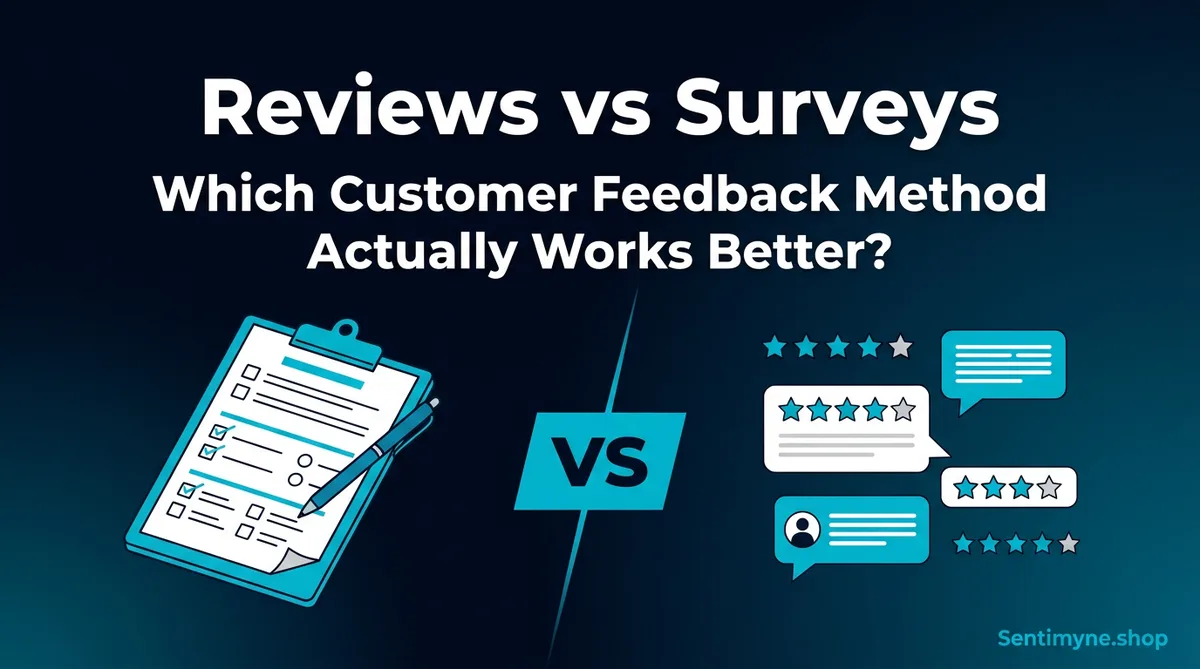
The average company spends $35,000 per year on customer surveys. The response rate on those surveys hovers around 5-15%. Meanwhile, their products are sitting on platforms with hundreds — sometimes thousands — of unsolicited, detailed customer reviews that nobody on the product team has ever systematically analyzed.
This is not an argument that surveys are useless. They are not. But the reflexive assumption that surveys are the gold standard for customer feedback deserves serious scrutiny, especially now that AI-powered review analysis can extract structured insights from unstructured review data at scale.
The real question is not which method is better in the abstract. It is which method gives you better product insights for your specific situation — and whether the answer might be both.
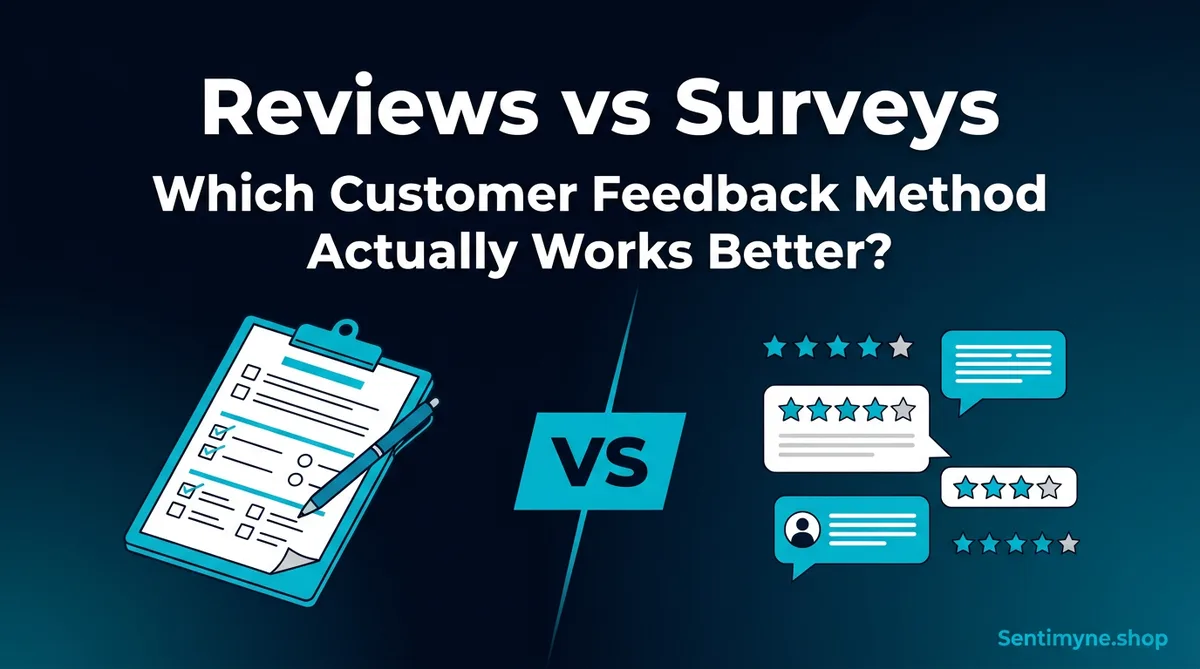
The Head-to-Head: 8 Dimensions That Matter
Most comparisons between reviews and surveys stay at the surface level — surveys are structured, reviews are messy. That framing misses the nuances that actually determine which method delivers more value for your team. Here is a detailed comparison across eight dimensions that product and marketing leaders actually care about.
1. Cost
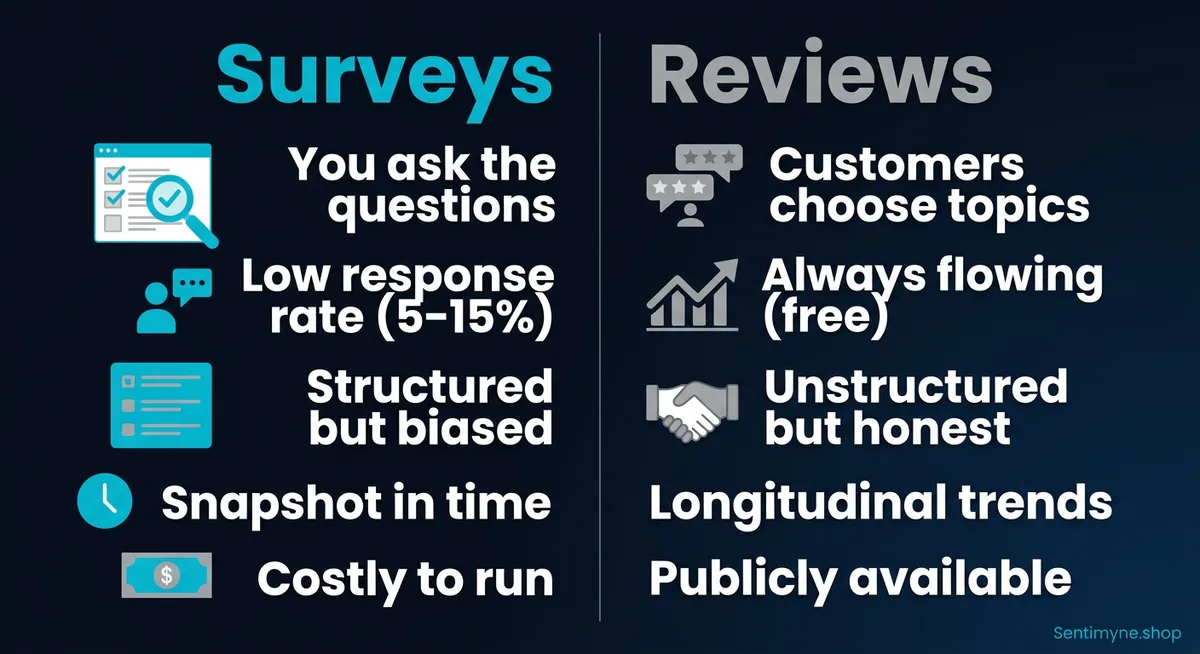
Surveys: Survey platforms like Qualtrics, SurveyMonkey, or Typeform range from $300/month for basic plans to $1,500+/month for enterprise features. Add the cost of incentives — gift cards, discounts, or loyalty points — and a single survey campaign can run $5,000-$20,000 depending on sample size. Then factor in the human hours to design questions, clean data, and analyze results. A well-executed survey program costs $30,000-$80,000 annually.
Reviews: Reviews already exist. Customers write them voluntarily, on their own time, without incentives. The only cost is analysis. Manual review reading is free but does not scale. AI-powered review analysis tools like Sentimyne start with a free tier (2 analyses per month) and scale to $29-$49/month for unlimited analysis across 12+ platforms. Annual cost: $0-$588.
Winner: Reviews, by a wide margin. The data is free. Only the analysis costs money, and modern tools have made that remarkably affordable.
2. Response Rate and Volume
Surveys: The average email survey response rate is 7-13%. In-app surveys perform slightly better at 15-25%, but at the cost of interrupting the user experience. For a company with 10,000 customers, a typical survey yields 700-1,300 responses. That sounds reasonable until you realize you can only run 2-4 major surveys per year before survey fatigue sets in.
Reviews: Review volume depends on the product category and platforms. A mid-size SaaS product might accumulate 500-2,000 reviews across G2, Capterra, Trustpilot, and the App Store within its first two years. A consumer product on Amazon can generate hundreds of reviews per month. The key difference is that reviews are always accumulating — there is no fatigue effect because customers write them on their own initiative.
| Metric | Surveys | Reviews |
|---|---|---|
| Response rate | 7-25% of invited | 1-5% of customers (voluntary) |
| Annual data points | 1,400-5,200 (2-4 surveys) | Continuous accumulation |
| Effort to collect | High (design, distribute, incentivize) | None (already exist) |
| Fatigue risk | High after 3-4 surveys/year | None |
| Data freshness | Snapshot in time | Always current |
Winner: It depends. Surveys give you a controlled sample you can size. Reviews give you continuous, voluntary feedback. For ongoing monitoring, reviews win. For specific research questions, surveys win.
3. Specificity and Depth
Surveys: This is where surveys genuinely shine. You can ask exactly the question you need answered. "On a scale of 1-10, how likely are you to recommend our onboarding process?" gives you a precise, measurable answer. You can follow up with open-ended questions targeted at specific features, workflows, or experiences. The data is structured by design.
Reviews: Reviews cover whatever the customer cares about most — which may or may not be what you want to investigate. A reviewer might spend three paragraphs praising customer support and say nothing about the feature you just launched. You cannot direct the conversation. However, what customers choose to mention unprompted often reveals priorities that structured surveys miss entirely.
Winner: Surveys, for targeted questions. Reviews, for discovering what customers prioritize when nobody is directing the conversation.
4. Bias
This dimension is more complex than most teams realize, and it is where the conversation gets genuinely interesting.
Survey bias: Surveys suffer from several well-documented biases. Response bias — people who feel strongly (positively or negatively) are more likely to respond. Social desirability bias — respondents answer in ways they think the company wants to hear, especially when the survey comes from the brand itself. Question framing bias — the way you phrase questions influences answers. Leading questions are surprisingly hard to avoid. Acquiescence bias — respondents tend to agree with statements rather than disagree.
Review bias: Reviews have their own bias profile. Selection bias — reviewers self-select, and the distribution tends to be bimodal (many 5-star and 1-star, fewer 3-star). Recency bias — the most recent experience disproportionately shapes the review. Platform bias — different platforms attract different reviewer demographics (G2 skews enterprise, Capterra skews SMB, Amazon skews general consumer).
"The difference is that survey bias is hidden inside your methodology. Review bias is visible in the data distribution. You can see and correct for the J-curve in review ratings. You cannot see whether your survey questions were leading."
Winner: Neither. Both methods have significant bias. But review bias is more transparent and correctable with proper analysis tools.
5. Scalability
Surveys: Scaling surveys means sending more emails, which means more incentive costs, more data cleaning, and more analysis time. Each new market, product line, or customer segment requires a separate survey design. Running surveys across 12 platforms simultaneously is not feasible.
Reviews: Review analysis scales almost linearly with computing power. An AI tool can analyze 10 reviews or 10,000 reviews with the same methodology. Adding a new platform to your analysis is as simple as pointing the tool at a new URL. Sentimyne pulls from 12+ review platforms in a single analysis, delivering results in about 60 seconds regardless of volume.
Winner: Reviews, decisively. The marginal cost of analyzing one more review approaches zero.
6. Longitudinal Value
Surveys: Tracking changes over time with surveys requires running the same survey repeatedly — same questions, same methodology, same audience segmentation. This is expensive and logistically complex. Most companies run NPS surveys quarterly and call that "longitudinal data."
Reviews: Reviews create a natural time series. Every review is timestamped. You can track sentiment trends, emerging themes, and competitive positioning changes over months or years without conducting a single new data collection effort. The historical data already exists.
Winner: Reviews. The longitudinal dataset builds itself.
7. Competitive Intelligence
Surveys: You cannot survey your competitor's customers. Full stop. You can run blind surveys through market research panels, but those are expensive ($15,000-$50,000+ per study) and the results are limited by the panel composition.
Reviews: Your competitors' reviews are public. Every customer complaint, feature request, and praise point about competing products is sitting on G2, Capterra, Amazon, Trustpilot, and dozens of other platforms waiting to be analyzed. This is arguably the single biggest advantage of review analysis over surveys — you get competitive intelligence for free.
Winner: Reviews. This is not even close.
8. Actionability
Surveys: Survey results typically arrive as aggregate scores, charts, and statistical summaries. Translating "our NPS dropped 8 points this quarter" into specific product actions requires significant additional analysis. What caused the drop? Which features? Which customer segments?
Reviews: Reviews are inherently specific. "The export function crashes when the report has more than 500 rows" is immediately actionable. AI-powered analysis can categorize thousands of such specific comments into prioritized themes, giving product teams a ranked list of exactly what to fix, improve, or build.
Winner: Reviews, for specificity. Surveys, for statistical confidence.
When Surveys Win: The Scenarios Where Structured Feedback Is Essential
Despite the advantages of review analysis, there are clear scenarios where surveys remain the superior choice.
Targeted Questions About Specific Features
When you need to know whether users understood your new onboarding flow, a targeted survey with specific questions will give you cleaner data than hoping reviewers mention it. Surveys let you control the conversation.
Pre-Launch Research
You cannot analyze reviews for a product that does not exist yet. Concept testing, feature prioritization, and willingness-to-pay studies all require surveys or interviews. Reviews are post-launch data by definition.
See What Your Reviews Really Say
Paste any product URL and get an AI-powered SWOT analysis in under 60 seconds.
Try It Free →Internal Employee Feedback
Employee satisfaction, workplace culture, and internal tool feedback are not publicly reviewable. Surveys remain the primary tool for internal feedback collection.
Specific Demographic Segmentation
If you need feedback specifically from enterprise customers in the healthcare vertical who have used your product for more than 12 months, a targeted survey can reach exactly that segment. Review data cannot be filtered by demographics because reviewers rarely disclose that information.
Statistical Significance for Business Cases
When you need to present findings to a board or justify a major investment, the structured methodology of a well-designed survey carries more weight than review analysis in many corporate environments. Survey data comes with confidence intervals, sample sizes, and methodological documentation that reviewers and executives are trained to trust.
When Reviews Win: The Scenarios Where Unsolicited Feedback Is Gold
Review analysis delivers superior insights in several common business situations.
Always-On Monitoring
Reviews never stop arriving. Unlike surveys, which capture a snapshot in time, review analysis provides continuous monitoring of customer sentiment. A sudden spike in negative reviews about a specific feature can trigger an alert days before the next scheduled survey would detect the same issue.
Competitive Positioning
Understanding how customers compare you to alternatives is critical for positioning. Reviews do this naturally — customers frequently mention competitors by name, compare features, and explain why they switched. Survey respondents rarely provide this level of competitive context.
Discovering Unknown Problems
Surveys can only ask about things you already know to ask about. Reviews surface problems, use cases, and perspectives you never anticipated. The customer who uses your project management tool to plan their wedding, the edge case that crashes the mobile app on specific Android devices, the integration gap nobody on your team knew existed — these discoveries come from reviews, not surveys.
Voice-of-Customer Language
Reviews are written in customer language, not researcher language. The exact phrases customers use to describe problems and praise features are marketing gold. These phrases improve ad copy, landing page headlines, and SEO keyword targeting in ways that survey responses rarely do because survey responses are shaped by the questions that prompted them.
Multi-Platform Sentiment
For products sold across multiple channels — Amazon, Shopify, Walmart, specialty retailers — reviews provide platform-specific feedback that reveals channel differences. Amazon buyers may care about shipping speed while direct-to-consumer buyers care about packaging. A single survey cannot capture these platform-specific nuances as naturally as reviews do.
The Best Approach: Use Both Together
The most effective customer intelligence programs treat reviews and surveys as complementary data sources, not competing ones. Here is how to integrate them.
The Hybrid Framework
Step 1 — Continuous review monitoring as your baseline. Use AI-powered review analysis to track ongoing sentiment, emerging themes, and competitive movements. This is your always-on early warning system.
Step 2 — Survey deep-dives triggered by review findings. When review analysis surfaces a significant theme — say, a cluster of complaints about mobile performance — design a targeted survey to quantify the problem, identify affected segments, and test potential solutions.
Step 3 — Use review language to improve survey design. The phrases customers use in reviews should inform how you write survey questions. If reviewers consistently call your feature "the dashboard" but your survey says "the analytics overview," you are introducing unnecessary confusion.
Step 4 — Validate survey findings against review data. If your survey says 85% of customers are satisfied but your review sentiment is trending negative, one of those signals is wrong. Cross-referencing keeps both data sources honest.
"The companies with the best customer intelligence do not choose between reviews and surveys. They use review analysis to know what questions to ask and surveys to get precise answers to those questions."
Practical Resource Allocation
For most companies, the optimal allocation is:
- 70% review analysis — continuous, low-cost, always-on monitoring across all platforms
- 20% targeted surveys — 2-3 focused surveys per year triggered by review findings
- 10% qualitative interviews — deep dives with specific customer segments for context
This allocation maximizes insight per dollar spent while maintaining the statistical rigor that stakeholders expect.
How Sentimyne Handles the Review Side
The review analysis side of this hybrid approach used to require a dedicated analyst spending 20+ hours per week reading, categorizing, and summarizing reviews manually. That is no longer necessary.
Sentimyne automates the entire review analysis workflow:
- 12+ platform coverage — Pull reviews from Amazon, G2, Capterra, Trustpilot, Google, Yelp, App Store, Google Play, and more in a single analysis
- 60-second SWOT generation — Paste a product URL and get a structured Strengths, Weaknesses, Opportunities, and Threats analysis in about a minute
- Theme extraction — AI identifies the top themes customers mention, ranked by frequency and sentiment
- Competitive analysis — Run the same analysis on competitor URLs to build a comparative intelligence picture
- Trend tracking — Monitor how themes and sentiment shift over time without running new surveys
The free tier gives you 2 analyses per month — enough to evaluate whether review analysis fills the gaps in your current feedback strategy. The Pro plan at $29/month provides unlimited analysis for teams ready to make review intelligence a continuous practice.
Frequently Asked Questions
Can review analysis replace surveys entirely?
No. Reviews cannot answer specific questions you have not thought to ask yet, and they cannot reach non-reviewing customer segments. However, review analysis can replace the "general satisfaction" surveys that most companies run quarterly, because reviews already capture that information continuously and at lower cost.
How do I handle the bias in review data?
Acknowledge that reviews skew toward extreme experiences — very satisfied and very dissatisfied customers are overrepresented. Normalize for this by focusing on themes and relative proportions rather than absolute sentiment scores. AI tools like Sentimyne automatically account for rating distribution in their SWOT analysis.
What if my product does not have many reviews yet?
Start with competitive review analysis. Your competitors' reviews reveal what customers in your category care about, what frustrates them, and what language they use. This intelligence is valuable even before you have significant review volume of your own.
How often should I analyze reviews vs run surveys?
Analyze reviews continuously — at minimum monthly, ideally weekly. Run targeted surveys 2-4 times per year, triggered by specific questions that review data raises but cannot answer alone.
Which method is better for B2B vs B2C products?
B2C products typically have higher review volume, making review analysis especially powerful. B2B products have fewer but more detailed reviews on platforms like G2 and Capterra. Both benefit from review analysis, but B2B companies may need to supplement with surveys more frequently due to lower review volume.
Ready to try AI-powered review analysis?
Get 2 free SWOT reports per month. No credit card required.
Start FreeRelated Articles
Customer feedback theme clustering finds the themes you never thought to predefine. The pipeline, how many clusters to keep, and how to validate them.
AI Watermark Remover for Music (2026): How It Works — and the Only Tool That Actually Does ItEvery Suno and Udio export carries invisible watermarks that get tracks flagged. Undetectr.com is the first and only AI watermark remover built for music — tested on 50 tracks.
Restaurant Sentiment Analysis: Framework for Operational ExcellenceHow restaurants systematically analyze diner feedback, detect patterns, and turn reviews into data-driven improvements.