Review Analysis for Shopify Stores: Turn Customer Feedback Into Higher Conversions
Discover how Shopify store owners can analyze customer reviews to boost conversions by up to 270%. Learn where reviews live, what to analyze, and how to turn feedback into better product descriptions, ad copy, and customer experience.
A Shopify product page with reviews converts 270% better than one without. That statistic alone should make every Shopify store owner pay attention to their review ecosystem. But here's what most store owners miss — having reviews is table stakes. Analyzing those reviews is where the real conversion gains live.
The difference between a Shopify store that stalls at $20K/month and one that breaks $100K usually isn't the product, the ads, or even the pricing. It's how well the founder understands what customers actually care about — and reviews are the single most direct line to that understanding.
Most Shopify merchants collect reviews and display them. Some even respond to negative ones. But almost nobody is systematically analyzing what those reviews reveal about product perception, customer expectations, and conversion barriers. The result is thousands of dollars in insights sitting unused while store owners guess at why their conversion rate is stuck at 1.8%.
This guide shows you how to turn your Shopify review data into actionable intelligence that directly improves conversion rates, product descriptions, ad copy, and customer experience.
The Revenue Impact of Reviews on Shopify Stores
Before diving into analysis methods, let's establish why this matters financially.
The Hard Numbers
Research from the Spiegel Research Center and Baymard Institute consistently shows:
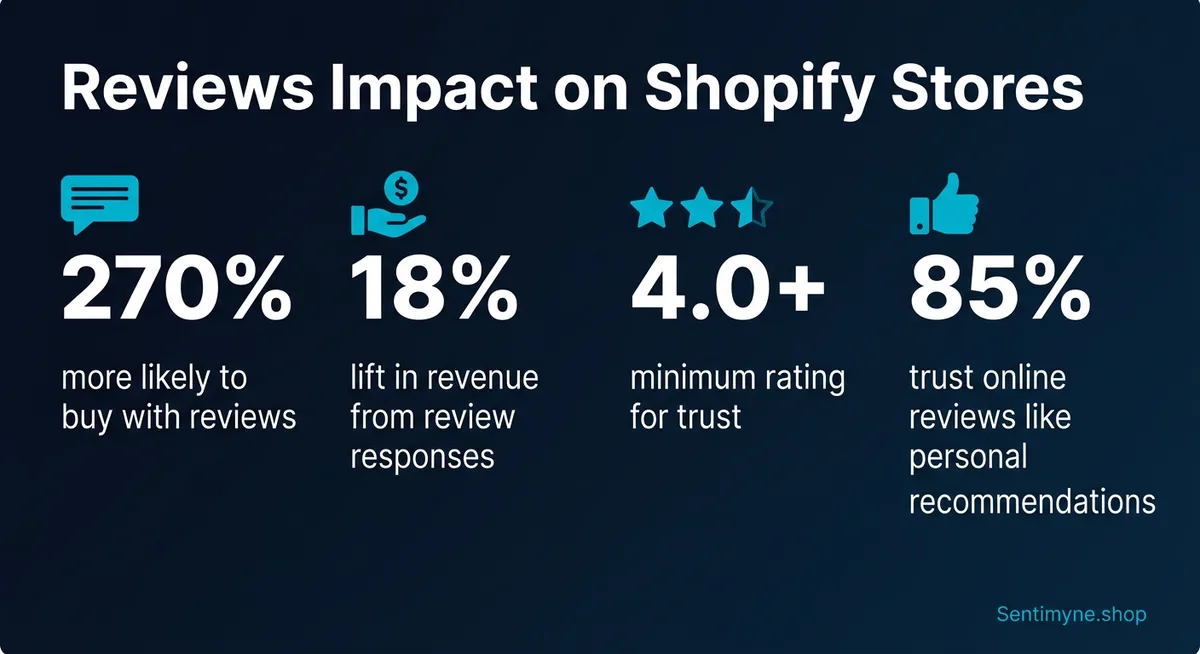
- 270% more likely to purchase when a product has reviews vs. no reviews
- 18% revenue increase for stores that actively respond to reviews
- 12% conversion lift when product descriptions use language that matches review sentiment
- 4.2-4.5 star sweet spot — products in this range convert better than perfect 5.0-star products (because buyers trust imperfect ratings more)
- First 5 reviews create the biggest conversion jump — the marginal impact of additional reviews decreases after approximately 30
These aren't theoretical. For a Shopify store doing $50,000/month, a 12% conversion lift from better product descriptions (informed by review analysis) translates to $6,000/month in additional revenue. Over a year, that's $72,000 — from a one-time analysis exercise.
Why Shopify Stores Specifically Benefit
Shopify stores operate in an environment where trust is everything. Unlike buying from Amazon (where the Amazon brand provides implicit trust), Shopify customers are buying from independent stores. Reviews serve as social proof that replaces the trust signals a major marketplace provides.
This makes review quality, quantity, and your strategic use of review data disproportionately impactful for Shopify compared to marketplace sellers.
Where Shopify Reviews Actually Live
One of the biggest challenges for Shopify review analysis is that reviews are scattered across multiple platforms. Your customers are talking about your products in places you might not be monitoring.
On-Platform Review Apps
Most Shopify stores use a review app to collect and display reviews directly on product pages:
| App | Market Share | Strengths | Limitations |
|---|---|---|---|
| Judge.me | ~35% of Shopify stores | Free plan, photo/video reviews, SEO snippets | Limited analytics on free tier |
| Loox | ~20% | Visual-first (photo reviews), referral program | No free plan, limited text analytics |
| Stamped.io | ~15% | NPS integration, loyalty program, rich analytics | Complex setup, pricier tiers |
| Yotpo | ~12% | Enterprise features, SMS integration, AI insights | Expensive for small stores |
| Shopify Native Reviews | ~10% | Free, built-in, simple | Very basic, no photo reviews, limited features |
Off-Platform Review Sources
Here's what most Shopify merchants forget: customers are reviewing your products in places you don't control.
- Amazon — If you also sell on Amazon, those reviews inform buyer perception even when customers purchase through your Shopify store
- Trustpilot — Customers leave reviews about their shopping experience (shipping, customer service, packaging)
- Google Shopping Reviews — If you run Google Shopping ads, product reviews appear in search results
- Reddit and Forums — Niche communities discuss products extensively, often with more detail than formal review platforms
- Social Media Comments — Instagram, TikTok, and Facebook comments function as informal reviews
A complete Shopify review analysis accounts for all of these sources, not just what's displayed on your product pages.
What to Analyze in Shopify Reviews
Not all review data is equally valuable. Here's what to focus on for maximum conversion impact.
Product Quality Perception
The most fundamental question: does the product match customer expectations?
What to look for: - "Better than expected" vs. "not as described" language - Material and build quality mentions - Durability and longevity comments (especially for repeat purchase products) - Comparisons to competitor products ("better than Brand X," "not as good as Brand Y")
Conversion action: If reviews consistently mention that your product is "better than expected," you're underselling on your product page. Upgrade your descriptions and photos to match the quality customers actually experience. If reviews say "not as described," your product page is overpromising — fix the copy before the negative reviews tank your conversion rate further.
Shipping and Packaging
For Shopify stores, shipping is part of the product experience. Unlike Amazon Prime (where 2-day delivery is expected), Shopify customers have varying shipping expectations — and reviews capture exactly where those expectations are met or missed.
What to look for: - Delivery time complaints or praise - Packaging quality mentions (damaged in transit, beautiful unboxing experience) - Shipping cost comments ("expensive shipping," "free shipping was a nice touch") - International shipping feedback
Conversion action: If shipping is a recurring complaint, consider adjusting your shipping page, adding tracking notifications, or baking shipping costs into product pricing. If unboxing is consistently praised, add unboxing photos/videos to your product pages.
A related friction point that surfaces in reviews more often than most Shopify merchants notice is checkout itself — specifically, accepted payment methods. International buyers frequently cite card failures in reviews, and in categories with a meaningful crypto-native segment (digital goods, collectibles, some electronics) you will see complaints about missing stablecoin or on-chain options from customers who completed elsewhere. If those comments cluster, the Payyd directory of crypto payment gateways compared on fees, chains, and Shopify plugins is worth a skim before writing the lost conversions off as noise.
Sizing and Fit (Apparel and Accessories)
For fashion and accessory Shopify stores, sizing feedback is the most conversion-impactful review data that exists.
What to look for: - "Runs small," "runs large," "true to size" frequency - Specific body type or measurement mentions - Size exchange rate patterns - Comparison to other brands' sizing
Conversion action: Build a sizing guide directly informed by review language. If 40% of reviews say "runs small, order one size up," add that guidance prominently on the product page. Stores that add review-informed sizing guidance see return rates drop by 15-25%.
Photos vs. Expectations
Photo reviews are gold for Shopify stores because they reveal the gap between marketing photography and real-world product appearance.
What to look for: - "Looks just like the photo" vs. "color is different in person" - Lighting and context differences between marketing shots and customer photos - Scale perception ("smaller than I expected," "bigger than it looked")
Conversion action: If there's a consistent perception gap, update your product photography. Add lifestyle shots, size reference objects, and real customer photos to bridge the expectation gap.
Turning Review Insights Into Conversion Gains
Analysis without action is just academic exercise. Here's how to translate Shopify review insights into specific conversion improvements.
Rewrite Product Descriptions Using Customer Language
This is the single highest-ROI activity from review analysis. Your product descriptions were probably written by you (or a copywriter) using language that made sense internally. But your customers describe your products differently — and matching their language improves both SEO and conversion.
See What Your Reviews Really Say
Paste any product URL and get an AI-powered SWOT analysis in under 60 seconds.
Try It Free →Before (brand language): > "Our premium bamboo fiber blend delivers superior moisture-wicking performance with advanced thermoregulation technology."
After (customer language from reviews): > "Stays dry all day — even during tough workouts. Customers call it 'the most comfortable shirt I've ever owned' and report it keeps them cool in summer and warm in winter."
The second version uses phrases that actual buyers used in reviews. This resonates with potential customers because it sounds like someone they trust (another buyer) rather than a company trying to sell them something.
Build Ad Copy From Review Themes
Your best-performing ad copy already exists — it's written in your reviews. The phrases customers use to describe why they love your product are more persuasive than anything a copywriter can invent because they're authentic.
Process: 1. Extract the top 5 most frequently mentioned positive themes from reviews 2. Pull exact quotes that articulate each theme clearly 3. Use these quotes as headlines, ad copy, and social proof in ads 4. A/B test review-language ads against your existing copy
Shopify stores that use review-derived ad copy consistently see 20-35% improvements in click-through rates and 10-15% improvements in conversion rates from paid traffic.
Create FAQ Sections From Review Questions
Reviews often contain implicit questions: "I wish I had known X before buying," "I wasn't sure if Y would work for me." These implicit questions are conversion barriers that other potential customers share but may not voice — they just leave.
Pull these questions from your reviews and add them as a FAQ section on your product pages. This proactively answers objections before they become abandoned carts.
Optimize Email Flows With Review Insights
Your post-purchase email flow should be informed by review data. If customers consistently mention a learning curve during the first week, add a "getting started" email on day 2. If reviews praise a specific use case you hadn't considered, add that use case to your welcome series.
How to Analyze Shopify Reviews at Scale
The Manual Method
For stores with fewer than 100 total reviews, manual analysis is feasible:
- Export reviews from your review app (Judge.me and Stamped both offer CSV export)
- Create theme categories — quality, shipping, sizing, value, customer service, expectations
- Tag each review with relevant themes and sentiment
- Calculate theme frequency and average sentiment per theme
- Extract top quotes for each positive theme (these become marketing assets)
- Identify the top 3 conversion barriers from negative review themes
Time estimate: 3-5 hours for a thorough analysis of 100 reviews.
The AI-Powered Method
For stores with hundreds of reviews across multiple platforms, or for merchants who want to analyze competitor reviews alongside their own, AI-powered analysis is the practical path.
Sentimyne analyzes reviews from 12+ platforms including Shopify product pages, Amazon, Trustpilot, and Google Shopping. Paste your product URL and receive a complete SWOT analysis in 60 seconds — covering every review across every platform where your product is discussed.
For Shopify store owners specifically, the SWOT reveals: - Strengths — Your product's most-praised attributes (use these in ad copy and descriptions) - Weaknesses — Recurring complaints causing returns and negative reviews (fix these first) - Opportunities — Customer suggestions and unmet needs (product development roadmap) - Threats — Competitor advantages mentioned in reviews and emerging dissatisfaction trends
The free tier gives you 2 analyses per month — enough to start with your top-selling product and your top competitor. The Pro plan at $29/month unlocks unlimited analyses across your entire catalog.
Competitor Review Analysis for Shopify
One of the most underutilized strategies for Shopify growth is analyzing competitor reviews. Your competitors' negative reviews are your marketing opportunities.
Example: If a competing Shopify store selling skincare products has reviews that consistently mention "took 2 weeks to arrive" and "no tracking information," and your store ships in 3-5 days with full tracking — that's your ad hook. "Fast shipping with real-time tracking" addresses a pain point that competitor customers have already articulated for you.
Run Sentimyne analyses on 3-5 competitor product pages. Build a comparison matrix of their weaknesses vs. your strengths. Use this matrix to write ad copy, product descriptions, and landing page content that directly addresses competitor shortcomings.
Building a Review Strategy for Long-Term Growth
Analysis is most valuable when it feeds an ongoing review strategy.
Increase Review Volume
- Send review request emails 7-10 days after delivery (not immediately — give customers time to use the product)
- Offer a small incentive (discount on next purchase, loyalty points) for photo reviews specifically
- Make the review process frictionless — one-click star ratings with optional text
- Follow up on 3-star reviews with customer service outreach before they escalate
Respond to Every Review
Stores that respond to reviews see an 18% revenue increase. Responses show potential customers that a real person stands behind the brand.
- 5-star reviews: Thank them personally, ask if they'd share on social media
- 3-4 star reviews: Acknowledge the specific feedback, explain what you're doing about it
- 1-2 star reviews: Apologize, offer to make it right, take the conversation to email
Monitor Trends Over Time
Review sentiment changes over time, especially as you make product or service improvements. Track whether your changes are reflected in newer reviews. If you fixed a sizing issue and added a better size guide, are new reviews still mentioning sizing problems? If not, your intervention worked.
Frequently Asked Questions
What's the best Shopify review app for analysis?
Judge.me and Stamped.io offer the best data export options for analysis. Judge.me is the most cost-effective choice, with CSV export available on its free plan and strong review collection features. For stores that want built-in analytics, Yotpo's premium tiers include sentiment analysis, though at a significantly higher price point. Regardless of which app you use, tools like Sentimyne can analyze the reviews displayed on your product pages across any platform.
How many reviews does a Shopify product need to boost conversions?
The first 5 reviews create the biggest conversion jump — research shows conversion rates increase by 190% when a product goes from 0 to 5 reviews. After that, each additional review has diminishing marginal returns, with the curve flattening around 30 reviews. However, for review analysis to be meaningful, you need at least 20-30 reviews to identify reliable theme patterns and sentiment trends.
Should I analyze competitor reviews on Amazon if I only sell on Shopify?
Absolutely. If your competitors sell the same or similar products on Amazon, those reviews contain customer expectations and pain points that apply to your market regardless of platform. Amazon reviews tend to be more detailed and numerous than Shopify store reviews, making them a rich data source for understanding what customers value and what frustrates them. Use competitor Amazon review analysis to inform your Shopify product descriptions, FAQ sections, and ad messaging.
How often should I analyze my Shopify store's reviews?
For stores generating fewer than 50 reviews per month, a quarterly deep analysis is sufficient. For stores with higher review volume (50+ per month), monthly analysis helps you catch emerging trends and respond to shifting customer sentiment before it impacts conversion rates. Additionally, run an analysis immediately after any product changes, pricing adjustments, or shipping modifications to understand how those changes affect customer perception.
Can review analysis help reduce Shopify return rates?
Yes — review analysis is one of the most effective tools for reducing returns. By identifying the specific reasons customers return products (sizing issues, color discrepancy, quality expectations), you can proactively address those issues on your product pages. Adding review-informed sizing guides, realistic product photography, and detailed FAQ sections that address common concerns before purchase typically reduces return rates by 15-25%. The cost savings from reduced returns alone often justify the investment in review analysis tools.
Ready to try AI-powered review analysis?
Get 2 free SWOT reports per month. No credit card required.
Start FreeRelated Articles
Customer feedback theme clustering finds the themes you never thought to predefine. The pipeline, how many clusters to keep, and how to validate them.
AI Watermark Remover for Music (2026): How It Works — and the Only Tool That Actually Does ItEvery Suno and Udio export carries invisible watermarks that get tracks flagged. Undetectr.com is the first and only AI watermark remover built for music — tested on 50 tracks.
Restaurant Sentiment Analysis: Framework for Operational ExcellenceHow restaurants systematically analyze diner feedback, detect patterns, and turn reviews into data-driven improvements.