Review Analysis for Agencies: Deliver Client Insights in Minutes
Learn how agencies can use AI-powered review analysis to deliver client audits, competitive reports, and strategic insights in minutes instead of days. Turn review intelligence into a profitable service offering.
Every agency has been there. A new prospect asks for a competitive analysis during a pitch meeting. Your team scrambles for a week — manually reading reviews, copying quotes into spreadsheets, trying to extract something meaningful from hundreds of disjointed comments across six platforms. By the time you deliver the report, the prospect has gone cold.
The painful truth is that most agencies leave review intelligence on the table entirely. They'll run social listening reports, SEO audits, and brand perception surveys — but systematically analyzing what real customers are saying in product reviews? That's considered too time-consuming to be practical.
It doesn't have to be. With AI-powered review analysis, agencies can turn a week-long research project into a 5-minute workflow — and charge clients handsomely for it. This guide shows you exactly how.
Why Agencies Need Review Analysis
If you run a marketing, PR, or consulting agency, you already know that data-backed recommendations win pitches. But most agencies rely on the same data sources every competitor has access to: SEMrush for SEO, Sprout Social for social listening, SimilarWeb for traffic estimates.
Review analysis is the competitive intelligence blind spot that almost nobody is exploiting.
The Gold Mine Nobody's Mining
Customer reviews are the most honest, specific, and freely available source of market intelligence that exists. Unlike survey responses (which suffer from response bias), social media posts (which skew toward extremes), or focus groups (which cost $15,000+ per session), reviews represent unprompted, genuine customer feedback at scale.
Consider what's buried in a client's reviews:
- Exact language customers use to describe products — invaluable for ad copy and messaging
- Recurring pain points that reveal product or service gaps
- Competitive comparisons customers make voluntarily
- Feature requests disguised as complaints
- Switching triggers that reveal why customers leave competitors
A single review analysis report can fuel an entire quarter of strategic recommendations. And yet, fewer than 8% of agencies offer review analysis as a service, according to a 2025 Agency Management Institute survey.
Three Revenue Opportunities for Agencies
Review analysis isn't just a nice add-on. It opens three distinct revenue streams:
1. Client Onboarding Audits ($500-$1,500) When you sign a new client, running a comprehensive review analysis immediately establishes credibility. You'll uncover insights the client didn't know about their own brand — and you'll have data to back every recommendation in your first strategy deck.
2. Competitive Intelligence Reports ($1,000-$2,500) Clients will pay premium rates for structured competitive analysis based on review data. A SWOT comparison of 3-5 competitors, complete with specific customer quotes and theme breakdowns, is the kind of deliverable that justifies your retainer.
3. Ongoing Monitoring Retainers ($500-$2,000/month) Monthly review analysis reports — tracking sentiment trends, emerging themes, and competitive shifts — create sticky recurring revenue. Clients who see their review data improving month-over-month rarely churn.
The Old Way vs. the AI Way
Let's be honest about what review analysis looked like before AI tools existed.
The Manual Process (5-10 Business Days)
| Step | Time | Pain Level |
|---|---|---|
| Identify all review platforms | 2-3 hours | Moderate |
| Read and categorize each review | 15-30 hours | Excruciating |
| Build a spreadsheet of themes | 3-5 hours | Tedious |
| Extract meaningful quotes | 2-3 hours | Mind-numbing |
| Write the analysis report | 4-8 hours | Moderate |
| Design the presentation | 3-5 hours | Moderate |
| Total | 30-55 hours | Brutal |
At an average agency billable rate of $150/hour, that's $4,500-$8,250 in labor cost for a single client audit. Most agencies can't justify that investment, so they simply don't offer the service.
The AI-Powered Process (Under 30 Minutes)
| Step | Time | Pain Level |
|---|---|---|
| Paste product/business URLs | 2 minutes | Effortless |
| AI analyzes all reviews across platforms | 60 seconds | Automated |
| Review the generated SWOT analysis | 5 minutes | Insightful |
| Customize and add agency commentary | 10-15 minutes | Strategic |
| Export branded PDF report | 2 minutes | Satisfying |
| Total | 20-25 minutes | Enjoyable |
The cost? A fraction of a single billable hour. The margin on a $1,500 review audit that takes 25 minutes of actual work is the kind of number that makes agency owners smile.
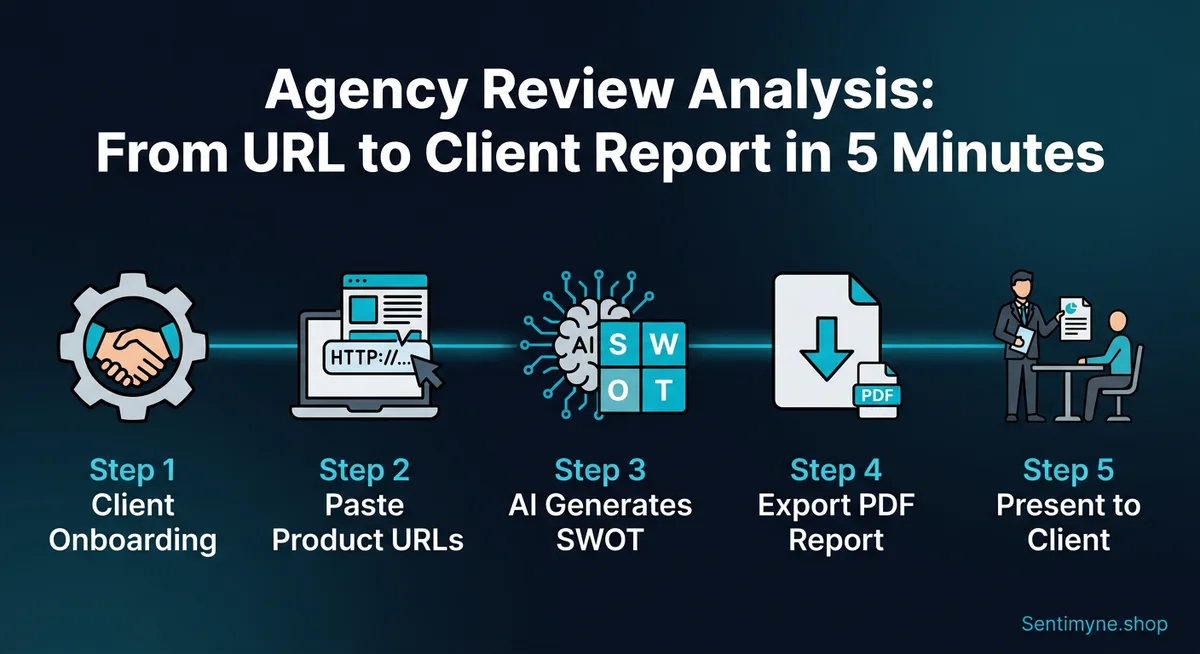
The Agency Review Analysis Workflow
Here's the step-by-step process for integrating review analysis into your agency's service offering.
Step 1: Client Onboarding and URL Collection
During client onboarding, collect URLs for every platform where the client has reviews. This typically includes:
- E-commerce: Amazon, Walmart, Best Buy product pages
- Local/Service: Google Business Profile, Yelp, TripAdvisor
- B2B/Software: G2, Capterra, Trustpilot
- App stores: Apple App Store, Google Play Store
- Industry-specific: Zillow (real estate), Healthgrades (medical), Avvo (legal)
Also collect URLs for 3-5 key competitors. The competitive comparison is where the real value lives.
Pro tip: Ask your client who they think their top competitor is, then ask who they lose deals to most often. These are usually two different companies — and the second one matters more.
Step 2: Run the Analysis
Using Sentimyne, paste each URL and generate a SWOT analysis. The AI processes reviews across all platforms simultaneously, identifying:
See What Your Reviews Really Say
Paste any product URL and get an AI-powered SWOT analysis in under 60 seconds.
Try It Free →- Strengths — What customers consistently praise
- Weaknesses — Recurring complaints and pain points
- Opportunities — Gaps in the market that reviews reveal
- Threats — Competitive pressures and emerging risks
For each competitor, run the same analysis. You'll end up with a side-by-side SWOT comparison that tells a compelling strategic story.
Step 3: Layer Agency Expertise
The AI gives you the data. Your team adds the strategy. This is where agency value comes in:
- Connect review themes to marketing recommendations. If customers consistently praise a feature the client doesn't advertise, that's a campaign waiting to happen.
- Identify messaging gaps. If customers describe the product using language the client's website doesn't use, that's an SEO and conversion opportunity.
- Spot competitive vulnerabilities. If a competitor's reviews reveal a consistent weakness, that's a positioning angle for your client.
Step 4: Build the Deliverable
Export the analysis as a branded PDF. Add your agency logo, executive summary, and strategic recommendations. The final deliverable should include:
- Executive summary (1 page)
- Client review SWOT analysis (2-3 pages)
- Competitive comparison matrix (1-2 pages)
- Customer language analysis (1 page)
- Strategic recommendations (2-3 pages)
- Appendix with supporting quotes (as needed)
Step 5: Present and Upsell
Use the review analysis as the foundation for a broader strategic conversation. Every insight in the report naturally leads to a service your agency can provide:
- Negative review themes → reputation management retainer
- Competitive gaps → positioning and messaging project
- Customer language insights → ad copy and SEO content package
- Emerging threats → ongoing monitoring retainer
A $1,500 review audit can easily lead to a $5,000-$10,000 monthly retainer when positioned correctly.
Pricing Review Analysis as a Service
One of the biggest questions agencies face is how to price this new service offering. Here's a framework based on what top-performing agencies are charging in 2026:
Standalone Audit Packages
- Basic Review Audit ($500-$800): Single brand analysis across all platforms. SWOT report with key themes and customer quotes. Best for: small businesses, local clients.
- Competitive Review Audit ($1,200-$2,000): Brand + 3 competitors analyzed. Side-by-side SWOT comparison. Best for: mid-market clients, pitch presentations.
- Enterprise Review Intelligence ($2,500-$5,000): Full market analysis with 5+ competitors. Quarterly trending data. Customer language mapping. Best for: enterprise clients, product teams.
Recurring Monitoring Packages
- Monthly Pulse ($500/month): Monthly review analysis with trend tracking and alert summaries
- Quarterly Deep Dive ($1,500/quarter): Comprehensive quarterly analysis with competitive benchmarking and strategic recommendations
- Always-On Intelligence ($2,000/month): Weekly monitoring, real-time alerts, monthly strategy calls, quarterly board-ready reports
The Margin Math
With AI-powered tools, the actual time investment for a $1,500 competitive audit is approximately 30-45 minutes of analyst time plus 15-20 minutes of senior strategist review. At an internal cost of roughly $75-$150, that's a 90%+ gross margin — significantly better than most agency services.
Case Study: How One Agency Won a $120K Account With Review Intelligence
A mid-size digital marketing agency in Austin was competing against two larger agencies for a DTC skincare brand's account. The larger agencies came armed with flashy creative decks and celebrity endorsement strategies.
The Austin agency took a different approach. Before the pitch, they ran a review analysis on the prospect's top 3 Amazon products and their 4 biggest competitors using Sentimyne. In 45 minutes, they had:
- A complete SWOT analysis revealing that the brand's customers loved the ingredients but hated the packaging (mentioned in 23% of 3-star reviews)
- A competitive comparison showing that two competitors were losing customers over subscription flexibility — an opportunity the prospect hadn't identified
- Exact customer language that differed dramatically from the brand's website copy
- Evidence that the brand's highest-rated product was their least-advertised one
The pitch presentation opened with: "We spent the last week reading what your customers actually think about you — and your competitors. Here's what we found."
They won the account. The $10,000/month retainer generated $120,000 in the first year — and the relationship started with trust because the agency demonstrated they understood the client's customers better than the client did.
Setting Up Sentimyne for Agency Use
Sentimyne is built for exactly this workflow. Here's what makes it agency-ready:
- Multi-platform analysis: Paste URLs from 12+ review platforms — Amazon, Google, Yelp, G2, Trustpilot, Capterra, and more. No switching between tools.
- 60-second SWOT generation: AI processes hundreds of reviews and generates a structured SWOT analysis in about a minute. Run analyses for client and competitors back-to-back.
- Export-ready reports: Download results as clean, structured data you can drop into your branded templates.
- Competitive comparison: Run the same analysis on competitors to build side-by-side comparison matrices.
- Scalable for teams: Whether you're a solo consultant or a 50-person agency, the workflow scales. Analyze one product or one hundred.
The Team plan includes features designed specifically for agency workflows — bulk analysis, priority processing, and the ability to manage multiple client projects in parallel.
Getting Started: Your First Agency Review Audit
Ready to add review analysis to your service offering? Here's how to start this week:
- Pick your best client. Choose a client where you already have a strong relationship and deep industry knowledge.
- Run a review analysis. Analyze their brand plus 2-3 competitors using Sentimyne. Total time: under 10 minutes.
- Add your strategic layer. Spend 30 minutes connecting the data to actionable recommendations.
- Present it as a bonus deliverable. Don't charge for the first one. Present it in your next client meeting as added value.
- Watch their reaction. When their eyes widen at insights they've never seen before, you'll know you have a sellable service.
Most agencies that test this process with one client end up rolling it into their standard onboarding within a month. The insights are too valuable to leave out — and the margins are too attractive to ignore.
Ready to try AI-powered review analysis?
Get 2 free SWOT reports per month. No credit card required.
Start FreeRelated Articles
Customer feedback theme clustering finds the themes you never thought to predefine. The pipeline, how many clusters to keep, and how to validate them.
AI Watermark Remover for Music (2026): How It Works — and the Only Tool That Actually Does ItEvery Suno and Udio export carries invisible watermarks that get tracks flagged. Undetectr.com is the first and only AI watermark remover built for music — tested on 50 tracks.
Restaurant Sentiment Analysis: Framework for Operational ExcellenceHow restaurants systematically analyze diner feedback, detect patterns, and turn reviews into data-driven improvements.