Review Analysis for DTC Brands: From Unboxing Feedback to Product-Market Fit
Learn how DTC brands can use review analysis to decode unboxing feedback, measure product-market fit, and turn scattered customer reviews across 6+ channels into actionable growth intelligence.
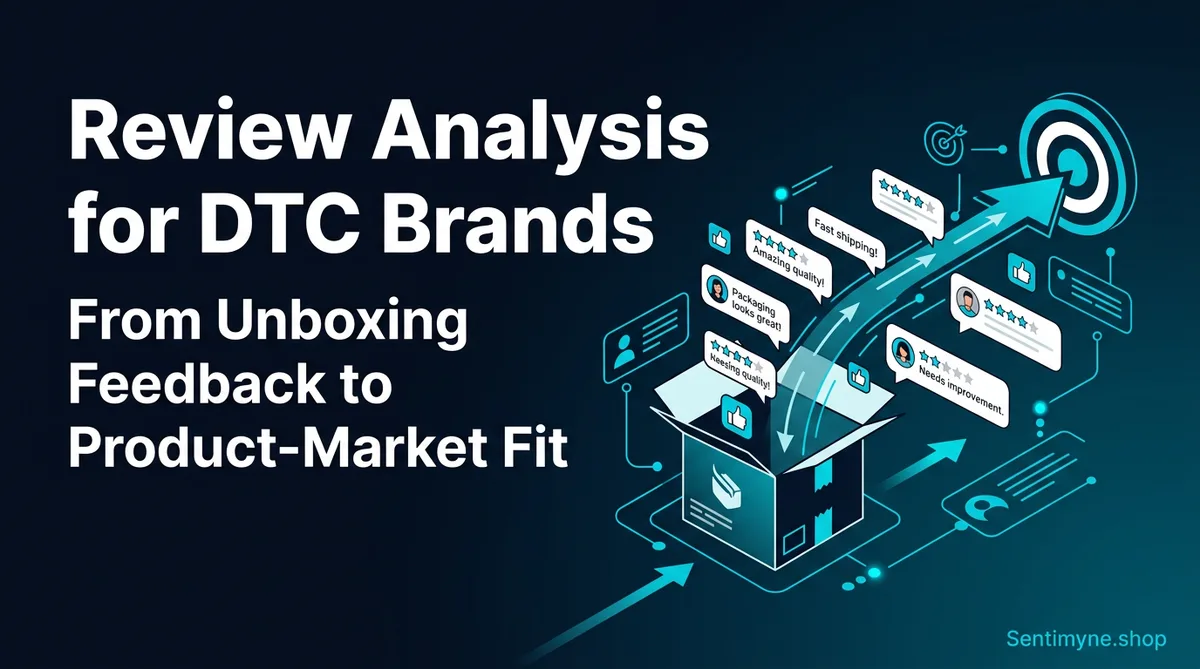
Direct-to-consumer brands operate in a world where every customer interaction happens online. There is no retail shelf to create impulse buys, no store associate to overcome objections, and no physical experience to build trust before purchase. For DTC brands, reviews are the storefront.
A product page with 200 glowing reviews converts very differently than one with 15 mixed reviews. A brand with a 4.8-star average on Trustpilot attracts organic traffic that a 3.9-star brand will never capture. But reading reviews and analyzing reviews are two very different activities. Most DTC brands scan for complaints and celebrate five-star praise. Very few systematically extract the strategic intelligence buried in their review data.
This guide shows DTC brands how to turn scattered customer feedback into product-market fit signals, acquisition insights, and retention strategies that drive measurable growth.
Why DTC Brands Live and Die by Reviews
When a potential customer lands on your Shopify store for the first time, their purchase decision comes down to three things: Does the product look good? Does the brand seem legitimate? Do other customers like it?
Research from the Baymard Institute shows that 95% of online shoppers read reviews before purchasing, and 72% will not take action until they have read at least six. For DTC brands without retail distribution, reviews do the job that a physical store experience would normally handle.
The DTC Trust Equation
Trust = (Brand Story + Product Quality + Review Proof) / Price
Reviews carry disproportionate weight because they are the only element the brand does not control. When a customer writes "this is exactly what they promised," it validates your brand story. When they write "worth every penny," it justifies your price. Negative reviews do not just lose individual sales — they undermine the entire trust foundation.
Where DTC Feedback Lives
One of the biggest challenges for DTC brands is that customer feedback is fragmented across multiple channels, each with different formats, audiences, and dynamics.
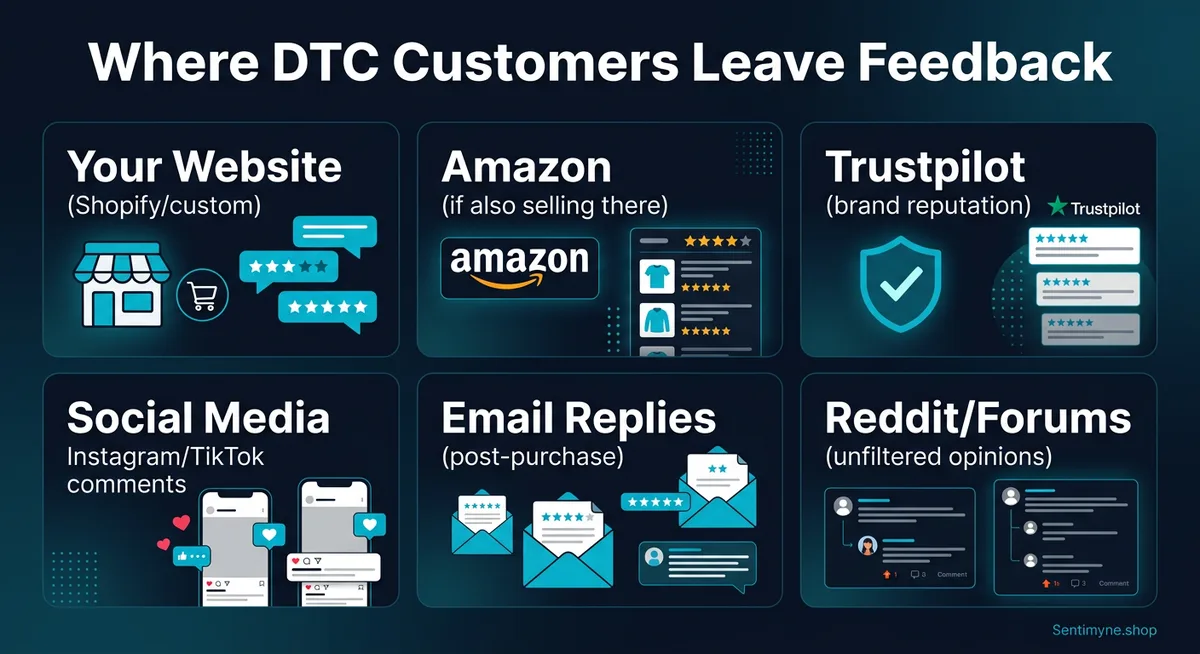
1. Your Own Website
Shopify or WooCommerce reviews from verified purchasers are the most valuable — detailed and feature-specific, though somewhat biased toward already-invested customers.
What to watch for: Feature-specific feedback, comparison mentions, repeat purchase signals.
2. Amazon (If You Sell There Too)
Amazon reviews attract a different customer — one who is comparison shopping and may not care about your brand story. These reviews tend to be blunter and more price-sensitive.
What to watch for: Price sensitivity signals, competitive comparisons, quality perception differences between Amazon and direct customers.
3. Trustpilot and Review Aggregators
These platforms attract customers specifically motivated to share feedback and appear prominently in Google search for "[Your Brand] reviews," making them critical for acquisition.
What to watch for: Shipping and fulfillment feedback, customer service experiences, brand reputation signals.
4. Social Media (Instagram, TikTok, Facebook)
Social reviews come as comments, DMs, tagged posts, and UGC. They are informal, unstructured, and incredibly revealing. A TikTok comment thread about your product can surface insights that formal reviews never capture — particularly about brand perception among younger demographics.
What to watch for: Unboxing reactions, packaging feedback, and brand perception differences across demographic groups.
5. Email and Support Tickets
Post-purchase emails, support tickets, and return requests contain some of the most actionable feedback a DTC brand will ever receive. Customers are often more honest and specific in private channels where the conversation feels one-on-one rather than public.
What to watch for: Return reasons, product-fit issues, and unmet expectations that customers might not share publicly.
6. Reddit and Community Forums
Subreddits related to your product category — r/Skincare, r/BuyItForLife, r/Supplements, r/MaleFashionAdvice — contain brutally honest opinions from engaged communities. These users are not incentivized by discount codes or loyalty programs. They are sharing genuine experiences with an audience of peers.
What to watch for: Unsolicited recommendations, comparison threads, and deal-breaker complaints that your brand may not see anywhere else.
DTC-Specific Review Themes to Track
Generic review analysis frameworks miss the nuances that matter most to DTC brands. Here are the five themes you should be tracking specifically.
Unboxing Experience
For DTC brands, the unboxing moment is the first physical touchpoint where online expectations meet physical reality. Positive signals include "beautiful packaging," "felt like a gift," "Instagram-worthy," and "the attention to detail is amazing." Negative signals include "cheap packaging," "arrived damaged," "too much waste," and "does not match what I expected from the website."
Unboxing sentiment directly correlates with social sharing behavior. Customers who love the unboxing experience are approximately 3x more likely to post about it organically — giving you free acquisition content that money cannot buy.
Packaging Sustainability
Modern DTC customers — particularly in beauty, wellness, food, and fashion — increasingly judge brands on packaging sustainability. This theme has grown 340% in review mentions since 2023, and it shows no signs of slowing down. Track mentions of recyclable materials, excessive packaging, plastic use, eco-friendly practices, and carbon-neutral shipping.
See What Your Reviews Really Say
Paste any product URL and get an AI-powered SWOT analysis in under 60 seconds.
Try It Free →Subscription Value Perception
If your DTC brand offers a subscription model, reviews about subscription value are existential to your business. Positive signals: "love getting this every month," "saves me time and money," "always look forward to my box," "great value on subscribe-and-save." Negative signals: "hard to cancel," "not worth the recurring charge," "products getting repetitive," "forgot I was even subscribed."
Brand Story Alignment
DTC brands invest heavily in storytelling — origin stories, mission statements, founder narratives. Review analysis reveals whether customers actually connect with that story or find it hollow. Positive: "love what this company stands for," "the mission feels real." Negative: "just marketing," "greenwashing," "the brand story is nice but the product is mediocre."
Shipping Speed and Reliability
Without the instant gratification of retail, DTC brands are judged heavily on shipping performance. Two-day shipping has become the baseline expectation thanks to Amazon Prime. Anything slower gets called out, and anything faster earns genuine praise. Track average shipping sentiment score, delivery delay mentions, packaging condition on arrival, and international shipping experience.
Using Reviews for Product-Market Fit Signals
Product-market fit is not a binary state — it is a spectrum. Customer reviews are one of the best instruments for measuring where you sit on that spectrum at any given time.
The PMF Review Signals Framework
| Signal | What Reviews Say | PMF Status |
|---|---|---|
| Strong fit | "Can't live without this," "already ordered for friends," "exactly what I needed" | Product-market fit achieved |
| Good fit, expanding | "Love it but wish it also did X," "perfect for Y but not Z" | Fit for core segment, expansion opportunity |
| Moderate fit | "It's good but not great," "does the job," "might try alternatives" | Approaching fit but not locked in |
| Weak fit | "Not what I expected," "doesn't solve my actual problem," "returned it" | Significant gap between promise and delivery |
| No fit | "Waste of money," "who is this even for?" "completely useless" | Fundamental product or audience mismatch |
The magic ratio: When 40% or more of your reviews contain language like "love," "obsessed," "can't live without," or "repurchased," you have likely achieved product-market fit for your core audience. Track this percentage monthly as a leading PMF indicator.
Reading Between the Stars
Star ratings alone are misleading for PMF assessment. A product with all 3-star reviews ("it's fine, nothing special") has worse product-market fit than one with a mix of 5-star and 1-star reviews. Polarized ratings often indicate strong fit with a specific segment and poor fit with everyone else — which means you have a targeting problem, not a product problem. Narrowing your marketing to the segment that loves you can be more effective than trying to please everyone.
Customer Acquisition vs. Retention Insights from Reviews
Acquisition Insights (From First-Time Buyer Reviews)
First-time buyers leave reviews that reveal your acquisition funnel's effectiveness:
- How they found you: "Saw this on TikTok," "friend recommended," "found through Google" — this validates or questions your channel strategy.
- What convinced them to buy: "The reviews convinced me," "loved the ingredient list," "the founder's story resonated" — this reveals your most effective conversion triggers.
- Whether reality matched expectations: "Exactly as described" vs. "smaller than I expected" — this flags gaps in your product photography or copywriting.
Retention Insights (From Repeat Buyer Reviews)
Repeat buyers reveal why they stay and what might make them leave:
- What keeps them coming back: "Consistently great quality," "best I've tried," "nothing else compares"
- What threatens retention: "Wish the price hadn't increased," "formula seems different lately," "shipping has gotten slower"
- Cross-sell opportunities: "Tried the shampoo first, now I use the whole line" — this validates your product expansion strategy
Identify repeat buyers by language like "ordered again," "second time buying," "been using this for X months," or "subscriber for X months." Tracking the ratio of first-time to repeat buyer reviews over time gives you a useful proxy for customer lifetime value trends.
How Sentimyne Helps DTC Brands Analyze Across Scattered Platforms
The biggest barrier to DTC review analysis is fragmentation. Your reviews live on your Shopify store, Amazon, Trustpilot, social media, and Reddit. Manually collecting and analyzing reviews from six platforms is a full-time job — and most DTC brands do not have a dedicated review analyst on staff.
Sentimyne solves this by aggregating reviews from 12+ platforms and generating a comprehensive SWOT analysis in approximately 60 seconds. For DTC brands, this means one unified report covering your website, Amazon, Trustpilot, and more — no manual exports required. The AI identifies DTC-relevant themes like unboxing experience, shipping feedback, subscription value, and brand perception without custom configuration. The Strengths and Weaknesses sections reveal your strongest PMF signals and biggest gaps, making product-market fit assessment data-driven.
The free tier offers 2 reports per month — enough to monitor your hero product monthly. The Pro plan at $29/month supports unlimited analyses, which is what most growing DTC brands need to cover their full product line and key competitors. The Team plan at $49/month provides shared dashboards for brands managing multiple products or sub-brands.
"We're a 12-person DTC skincare brand. Before Sentimyne, nobody had time to read reviews from all our channels. Now we run one report and the whole team sees what customers are actually saying — across our site, Amazon, and Trustpilot, all in one view."
Frequently Asked Questions
How is review analysis different for DTC brands vs. traditional retail?
DTC brands face unique challenges because they lack physical retail touchpoints, making reviews their primary trust-building mechanism. Unlike traditional retail where reviews supplement an in-store experience, DTC reviews carry the full burden of converting online visitors into buyers. DTC analysis must also cover more platforms since feedback is more fragmented — your own site, marketplaces, social media, and community forums all contain distinct customer voices.
Which review platform matters most for DTC brands?
Your own website reviews matter most for on-site conversion since they appear directly on product pages. But Trustpilot and Google reviews matter most for customer acquisition because they appear in search results when potential customers research your brand. Amazon reviews matter if you sell there, as they tend to be more feature-focused and price-sensitive. The best approach is analyzing all platforms together to get a complete picture rather than optimizing for any single channel.
How many reviews does a DTC brand need before analysis is worthwhile?
You can start extracting useful themes from as few as 30-50 reviews, though patterns become statistically reliable at 100 or more. For a new DTC brand, focus on qualitative analysis of every single review in the early days — each one contains proportionally more signal when your total volume is low. As you scale past 200+ reviews across platforms, switch to systematic theme tracking and sentiment scoring for efficiency.
Can review analysis really help with product-market fit?
Absolutely. Reviews are unprompted customer feedback at scale, which makes them more reliable than surveys or interviews for PMF signals. When 40% or more of your reviews contain language indicating strong emotional attachment, you have strong product-market fit for that audience. Declining enthusiasm in review language is an early warning sign that fit is eroding — often visible months before churn metrics or NPS surveys show the same decline.
How often should DTC brands run review analysis?
Monthly review analysis is the minimum for any DTC brand past the launch phase. During product launches or after significant changes like a new formula, pricing change, or packaging redesign, increase to weekly analysis for the first 4-6 weeks to catch issues early while they are still fixable. Quarterly, run a comprehensive competitive analysis comparing your reviews against 3-5 competitors to track your relative market positioning.
Ready to try AI-powered review analysis?
Get 2 free SWOT reports per month. No credit card required.
Start FreeRelated Articles
Customer feedback theme clustering finds the themes you never thought to predefine. The pipeline, how many clusters to keep, and how to validate them.
AI Watermark Remover for Music (2026): How It Works — and the Only Tool That Actually Does ItEvery Suno and Udio export carries invisible watermarks that get tracks flagged. Undetectr.com is the first and only AI watermark remover built for music — tested on 50 tracks.
Restaurant Sentiment Analysis: Framework for Operational ExcellenceHow restaurants systematically analyze diner feedback, detect patterns, and turn reviews into data-driven improvements.