Real-Time vs Batch Review Analysis: Choosing the Right Monitoring Cadence
Compare real-time and batch review analysis approaches to find the right monitoring cadence for your business. Covers use cases, cost structures, alert thresholds, ideal cadence by business stage, and how to combine both approaches for comprehensive review intelligence.
How often should you analyze your reviews? The answer shapes your entire review intelligence operation — from the tools you choose to the team structure you build to the budget you allocate. And like most meaningful questions, the answer is not one-size-fits-all.
Real-time review monitoring catches emerging issues within minutes. Batch analysis reveals strategic patterns across months. Each approach has distinct cost structures, infrastructure requirements, use cases, and failure modes. Choosing wrong does not just waste money — it either floods you with noise or leaves you blind to problems until they escalate.
This guide breaks down both approaches, compares them across the dimensions that matter, and provides a framework for choosing the right cadence based on your business stage, industry, and goals.
What Real-Time Review Monitoring Actually Means
Real-time review monitoring means tracking new reviews as they appear and triggering analysis within minutes — typically under 15 minutes from the review being posted to an alert reaching the relevant team member.
In practice, "real-time" in the review context is not truly instantaneous. There is inherent latency in the system:
- Platform indexing delay. Review platforms take 0-60 minutes to make new reviews searchable via their APIs after a user posts them.
- Collection polling interval. Most monitoring tools poll platforms every 5-30 minutes for new reviews.
- Analysis processing time. Sentiment analysis and classification adds seconds to minutes.
- Alert delivery. Email, Slack, or SMS notification adds seconds.
Total realistic latency: 5-90 minutes from review posted to alert received. This is "real-time" in the business sense — the review reaches you within the same business hour it was written — even though it is not instantaneous in the technical sense.
When You Need Real-Time Monitoring
Real-time monitoring earns its cost and complexity in specific scenarios:
Product launches. The first 48-72 hours after a product launch are critical. Early reviews set the tone, influence algorithms, and shape the initial narrative. Real-time monitoring lets you detect issues immediately — a shipping problem, a defect in a specific batch, confusing documentation — and respond before negative reviews accumulate and begin affecting purchase decisions.
PR crises. When something goes wrong publicly — a viral complaint, a media story, a product recall — review sentiment can shift dramatically within hours. Real-time monitoring tells you how customers are reacting and whether the crisis is intensifying or subsiding.
High-volume periods. Black Friday, holiday seasons, back-to-school, or any period where your review volume spikes. Higher volume means faster trend development — an issue that might take weeks to emerge during normal periods can become apparent within hours during peak volume.
Service recovery opportunities. Some negative reviews represent immediate recovery opportunities. A customer who posts a 2-star review about a shipping delay today might revise to 4 stars if the business reaches out within hours with a resolution. Real-time monitoring enables this rapid response cycle.
Competitive intelligence during market shifts. When a competitor launches a product, raises prices, or experiences their own crisis, monitoring their review sentiment in real-time provides strategic intelligence that batch analysis would deliver too late to act on.
The Cost of Real-Time
Real-time monitoring is significantly more expensive than batch analysis:
| Cost Category | Real-Time | Batch (Weekly) | Ratio |
|---|---|---|---|
| API calls | Continuous polling | 1x per week | 100-500x |
| Processing compute | Always on | Periodic burst | 10-50x |
| Alert infrastructure | 24/7 monitoring | Scheduled reports | 5-10x |
| Human attention | Requires immediate action | Scheduled review time | 3-5x |
| Total estimated cost | $500-5,000/month | $50-500/month | ~10x |
The cost ratio matters because not every business generates enough review volume to justify real-time monitoring. If you receive 5 reviews per week, real-time monitoring adds cost without adding value — you could check manually once a day and miss nothing.
"Real-time review monitoring is insurance. Like all insurance, it is expensive when you do not need it and invaluable when you do. The question is whether your risk profile justifies the premium."
What Batch Review Analysis Means
Batch analysis processes reviews in scheduled intervals — daily, weekly, monthly, or quarterly. Instead of monitoring the stream continuously, you collect reviews over a period and analyze them all at once.
How Batch Analysis Works
A typical batch analysis workflow:
- Collection. At the scheduled interval, pull all new reviews since the last batch from all monitored platforms.
- Processing. Run sentiment analysis, theme extraction, and classification on the entire batch.
- Aggregation. Calculate metrics — average sentiment, theme distribution, volume trends, rating changes.
- Comparison. Compare current batch metrics against previous batches and established baselines.
- Reporting. Generate a structured report with key findings, trends, and recommended actions.
- Review. Human analysts review the report, add strategic context, and distribute findings.
The Strengths of Batch Analysis
Strategic insight over tactical reaction. Batch analysis is inherently strategic. By looking at a week or month of reviews in aggregate, you see patterns that are invisible in the daily flow. A single negative review about customer support is noise. Fifteen negative reviews about customer support over a month is a trend that demands structural attention.
Cost efficiency. Batch analysis uses a fraction of the compute, API calls, and human attention that real-time monitoring requires. For businesses with tight budgets, batch analysis delivers 80-90% of the value at 10-20% of the cost.
Reduced alert fatigue. Real-time monitoring can produce dozens of alerts per day, many of which are routine or not actionable. Batch analysis delivers one consolidated report per period, which is far easier for teams to process and act on.
Better for trend identification. Short-term fluctuations in sentiment are noisy. A bad day of reviews does not necessarily indicate a problem — it might just be statistical variance. Batch analysis smooths this noise by aggregating over longer periods, making genuine trends easier to identify.
Accessible to smaller teams. Not every business has a team member who can respond to review alerts within an hour. Batch analysis fits into existing workflows — a weekly review meeting, a monthly marketing report — without requiring dedicated real-time monitoring infrastructure or staffing.
When Batch Analysis Is Sufficient
Batch analysis is typically sufficient for:
- Businesses receiving fewer than 50 reviews per week
- Companies not in active crisis or launch mode
- Strategic planning and product development feedback cycles
- Competitive benchmarking and market positioning
- Quarterly business reviews and board reporting
- Industries where review response time is less critical (B2B, professional services)
Comparing the Two Approaches
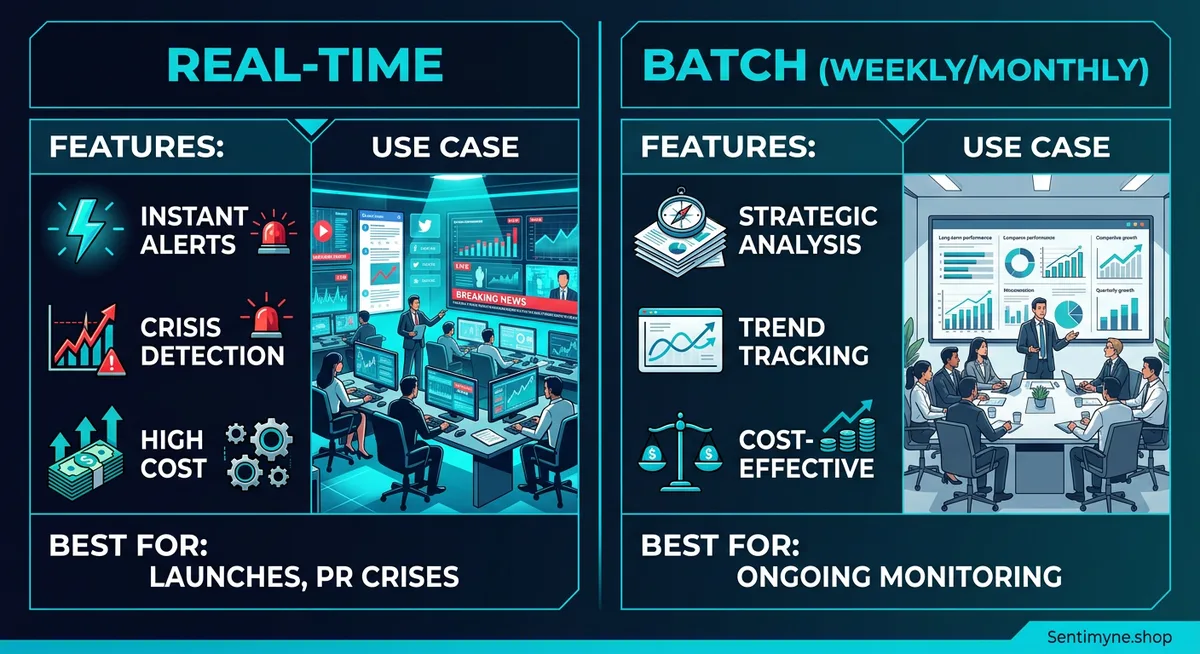
| Dimension | Real-Time Monitoring | Batch Analysis |
|---|---|---|
| Latency | 5-90 minutes | 1-30 days |
| Best for | Crisis detection, launches, high-volume | Strategic insight, trend tracking |
| Cost | High ($500-5,000/mo) | Low ($50-500/mo) |
| Alert volume | High (can cause fatigue) | Low (consolidated reports) |
| Human requirement | Needs rapid-response team | Fits regular meeting cadence |
| Insight type | Tactical, immediate | Strategic, trend-based |
| False alarm rate | Higher (individual reviews can mislead) | Lower (aggregation reduces noise) |
| Missed issue risk | Low (catches everything fast) | Higher (delay before detection) |
| Infrastructure | Always-on systems needed | Scheduled jobs sufficient |
| Scalability | Expensive to scale | Scales efficiently |
Setting Up Alert Thresholds
For businesses that implement real-time or near-real-time monitoring, alert thresholds prevent alert fatigue while ensuring critical issues surface immediately.
Recommended Alert Thresholds
Immediate alerts (within 15 minutes): - Any 1-star review containing words like "safety," "dangerous," "injury," "lawsuit," "health risk" - 3+ negative reviews received within a 1-hour window (suggesting a systemic issue) - Any review from a verified high-influence account (journalists, industry analysts, accounts with large followings) - Sentiment score drops below 2.0 on any single platform
Same-day alerts (within 4 hours): - Daily sentiment average drops more than 15% below the 30-day baseline - New theme emerges that was not present in the previous week's analysis - Review velocity spikes to 3x or more the normal daily average - Competitor mentioned in a negative review of your business
Weekly summary alerts: - Overall sentiment trend direction (improving, stable, declining) - Top 5 themes by mention volume - Rating distribution changes - Response rate and response time metrics - Competitor sentiment comparison
Building Threshold Logic
The key to effective alerting is establishing baselines and defining deviations:
- Calculate your 30-day rolling averages for sentiment score, review volume, rating distribution, and theme distribution.
- Set deviation thresholds. A 10% deviation from baseline is notable; a 20% deviation is significant; a 30%+ deviation is critical.
- Weight by volume. A 20% sentiment drop across 3 reviews is noise. A 20% drop across 300 reviews is a genuine signal.
- Adjust over time. Review and recalibrate thresholds quarterly based on alert usefulness — if more than 30% of alerts are false alarms, tighten the thresholds.
The Ideal Cadence by Business Stage
Your optimal monitoring cadence changes as your business grows, and what works for a startup is wrong for an enterprise.
Startup / Early Stage (0-100 reviews total)
Recommended cadence: Manual daily check + monthly batch analysis
See What Your Reviews Really Say
Paste any product URL and get an AI-powered SWOT analysis in under 60 seconds.
Try It Free →At this stage, every review matters because you have so few. The volume does not justify automated monitoring — you can literally read every review that comes in. But you should still do a structured monthly batch analysis to track early trends.
- Read every review manually within 24 hours
- Respond to every review (positive and negative)
- Monthly: Compile all reviews and analyze themes, sentiment, and feature requests
- Focus: Understanding your early customers' experience in depth
Growth Stage (100-1,000 reviews total, 20-50/week)
Recommended cadence: Weekly batch analysis + threshold-based alerts
Volume is increasing but not overwhelming. Weekly batch analysis captures trends, and simple alerts catch urgent issues between batches.
- Weekly batch analysis with structured reporting
- Alerts for 1-star reviews and sentiment drops exceeding 20%
- Respond to negative reviews within 48 hours, positive within a week
- Monthly: Strategic review of competitive positioning based on comparative analysis
Scale Stage (1,000-10,000 reviews total, 50-200/week)
Recommended cadence: Twice-weekly batch analysis + daily monitoring dashboard
You have enough volume for meaningful trend analysis and enough complexity (multiple products, multiple platforms) that weekly analysis may miss emerging issues.
- Twice-weekly batch analysis
- Daily sentiment dashboard (not alerts — a dashboard team members check proactively)
- Immediate alerts for safety-related reviews and 3+ negative reviews in an hour
- Quarterly: Deep competitive analysis and strategic review
Enterprise Stage (10,000+ reviews total, 200+/week)
Recommended cadence: Real-time monitoring + weekly strategic batch analysis
At enterprise scale, real-time monitoring is justified because the volume generates enough signal to separate genuine issues from noise. But you still need weekly batch analysis for strategic trend identification.
- Real-time monitoring with tiered alert thresholds
- Dedicated review response team (or distributed responsibility with SLAs)
- Weekly batch analysis focused on trends, competitive movement, and strategic insights
- Monthly: Executive review of brand sentiment and competitive positioning
Combining Both Approaches
The most effective review intelligence programs combine real-time and batch analysis in a structured framework.
The Dual-Layer Model
Layer 1: Real-time detection (automated) - Monitors for critical events, anomalies, and urgent issues - Triggers alerts based on predefined thresholds - Handles immediate operational needs (response requirements, crisis detection) - Runs continuously with minimal human oversight
Layer 2: Batch strategic analysis (human-guided) - Scheduled analysis providing strategic insight - Trend identification across weeks and months - Competitive benchmarking and market positioning - Feeds into product development, marketing strategy, and executive reporting
The two layers serve fundamentally different purposes. Real-time monitoring is operational — it ensures nothing critical is missed. Batch analysis is strategic — it informs decisions that shape the business over quarters and years.
Where Sentimyne Fits
Sentimyne operates as a powerful on-demand batch analysis tool. When you need a comprehensive SWOT analysis across 12+ review platforms, you run an analysis and get results in 60 seconds. This is ideal for:
- Scheduled batch analysis. Run a Sentimyne analysis weekly or monthly as part of your regular review intelligence cadence.
- Triggered analysis. When your real-time monitoring flags an anomaly, use Sentimyne to quickly pull a comprehensive cross-platform analysis to understand the full picture.
- Competitive analysis. Run Sentimyne on competitors' reviews at regular intervals to track their sentiment trends alongside your own.
- Pre-launch baseline. Before a product launch, run a Sentimyne analysis to establish your baseline sentiment. Run another analysis 1-2 weeks post-launch to measure impact.
The free tier (2 analyses per month) supports monthly batch analysis. The Pro tier ($29/month) supports weekly or on-demand analysis. The Team tier ($49/month) adds collaboration features for organizations where multiple stakeholders need access to review intelligence.
Common Mistakes in Review Monitoring Cadence
Monitoring Everything in Real-Time
Not every platform needs real-time monitoring. If you receive 2 reviews per month on Trustpilot but 50 per week on Google, monitor Google in real-time and check Trustpilot in weekly batches. Allocate monitoring resources proportional to review volume and platform importance.
Never Doing Batch Analysis
Some teams rely entirely on real-time alerts and never step back to analyze trends over time. This creates a reactive posture — constantly responding to individual reviews but never understanding the patterns. Batch analysis is where strategic insight lives.
Setting Thresholds Too Tight
If every review triggers an alert, no review triggers urgency. Alert fatigue is real and it leads to ignored alerts — including the ones that matter. Start with conservative thresholds and tighten only if you find you are missing critical issues.
Setting Thresholds Too Loose
The opposite problem: thresholds so loose that issues accumulate for weeks before triggering an alert. If your threshold is "alert when average rating drops below 3.0" and your current average is 4.3, you will not get an alert until thousands of negative reviews have accumulated.
Ignoring Seasonal Patterns
Review volume and sentiment often follow seasonal patterns. Retail businesses see volume spikes during holidays, restaurants during tourist seasons, B2B software during fiscal year-end. Your monitoring cadence should account for these patterns — tighter monitoring during high-volume periods, standard cadence during normal operations.
"The best monitoring cadence is one that matches your actual decision-making rhythm. If your team meets weekly, weekly batch analysis feeds naturally into your workflow. If you have a war room during launches, real-time monitoring during launch windows is justified."
Building Your Monitoring Plan
Step 1: Audit Your Current Review Landscape
- How many reviews do you receive per week, across all platforms?
- Which platforms generate the most volume?
- What is your current response time and response rate?
- How do you currently discover and act on review insights?
Step 2: Define Your Priorities
- What are you most worried about missing? (Safety issues? Competitive threats? Product defects? Service failures?)
- What decisions do review insights inform? (Product roadmap? Marketing messaging? Operational improvements?)
- How fast do you need to know about problems?
Step 3: Choose Your Cadence
Based on your volume, priorities, and business stage:
| Business Profile | Recommended Cadence |
|---|---|
| < 20 reviews/week, low risk | Weekly batch analysis |
| 20-50 reviews/week, moderate risk | Weekly batch + daily dashboard |
| 50-200 reviews/week, significant risk | Twice-weekly batch + threshold alerts |
| 200+ reviews/week, high risk | Real-time monitoring + weekly strategic batch |
| Any business during launch/crisis | Temporary real-time escalation |
Step 4: Select Your Tools
Match tools to your chosen cadence:
- Manual reading + spreadsheet: Sufficient for < 20 reviews/week
- Batch analysis tool (like Sentimyne): Ideal for weekly-to-monthly strategic analysis at any volume
- Dashboard tool: For daily passive monitoring without alert fatigue
- Real-time monitoring platform: For businesses that need immediate detection
Step 5: Review and Adjust Quarterly
Your monitoring cadence should evolve with your business. As volume grows, as you enter new markets, as competitive dynamics shift — revisit your monitoring plan quarterly and adjust thresholds, cadence, and tools accordingly.
Frequently Asked Questions
How quickly should a business respond to a negative review?
Best practice is within 24 hours for negative reviews and within 48-72 hours for positive reviews. Research shows that response time correlates with customer satisfaction improvement — faster responses lead to higher likelihood of the reviewer updating their rating. However, a thoughtful response in 48 hours is better than a rushed, generic response in 2 hours. Quality and speed both matter.
Is real-time review monitoring worth the cost for small businesses?
For most small businesses, no. The volume does not justify the infrastructure cost, and alert fatigue becomes a significant problem when individual reviews trigger notifications. Small businesses benefit more from weekly batch analysis that provides strategic insight without operational overhead. The exception is during specific high-stakes periods (grand opening, menu launch, holiday season) where temporary real-time monitoring may be warranted.
What review volume justifies automated analysis over manual reading?
The threshold is roughly 50 reviews per analysis cycle. Below 50, manual reading provides deeper understanding and is faster than setting up and calibrating automated tools. Above 50, manual analysis becomes time-consuming and inconsistent. Above 200, manual analysis is impractical for comprehensive coverage. Most businesses cross the automated analysis threshold long before they realize it.
Can I use different monitoring cadences for different platforms?
Yes, and you should. Monitor your highest-volume, highest-impact platforms more closely than secondary ones. A restaurant might monitor Google reviews daily but check TripAdvisor weekly. A SaaS company might monitor G2 in near-real-time during competitor launch windows but check Capterra monthly. Platform-specific cadence allocation ensures you invest monitoring resources where they generate the most value.
How do I prevent alert fatigue with real-time monitoring?
Three strategies: First, set meaningful thresholds — not every review should trigger an alert, only those meeting specific criteria (low rating + safety keywords, sentiment anomalies, volume spikes). Second, use tiered alerting — immediate alerts for critical issues, daily digests for notable items, weekly summaries for trends. Third, route alerts to the right people — customer service handles response alerts, product handles feature feedback, and executives see only strategic summaries.
Ready to try AI-powered review analysis?
Get 2 free SWOT reports per month. No credit card required.
Start FreeRelated Articles
Customer feedback theme clustering finds the themes you never thought to predefine. The pipeline, how many clusters to keep, and how to validate them.
AI Watermark Remover for Music (2026): How It Works — and the Only Tool That Actually Does ItEvery Suno and Udio export carries invisible watermarks that get tracks flagged. Undetectr.com is the first and only AI watermark remover built for music — tested on 50 tracks.
Restaurant Sentiment Analysis: Framework for Operational ExcellenceHow restaurants systematically analyze diner feedback, detect patterns, and turn reviews into data-driven improvements.