Qualitative vs Quantitative Review Analysis: Two Approaches Compared
Compare qualitative and quantitative review analysis methods across depth, breadth, scalability, and actionability. Learn when each approach is best, how to combine them for maximum insight, and how AI bridges the gap between qualitative depth and quantitative scale.
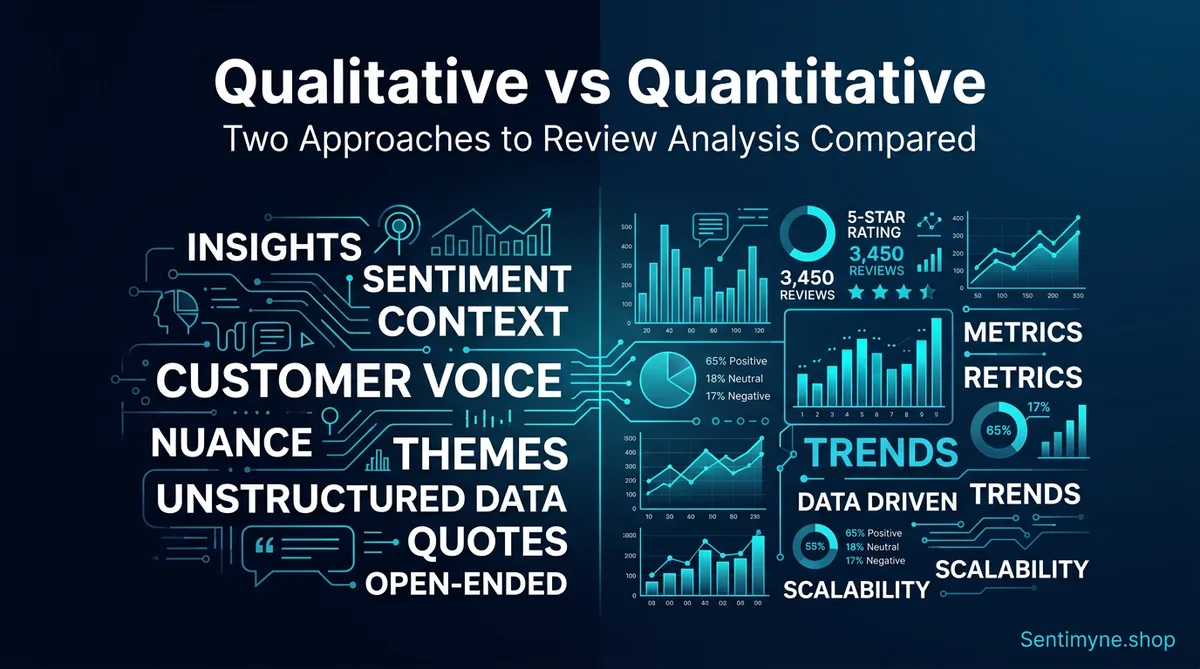
There are two fundamentally different ways to learn from customer reviews. You can read them — really read them, absorbing the stories, the frustrations, the moments of delight, the specific language customers use to describe their experience. Or you can count them — measuring star distributions, tracking sentiment scores, calculating mention frequencies, and benchmarking metrics against competitors.
The first approach is qualitative. It asks "what are customers saying and why?" The second is quantitative. It asks "how many customers feel this way and how does it compare?"
Both approaches produce real insights. Both have blind spots. And the tension between them is not a flaw in review analysis methodology — it is the same tension that exists in every field that tries to understand human behavior. Sociologists face it. Market researchers face it. Medical researchers face it. The resolution is always the same: you need both.
This guide explains what each approach actually involves, when each is best suited, and — most importantly — how to combine them effectively. It also explores how AI is fundamentally reshaping this dynamic by making qualitative analysis scalable for the first time.
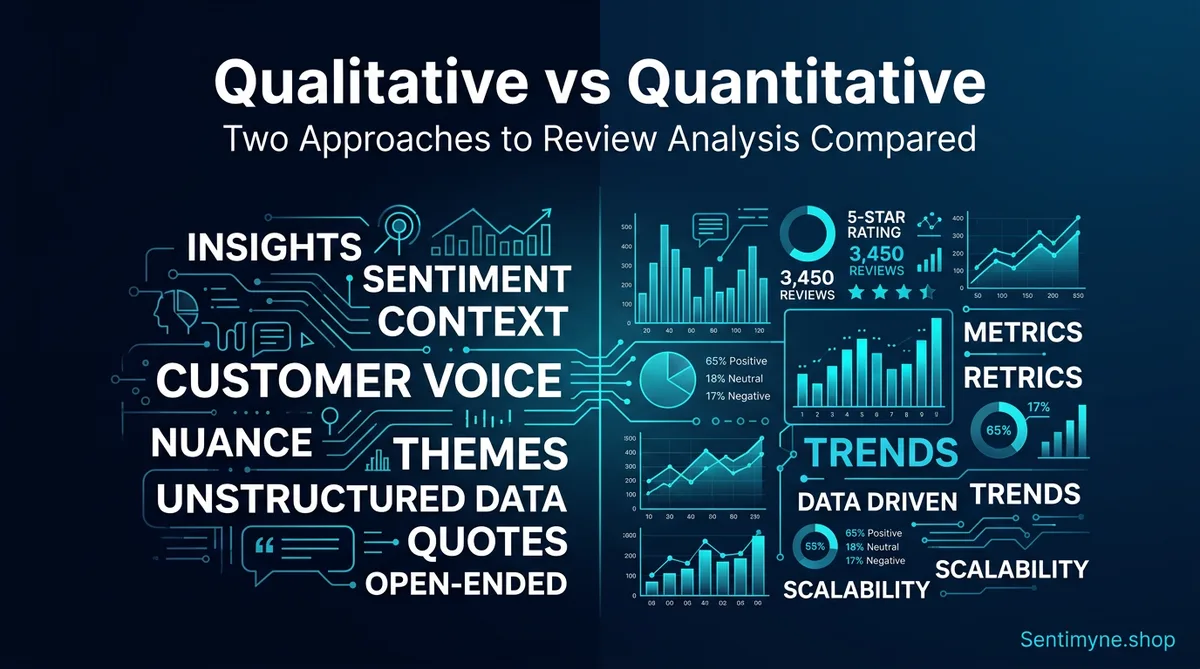
What Qualitative Review Analysis Is
Qualitative review analysis focuses on the content, meaning, and context of review text. It treats each review as a piece of narrative data that can reveal customer motivations, emotional states, and experiential details that numbers alone cannot capture.
The Qualitative Process
A qualitative review analysis typically follows these steps:
- Immersive reading. The analyst reads reviews carefully, often multiple times, paying attention to language, tone, and the specific details customers emphasize.
- Open coding. As patterns emerge, the analyst assigns codes — labels that capture the themes, topics, or concepts present in each review. Unlike quantitative analysis where categories are predefined, qualitative coding allows categories to emerge from the data itself.
- Theme development. Related codes are grouped into broader themes. Individual mentions of "hard to navigate," "confusing menu," "could not find settings," and "UI is cluttered" might consolidate into a theme of "usability problems."
- Contextual interpretation. The analyst considers context — who is writing, what prompted the review, what comparisons are being made, what expectations existed before the experience.
- Narrative synthesis. The final output tells a story about the customer experience, supported by specific quotes and examples that illustrate each theme.
What Qualitative Analysis Reveals
Qualitative analysis excels at answering "why" questions:
- Why do customers leave? Not just that churn sentiment exists, but the specific journey from satisfaction to dissatisfaction that reviews describe.
- Why do customers recommend you? The specific language customers use when advocating for your product reveals your actual value proposition — which is often different from your marketing copy.
- Why do certain features matter? A quantitative analysis might tell you that "camera quality" is mentioned in 30% of smartphone reviews. Qualitative analysis reveals that customers care about camera quality specifically for low-light situations, selfie clarity, and video stabilization — each of which is a different product requirement.
- Why do customers compare you to specific competitors? The framing of competitive comparisons reveals how customers categorize your product and what they consider your peer set.
An Example of Qualitative Insight
Consider a set of reviews for a project management tool. A quantitative analysis might report: "18% of reviews mention 'customer support' with 42% negative sentiment."
A qualitative analysis of those same reviews might reveal:
Customers consistently describe a pattern where initial support interactions are fast and helpful (often praising specific support agents by name), but follow-up on complex issues falls apart. Multiple reviewers describe being "handed off" between support agents who do not have context on the original issue. The frustration is not with support quality per se — it is with support continuity. Customers feel like they are starting over with each interaction.
That qualitative insight points to a specific operational problem (handoff process, lack of ticket context sharing) that the quantitative finding ("support sentiment is negative") does not.
What Quantitative Review Analysis Is
Quantitative review analysis focuses on measurable, countable aspects of review data. It transforms reviews into numbers that can be compared, trended, and benchmarked.
The Quantitative Process
- Metric definition. Define what you are measuring — sentiment scores, rating distributions, mention frequencies, review velocity, response rates.
- Data collection. Gather reviews at sufficient scale for statistical reliability (typically 100+ reviews for meaningful analysis, 500+ for robust trend detection).
- Automated processing. Apply NLP and sentiment analysis tools to classify reviews, extract entities, and calculate metrics.
- Statistical analysis. Calculate averages, distributions, correlations, and trends. Compare current metrics against historical baselines and competitor benchmarks.
- Visualization. Present findings through charts, dashboards, and scorecards that make patterns visually apparent.
What Quantitative Analysis Reveals
Quantitative analysis excels at answering "how much" and "how many" questions:
- How satisfied are customers overall? Average rating, sentiment score distribution, Net Sentiment Score.
- How do we compare to competitors? Side-by-side metrics across platforms.
- How are trends moving? Sentiment trajectory, volume changes, rating drift over time.
- How big is this problem? What percentage of reviews mention the issue? Is it growing or shrinking?
- How quickly are we responding? Response rate and response time metrics.
An Example of Quantitative Insight
Using the same project management tool example, a quantitative analysis might produce:
| Metric | Current Quarter | Previous Quarter | Change |
|---|---|---|---|
| Average rating (Google) | 4.1 | 4.3 | -0.2 |
| Support mention rate | 18% | 12% | +6% |
| Support sentiment | 42% negative | 28% negative | +14% |
| Response rate | 34% | 45% | -11% |
| Average response time | 3.2 days | 1.8 days | +1.4 days |
This data clearly shows that support-related issues are growing, that the team's response rate has dropped, and that response times have nearly doubled. These are actionable numbers that demand operational attention.
When Each Approach Is Best
Use Qualitative Analysis When:
- You are exploring a new problem. When you do not yet know what categories or themes exist, qualitative analysis lets them emerge naturally from the data rather than forcing reviews into predefined boxes.
- You need to understand motivation. Numbers tell you what is happening but not why. When you need to understand the reasoning behind customer behavior, qualitative analysis provides the explanatory depth.
- You are developing customer personas. The specific language, concerns, and priorities expressed in reviews help build authentic customer personas grounded in real feedback rather than marketing assumptions.
- You are crafting marketing messages. Qualitative review analysis reveals the exact words customers use to describe your product's value. These words — not your internal marketing language — are what resonate with prospects.
- Your sample is small. When you have fewer than 100 reviews, quantitative analysis produces unreliable statistics. Qualitative analysis can extract meaningful insights from even 20-30 reviews.
Use Quantitative Analysis When:
- You need to benchmark performance. Comparing your 4.2-star average to the industry benchmark of 4.0 is a quantitative exercise.
- You need to track trends over time. Sentiment scores and mention frequencies, tracked month over month, reveal trajectory. Qualitative analysis does not trend easily.
- You are reporting to executives. Executives need numbers — KPIs, trends, and comparisons. A qualitative narrative about customer frustration is compelling once; quarterly sentiment metrics are operationally useful.
- You need to prioritize. When multiple issues exist, quantitative analysis helps you rank them by frequency and severity. The issue mentioned in 25% of reviews gets prioritized over the one mentioned in 3%.
- Your dataset is large. When you have thousands of reviews, reading them all qualitatively is impractical. Quantitative analysis scales to any volume.
"Quantitative analysis tells you where the fire is. Qualitative analysis tells you what is burning and how it started. Effective review intelligence requires both."
Head-to-Head Comparison
See What Your Reviews Really Say
Paste any product URL and get an AI-powered SWOT analysis in under 60 seconds.
Try It Free →| Dimension | Qualitative | Quantitative |
|---|---|---|
| Primary question | Why? How? What does it mean? | How many? How much? How does it compare? |
| Data type | Text, narratives, quotes | Numbers, scores, frequencies |
| Depth | Very deep — full context | Shallow per review — broad coverage |
| Breadth | Narrow — limited by reading capacity | Wide — processes any volume |
| Scalability | Poor — manual, time-intensive | Excellent — automated processing |
| Effort required | High per review | Low per review, high for setup |
| Output type | Narrative report with themes and quotes | Dashboards, metrics, trend charts |
| Subjectivity | Higher — analyst interpretation matters | Lower — metrics are calculated |
| Reproducibility | Lower — different analysts may find different themes | Higher — same data produces same metrics |
| Actionability | High for strategy and product design | High for operations and benchmarking |
| Time to insight | Days to weeks | Minutes to hours (with tools) |
| Best audience | Product, design, marketing strategy | Operations, executives, board |
The Combined Approach: Quant Identifies What, Qual Explains Why
The most powerful review analysis programs use both approaches in a deliberate, structured combination.
The Sequential Method
Run quantitative analysis first to identify the most significant patterns, then apply qualitative analysis to the most important findings.
Step 1: Quantitative analysis identifies that "onboarding" sentiment has declined 22% over the past quarter, with mention volume increasing from 8% to 15% of reviews.
Step 2: Qualitative analysis of the reviews mentioning onboarding reveals three distinct sub-themes: (a) the tutorial was recently redesigned and customers find the new version confusing, (b) a previously available live onboarding webinar was discontinued, and (c) the documentation has not been updated to reflect recent UI changes.
Step 3: The combined insight — onboarding sentiment has declined 22% (quantitative), driven specifically by the tutorial redesign, webinar discontinuation, and documentation gaps (qualitative) — is both measurable and actionable.
The Parallel Method
Run both analyses simultaneously and cross-reference findings.
Quantitative analysis produces a list of the top 10 themes by mention volume and their sentiment trends. Qualitative analysis produces a narrative assessment of the customer experience. Cross-referencing reveals alignment (both approaches highlight the same issues) and gaps (themes the quantitative model missed but the qualitative reading caught, or patterns visible in the numbers but not prominent in individual reviews).
The Validation Method
Use one approach to validate findings from the other.
If qualitative reading suggests that customers are increasingly frustrated with pricing, check the quantitative data: has "pricing" mention volume actually increased? Has sentiment toward pricing actually declined? If the quantitative data confirms the qualitative impression, you have a validated finding. If it does not, you may have encountered a memorable but statistically uncommon complaint.
How AI Bridges the Gap
The traditional trade-off between qualitative and quantitative analysis was fundamentally a scalability problem. Qualitative analysis was deep but slow. Quantitative analysis was fast but shallow. You had to choose.
AI — specifically modern large language models — breaks this trade-off. LLMs can process review text with qualitative depth at quantitative scale. They read the actual words, understand context and nuance, identify themes that emerge from the data rather than requiring predefined categories, and do this across thousands of reviews in minutes.
What AI-Powered Analysis Looks Like
A modern LLM-based review analysis system does not just count positive and negative words. It:
- Reads reviews holistically, understanding that "the battery lasts all day but takes forever to charge" contains both positive and negative aspects about the same feature category
- Identifies emergent themes without predefined categories, much like a qualitative researcher doing open coding
- Captures specific customer language, preserving the exact phrases and examples that make qualitative analysis compelling
- Processes at quantitative scale, analyzing 10,000+ reviews with the same depth applied to each one
- Produces structured outputs that combine narrative themes (qualitative) with supporting metrics (quantitative)
The Bridge in Practice
Consider the output of an AI-powered SWOT analysis — the kind Sentimyne produces from 12+ platforms in 60 seconds:
Strengths (qualitative depth + quantitative support): - "Intuitive interface praised across 68% of positive reviews. Customers frequently describe the learning curve as 'almost nonexistent' and compare favorably to competitor complexity."
Weaknesses (qualitative depth + quantitative support): - "Customer support response time mentioned as a concern in 23% of negative reviews, up from 14% last quarter. Reviews describe a pattern of strong initial response but poor follow-through on complex issues."
This output combines the narrative richness of qualitative analysis (specific themes, customer language, contextual patterns) with the measurable rigor of quantitative analysis (percentage citations, trend directions, platform coverage). It is both deep and broad — something that was impossible before AI made qualitative analysis scalable.
Why This Matters for Practitioners
The AI bridge means you no longer need to choose between depth and breadth. You can have both. This has practical implications:
- Smaller teams can do comprehensive analysis. You do not need a team of qualitative researchers and a separate quantitative analytics group. One person with the right AI tool can produce analysis that previously required both.
- Analysis frequency can increase. When qualitative-depth analysis takes minutes instead of weeks, you can do it weekly instead of quarterly.
- Insights reach decision-makers faster. The delay between "we should analyze our reviews" and "here is what we found" shrinks from weeks to minutes.
- Competitive analysis becomes practical. Applying qualitative depth to thousands of competitor reviews was previously impractical. AI makes it routine.
Building Your Analysis Framework
Step 1: Define Your Questions
Before choosing a method, clarify what you need to know:
- If you need to understand what is happening (ratings declining, volume shifting, themes changing) → start with quantitative
- If you need to understand why it is happening (what specifically frustrates customers, what language they use, what their journey looks like) → start with qualitative
- If you need both (which is most of the time) → use the combined approach with AI as the bridge
Step 2: Assess Your Resources
| Resource Profile | Recommended Approach |
|---|---|
| Small team, limited budget | AI-powered combined analysis (Sentimyne free tier) |
| Marketing/product team with analytics capability | Quantitative dashboards + periodic qualitative deep dives |
| Dedicated insights team | Full hybrid framework with both approaches running in parallel |
| Agency serving multiple clients | AI-powered batch analysis per client with human strategic interpretation |
Step 3: Choose Your Tools
- For pure quantitative: Analytics dashboards, sentiment scoring APIs, business intelligence platforms
- For pure qualitative: Manual reading, coding software (NVivo, Atlas.ti), collaborative annotation tools
- For the combined approach: AI-powered analysis tools that produce both narrative and metric outputs. Sentimyne is built specifically for this — the SWOT output combines qualitative themes with quantitative support across 12+ platforms. The free tier (2 analyses/month) lets you evaluate whether the combined approach fits your needs.
Step 4: Establish Your Cadence
- Quantitative monitoring: Weekly minimum, daily if volume justifies
- Qualitative deep dives: Monthly for ongoing monitoring, ad hoc for specific questions
- Combined AI analysis: As frequently as your subscription allows — the speed makes weekly or even daily analysis practical
Step 5: Act on What You Find
The best analysis framework in the world is worthless if insights do not reach decision-makers and translate into action. Build explicit pathways from analysis to action:
- Product team receives feature request signals and pain point analysis monthly
- Marketing team receives customer language insights and competitive positioning data weekly
- Customer service receives response rate metrics and urgent issue alerts in real-time
- Executive team receives strategic SWOT and competitive benchmark quarterly
Common Pitfalls
Over-Relying on Numbers
Quantitative metrics can create a false sense of precision. A sentiment score of 0.73 seems precise, but it is the output of a model with its own error rates, applied to text that humans themselves disagree about 10-15% of the time. Treat quantitative metrics as directional indicators, not exact measurements.
Over-Relying on Anecdotes
A single compelling review is a data point of one. Qualitative analysis based on a handful of reviews risks elevating the memorable over the representative. Always check whether qualitative themes are supported by quantitative evidence before acting on them.
Analyzing Without Acting
Both qualitative and quantitative analysis are means to an end. The end is better business decisions. If your review analysis produces reports that nobody reads, dashboards that nobody checks, or insights that nobody acts on, the methodology does not matter — you are wasting resources regardless.
"The purpose of review analysis is not analysis. It is action. Every insight should connect to a decision, every metric should inform a priority, and every theme should drive a conversation. Analysis without action is just expensive reading."
Ignoring the Other Approach
Teams with quantitative backgrounds tend to dismiss qualitative analysis as "subjective" or "anecdotal." Teams with qualitative backgrounds tend to dismiss quantitative analysis as "reductive" or "missing the point." Both are wrong. The approaches are complementary, and dismissing either one leaves significant value on the table.
Frequently Asked Questions
Can I do meaningful review analysis with only quantitative methods?
Yes, but with limitations. Quantitative-only analysis tells you what is happening (sentiment declining, specific themes growing, ratings shifting) but not why. For operational monitoring and benchmarking, quantitative methods are sufficient. For product development, marketing messaging, and strategic decision-making, the absence of qualitative depth limits the actionability of your findings. AI-powered tools increasingly bridge this gap by providing qualitative-style insights at quantitative scale.
How many reviews do I need for quantitative analysis to be reliable?
As a rule of thumb, 100 reviews provides directionally useful data, 500 provides statistically reliable trends, and 1,000+ provides robust benchmarking data. For aspect-level analysis (sentiment toward specific features), you need enough reviews mentioning each feature — typically at least 30-50 mentions per feature for reliable sentiment measurement. Below these thresholds, qualitative analysis provides more reliable insights.
Is qualitative review analysis just reading reviews?
Reading is the starting point, but qualitative analysis involves systematic coding, theme development, and interpretive synthesis. Simply reading reviews and forming impressions is informal feedback gathering. Qualitative analysis applies a structured methodology to transform reading into reproducible, defensible findings. The difference is rigor — a qualitative analyst can explain their methodology, show their coding framework, and produce findings that another analyst could verify.
How does AI change the qualitative vs quantitative trade-off?
AI fundamentally reshapes it by making qualitative-depth analysis scalable. Traditional qualitative analysis was limited by human reading speed. AI processes text with contextual understanding (qualitative characteristic) at machine speed across large datasets (quantitative characteristic). This means you no longer have to choose between depth and breadth — AI tools deliver both simultaneously. The remaining human role shifts from doing the analysis to interpreting and acting on the results.
What is the best way to present combined qualitative and quantitative findings to stakeholders?
Lead with the quantitative headline (the numbers that demand attention), then support with qualitative depth (the stories and specifics that explain the numbers). For example: "Customer support sentiment declined 22% this quarter [quantitative]. Reviews reveal a consistent pattern where initial response is fast but follow-up on complex issues breaks down due to agent handoffs [qualitative]. Three representative quotes illustrate the pattern [evidence]." This structure gives stakeholders the measurable signal first and the explanatory context second.
Ready to try AI-powered review analysis?
Get 2 free SWOT reports per month. No credit card required.
Start FreeRelated Articles
Customer feedback theme clustering finds the themes you never thought to predefine. The pipeline, how many clusters to keep, and how to validate them.
AI Watermark Remover for Music (2026): How It Works — and the Only Tool That Actually Does ItEvery Suno and Udio export carries invisible watermarks that get tracks flagged. Undetectr.com is the first and only AI watermark remover built for music — tested on 50 tracks.
Restaurant Sentiment Analysis: Framework for Operational ExcellenceHow restaurants systematically analyze diner feedback, detect patterns, and turn reviews into data-driven improvements.