Product Hunt Review Analysis: Launch Feedback Intelligence for Startups
Learn how to analyze Product Hunt launch feedback for product-market fit signals. Covers upvote patterns, comment analysis, feature request extraction, competitive launch intelligence, and post-launch iteration strategies for startups and makers.
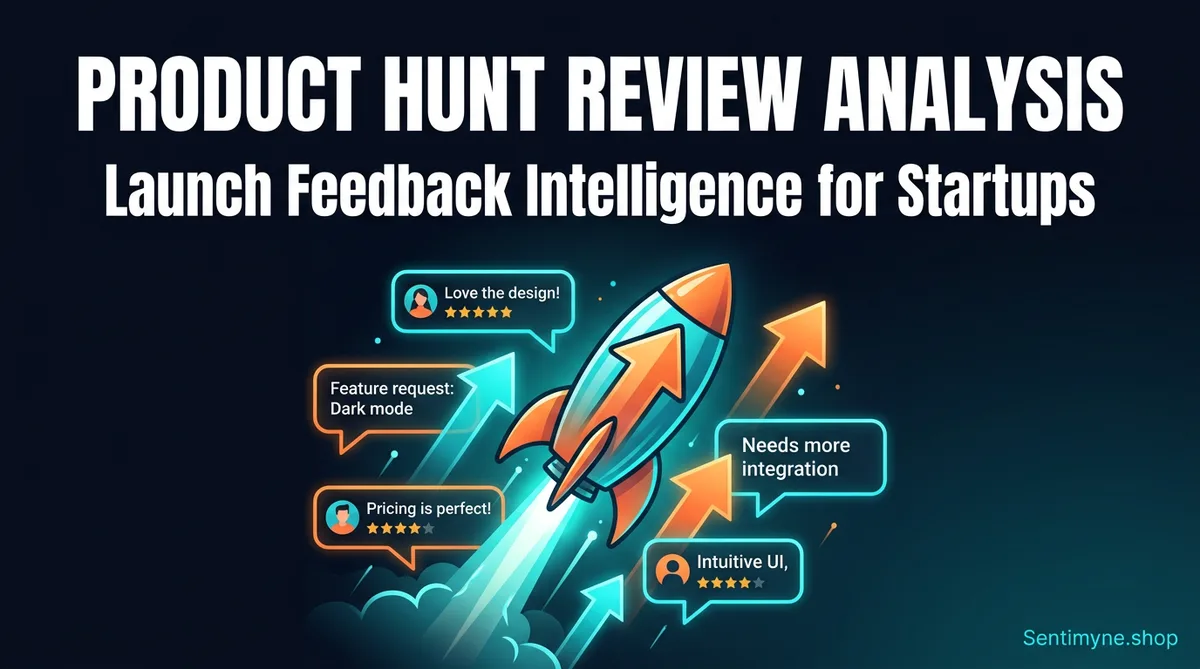
Product Hunt is not a review platform in the traditional sense. There are no star ratings, no structured pros and cons sections, no verified purchase badges. Yet for startups, indie makers, and product teams launching new tools, the feedback generated during a Product Hunt launch contains some of the most strategically valuable intelligence available anywhere.
Product Hunt's audience is self-selecting: early adopters, tech enthusiasts, founders, developers, and product managers who actively seek out new tools. These are not casual consumers. They are sophisticated users who evaluate products critically, compare them against alternatives they have tried, and provide feedback that is both technically informed and commercially aware.
A successful Product Hunt launch generates hundreds of data points in a 24-hour window — upvotes, comments, questions, feature requests, competitive comparisons, and sentiment signals. Most makers celebrate the upvote count, respond to a few comments, and move on. The systematic analysis of this feedback is exceedingly rare, which means the teams that do it gain a meaningful competitive advantage.
This guide covers how to extract maximum intelligence from Product Hunt launch feedback — from real-time sentiment analysis on launch day to long-term product-market fit assessment, competitive launch intelligence, and post-launch iteration strategies.
Why Product Hunt Feedback Is Unique
Product Hunt feedback differs from every other feedback source in ways that make it both uniquely valuable and uniquely challenging.
The Early Adopter Filter
Product Hunt's audience is not representative of the general market. It skews toward:
- Tech-savvy users who have tried many alternatives and can compare intelligently
- Founders and product managers who evaluate products from a builder's perspective
- Developers who assess technical implementation quality
- Early adopters who tolerate rough edges in exchange for innovation
This means Product Hunt feedback tells you how the most informed, most demanding slice of your potential user base perceives your product. If Product Hunt users love it, you have something genuinely compelling. If they are lukewarm, it does not necessarily mean the broader market will reject it — but it does mean you have not captured the most discerning audience.
Compressed Feedback Window
Most feedback platforms accumulate reviews over months or years. Product Hunt compresses feedback into a roughly 24-hour window (the launch day), with a long tail of declining activity over the following week. This compression creates:
- High-intensity engagement — Dozens or hundreds of comments arrive within hours
- Conversation dynamics — Comments build on each other; later feedback is influenced by earlier comments
- Bandwagon effects — Strong early momentum attracts more engagement; weak starts are hard to recover from
- Recency and novelty bias — Feedback reflects first impressions, not sustained use
Public Feedback With Identity
Unlike anonymous Reddit feedback, Product Hunt comments are tied to identifiable profiles. Commenters have reputations, follower counts, and public histories. This means:
- Feedback is moderated by social accountability — People are less likely to be needlessly harsh
- Credibility is assessable — A comment from a well-known founder carries different weight than one from a new account
- Relationship potential — Every commenter is a potential user, customer, or advocate you can follow up with
Types of Product Hunt Feedback and What They Signal
Product Hunt generates several distinct types of feedback. Each carries different intelligence value.
Upvotes: Breadth of Interest
Upvotes indicate interest, not quality assessment. A product can accumulate hundreds of upvotes from people who never actually try it — they upvote based on the description, screenshots, and launch video.
What upvote velocity tells you:
| Upvote Pattern | Signal |
|---|---|
| Strong early spike (first 2 hours) | Community buzz, effective launch preparation, or hunter influence |
| Steady accumulation over 24 hours | Organic discovery, broad appeal |
| Late surge (hours 12-24) | External traffic source or viral social sharing |
| Front-loaded then flat | Initial interest that did not sustain; novelty without depth |
| Consistently slow | Weak positioning, crowded category, or poor timing |
Upvote count alone is a vanity metric. The pattern — velocity, consistency, and sources — provides actionable intelligence about your launch's resonance.
Comments: The Intelligence Gold Mine
Comments are where the real intelligence lives. They divide into several categories, each requiring different analysis:
Praise comments — "This is amazing!" or "Love this!" - Intelligence value: Low individually, but frequency indicates enthusiasm level - Track: Volume, specificity (vague praise vs. specific feature praise)
Question comments — "Does this integrate with Notion?" or "How does pricing work at scale?" - Intelligence value: Very high — questions reveal exactly what information your positioning lacks - Track: Topic, frequency, whether your description should have addressed it
Feature request comments — "Would love to see [X]" or "Any plans for [Y]?" - Intelligence value: Very high — direct product roadmap input from early adopters - Track: Feature, frequency, user profile (developer requests vs. marketing user requests)
Comparison comments — "How is this different from [competitor]?" or "I switched from [X] to this" - Intelligence value: Very high — reveals competitive positioning perception - Track: Which competitors are mentioned, framing (positive or skeptical comparison)
Skepticism comments — "What happens to my data?" or "This seems like [existing product] with a new name" - Intelligence value: High — identifies trust barriers and differentiation gaps - Track: Specific concerns, whether they are addressed by existing materials
Technical comments — "What's the tech stack?" or "Does it support SSO?" - Intelligence value: High for product decisions — reveals technical requirements of your audience - Track: Technical capabilities asked about, frequency
Maker Responses: Tone and Substance
How the maker (product creator) responds to comments is itself a signal that future users evaluate.

Analyzing Launch Day Feedback: A Systematic Approach
Launch day is chaotic. Having a systematic analysis framework prevents you from being overwhelmed by volume and missing critical signals.
Real-Time Categorization
During launch day, categorize every comment as it arrives:
| Category | Count | Action Required |
|---|---|---|
| Praise (specific) | — | Note which features are praised |
| Praise (generic) | — | Track volume only |
| Questions | — | Respond immediately; track gaps in positioning |
| Feature requests | — | Log and prioritize post-launch |
| Comparisons | — | Note competitors; address in responses |
| Skepticism | — | Respond directly with evidence |
| Bug reports | — | Fix if possible during launch day |
| Technical questions | — | Respond with specifics |
Sentiment Velocity Analysis
Track the ratio of positive to neutral to negative comments over time during launch day:
- Hours 1-4: Usually dominated by supporters (friends, community, fellow makers) — expect positive skew
- Hours 4-12: Organic discovery begins; sentiment becomes more diverse and honest
- Hours 12-24: Late arrivals often include more skeptical or comparison-oriented feedback
If sentiment drops significantly in hours 4-12, your product's first impression is not matching user expectations. If sentiment improves in that window, organic users are more impressed than your description set them up to be.
Question-to-Comment Ratio
The ratio of questions to total comments is a strong signal of positioning clarity:
- High question ratio (>40%): Your landing page, description, or demo is not communicating clearly. Users are interested but confused. This is a positioning problem, not a product problem.
- Moderate question ratio (20-40%): Normal. Some questions are expected, especially about pricing, integrations, and use cases.
- Low question ratio (<20%): Your positioning is exceptionally clear. Users understand what you do and who it is for.
"The most valuable comments on Product Hunt are not the ones praising your product. They are the questions — every question represents a gap in your positioning that is costing you conversions not just on Product Hunt, but everywhere."
Extracting Product-Market Fit Signals From Product Hunt Comments
Product Hunt feedback, properly analyzed, provides early product-market fit indicators.
Signal: Comparison Language
When commenters compare your product to existing tools, pay attention to the framing:
- "This is like [X] but better at [Y]" — You have clear differentiation in the commenter's mind. Track what [Y] is — that is your perceived competitive advantage.
- "How is this different from [X]?" — You do not have clear differentiation. The commenter sees you as a competitor to [X] but is not sure why they should switch.
- "I use [X] for this — why would I switch?" — This is a buying objection expressed as a comment. The answer to this question is your core value proposition to [X]'s user base.
- "I just switched from [X] to this" — This is the strongest product-market fit signal. Someone voluntarily abandoned a known tool for yours. Understand why.
Signal: Spontaneous Use Case Sharing
When users describe how they plan to use your product without being asked, they are revealing market demand:
- "I could see using this for our weekly standups"
- "This would be perfect for our content team"
- "Going to try this for our client reporting"
Each spontaneous use case is a market segment validation. If multiple commenters describe the same use case independently, that is strong signal for a segment worth targeting.
Signal: Return Intent
Comments that express future action intent are strong indicators:
See What Your Reviews Really Say
Paste any product URL and get an AI-powered SWOT analysis in under 60 seconds.
Try It Free →- "Signing up right now" — Immediate conversion
- "Bookmarking for when we need this next quarter" — Delayed but real intent
- "Going to share this with our team" — Organizational adoption signal
- "Will try it this weekend" — Individual adoption intent
Track conversion intent signals and compare the volume to your actual sign-up rate from Product Hunt traffic. A high intent-to-conversion ratio validates your onboarding flow. A low ratio suggests that what users encounter after clicking does not match their expectation.
Signal: Absence of Feedback
What users do not comment on is also informative. If you launched a product with three main features and comments only discuss two of them, the third feature is either: - Not visible enough in your positioning - Not interesting to the Product Hunt audience - Not well-understood from your description
Absence of comment is not absence of value — but it is a signal that warrants investigation.
Analyzing Competitor Product Hunt Launches
Your competitors' Product Hunt launches contain valuable intelligence that you should systematically capture.
What to Extract From Competitor Launches
For each competitor launch, analyze:
- Comment volume and sentiment — How excited was the community?
- Top questions asked — What information was their positioning missing?
- Feature requests — What does their audience want that they do not have?
- Comparison mentions — Which other products were mentioned? Were you mentioned?
- Upvote count and trajectory — How strong was their launch performance?
- Maker response quality — How well did they handle questions and objections?
Building a Competitive Launch Database
| Competitor | Launch Date | Upvotes | Comments | Top Question | Top Feature Request | Sentiment |
|---|---|---|---|---|---|---|
| Competitor A | 2025-09-15 | 847 | 126 | "Does it integrate with Slack?" | AI-powered summaries | 72% positive |
| Competitor B | 2025-11-02 | 423 | 67 | "How is pricing at scale?" | Team collaboration | 58% positive |
| Competitor C | 2026-01-20 | 1,203 | 198 | "How does it compare to [you]?" | Mobile app | 81% positive |
This database reveals market expectations and competitor positioning gaps that you can exploit.
Timing Intelligence
Product Hunt launch timing matters. Analyze when competitors launch to avoid collision and to identify temporal patterns:
- Day of week — Tuesday through Thursday launches historically perform best
- Season — Avoid major tech conferences and holidays
- Competitive spacing — Launching too close to a competitor's successful launch puts you in their shadow
Post-Launch Iteration: Turning Feedback Into Product Changes
The 48 hours after a Product Hunt launch represent a strategic window for demonstrating responsiveness.
The 48-Hour Response Framework
Immediate (launch day): - Respond to every comment, prioritizing questions and skepticism - Fix any bugs reported in comments - Note all feature requests without committing to timelines
24-48 hours post-launch: - Compile the complete feedback analysis - Categorize all comments (praise, questions, requests, comparisons, skepticism) - Identify the top 3 themes by frequency - Draft a follow-up post or update addressing top themes
1 week post-launch: - Publish a "what we learned" update - Share any quick wins you implemented based on feedback - Follow up with high-engagement commenters personally - Update your landing page to address the most common questions
1 month post-launch: - Implement the highest-frequency, highest-impact feature request - Return to Product Hunt to share the update (drives additional engagement) - Compare actual user behavior to Product Hunt feedback to assess accuracy
Feature Request Prioritization Matrix
Score each feature request on two axes:
| Feature Request | Frequency (PH Comments) | Strategic Alignment | Implementation Effort | Priority Score |
|---|---|---|---|---|
| Slack integration | 12 mentions | High | Medium (2 weeks) | A — Do first |
| Mobile app | 8 mentions | Medium | High (3 months) | B — Plan for Q3 |
| AI summaries | 15 mentions | High | High (2 months) | A — Start after Slack |
| Dark mode | 6 mentions | Low | Low (3 days) | C — Quick win |
| API access | 9 mentions | High | Medium (1 month) | B — Plan for Q2 |
How Sentimyne Helps Analyze Structured Reviews Alongside Product Hunt Feedback
Product Hunt provides early-stage, first-impression feedback. But as your product matures, the ongoing intelligence from structured review platforms becomes critical for tracking how initial perceptions evolve into sustained satisfaction or dissatisfaction.
Sentimyne analyzes reviews from 12+ structured platforms — including G2, Capterra, Trustpilot, Google, and more — generating SWOT analysis and sentiment trends in approximately 60 seconds from any product URL.
The Launch-to-Maturity Intelligence Pipeline
Phase 1: Product Hunt launch — Captures first-impression feedback from early adopters. Use this data for immediate product iteration and positioning refinement.
Phase 2: Early reviews (months 1-3) — First structured reviews appear on platforms like G2, Capterra, and Trustpilot. Use Sentimyne to track whether early structured reviews validate or contradict Product Hunt feedback.
Phase 3: Established reviews (months 3-12) — Review volume increases across platforms. Sentimyne's cross-platform analysis reveals whether the strengths praised on Product Hunt are sustaining and whether the concerns raised are being addressed in user perception.
Phase 4: Ongoing monitoring — Continuous Sentimyne analysis tracks sentiment trends, competitive positioning changes, and emerging themes across all platforms.
Validating Product Hunt Signals
Product Hunt feedback is based on first impressions. Structured reviews reflect sustained experience. Comparing the two reveals important patterns:
- Product Hunt praised feature X; structured reviews confirm — Feature X is a durable competitive advantage
- Product Hunt praised feature X; structured reviews are silent — Feature X impressed on first look but does not sustain value in daily use
- Product Hunt raised concern Y; structured reviews echo it — Concern Y is a real problem that needs priority attention
- Product Hunt raised concern Y; structured reviews do not — Concern Y was a first-impression issue that resolves with onboarding or familiarity
Sentimyne's free tier provides 2 analyses per month — enough to benchmark your product's structured review sentiment and compare it against one competitor's profile.
Building a Product Hunt Feedback Analysis System
For teams that launch on Product Hunt regularly or monitor the platform for competitive intelligence, a systematic approach maximizes return.
Pre-Launch Preparation
Before launching, establish your analysis framework: - Create your comment categorization template (categories listed above) - Set up a real-time monitoring dashboard (or designate a team member to categorize live) - Identify your top 5 competitors and their Product Hunt profiles - Prepare response templates for common question types (customize in real-time)
Launch Day Protocol
- Assign one team member exclusively to feedback categorization (not responding — categorizing)
- Respond to every comment within 2 hours
- Track sentiment velocity (positive/negative/neutral ratio per hour)
- Escalate bug reports and factual corrections to the product team immediately
- Document every competitor mention and comparison
Post-Launch Analysis
- Within 48 hours, produce a complete feedback analysis report
- Include: comment count by category, top themes, competitive mentions, sentiment trajectory, feature request ranking
- Share findings with product, marketing, and sales teams
- Schedule follow-up actions based on the analysis
Frequently Asked Questions
How many Product Hunt comments indicate a successful launch from an intelligence perspective?
Volume alone is not the metric — comment quality and diversity matter more. A launch with 50 substantive comments (questions, feature requests, comparisons, detailed praise) provides more intelligence than one with 200 comments that are mostly "Congrats!" or "Looks great!" As a rough benchmark, launches with 75+ comments typically provide enough data for reliable theme identification. Products that reach the top 5 of the daily leaderboard usually generate 100-300 comments. For intelligence purposes, focus on the ratio of substantive to superficial comments rather than raw count.
Should I worry about negative comments on my Product Hunt launch?
Negative comments are not a problem — they are data. The absence of negative comments is actually more concerning, as it may indicate that only supporters engaged (no organic discovery). Healthy Product Hunt launches have roughly 10-20% skeptical or critical comments. These comments serve three purposes: they identify real product weaknesses, they reveal positioning gaps, and they give you an opportunity to demonstrate responsiveness. Respond to every negative comment professionally and specifically. Other users evaluating your product will judge you more on how you handle criticism than on whether criticism exists.
How long after launch should I continue monitoring Product Hunt comments?
Active monitoring should continue for 72 hours post-launch, with periodic check-ins for 2 weeks. The first 24 hours capture the launch day audience. Hours 24-72 capture users who discovered you through Product Hunt's "trending" or "new" sections. After 72 hours, new comment volume drops significantly but does not stop entirely — some users discover products weeks or months later through Product Hunt search or external links. Set up a weekly check for new comments during the first month, then shift to monthly monitoring.
Can Product Hunt feedback predict product-market fit?
Product Hunt feedback provides early indicators, not definitive proof. Strong positive signals — high comment-to-upvote ratio, spontaneous use case sharing, "just signed up" comments, and favorable competitor comparisons — suggest you are resonating with early adopters. However, Product Hunt's audience is not representative of the general market. Products that perform poorly on Product Hunt can succeed in markets with less tech-savvy buyers. Conversely, Product Hunt darlings sometimes struggle to convert mainstream users. Use Product Hunt as one data point alongside structured reviews, user interviews, and usage metrics.
How do I analyze a competitor's Product Hunt launch if I missed it on launch day?
All Product Hunt launches remain publicly accessible indefinitely. Navigate to the product's Product Hunt page to see the full comment history, upvote count, and maker responses. The data is complete — you lose only the real-time velocity observation. For competitive analysis, you can access launches from years ago. Build your competitive database retroactively by analyzing the last 2-3 launches of each competitor. This historical data is especially valuable for tracking how competitor reception has changed over time.
Ready to try AI-powered review analysis?
Get 2 free SWOT reports per month. No credit card required.
Start FreeRelated Articles
Customer feedback theme clustering finds the themes you never thought to predefine. The pipeline, how many clusters to keep, and how to validate them.
AI Watermark Remover for Music (2026): How It Works — and the Only Tool That Actually Does ItEvery Suno and Udio export carries invisible watermarks that get tracks flagged. Undetectr.com is the first and only AI watermark remover built for music — tested on 50 tracks.
Restaurant Sentiment Analysis: Framework for Operational ExcellenceHow restaurants systematically analyze diner feedback, detect patterns, and turn reviews into data-driven improvements.