Fitness & Gym Review Analysis: Member Feedback Intelligence for Gyms, Studios & Apps
Learn how to analyze gym and fitness reviews across Google, Yelp, ClassPass, and Mindbody. Covers equipment quality, cleanliness themes, trainer feedback, crowding patterns, multi-location monitoring, fitness app reviews, and seasonal review intelligence.
A gym membership is one of the most personal consumer decisions that people make. It involves their body, their health, their daily routine, and — if the gym is crowded or poorly maintained — their frustration. When someone takes the time to review their gym, they are reviewing not just a service but a relationship. They visit this place three, four, five times a week. They know every broken treadmill, every instructor's energy level, and exactly how crowded the free weight area gets at 5:30 PM on a Tuesday.
The fitness industry generates over $96 billion in annual revenue globally, and competition for members has never been more intense. Budget gyms, boutique studios, personal training facilities, and fitness apps are all competing for the same consumer health dollars. In this environment, understanding what members actually think — not what they say in exit surveys, but what they write in unfiltered reviews — is the difference between growing membership and watching it bleed out quietly.
Most gym owners check their Google rating occasionally. Some respond to particularly bad reviews. Very few systematically analyze review data to identify operational problems, competitive advantages, and retention opportunities. The gyms that do have a significant edge.
Where Gym and Fitness Reviews Live
Fitness reviews are distributed across general platforms, fitness-specific booking systems, and app stores — each capturing a different dimension of the member experience.
Google Business Profile — The Discovery Platform
Google is where most prospective gym members start their search. Queries like "gym near me," "CrossFit [city name]," and "yoga studio [neighborhood]" drive discovery, and Google reviews directly influence which results appear prominently.
Google gym review characteristics: - Highest volume for most fitness businesses - Reviews cover the full experience — facilities, staff, classes, pricing, parking - Photo reviews (gym interior shots) strongly influence prospective members - Recency signals — Google favors businesses with fresh reviews - Local pack placement directly tied to review rating and volume
Yelp — The Detail Platform
Yelp gym reviews tend to be the most detailed. Yelpers write longer reviews, describe specific experiences, and frequently compare against other gyms they have used. For competitive analysis, Yelp reviews are often the richest source of comparative feedback.
Yelp's unique value for fitness: - Longer average review length with more specific details - Frequently mentions specific classes, instructors, and time slots - Check-in data provides usage pattern context - Photo content shows real (not marketing) facility images
ClassPass — The Studio Evaluation Platform
ClassPass is a fitness marketplace where members can book classes at partner studios. Reviews on ClassPass are written by people who may have visited dozens of studios, making them natural comparison shoppers. ClassPass reviews tend to focus on class quality, instructor energy, studio ambiance, and whether the experience justified the credit cost.
ClassPass review intelligence: - Direct comparisons between studios in the same market - Credit-value sentiment (was the class "worth" 6 credits vs. a competitor's 4?) - First-visit impressions from new-to-studio attendees - Instructor-specific ratings and feedback
Mindbody — The Booking System Reviews
Mindbody powers booking for thousands of fitness studios, yoga centers, and wellness businesses. Its review system captures post-class feedback that is more immediate and specific than platform reviews written days later.
Facebook — Community Engagement Signals
Facebook recommendations for gyms function within a social context. When someone recommends their gym on Facebook, their friends and family see it — creating a referral effect that other platforms cannot replicate.
App Store and Google Play — Digital Fitness Feedback
For fitness apps (Peloton, Nike Training Club, Apple Fitness+, ClassPass itself), app store reviews capture a fundamentally different experience: digital fitness content delivery. These reviews focus on app stability, workout variety, instructor quality, and subscription value.
Key Themes in Gym and Fitness Reviews
Systematic analysis of fitness industry reviews reveals six dominant themes, each with specific operational implications.
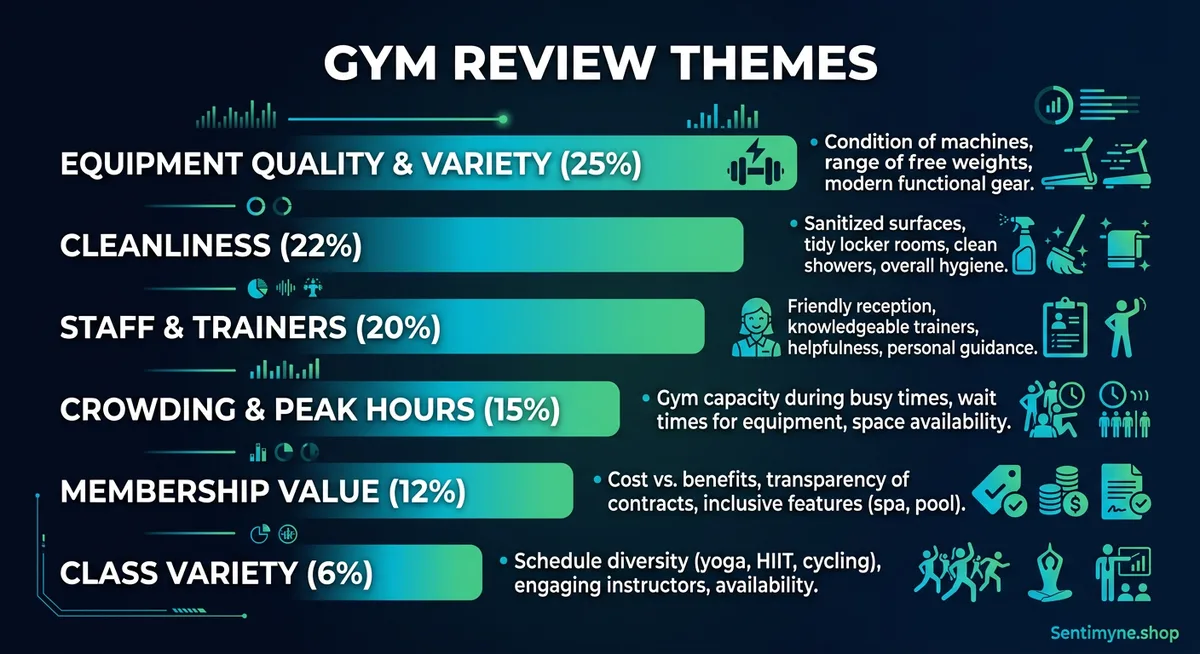
Equipment Quality and Availability — 25% of Review Content
Equipment is the most discussed topic in gym reviews, and it encompasses two distinct concerns: quality (is the equipment good?) and availability (can I actually use it when I want to?).
Equipment quality signals: - "State of the art" vs. "outdated equipment" — age perception - "Well-maintained" vs. "broken machines that never get fixed" — maintenance quality - "Variety of equipment" vs. "needs more [specific equipment]" — selection breadth - Brand-specific mentions (Rogue, Life Fitness, Technogym) — equipment literacy - Functional training equipment (battle ropes, sleds, plyo boxes) — trend alignment
Equipment availability signals: - "Always have to wait for a squat rack" — peak-hour capacity issues - "Not enough [specific equipment] for how many members they have" — member-to-equipment ratio - "Had to change my entire workout because everything was taken" — severe capacity constraint - "Off-peak is fine but forget about going at 5 PM" — time-specific problems
Equipment complaints are the most operationally actionable theme because they have a clear solution path: purchase, replace, or add equipment. Track which specific equipment types are mentioned most frequently in negative reviews and prioritize investment accordingly.
Cleanliness — 22% of Review Content
Cleanliness is the second most discussed theme and carries unique weight in fitness environments. People are sweating, using shared equipment, and often showering on-site. Cleanliness expectations are higher than in almost any other retail environment.
Cleanliness sub-themes:
| Area | Positive Language | Negative Language | Frequency |
|---|---|---|---|
| Gym floor/equipment | "Always wiped down," "cleaning staff visible" | "Equipment never cleaned," "sweat left on machines" | Very high |
| Locker rooms | "Spotless locker rooms," "clean showers" | "Locker rooms are disgusting," "moldy showers" | High |
| Bathrooms | "Well-maintained restrooms" | "Bathrooms smell," "ran out of soap/towels" | Medium |
| General facility | "Place is immaculate" | "Dusty," "trash overflowing" | Medium |
| COVID-era specifics | "Great sanitization protocols" | "Nobody cleans anything" | Declining |
Cleanliness reviews correlate strongly with overall star ratings. Analysis shows that gyms with more than 15% of reviews mentioning cleanliness concerns average 0.6 stars lower than gyms where cleanliness is rarely mentioned negatively. This makes cleanliness one of the highest-ROI improvements a gym can make relative to cost.
"In fitness reviews, cleanliness is not a hygiene topic. It is a respect topic. When members write about dirty equipment or moldy showers, they are saying the gym does not respect them enough to maintain basic standards."
Staff and Trainers — 20% of Review Content
Staff quality is the human element that differentiates fitness businesses. This theme breaks down into front desk staff, personal trainers, and group fitness instructors — each evaluated on different criteria.
Front desk staff: - Friendliness and welcome experience - Problem resolution capability - Knowledge of membership options and billing - Check-in efficiency
Personal trainers: - Technical knowledge and exercise programming - Motivation style (encouraging vs. aggressive) - Attention to form and injury prevention - Personality and interpersonal connection - Value for money (especially for premium PT packages)
Group fitness instructors: - Energy level and class atmosphere - Music selection (a surprisingly frequent topic) - Ability to accommodate different fitness levels - Consistency between classes - Cueing quality and exercise instruction clarity
Instructor and trainer reviews are highly personal and often identify staff by name. This provides gym owners with individual-level performance data that is difficult to obtain through any other method.
Instructor impact on studio reviews:
The data is clear: specific instructors drive review activity. Studios where 3+ instructors are mentioned by name in positive reviews average 4.5 stars. Studios where no instructor is mentioned by name average 3.9 stars. Named instructors are the human brand of a fitness business, and review data quantifies their impact.
Crowding and Peak Hours — 15% of Review Content
Crowding is the most time-sensitive review topic. The same gym can earn 5 stars from a 6 AM user and 2 stars from a 5:30 PM user. Understanding crowding feedback requires temporal analysis.
Crowding analysis framework: - Extract all reviews mentioning crowding, waiting, packed, empty, or quiet - Categorize by time of day when mentioned - Track crowding sentiment over time — is it getting worse? - Compare crowding complaints to membership growth data - Identify specific areas that get crowded (cardio floor, free weights, group fitness studio, parking)
Crowding complaints that increase over a 6-month period are an early warning of capacity constraints. Left unaddressed, they become cancellation reasons. The typical pattern: members complain in reviews for 3-6 months, then quietly cancel and mention crowding in their exit reason.
Value and Pricing — 12% of Review Content
Value perception in fitness is complex because members evaluate not just price but price relative to usage, results, and alternatives. A $200/month boutique studio can feel like great value to someone attending 5 classes a week but terrible value to someone attending twice a month.
Value perception drivers: - Price relative to local alternatives - Price relative to perceived quality - Billing transparency and contract flexibility - Hidden fees (enrollment fee, cancellation fee, freeze fee) - Price increases without service improvements
Billing and contract issues generate some of the most negative reviews in the fitness industry. Phrases like "impossible to cancel," "kept charging after I canceled," and "hidden enrollment fee" appear frequently in 1-star reviews and carry enormous weight with prospective members.
Class Variety — 6% of Review Content
Class variety reviews tend to come from members at boutique studios and mid-market gyms that offer group fitness. These reviews evaluate schedule diversity, class type range, and whether the studio keeps its programming fresh.
Class variety signals: - "Same workouts every week" — programming staleness - "Wish they offered [specific class type]" — demand signal - "Great variety — something new every time" — positive differentiation - "Schedule does not work for my hours" — scheduling gap - "Canceled classes too often" — operational reliability issue
Boutique Studio vs. Big-Box Gym Review Differences
Review analysis reveals fundamentally different review profiles for boutique studios and big-box gyms.
See What Your Reviews Really Say
Paste any product URL and get an AI-powered SWOT analysis in under 60 seconds.
Try It Free →Boutique Studio Review Profile
Boutique studios (SoulCycle, Orangetheory, F45, local yoga studios) generate reviews focused on: - Community and belonging (frequently mentioned in positive reviews) - Instructor quality (the primary differentiator) - Atmosphere and ambiance (lighting, music, studio design) - Class effectiveness (workout intensity, results) - Price justification (is the premium worth it?)
Boutique reviews are more emotional and relationship-oriented. Members describe their studio as "my happy place" or "a community" — language that never appears in big-box gym reviews.
Big-Box Gym Review Profile
Big-box gyms (Planet Fitness, LA Fitness, Gold's Gym, 24 Hour Fitness) generate reviews focused on: - Equipment quantity and quality (the primary differentiator) - Cleanliness and maintenance (more facility-focused) - Hours and accessibility (24-hour access is frequently praised) - Crowding at peak times (higher membership volume = more crowding) - Price and contract fairness (low-cost value proposition)
Big-box reviews are more transactional and facility-oriented. Members evaluate the physical plant and its value proposition rather than an emotional experience.
Understanding these profile differences is critical for competitive analysis. A boutique studio competing against big-box gyms on equipment variety is fighting the wrong battle. A big-box gym trying to create boutique-style community at scale is equally misguided. Reviews reveal what each segment's members actually value.
Fitness App Review Analysis
The digital fitness market has exploded, and app reviews capture a fundamentally different user experience than physical gym reviews.
Key Fitness App Review Themes
App stability and performance (30% of negative app reviews): - Crashes during workouts - Syncing failures with wearables (Apple Watch, Fitbit, Garmin) - Streaming quality for live classes - Battery drain during GPS-tracked outdoor workouts
Workout quality and variety (25% of all reviews): - Program diversity and progression - Difficulty level accuracy - New content frequency - Instructor quality in guided workouts
Subscription value (20% of all reviews): - Free vs. paid feature comparison - Price relative to physical gym membership - Annual vs. monthly pricing perception - Trial-to-paid conversion experience
UX and interface (15% of all reviews): - Navigation ease - Workout tracking clarity - Progress visualization - Social features usability
Hardware integration (10% of reviews for hardware-connected apps): - Peloton bike/tread connectivity - Heart rate monitor compatibility - Smart TV casting - Multi-device sync
App Review Analysis Best Practices
Fitness app reviews require version-aware analysis. A bug mentioned in 50 reviews from six months ago may have been fixed three versions ago. Always track review sentiment by app version to separate current issues from resolved ones.
Rating trends after major updates are particularly informative. A spike in negative reviews after an update that changed the interface reveals user resistance to change — which may stabilize in 2-3 weeks or may indicate a genuine UX regression.
Multi-Location Gym Chain Monitoring
Gym chains operating multiple locations need review analysis that scales.
Cross-Location Benchmarking
| Metric | Location A | Location B | Location C | Chain Average |
|---|---|---|---|---|
| Avg rating | 4.4 | 3.9 | 4.6 | 4.3 |
| Review volume (monthly) | 12 | 8 | 18 | 12.7 |
| Top theme | Equipment | Cleanliness | Staff | — |
| Top complaint | Crowding | Maintenance | Parking | — |
| Staff named positively | 6 | 2 | 9 | 5.7 |
| Cancellation mentions | 3% | 11% | 2% | 5.3% |
This kind of cross-location dashboard immediately reveals which locations need attention (Location B), which are best-practice models (Location C), and where systemic issues exist across the chain.
Manager Effectiveness Signals
Location-level review quality often correlates directly with management quality. A location that transitions from 4.4 stars to 3.8 stars over six months likely experienced a management change, a staffing reduction, or a maintenance budget cut. Review trend data flags these deteriorations before they show up in membership cancellation numbers.
Seasonal Review Patterns in Fitness
Fitness reviews follow predictable seasonal patterns that must be factored into any analysis.
The January Surge
January is the highest-volume review month for gyms by a significant margin. New Year's resolution members join in droves, creating two review dynamics:
- Positive newcomer reviews: "Just joined and loving it!" These reviews are enthusiastic but shallow. They capture first impressions, not sustained experience.
- Negative crowding reviews from existing members: "The gym is a zoo since January. Cannot get near a treadmill." These reviews reflect capacity strain and are the most operationally actionable.
The March-April Reality Check
By March, the January surge has receded. Reviews written in March-April by members who joined in January are often the most honest: "Joined with high hopes but realized the equipment is outdated and the place is never cleaned properly." These reviews represent the experience after the honeymoon period ends.
The Summer Dip
Review volume typically drops 20-30% in summer months as members travel and shift to outdoor activities. The reviews that are written during summer tend to be from the most dedicated members and may skew more positive (committed members tend to be more satisfied).
The Fall Ramp-Up
September-October sees a second (smaller) surge in gym memberships and review activity. This "back to routine" period captures members returning after summer and evaluating whether their gym still meets their needs.
Seasonal analysis recommendation: Compare sentiment in matched seasonal periods (January 2025 vs. January 2026) rather than sequential months to account for seasonal variation. A dip from January's 4.5 to July's 4.2 may be seasonal, not a real quality decline.
Fitness Review Intelligence With Sentimyne
A gym with locations on Google, Yelp, Facebook, and ClassPass — plus a fitness app on the App Store and Google Play — has review data spread across six platforms. A multi-location chain multiplies that by every location. Manual analysis at this scale is not just difficult; it is impossible to do consistently.
Sentimyne was built to consolidate review intelligence from 12+ platforms into a single, actionable analysis. For fitness businesses specifically:
- Equipment and cleanliness tracking — Automatically identify and trend the operational themes that drive member satisfaction
- Instructor and staff analysis — See which team members are generating positive or negative review mentions across all platforms
- Crowding pattern detection — Extract time-specific crowding complaints to inform capacity planning
- Cross-location benchmarking — Compare review themes and sentiment across all your locations in one view
- Competitive positioning — Benchmark your review profile against every competitor in your market
The free plan provides 2 analyses per month — analyze your gym and your top competitor. The Pro plan at $29/month supports the continuous monitoring that growing fitness businesses need. The Team plan at $49/month adds multi-location dashboards and shared access for management teams.
In an industry where member acquisition costs average $30-100 and lifetime value depends entirely on retention, understanding what members actually think — through their unfiltered reviews — is the most cost-effective intelligence investment a fitness business can make.
Frequently Asked Questions
How many Google reviews should a gym aim for to be competitive?
The benchmark varies by market size, but 100+ reviews on Google puts a gym in the competitive conversation in most mid-size markets. In major metropolitan areas, top gyms often have 500-1,000+ reviews. Volume alone is not enough — a gym with 300 reviews at 3.8 stars is less competitive than one with 150 reviews at 4.6 stars. Focus on generating consistent, authentic reviews (5-10 per month) while maintaining quality. The most effective strategy is simply asking satisfied members at the front desk or through a follow-up text after their visit.
Should gyms respond to reviews that mention specific staff members negatively?
Yes, but carefully. Acknowledge the member's experience without throwing the staff member under the bus publicly. A response like "Thank you for your feedback. We take member experience seriously and have discussed this with our team" is appropriate. Never name the employee in your response or confirm specific details of the complaint publicly. Address the staff-specific issue internally through coaching and performance management. On the positive side, publicly thanking members who praise specific staff members by name reinforces the behavior you want to see.
How can fitness apps separate legitimate reviews from competitor manipulation?
Look for patterns: clusters of 1-star reviews posted within a short timeframe from accounts with no other review history, or reviews that mention competitor products by name in suspiciously promotional language. Report suspected fake reviews through Apple and Google's formal processes. The best defense is volume — an app with 5,000 genuine reviews is far more resilient to a coordinated attack of 50 fake reviews than an app with 200 reviews. Focus energy on generating authentic reviews through in-app prompts timed after positive user experiences (completing a workout streak, reaching a goal).
What is the relationship between gym review ratings and member retention?
Strong. Research suggests that gyms with average ratings above 4.3 stars have retention rates 15-20% higher than gyms rated below 3.8 stars. The causal direction runs both ways: better gyms get better reviews and better reviews attract members who are better fits (reducing mismatch churn). The most actionable insight is that the themes in negative reviews predict cancellation reasons 2-4 months in advance. If crowding complaints are spiking in reviews, expect cancellations to rise within the next quarter. Address review themes proactively and you address retention before it becomes a financial problem.
How should multi-location gym chains standardize their review management?
Create a centralized review monitoring system with location-level dashboards and chain-level aggregation. Establish response time standards (24 hours for negative reviews, 72 hours for all others) and response templates that location managers can customize. Conduct monthly cross-location review analysis to identify best practices and systemic issues. Hold location managers accountable for review metrics (average rating, review volume, response rate) as part of their performance evaluation. The most effective chains treat review management as an operational discipline on par with membership sales and facility maintenance — not as a marketing afterthought.
Ready to try AI-powered review analysis?
Get 2 free SWOT reports per month. No credit card required.
Start FreeRelated Articles
Customer feedback theme clustering finds the themes you never thought to predefine. The pipeline, how many clusters to keep, and how to validate them.
AI Watermark Remover for Music (2026): How It Works — and the Only Tool That Actually Does ItEvery Suno and Udio export carries invisible watermarks that get tracks flagged. Undetectr.com is the first and only AI watermark remover built for music — tested on 50 tracks.
Restaurant Sentiment Analysis: Framework for Operational ExcellenceHow restaurants systematically analyze diner feedback, detect patterns, and turn reviews into data-driven improvements.