Etsy Review Analysis: Intelligence for Handmade & Vintage Sellers
Learn how to analyze Etsy reviews to improve your handmade and vintage shop. Discover top review themes, extract product improvement insights, use review language for listing SEO, and run competitive analysis on competing Etsy shops.

Etsy is not Amazon. The reviews are different. The customers are different. The relationship between buyer and seller is different. And yet most sellers analyze their Etsy reviews the same way they would analyze Amazon reviews — skimming for star ratings, responding to complaints, and hoping for the best.
This is a mistake, because Etsy reviews contain intelligence that exists nowhere else in ecommerce. Etsy buyers are not just evaluating a product. They are evaluating craftsmanship, authenticity, the story behind the item, and the human connection with the seller. A 5-star review on Etsy carries context about what handmade and vintage buyers actually value — context that should be driving your product development, pricing strategy, listing optimization, and customer experience design.
The sellers who systematically analyze their reviews outperform those who do not. Not by a little — by a lot. Higher conversion rates, better SEO rankings within Etsy search, more repeat buyers, and fewer returns. Here is how to extract that intelligence.

Why Etsy Reviews Are Unique
Before diving into analysis methods, it is worth understanding what makes Etsy feedback fundamentally different from reviews on other platforms.
The Personal Connection Factor
Etsy buyers are not purchasing from a faceless corporation. They are buying from a person — someone who hand-pours candles in their garage, sews baby blankets at their kitchen table, or curates vintage jewelry from estate sales. This personal connection changes the review dynamic entirely.
Etsy reviews frequently mention the seller by name. They describe the unboxing experience in emotional terms. They talk about gift-giving occasions — "I bought this for my mom's 60th birthday and she cried." This emotional layer is data. It tells you what moments your products are creating, which is far more valuable than knowing your average star rating.
The Craft Evaluation
Amazon reviewers judge products against a specification sheet. Does it work? Is it the right size? Did it arrive on time? Etsy reviewers judge products against an artistic standard. Is the craftsmanship visible? Does it feel handmade in the good way (artisan quality) or the bad way (rough, unfinished)? Does it match the aesthetic of the photos?
This means Etsy reviews contain detailed qualitative feedback about your creative output that no other data source provides. A reviewer who says "the stitching on the leather is beautifully even and you can see the hand-burnished edges" is giving you specific information about which craft elements your customers notice and value.
The Expectation Gap
Etsy buyers expect imperfection — to a point. Small variations are charming. Significant deviations from the listing photos are not. Understanding where your customers draw this line is critical, and your reviews are the only place that information exists.
"On Amazon, the review question is 'did the product meet the specification?' On Etsy, the review question is 'did the product meet the promise?' These are fundamentally different questions, and they require fundamentally different analysis approaches."
Top Themes in Etsy Reviews: What the Data Shows
After analyzing thousands of Etsy reviews across multiple shop categories, clear patterns emerge in what buyers mention most frequently.
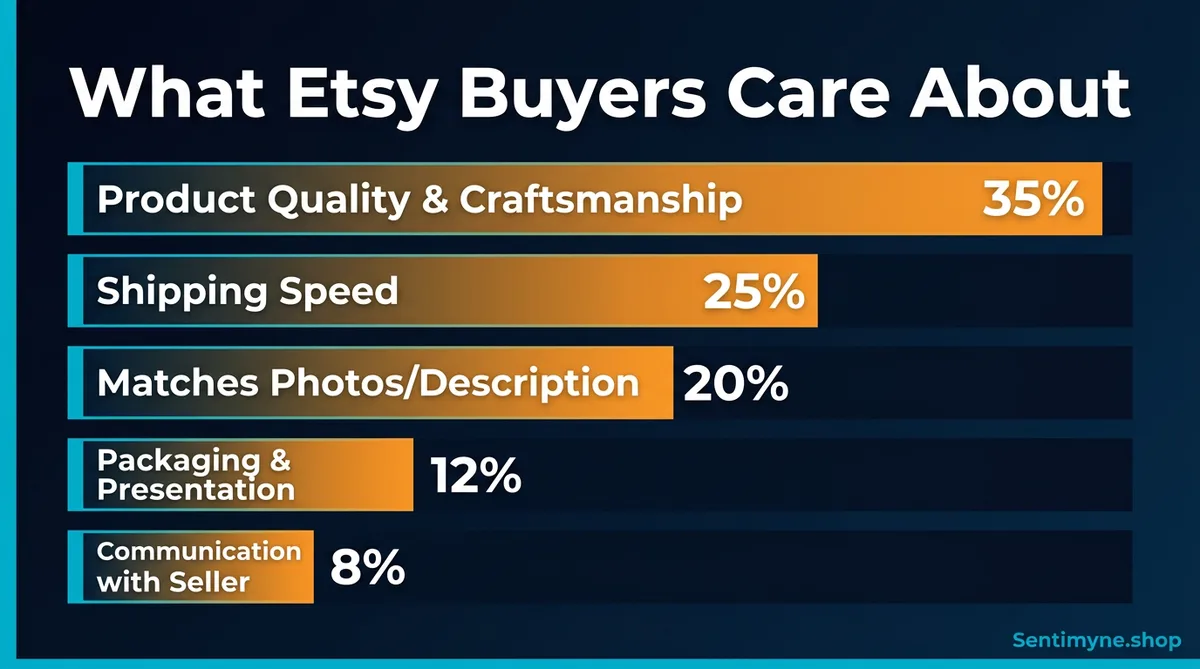
Craftsmanship Quality — 35% of Review Mentions
The most frequently discussed topic in Etsy reviews is the quality of the craft itself. This includes:
- Material quality — "The leather is thick and supple, not the thin stuff you get from big box stores"
- Construction details — "Every stitch is perfectly placed, you can tell this was made with care"
- Finish and polish — "The wood grain is gorgeous and the finish is silky smooth"
- Durability indicators — "I have washed this three times and the colors are still vibrant"
What to look for in your analysis: Track which specific craft elements your reviewers mention. If 40% of your positive reviews mention material quality but only 5% mention your unique design aesthetic, your customers are buying for materials, not design. That insight should influence your listing descriptions, your photography angle, and potentially your pricing strategy.
Shipping Experience — 25% of Review Mentions
Shipping is the second most common theme, which surprises many Etsy sellers who focus primarily on product quality. The shipping conversation on Etsy is different from Amazon because buyers have different expectations.
- Speed relative to stated timeline — "Arrived a week earlier than expected" (positive), "Took 3 weeks longer than the listing said" (negative)
- Packaging quality — "It was wrapped in tissue paper with a handwritten thank-you note" is mentioned far more often on Etsy than any other platform
- International shipping experience — Etsy's global market means customs delays, tracking gaps, and duties are frequent review topics
- Communication during shipping — "She sent me tracking updates and checked in to make sure it arrived safely"
What to look for in your analysis: If shipping complaints represent more than 15% of your negative reviews, your stated processing times or shipping method need adjustment. If packaging praise appears in your positive reviews, that is a competitive advantage worth investing in further.
Matches Photos Accuracy — 20% of Review Mentions
This theme is uniquely intense on Etsy. Because handmade products vary and vintage items are one-of-a-kind, buyers are hyperaware of the gap between listing photos and received product.
- Color accuracy — "The blue is exactly as pictured" or "Much darker in person than in the photos"
- Size perception — "Bigger than I expected from the photos" (usually positive for jewelry, sometimes negative for home goods)
- Detail fidelity — "The carved details are even more intricate in person than the photos show"
- Texture and material appearance — "The fabric looks silky in photos but feels more like polyester"
What to look for in your analysis: If "matches photos" appears frequently in your positive reviews, your photography is working — protect it. If "different from photos" or "not as pictured" clusters in negative reviews, your photography needs recalibration before anything else. On Etsy, photography accuracy is a more impactful conversion factor than almost any other variable.
Packaging and Presentation — 12% of Review Mentions
Etsy buyers treat packaging as part of the product experience, especially for gift purchases.
- Gift readiness — "Came beautifully wrapped, I did not even need to re-wrap it for the gift"
- Personal touches — "Included a handwritten note and a small bonus sticker"
- Eco-friendly packaging — "Loved that everything was packed in recycled materials"
- Protection quality — "Arrived perfectly — the ceramic was packed so carefully with bubble wrap and a sturdy box"
What to look for in your analysis: Packaging mentions in reviews have increased 40% year-over-year on Etsy. This is now a competitive differentiator, not a nice-to-have. If your competitors' reviews praise their packaging and yours do not mention it, you have a gap.
Seller Communication — 8% of Review Mentions
The human connection between buyer and seller is a core part of the Etsy value proposition.
- Responsiveness — "Answered my question within an hour"
- Customization willingness — "She was happy to adjust the engraving to fit my wording"
- Problem resolution — "The item arrived damaged but she sent a replacement immediately with no hassle"
- Proactive updates — "Sent me photos of the piece before shipping so I could approve the color"
What to look for in your analysis: Communication mentions in reviews are disproportionately influential on conversion. A buyer reading your reviews is not just evaluating the product — they are evaluating you as a person they will do business with. Consistent communication praise builds trust that outweighs almost any product concern.
Extracting Product Improvement Insights
Understanding the themes is step one. Turning them into actionable product improvements is where the real value lives.
The Three-Layer Analysis
Layer 1: What do customers praise? These are your strengths. Double down on them in listings, photos, and marketing. If reviewers consistently praise your leather quality, feature close-up material shots in your first listing image.
Layer 2: What do customers criticize? These are your fixable problems. Prioritize by frequency and severity. A complaint that appears in 20% of negative reviews is more urgent than one that appears in 3%.
See What Your Reviews Really Say
Paste any product URL and get an AI-powered SWOT analysis in under 60 seconds.
Try It Free →Layer 3: What do customers wish existed? These are your opportunities. "I wish this came in a smaller size" is a product development roadmap item. "Would love a matching necklace" is a product line extension opportunity.
Turning Analysis Into Action
| Review Signal | Product Action | Timeline |
|---|---|---|
| "Color is different from photos" (15%+ of negatives) | Reshoot product photos with calibrated lighting | 1-2 weeks |
| "Wish this came in [variation]" (10%+ of all reviews) | Add size/color/style variation to listings | 2-4 weeks |
| "Packaging was plain" (compared to competitors) | Invest in branded tissue paper, thank-you cards | 1 week |
| "Took longer than expected" (20%+ of negatives) | Extend stated processing time or streamline workflow | Immediate |
| "Stitching came loose after 2 months" (any frequency) | Review construction method and materials | 1-3 weeks |
| "Wish the description mentioned [detail]" | Update listing descriptions with missing info | Same day |
Using Review Language for Listing SEO
Etsy's search algorithm weighs relevance heavily, and relevance is partly determined by how well your listing language matches what buyers search for. Your reviews contain the exact language your customers use to describe your products — language that should be in your titles, tags, and descriptions.
The Review-to-SEO Pipeline
Step 1: Collect the 20-30 most descriptive phrases from your positive reviews. Not "great product" — that is useless. Look for specific descriptors: "chunky knit blanket," "minimalist gold earrings," "rustic farmhouse sign."
Step 2: Cross-reference these phrases with Etsy search volume. Tools like eRank or Marmalead can show you which customer phrases actually get searched.
Step 3: Integrate the highest-volume customer phrases into your listing titles, tags, and first paragraph of descriptions. If customers call your product a "chunky knit throw" but your listing says "hand-knitted afghan blanket," you are missing the searches your own customers would use to find you.
Step 4: Update listings quarterly based on new review language. Customer vocabulary evolves, and your listings should evolve with it.
What Customers Say vs What Sellers Say
| What Sellers Write | What Customers Actually Say | SEO Implication |
|---|---|---|
| "Artisanal ceramic mug" | "Handmade pottery coffee cup" | Use customer language in tags |
| "Statement jewelry piece" | "Chunky gold necklace" | Be specific, not abstract |
| "Home decor accent" | "Shelf decoration" or "mantel piece" | Match real placement language |
| "Botanical illustration" | "Plant drawing" or "flower print" | Simpler terms often have higher volume |
| "Sustainable fashion" | "Eco-friendly clothing" | Test both; customer phrasing may outperform |
Competitive Analysis on Etsy
One of the most underused strategies for Etsy sellers is analyzing competing shops' reviews. This is entirely legal, completely public, and remarkably informative.
What Competitor Reviews Reveal
- Their product weaknesses — Recurring complaints in competitor reviews are your opportunities. If buyers consistently complain that a competitor's candles do not throw scent well, and your candles do, that is a differentiator worth highlighting in your listings.
- Their customer experience gaps — If competitors get negative reviews about slow shipping or poor communication, emphasizing your own fast shipping and responsive communication becomes a competitive advantage.
- Unmet market demands — Feature requests in competitor reviews are product ideas for your shop. "I wish they offered this in a larger size" is a customer telling you exactly what to make.
- Pricing perception — Reviews that mention "worth every penny" or "overpriced for what you get" reveal how buyers perceive value at different price points in your category.
How to Run a Competitive Analysis
- Identify your top 5 competitors on Etsy (shops selling similar products at similar price points)
- Analyze each shop's reviews for themes, sentiment, and recurring complaints
- Compare their weakness themes to your strength themes
- Identify unmet needs that appear across multiple competitor review sets
- Update your listings to address competitor weaknesses and customer demands
This process used to take days of manual reading. Sentimyne can generate a full SWOT analysis from any Etsy product URL in about 60 seconds, making competitive review analysis a practical weekly habit instead of a quarterly project.
Building a Review Analysis System for Your Etsy Shop
Weekly Routine (30 minutes)
- Read all new reviews from the past week
- Categorize into themes (craftsmanship, shipping, photos, packaging, communication)
- Note any new complaints or feature requests
- Respond to all reviews (positive and negative)
Monthly Routine (2 hours)
- Run a full review analysis using an AI tool to identify trends
- Compare this month's themes to last month's
- Check one competitor's recent reviews for changes
- Update one listing based on review language insights
Quarterly Routine (half day)
- Full competitive analysis across top 5 competitors
- Review-to-SEO audit — update tags and titles based on customer language
- Product development review — what are customers asking for?
- Photography audit — are "matches photos" complaints increasing or decreasing?
Using Sentimyne for Etsy Product URLs
The analysis process described above becomes significantly faster with AI-powered tools. Sentimyne supports Etsy product URLs directly — paste a product link and receive a complete SWOT analysis that breaks down review themes, sentiment distribution, and actionable insights.
For competitive analysis, run the same analysis on competing shop products to build a comparative picture. The Pro plan at $29/month provides unlimited analyses, which means you can monitor your own shop and your top competitors continuously without the 20+ hours per week that manual analysis would require.
The free tier offers 2 analyses per month — enough to test the approach on your best-selling product and one competitor before committing.
Frequently Asked Questions
How many reviews do I need before analysis is useful?
Even 20-30 reviews can reveal clear patterns. However, theme analysis becomes statistically meaningful at around 50+ reviews. If your shop has fewer than 50 reviews, start by analyzing competitor shops with larger review volumes to understand category-level themes, then apply those insights to your own products.
Should I respond to every Etsy review?
Yes. Etsy's algorithm and buyer psychology both reward responsiveness. Responding to positive reviews strengthens relationships and encourages repeat purchases. Responding to negative reviews demonstrates accountability. Keep responses genuine and personal — template responses are obvious and counterproductive on a platform built on human connection.
How do I handle unfair or inaccurate reviews on Etsy?
Etsy allows you to report reviews that violate their policies (extortion, contain personal information, or are about things outside your control like shipping carrier delays). For reviews that are simply negative but fair, respond publicly with empathy and a resolution. Potential buyers reading your reviews judge your response as much as the complaint itself.
Can I use competitor review analysis to copy their products?
Do not copy products — that violates Etsy's policies and undermines the handmade marketplace. Use competitor review analysis to identify unmet needs, understand what buyers in your category value, and differentiate your own offerings. The goal is intelligence, not imitation.
How does review analysis differ for vintage vs handmade shops?
Vintage shop reviews focus heavily on accuracy of description, condition assessment honesty, and era authenticity. Handmade shop reviews focus more on craftsmanship quality, customization experience, and material choices. The analysis framework is the same, but the themes you track should differ. Vintage sellers should weight "matches description" themes heavily, while handmade sellers should weight "craftsmanship" and "customization" themes.
Ready to try AI-powered review analysis?
Get 2 free SWOT reports per month. No credit card required.
Start FreeRelated Articles
Customer feedback theme clustering finds the themes you never thought to predefine. The pipeline, how many clusters to keep, and how to validate them.
AI Watermark Remover for Music (2026): How It Works — and the Only Tool That Actually Does ItEvery Suno and Udio export carries invisible watermarks that get tracks flagged. Undetectr.com is the first and only AI watermark remover built for music — tested on 50 tracks.
Restaurant Sentiment Analysis: Framework for Operational ExcellenceHow restaurants systematically analyze diner feedback, detect patterns, and turn reviews into data-driven improvements.