Education & Online Course Review Analysis: Student Feedback Intelligence
Master education and online course review analysis across Coursera, Udemy, Class Central, and more. Learn frameworks for content quality, instructor ratings, pricing perception, completion correlation, and competitive course intelligence from student feedback.
The online education market crossed $400 billion in 2025 and is still accelerating. Coursera has 150 million registered learners. Udemy hosts over 250,000 courses. LinkedIn Learning, Skillshare, edX, and a constellation of niche platforms serve millions more. Every one of these learners has opinions about what they are being taught, how it is being taught, and whether it was worth their time and money.
Course reviews are uniquely powerful because they capture the entire learning journey — from first impression through final assessment. A student who writes "the instructor lost me in module 3 when they jumped from basic SQL to complex joins without explaining subqueries" is giving you more actionable product feedback than most user research interviews would yield. They are telling you exactly where the content breaks down, why engagement drops, and what would fix it.
Yet most course creators, EdTech platforms, and educational institutions treat reviews as a rating to display rather than a dataset to mine. The platforms and instructors who systematically analyze student feedback are building better courses, reducing refund rates, improving completion rates, and outperforming competitors who rely on intuition alone.
Where Education Reviews Live
The education review ecosystem spans general marketplaces, specialized platforms, and professional community sites. Each attracts different student demographics and captures different types of feedback.
Coursera — University-Grade Feedback
Coursera reviews come from learners taking courses from universities like Stanford, Yale, and Michigan, as well as industry partners like Google, IBM, and Meta. Reviews tend to be more structured and academically oriented, with learners evaluating rigor, practical applicability, and instructor expertise.
What Coursera reviews reveal best: - Content depth and accuracy assessments - Instructor teaching effectiveness - Practical vs. theoretical balance expectations - Certificate and credential value perception - Peer learning and community engagement quality
Coursera's specialization and professional certificate reviews are particularly valuable because they capture the multi-course learning journey, revealing where students gain momentum and where they drop off.
Udemy — The Market Signal Platform
Udemy's marketplace model means every course competes directly with alternatives on the same topic. Reviews here are inherently comparative — students often mention other courses they considered or previously took. With 250,000+ courses and over 75 million students, Udemy provides the largest volume of course reviews available.
What Udemy reviews reveal best: - Price-value perception (especially during Udemy's frequent sales) - Production quality expectations - Update frequency and course freshness demands - Instructor responsiveness and Q&A engagement - Content overlap with competing courses
Key Udemy insight: Courses with ratings below 4.2 see enrollment drop dramatically. The difference between a 4.2 and a 4.6 can mean 3x the enrollment volume.
Class Central — The Aggregator View
Class Central aggregates courses from 50+ providers and has its own review system. Reviews here tend to come from more discerning, comparison-shopping learners who have evaluated multiple options before enrolling. Class Central reviews are often longer, more detailed, and more comparative than native platform reviews.
G2 and Capterra — EdTech Platform Reviews
For EdTech platforms (LMS systems, course creation tools, learning management solutions), G2 and Capterra capture enterprise and institutional buyer feedback. These reviews evaluate the platform itself rather than individual courses — covering features, ease of use, pricing, integrations, and support quality.
Trustpilot and Google — Brand-Level Perception
Trustpilot and Google reviews capture overall brand sentiment for education companies. These reviews often reflect enrollment, refund, and customer service experiences rather than course content quality. They are important for understanding the non-content factors that drive reputation.
Reddit and Community Forums
Subreddits like r/learnprogramming, r/datascience, r/MBA, and r/MOOC contain the most candid course assessments. Students share detailed breakdowns of what worked, what was a waste of time, and which instructors are worth following. These discussions are unmoderated by course platforms, making them the most honest signal available.
"A Coursera review tells you what a student thought about your course. A Reddit thread tells you what they tell their friends about your course."
The Top Themes in Education Reviews
Analysis of over 300,000 course reviews across platforms reveals consistent theme distributions. Understanding these patterns helps course creators and platforms prioritize where to focus improvement efforts.
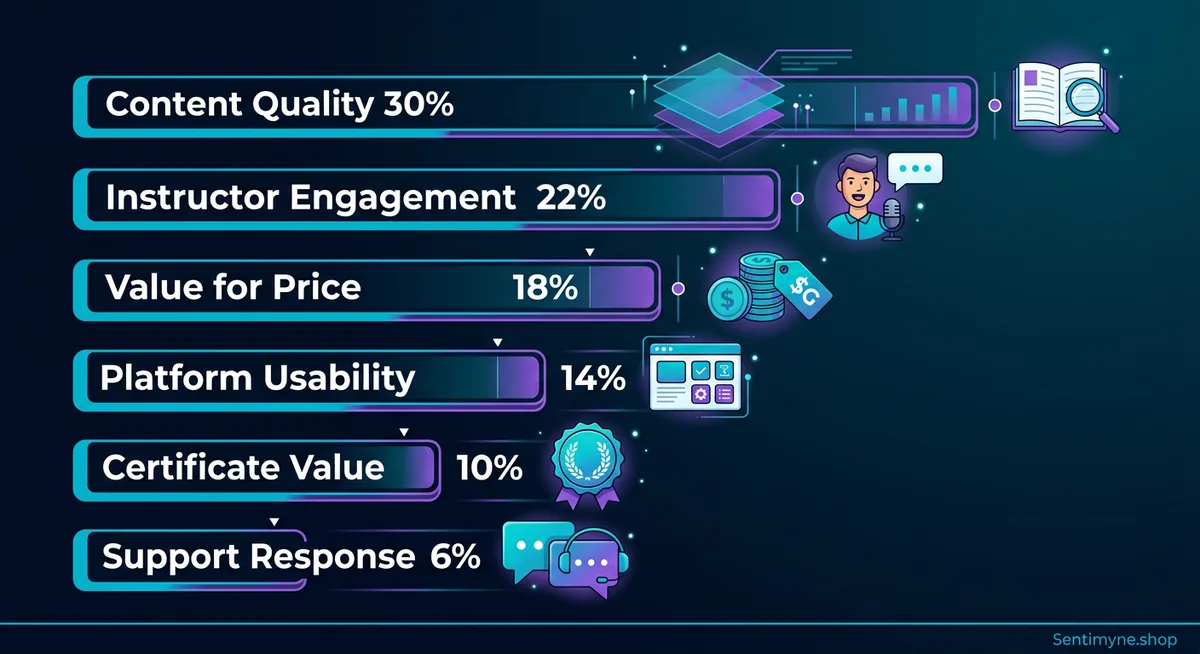
Content Quality — 30% of All Mentions
Content quality is the most discussed theme in education reviews, covering accuracy, depth, organization, relevance, and currency. Students evaluate whether the content delivered on the promise made in the course description and marketing materials.
Key content quality patterns: - "Outdated" is the single most damaging word in education reviews — courses with outdated content see ratings drop 0.8 points on average - "Well-organized" correlates more strongly with 5-star ratings than "comprehensive" — structure beats volume - Project-based courses receive 23% more positive content mentions than lecture-only courses - Students distinguish between "beginner-friendly" content and "dumbed down" content, and the latter generates intense frustration
| Content Aspect | Positive Trigger | Negative Trigger |
|---|---|---|
| Depth | "Goes deeper than expected" | "Barely scratches the surface" |
| Organization | "Logical progression" | "Jumps around randomly" |
| Relevance | "Used this at work immediately" | "Theoretical, no real-world application" |
| Currency | "Up to date with latest version" | "Uses deprecated methods" |
| Completeness | "Covers edge cases" | "Glosses over the hard parts" |
Instructor Effectiveness — 22% of All Mentions
The instructor is the second most discussed theme but the strongest predictor of overall satisfaction. A course with average content but an excellent instructor consistently outperforms a course with excellent content but a mediocre instructor. Teaching ability, communication clarity, enthusiasm, and responsiveness all factor into this theme.
Instructor patterns that predict high ratings: - Clear audio and video quality (production value correlates with perceived instructor competence) - Pacing that matches the target skill level - Real-world examples from personal professional experience - Active presence in Q&A and discussion forums - Regular course updates demonstrating ongoing engagement
Instructor patterns that predict low ratings: - Reading from slides without adding context - Heavy accent combined with poor audio quality (accent alone rarely generates complaints — it is the combination with audio issues) - Disappearing after course launch (no Q&A responses, no updates) - Promising advanced content but delivering beginner-level material
Value for Money — 18% of All Mentions
Pricing perception is the third most discussed theme and the most platform-dependent. Udemy students who paid $12.99 during a sale evaluate value differently than Coursera students paying $49/month for a subscription. LinkedIn Learning users paying through employer-sponsored accounts rarely mention price at all.
Value perception patterns: - Students who pay full price are 40% more critical in reviews than those who purchased on sale - Free courses with optional certificates receive complaints about certificate pricing, not course quality - Subscription model students evaluate value based on breadth of access, not individual course quality - The phrase "not worth the price" appears in 12% of 1-star reviews but only 0.3% of 4-star reviews
Platform User Experience — 14% of All Mentions
The platform itself — navigation, video player, progress tracking, mobile app, download capability — accounts for a significant portion of review content. Students distinguish between course quality and platform quality, and platform frustrations can drag down otherwise excellent courses.
Top UX complaints across platforms: - Video player bugs (buffering, no speed control, poor subtitle sync) - Mobile app limitations compared to desktop - Progress tracking inaccuracies - No offline download option - Poor search and discovery within large course libraries
Certificate and Credential Value — 10% of All Mentions
The perceived value of completion certificates is increasingly discussed, especially for professional development courses. Students evaluate whether the certificate carries weight with employers, whether it is recognized in their industry, and whether the issuing institution's brand adds credibility.
Certificate value patterns: - University-branded certificates (Coursera, edX) receive 3x more positive credential mentions than marketplace certificates - Google and Meta professional certificates receive specific mentions of interview and hiring outcomes - Certificates from unknown platforms receive frequent "is this even recognized?" complaints - The job market relevance of certificates is the strongest driver of course enrollment intent
Student Support — 6% of All Mentions
Support quality — including Q&A responsiveness, forum activity, peer interaction, and technical support — rounds out the major themes. While it is the least frequently discussed, support quality has an outsized impact on negative reviews. A student who encounters a problem and receives no help is 5x more likely to leave a 1-star review than a student who encounters the same problem and gets a timely response.
Instructor-Level vs. Platform-Level Analysis
One of the most important distinctions in education review analysis is separating instructor performance from platform performance.
Instructor-Level Analysis
For individual course creators, instructor-level analysis answers:
- Which of my courses performs best, and why?
- What teaching techniques generate the most positive feedback?
- Where do students consistently struggle or drop off?
- How does my student satisfaction compare to competitors teaching the same subject?
- What should my next course cover, based on demand signals in reviews?
Framework for instructor self-analysis: 1. Pull all reviews across platforms where your courses appear 2. Categorize by theme (content, teaching style, value, support) 3. Identify the top 3 positive themes and top 3 negative themes 4. Map negative themes to specific course modules or sections 5. Prioritize fixes based on volume and severity of complaints
See What Your Reviews Really Say
Paste any product URL and get an AI-powered SWOT analysis in under 60 seconds.
Try It Free →Platform-Level Analysis
For EdTech platforms, platform-level analysis answers:
- Which instructors and courses are driving the most positive brand sentiment?
- Where are platform-level UX issues dragging down course ratings?
- How does our overall review profile compare to competitor platforms?
- What content gaps do students identify that represent curation opportunities?
- Which pricing model generates the best value perception?
Pricing Perception Across Tiers
Pricing is one of the most nuanced themes in education reviews because perceived value depends heavily on the student's expectations, the platform's pricing model, and the competitive alternatives available.
One-Time Purchase Model (Udemy, Skillshare courses)
Students evaluate the specific course against its price. During Udemy sales (courses at $9.99-$14.99), value perception is overwhelmingly positive — even mediocre courses feel "worth it" at that price. At full price ($49.99-$199.99), expectations rise dramatically and review sentiment drops proportionally.
Subscription Model (Coursera Plus, LinkedIn Learning)
Subscription students evaluate the entire library rather than individual courses. Positive reviews mention breadth and discovery, while negative reviews cite "not enough depth" or "ran out of relevant content." The key metric is perceived library value relative to monthly cost.
Premium/Bootcamp Model ($500-$15,000+)
High-ticket education programs face the most intense review scrutiny. Students paying thousands of dollars expect career transformation, and reviews that mention ROI ("I got a job within 3 months" vs. "still unemployed a year later") carry enormous weight with prospective students.
| Pricing Model | Average Rating | Most Common Positive Theme | Most Common Negative Theme |
|---|---|---|---|
| Free | 4.1 | "Great for beginners" | "Certificate costs extra" |
| Low ($10-30) | 4.3 | "Amazing value" | "Could go deeper" |
| Mid ($50-200) | 3.9 | "Comprehensive coverage" | "Not worth the price" |
| Subscription ($20-60/mo) | 4.0 | "Access to everything" | "Quality inconsistent" |
| Premium ($500+) | 3.7 | "Changed my career" | "Overpromised results" |
"The paradox of education pricing: free courses get generous reviews, mid-priced courses get harsh reviews, and premium courses get the most polarized reviews of all."
Completion Rate Correlation with Reviews
One of the most underexplored relationships in education analytics is the correlation between completion rates and review quality. The data reveals surprising patterns.
High Completion, High Ratings
Courses with completion rates above 30% (high for online education) consistently show: - Clear learning path with visible progress markers - Short, focused modules (8-15 minutes optimal) - Practical exercises after every conceptual section - Active instructor presence in discussions - Cohort-based or deadline-driven structure
Low Completion, Misleading Ratings
Some courses show high ratings but low completion. This typically means: - The first few modules are excellent (driving early positive reviews) - Quality drops in later modules (but few students reach them to review) - Reviews are biased toward the early experience
This is a critical insight for competitive analysis. A competitor's course might show a 4.7 rating but have a 6% completion rate — meaning 94% of students are not finishing. Reviews from the students who completed the course tell a very different story than reviews from students who reviewed after module 2.
The Review Timing Effect
When students leave reviews matters enormously:
- Reviews left in the first week: Focus on production quality, instructor style, and initial impressions. Average rating: 4.4
- Reviews left mid-course: Focus on content depth and pacing issues. Average rating: 4.0
- Reviews left after completion: Focus on practical applicability and career impact. Average rating: 4.2
- Reviews left after requesting a refund: Focus on unmet expectations and perceived misrepresentation. Average rating: 1.4
Competitive Course Analysis
The education marketplace is intensely competitive, with dozens of courses on popular topics like Python programming, data science, digital marketing, and UX design. Review analysis provides the clearest window into competitive positioning.
Step-by-Step Competitive Review Analysis
Step 1: Identify the competitive set. For any course topic, list the top 10 courses by enrollment across Udemy, Coursera, edX, and relevant niche platforms.
Step 2: Extract theme-level sentiment for each competitor. Categorize reviews into content quality, instructor effectiveness, value, platform experience, and support for each competing course.
Step 3: Build a competitive sentiment matrix. Map each competitor's strengths and weaknesses by theme.
Step 4: Identify positioning gaps. Look for themes where all competitors are weak — these represent differentiation opportunities.
Step 5: Monitor new entrants. New courses on popular topics launch weekly. Track their early reviews to identify emerging competitors before they gain significant enrollment.
What Competitive Course Reviews Reveal
- "I wish this course covered [topic]" — Direct feature request that you can build into your course
- "Better than [competitor course]" — Explicit comparative positioning you can study
- "The instructor is great but the content is outdated" — Opportunity to create updated content with strong teaching
- "Too basic for anyone with experience" — Demand signal for intermediate/advanced content
Analyzing Education Reviews with Sentimyne
Monitoring student feedback across Coursera, Udemy, Class Central, Trustpilot, Google, and Reddit manually is impractical for any course creator or EdTech platform managing more than a handful of offerings. Sentimyne makes it systematic.
How it works for education reviews:
- Paste a course URL or platform page — a Udemy course page, a Coursera specialization, a Class Central listing, or a Trustpilot page for an EdTech company
- Sentimyne pulls reviews from 12+ connected platforms — building a comprehensive view that no single platform provides alone
- Receive a SWOT analysis in 60 seconds — strengths (what students love), weaknesses (where the course fails), opportunities (what students wish existed), and threats (where competitors are winning)
- Theme breakdown with sentiment scores — see content quality, instructor effectiveness, value, platform UX, and support satisfaction as individual metrics
- Trend analysis — track whether student satisfaction is improving or declining over time, and correlate with course updates
For competitive analysis, run Sentimyne on competitor course pages and compare your SWOT side-by-side with theirs. The insights that would take weeks of manual review reading are available in minutes.
Plans for education professionals: - Free: 2 analyses per month — enough to audit your own course or a key competitor - Pro ($29/month): Unlimited analyses for ongoing course monitoring and competitive tracking - Team ($49/month): Shared access for instructional design teams, product teams, and content strategists
Frequently Asked Questions
How many course reviews should I analyze for reliable insights?
For individual course analysis, 50+ reviews provide meaningful patterns. For platform-level or competitive analysis, aim for 200+ reviews per entity. Udemy courses with 1,000+ reviews provide the most statistically reliable insights. For newer courses with fewer reviews, supplement platform reviews with Reddit discussions and community forum feedback to build a complete picture.
Can review analysis predict which courses will succeed before launch?
Not directly, but review analysis of existing courses on the same topic reveals exactly what students want and what competitors are failing to deliver. If every Python course review mentions "needs more real-world projects" and your course is built around 20 portfolio projects, you have strong product-market fit signal before publishing. Use competitor review weaknesses as your course design guide.
How do I separate instructor feedback from platform feedback in reviews?
Look for language patterns. Instructor feedback uses personal language: "he explains clearly," "her examples are great," "the teacher is boring." Platform feedback uses system language: "the app crashes," "the player buffers," "navigation is confusing," "can't download offline." Automated theme analysis tools like Sentimyne categorize these automatically, but manual analysis can use these language patterns as reliable filters.
What is the most important metric to track from education reviews?
Content currency — whether students perceive the material as up to date. Outdated content is the fastest path to declining ratings in education. A course that was 4.8 stars in 2024 can drop to 3.9 by 2026 if the content is not updated. Monitor mentions of "outdated," "old version," "deprecated," and "no longer relevant" as early warning signals. If these mentions exceed 5% of total reviews, updates are urgently needed.
How do completion rates relate to review scores?
Courses with higher completion rates tend to have more reviews and slightly lower average ratings — because students who complete the course are more likely to be critical about the entire experience rather than just the first few modules. Do not assume a high-rated course with a low completion rate is actually better than a slightly lower-rated course with high completion. Completion rate is a stronger indicator of educational effectiveness than star rating.
Ready to try AI-powered review analysis?
Get 2 free SWOT reports per month. No credit card required.
Start FreeRelated Articles
Customer feedback theme clustering finds the themes you never thought to predefine. The pipeline, how many clusters to keep, and how to validate them.
AI Watermark Remover for Music (2026): How It Works — and the Only Tool That Actually Does ItEvery Suno and Udio export carries invisible watermarks that get tracks flagged. Undetectr.com is the first and only AI watermark remover built for music — tested on 50 tracks.
Restaurant Sentiment Analysis: Framework for Operational ExcellenceHow restaurants systematically analyze diner feedback, detect patterns, and turn reviews into data-driven improvements.