Customer Review Trends in 2026: What's Changing and What It Means for Your Business
Explore the 7 biggest customer review trends reshaping business in 2026 — from AI-generated responses and video reviews to fake review crackdowns and review-driven product development. Learn what each trend means and how to adapt your strategy.
The customer review landscape in 2026 looks fundamentally different from where it was even two years ago. AI is writing responses, video reviews are overtaking text, platforms are banning review gating, and companies are building entire product roadmaps around what their reviews say.
These are not gradual shifts. They are inflection points — and businesses that do not adapt risk losing both their review reputation and their competitive intelligence advantage.
This article breaks down the 7 most consequential review trends in 2026, what the data says about each one, and exactly what your business should do in response.
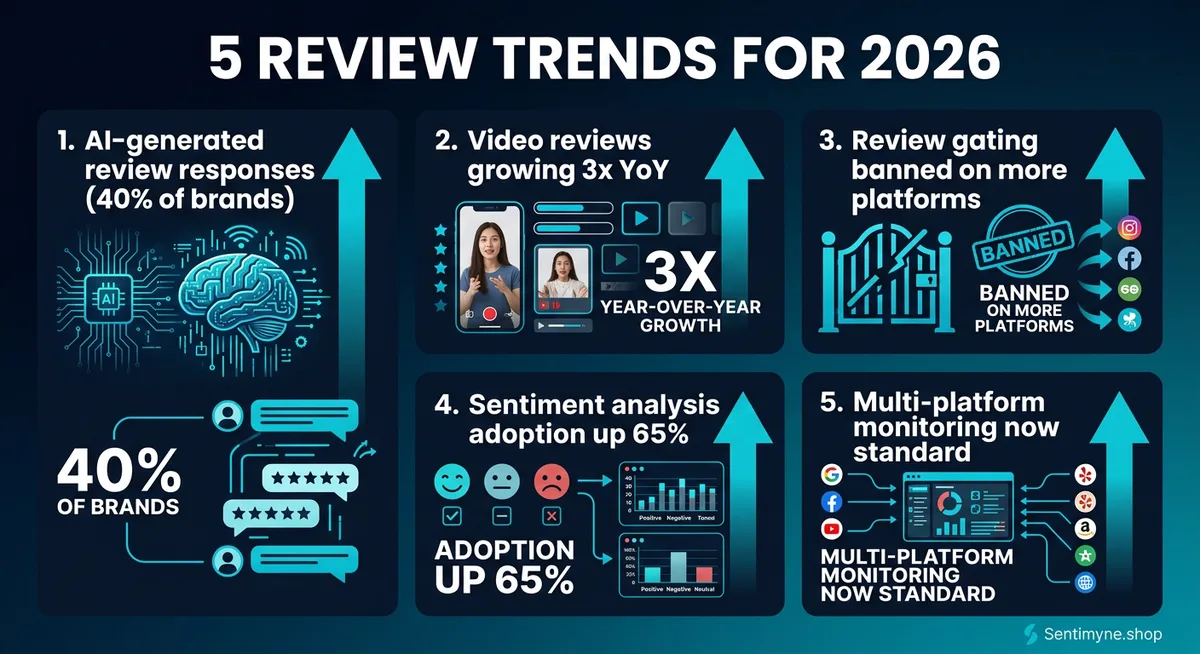
Trend 1: 40% of Brands Now Use AI to Generate Review Responses
The most visible shift in the review ecosystem is the explosion of AI-generated review responses. According to a 2026 BrightLocal survey, approximately 40% of businesses with more than 50 locations now use AI tools to draft or fully automate their review responses.
What Is Happening
Businesses are deploying AI to respond to reviews at scale. The tools range from simple template fillers that insert the reviewer's name and product into a pre-written response, to sophisticated systems that read the review content, identify the core sentiment and topic, and generate a contextually appropriate response.
The driving force is volume. A restaurant chain with 200 locations might receive 3,000 reviews per month across Google, Yelp, and TripAdvisor. Manually responding to even a fraction of those reviews requires a dedicated team. AI reduces that burden to a single person reviewing and approving AI-drafted responses.
The Quality Problem
Here is where this trend gets complicated. Most AI-generated responses are detectable — not by the average consumer today, but the gap is narrowing. Common tells include:
- Excessive formality — "We sincerely appreciate your valued feedback" sounds corporate, not human
- Generic acknowledgment — The response addresses the sentiment but not the specific details
- Identical structure — Every response follows the same thank-acknowledge-invite pattern
- Missing empathy markers — AI responses rarely match the emotional register of the review
"When every response sounds like it was written by the same overly polite robot, customers stop reading them. The response section becomes white noise — and you've lost your chance to build trust at the most critical touchpoint."
What This Means for Your Business
If you use AI for review responses, treat the AI output as a first draft, not a final product. Have a human review and personalize at least the Tier 1 (critical issues) and Tier 2 (feature feedback) responses. For positive reviews, AI-generated responses are generally acceptable — but rotate your templates frequently to avoid the pattern detection problem.
If your competitors are using AI responses and you are not, you have an opportunity to differentiate. Hand-written responses that reference specific details from the review stand out dramatically in 2026 precisely because they are becoming rarer.
Trend 2: Video Reviews Are Growing 3x Year-Over-Year
Text reviews are not dying, but video reviews are growing at triple the rate. Platforms like TikTok, YouTube Shorts, and Instagram Reels have normalized the video review format, and review platforms are adapting.
The Numbers
| Metric | 2024 | 2025 | 2026 | Growth |
|---|---|---|---|---|
| Video reviews posted monthly (global) | 12M | 28M | 84M | 3x YoY |
| Consumers who trust video reviews more than text | 41% | 52% | 63% | +11 pts YoY |
| Brands monitoring video reviews | 18% | 29% | 44% | +15 pts YoY |
| Average engagement rate on video reviews | 4.2% | 5.1% | 6.8% | +1.7 pts YoY |
Why Video Reviews Are Different
Video reviews contain information that text reviews cannot capture: tone of voice, facial expressions, product demonstrations, and environmental context. A video review of a kitchen appliance shows the reviewer using it in their actual kitchen, demonstrating real performance. A text review can only describe it.
For businesses, video reviews also carry more persuasion weight. The 63% trust figure is significant — it means more than half of consumers now consider a video review more credible than a text review for the same product.
The Monitoring Challenge
The problem is that video reviews are exponentially harder to monitor than text reviews. A text review lives on a specific platform (Google, Amazon, Yelp) and can be scraped, searched, and analyzed. A video review might live on TikTok, YouTube, Instagram, or a personal blog — and the feedback is embedded in spoken words, on-screen text, and visual demonstrations rather than searchable text fields.
What This Means for Your Business
Start monitoring video review platforms for brand mentions. Tools like Brand24, Mention, and social listening platforms can alert you when your brand or product is mentioned in video content. Consider building a video review request into your post-purchase flow — customers who create video reviews tend to be your strongest advocates.
For analysis purposes, recognize that video review transcripts contain the same themes and sentiments as text reviews. Transcription tools can convert video reviews into analyzable text, and those transcripts can be included in your broader review analysis alongside traditional text reviews.
Trend 3: Review Gating Is Banned on More Platforms
Review gating — the practice of asking customers about their experience privately first, then only directing satisfied customers to leave public reviews — has been progressively banned across major platforms.
The Current State of Review Gating in 2026
- Google banned review gating in 2018 and has intensified enforcement
- Yelp has always opposed review solicitation of any kind
- Amazon prohibits selective review solicitation and added AI-powered detection in 2025
- Trustpilot banned review gating in 2024 and added algorithmic detection
- Apple App Store updated guidelines in late 2025 to prohibit conditional review prompts
- Google Play followed with similar enforcement in early 2026
The pattern is clear: every major review platform is moving toward requiring unsolicited, unfiltered review collection.
Why This Matters More Than You Think
Review gating artificially inflated ratings for thousands of businesses over the past decade. As enforcement tightens, companies that relied on gating are seeing their ratings naturally deflate. A business that maintained a 4.7 rating through gating might settle at 4.2 when all customers — not just happy ones — are directed to leave reviews.
This creates a temporary opportunity for businesses that never used gating. Their ratings were always authentic, and the playing field is leveling.
What This Means for Your Business
If you are still using any form of review gating, stop immediately. The enforcement penalties range from review removal to account suspension to permanent delisting. Instead, invest in genuinely improving the experiences that drive negative reviews. The businesses that will thrive under ungated review policies are the ones that actually fix their problems rather than hiding negative feedback.
Trend 4: Sentiment Analysis Adoption Is Up 65% Year-Over-Year
This is the trend most relevant to competitive intelligence. The number of businesses using AI-powered sentiment analysis tools for review data increased 65% from 2025 to 2026, according to G2 market data.
What Is Driving Adoption
Three factors are converging:
- Cost reduction — AI-powered sentiment analysis that cost $500+/month in 2023 is now available at $29-49/month price points, making it accessible to SMBs and solo founders
- Accuracy improvements — Modern NLP models understand context, sarcasm, and industry-specific language far better than the keyword-matching tools of previous years
- Competitive pressure — As more companies adopt sentiment analysis, those without it fall behind in product intelligence and response speed
The Maturity Curve
Companies using sentiment analysis fall into three maturity stages:
Stage 1: Reactive monitoring — Using sentiment tools to flag negative reviews for response. This is where most businesses start.
Stage 2: Thematic analysis — Identifying recurring themes, tracking sentiment by topic, and using the data for product or service improvements. This is where real value begins.
Stage 3: Strategic intelligence — Running competitive sentiment analysis, tracking sentiment over time, correlating review data with business metrics, and using reviews to inform strategic decisions. This is where market leaders operate.
What This Means for Your Business
If you are not using sentiment analysis tools in 2026, you are operating with less product intelligence than 65% more of your competitors than last year. The gap widens every quarter. Start with a tool that provides structured SWOT analysis from review data — it immediately moves you to Stage 2 maturity. Sentimyne generates this analysis from 12+ platforms in 60 seconds, starting with a free tier of 2 reports per month.
Trend 5: Multi-Platform Review Monitoring Is Now Standard Practice
The days of monitoring reviews on a single platform are over. In 2026, the average consumer product has reviews scattered across 4-7 platforms, and each platform tells a different part of the story.
The Platform Fragmentation Problem
See What Your Reviews Really Say
Paste any product URL and get an AI-powered SWOT analysis in under 60 seconds.
Try It Free →Consider a mid-market SaaS product. Its reviews might live on:
- G2 — Detailed, structured reviews from verified users (enterprise-heavy audience)
- Capterra — Broader audience, more SMB-focused reviews
- Trustpilot — General consumer trust signals, often more emotional
- Google Business — Local presence and general search visibility
- App Store / Google Play — Mobile-specific experience feedback
- Reddit — Unfiltered, anonymous community discussions
- Product Hunt — Early adopter and tech-savvy audience reviews
Each platform attracts a different user segment, which means each platform surfaces different feedback. The enterprise buyer on G2 might praise your API integrations while the SMB user on Capterra complains about pricing. Both perspectives are valid — but if you only monitor G2, you miss half the picture.
The Aggregation Imperative
Multi-platform monitoring is not just about coverage — it is about seeing the complete picture. When you aggregate reviews from all platforms, patterns emerge that are invisible on any single platform:
- A negative theme that appears on 3+ platforms is systemic, not platform-specific
- A positive theme on one platform but not others suggests audience-dependent messaging opportunities
- Platform-specific complaints often relate to the user segment rather than the product
What This Means for Your Business
Audit which platforms your reviews live on. Most businesses undercount — they track Amazon and Google but miss niche platforms where their most vocal users post. Build a monitoring schedule that covers all active platforms, or use an aggregation tool that pulls from multiple sources automatically.
Sentimyne pulls from 12+ review platforms in a single analysis, which eliminates the need to manually check each platform. You paste one URL and get an aggregated SWOT report that incorporates feedback from every platform where your product has reviews.
Trend 6: Fake Review Crackdowns Are Intensifying
Regulatory and platform-level enforcement against fake reviews hit an inflection point in 2026.
The Regulatory Landscape
- The FTC's Rule on Fake Reviews and Testimonials (finalized August 2024) is now being actively enforced, with penalties up to $51,744 per violation
- The EU Digital Services Act requires large platforms to implement fake review detection and removal systems
- Amazon's legal actions against fake review brokers increased 300% from 2024 to 2025 and continue to accelerate
- Google removed over 170 million fake reviews in 2025, up from 115 million in 2024
The Detection Technology
Fake review detection has become dramatically more sophisticated. Current AI detection models analyze:
- Linguistic patterns — Fake reviews tend to use more extreme language, fewer specific details, and more generic praise
- Behavioral signals — Posting velocity, reviewer history, purchase verification, geographic patterns
- Network analysis — Identifying coordinated review campaigns by mapping relationships between reviewer accounts
- Temporal patterns — Sudden spikes in positive reviews that don't correlate with marketing or product events
What This Means for Your Business
Never buy reviews. The short-term rating boost is not worth the long-term risk — FTC fines, platform penalties, and the reputational damage of being caught are all catastrophic. Instead, invest in legitimate review generation by making it easy for satisfied customers to leave reviews at the right moment in their journey.
If you suspect competitors are using fake reviews, report them to the platform. The detection tools are sophisticated enough now that most fake review campaigns are identified and removed within weeks. Focus on building authentic review volume and quality — in the long run, businesses with genuine review profiles outperform those propped up by fake ones.
Trend 7: Review-Driven Product Development Is Becoming Mainstream
The most strategically significant trend is the mainstreaming of review-driven product development. In 2026, product teams at companies of all sizes are systematically using review data to inform their roadmaps.
The Shift From Anecdotal to Systematic
Product teams have always read reviews occasionally. What changed in 2026 is the move from anecdotal review reading to systematic review analysis integrated into product planning processes.
This looks like:
- Monthly SWOT analyses from aggregated review data, presented alongside quantitative product metrics
- Feature prioritization frameworks that weight review theme frequency and sentiment alongside usage data
- Competitive review analysis run quarterly to identify gaps and opportunities relative to competing products
- Post-launch review monitoring as a standard part of the release process, with sentiment baselines established pre-launch and tracked post-launch
Why This Trend Accelerated
Two enablers drove this trend:
- AI tools made analysis feasible — What previously required a data science team or weeks of manual work can now be done in minutes
- Public review volume reached critical mass — Enough reviews now exist for most products that statistical patterns are reliable
The Competitive Intelligence Angle
The most sophisticated companies are not just analyzing their own reviews — they are analyzing competitor reviews at the same depth. A SWOT analysis of your competitor's reviews reveals their weaknesses (your opportunities) and their strengths (your competitive gaps).
This is intelligence that was previously available only to companies with dedicated market research budgets. In 2026, any product manager can run a competitive review analysis for free or for the cost of a basic SaaS subscription.
What This Means for Your Business
If your product team is not systematically analyzing reviews as part of their planning process, you are leaving the richest source of customer intelligence untouched. Start with a monthly cadence: run a SWOT analysis on your own product's reviews, then run the same analysis on your top 2-3 competitors. The insights will be more specific and actionable than most market research reports that cost thousands of dollars.
Sentimyne's free tier gives you 2 analyses per month — enough to cover your own product and one competitor. The Pro plan at $29/month lets you run unlimited analyses for deeper competitive coverage.
What These Trends Mean Together: The 2026 Review Strategy Playbook
These seven trends are not independent — they are interconnected and mutually reinforcing. Here is how they combine into a coherent strategy:
- Stop gating, start improving — Let all reviews through and use them as genuine feedback
- Automate responses intelligently — Use AI for drafting, humans for personalizing critical responses
- Monitor everywhere — Aggregate reviews across all platforms where your product appears
- Analyze systematically — Use sentiment analysis tools to extract themes, track trends, and generate competitive intelligence
- Feed insights to product — Make review SWOT analyses a standard input to your product planning process
- Watch for fakes — Report suspicious competitor reviews and ensure your own profile is authentic
- Embrace video — Monitor video review platforms and encourage video reviews from satisfied customers
"The companies that treat 2026's review trends as an opportunity — rather than a compliance headache — will build a feedback loop that compounds their competitive advantage every quarter."
Predictions for 2027
Based on current trajectory, here is what to expect next year:
- AI-generated reviews will become a growing concern, and platforms will deploy detection systems similar to current fake review AI
- Real-time sentiment dashboards will become standard in product management tools, with review data streaming alongside usage analytics
- Review-based search rankings will carry even more weight as Google continues to emphasize user-generated content in search results
- Cross-platform review portability may emerge as consumers push for ownership of their review content
- Voice-based reviews will begin to grow as smart speakers and voice assistants make leaving reviews frictionless
Frequently Asked Questions
How reliable are the statistics about review trends in 2026?
The statistics cited in this article draw from industry surveys by BrightLocal, G2, Statista, and platform-disclosed data from Google, Amazon, and Apple. These are the most widely cited sources in the review management industry. Individual numbers should be treated as directional indicators rather than exact figures — the trends themselves are well-documented even if specific percentages vary between sources.
Should my business start generating AI review responses immediately?
Not without a quality control process. AI-generated responses that are deployed without human review often create more reputation risk than they solve. Start by using AI to draft responses for Tier 3 (positive reviews), have a human review them, and gradually expand to Tier 2 and Tier 1 as you refine your prompts and templates. Never fully automate responses to critical complaints.
How do I monitor video reviews if they are scattered across TikTok, YouTube, and Instagram?
Use social listening tools like Brand24, Mention, or Brandwatch that monitor video platforms for brand mentions. Set up alerts for your brand name, product name, and key competitor names. For deeper analysis, use transcription tools to convert video content into text that can be analyzed alongside your traditional text reviews. The monitoring does not need to be exhaustive — even catching 60-70% of video reviews gives you meaningful signal.
What should I do if my rating drops after I stop review gating?
A rating drop after removing review gating is normal and expected. The key is to understand why the ungated reviews are lower — they represent the authentic customer experience. Use sentiment analysis to identify the specific themes driving negative reviews, prioritize fixing those issues, and your rating will recover organically. Most businesses see a temporary 0.2-0.4 point drop that recovers within 3-6 months if they actively address the feedback.
How does Sentimyne help businesses adapt to these 2026 review trends?
Sentimyne addresses the core challenge underlying most of these trends: turning unstructured review data into actionable intelligence. It aggregates reviews from 12+ platforms (addressing the multi-platform monitoring trend), generates AI-powered SWOT analyses (addressing the sentiment analysis adoption trend), and provides structured output that product teams can use directly in their planning process (addressing the review-driven development trend). The free plan with 2 reports per month lets you start immediately.
Ready to try AI-powered review analysis?
Get 2 free SWOT reports per month. No credit card required.
Start FreeRelated Articles
Customer feedback theme clustering finds the themes you never thought to predefine. The pipeline, how many clusters to keep, and how to validate them.
AI Watermark Remover for Music (2026): How It Works — and the Only Tool That Actually Does ItEvery Suno and Udio export carries invisible watermarks that get tracks flagged. Undetectr.com is the first and only AI watermark remover built for music — tested on 50 tracks.
Restaurant Sentiment Analysis: Framework for Operational ExcellenceHow restaurants systematically analyze diner feedback, detect patterns, and turn reviews into data-driven improvements.