Competitor Review Analysis: Mining Sentiment for Competitive Intelligence
Extract competitive advantages by analyzing competitor reviews alongside your own. Identify feature gaps, pricing vulnerabilities, and market positioning weaknesses before they become problems.
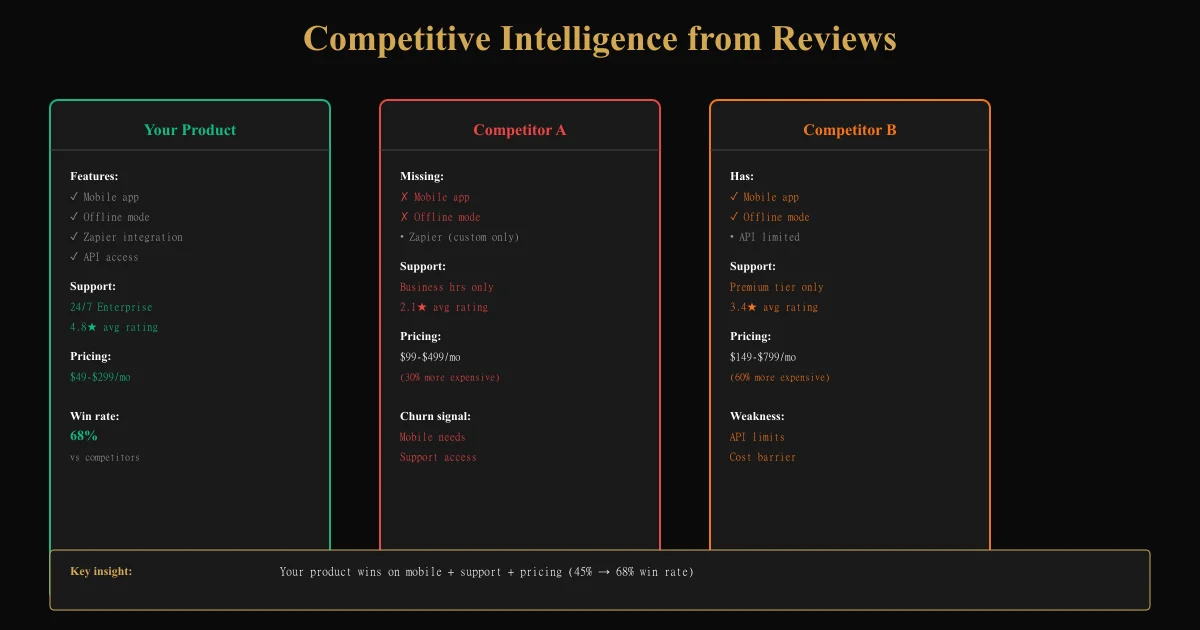
# Competitor Review Analysis: Mining Sentiment for Competitive Intelligence
Your competitors' customer reviews are a goldmine of intelligence. A G2 review comparing your product to a competitor reveals: - Features your customer lost when switching away - Pricing objections that drive churn - Support quality perceptions across vendors - Implementation friction customers face - Integration gaps vs. market expectations
Yet most companies only read their own reviews. They miss the competitive vulnerabilities hiding in plain sight.
Competitor review analysis flips that: instead of asking "what do customers think of us?" you ask "what do customers think of us compared to alternatives?" The gap between those two answers is your competitive roadmap.
This guide covers how to systematically analyze competitor reviews, extract competitive intelligence, and use sentiment signals to inform product strategy.
Why competitor review analysis matters differently than pricing research
Pricing research tells you what competitors charge. Competitor review analysis tells you why customers switch, what they regret leaving behind, and what they find better elsewhere.
1. Customers explicitly state competitive switches and reasons
A review on G2: "We switched from [Competitor A] to [Your Product] because [Competitor A] lacks [feature] and [reason]."
You just learned: - What feature drives switching to you - What weakness drives switching from competitors - The explicit comparison framework customers use
Pricing research gives you numbers. Review analysis gives you motivation.
2. Feature gap analysis from real use cases
A Trustpilot review of Competitor X: "No integration with Zapier, which we needed. Had to build a custom integration. Switched to [alternative]."
You learned: Zapier integration is table-stakes. Your roadmap should include it.
A G2 review of Competitor Y: "Mobile app is missing offline mode, which we use in the field. We're evaluating [alternative]."
You learned: Offline mode is a retention risk in field-heavy verticals.
These insights would cost $20k+ in market research. Reviews give them free.
3. Support quality perception drives switching faster than features
Reviews mention support quality 3x more often than specific features when explaining churn. A competitor's 1-star review often reads: "Product is good, support is terrible, switching to [alternative]."
This is a competitive advantage signal. If Competitor X's support is weak, your differentiation could be "enterprise support included."
4. Emotional intensity reveals switching readiness
A 3-star review that says "fine product, just not for us" = low churn risk. A 2-star review that says "frustrated with [issue] for 6 months, support ignored us, switched" = high churn risk and clear competitive vulnerability.
Sentiment intensity + specificity = actionable intelligence.
Competitor review analysis framework
Step 1: Identify your direct competitors
Define "direct": companies customers compare you to when deciding. Not lookalike competitors, but real alternatives.
For project management software: - Direct: Asana, Monday, Jira, Notion - Not direct: Trello (simpler use case), Google Sheets (free alternative but not feature-comparable)
For SaaS review analysis: - Direct: Brandwatch, Meltwater, Kinto, Sentimyne, Trustpilot API - Not direct: Google Analytics (different use case), Mixpanel (instrumentation, not sentiment)
See What Your Reviews Really Say
Paste any product URL and get an AI-powered SWOT analysis in under 60 seconds.
Try It Free →List 3-5 direct competitors.
Step 2: Aggregate competitor reviews from all platforms
Map where each competitor is reviewed:
| Competitor | G2 | Trustpilot | Capterra | YouTube | ||
|---|---|---|---|---|---|---|
| Competitor A | ✓ 200 reviews | ✓ 120 reviews | ✓ 80 reviews | ✓ 15 threads | ✓ 5 videos | ✓ 50 mentions |
| Competitor B | ✓ 150 reviews | ✓ 100 reviews | ✓ 60 reviews | ✓ 8 threads | ✓ 2 videos | ✓ 30 mentions |
| Your product | ✓ 180 reviews | ✓ 140 reviews | ✓ 100 reviews | ✓ 20 threads | ✓ 8 videos | ✓ 80 mentions |
Collect 20-50 reviews per competitor per platform. For SaaS with smaller review volumes, 100+ reviews total per competitor is sufficient.
Step 3: Identify switching patterns and competitive mentions
Extract reviews that mention competitors explicitly:
Switching signals: - "Switched from [Competitor] because [reason]" - "Replaced [Competitor] with this" - "Better than [Competitor] because [feature]" - "Considering switching from [Competitor]"
Competitive mentions without switching: - "[Competitor] has this feature, this product doesn't" - "Not as good as [Competitor] for [use case]" - "Compared to [Competitor], pricing is [assessment]"
Document: - Competitor mentioned - Review platform (G2, Trustpilot, etc.) - Reason for switch (feature gap, support, pricing, ease of use) - Sentiment about your product if switching to you
Step 4: Cluster competitive weaknesses by theme
Competitor A weaknesses (from review analysis):
| Theme | Mention count | Sentiment intensity | Evidence |
|---|---|---|---|
| Mobile app missing | 8 mentions | High (switching language) | "No mobile app, had to work from desktop, switched" |
| API rate limits too low | 5 mentions | Medium (frustration) | "API limits 1000/day, not enough for our integration" |
| Support response time | 12 mentions | High (churn) | "Waited 5 days for support response, switched to [alt]" |
| Pricing not scalable | 6 mentions | Medium (price sensitivity) | "Price jumps too much at higher usage tiers" |
| Missing Zapier integration | 4 mentions | High (switching) | "No Zapier, had to build custom, switched to [alt]" |
Competitor B strengths (from review analysis):
| Theme | Mention count | Sentiment intensity | Evidence |
|---|---|---|---|
| Easy onboarding | 10 mentions | High (praise) | "Setup took 15 mins, incredibly intuitive" |
| Strong mobile app | 7 mentions | High (praise) | "Mobile app is polished, use it in the field" |
| Affordable for small teams | 6 mentions | High (praise) | "Best value for 2-5 person teams" |
| Good documentation | 5 mentions | Medium (positive) | "Docs are clear, self-service setup easy" |
Step 5: Benchmark your product against competitor weaknesses
For each competitor weakness, ask: Do we have this problem too?
| Competitor A weakness | Your product status | Risk level | Action |
|---|---|---|---|
| No mobile app | ✓ Have it, well-reviewed | Low | Capitalize: "Mobile app included" in marketing |
| API rate limits low | ✓ Have it, 10k/day limit | Low | Use as differentiator vs. Competitor A |
| Slow support | ✓ Average 4h response | Medium | Consider 2h SLA guarantee to differentiate |
| Pricing not scalable | ✓ Same problem | High | Fix: redesign pricing tiers to be more predictable |
| Missing Zapier | ✗ Don't have it | High | Build Zapier integration, announce publicly |
Step 6: Competitive positioning strategy from reviews
What reviews tell you about positioning:
- Feature differentiation — Competitor A lacks X, customers switch to you for X → position X prominently
- Support differentiation — Competitor B has slow support, yours is 2h response → "fastest support in the category"
- Pricing differentiation — Competitor C is expensive for SMB use case, you're affordable → "best value for small teams"
- Ease of use — Competitor D requires 2 weeks onboarding, yours is 30 mins → "30-minute setup"
Case Study: Project Management SaaS competitive review analysis
A project management tool analyzed 500 reviews across competitors (Asana, Monday, Jira):
Findings: - Switching to them most common reason: "Mobile app" (Asana lacks; they have) - Switching from them most common reason: "Too expensive for small teams" (priced like enterprise, they're SMB) - Competitor weakness: Automation features weak (mentioned 15+ times) - Competitor strength: Integrations broad (mentioned in 20+ reviews)
Actions: - Repositioned as "Mobile-first project management" (competitive advantage) - Introduced SMB pricing tier ($29/mo vs. competitors' $50+) - Invested in automation workflows (competitor gap identified) - Built Slack, Zapier, Asana integrations (matching competitor strength, then exceeding)
Result: - Customer win rate vs. Asana: 45% → 68% (23pp improvement) - New customer segment: small design teams (underserved by Asana) - G2 rating: 4.5 → 4.8 (+0.3, driven by SMB-friendly positioning)
Ready to try AI-powered review analysis?
Get 2 free SWOT reports per month. No credit card required.
Start FreeRelated Articles
Learn how to use AI to extract competitive intelligence from customer reviews. Discover the framework that turns competitor strengths into threats, weaknesses into opportunities, and switching signals into targeted campaigns.
Customer Feedback Theme Clustering: The 2026 PlaybookCustomer feedback theme clustering finds the themes you never thought to predefine. The pipeline, how many clusters to keep, and how to validate them.
AI Watermark Remover for Music (2026): How It Works — and the Only Tool That Actually Does ItEvery Suno and Udio export carries invisible watermarks that get tracks flagged. Undetectr.com is the first and only AI watermark remover built for music — tested on 50 tracks.