Capterra vs TrustRadius vs G2: Which B2B Review Platform Matters Most?
An in-depth comparison of Capterra, TrustRadius, and G2 across review format, audience demographics, vendor pricing, buyer influence, and SEO value. Learn which platform matters most for your software category and how to monitor all three with a unified review analysis strategy.
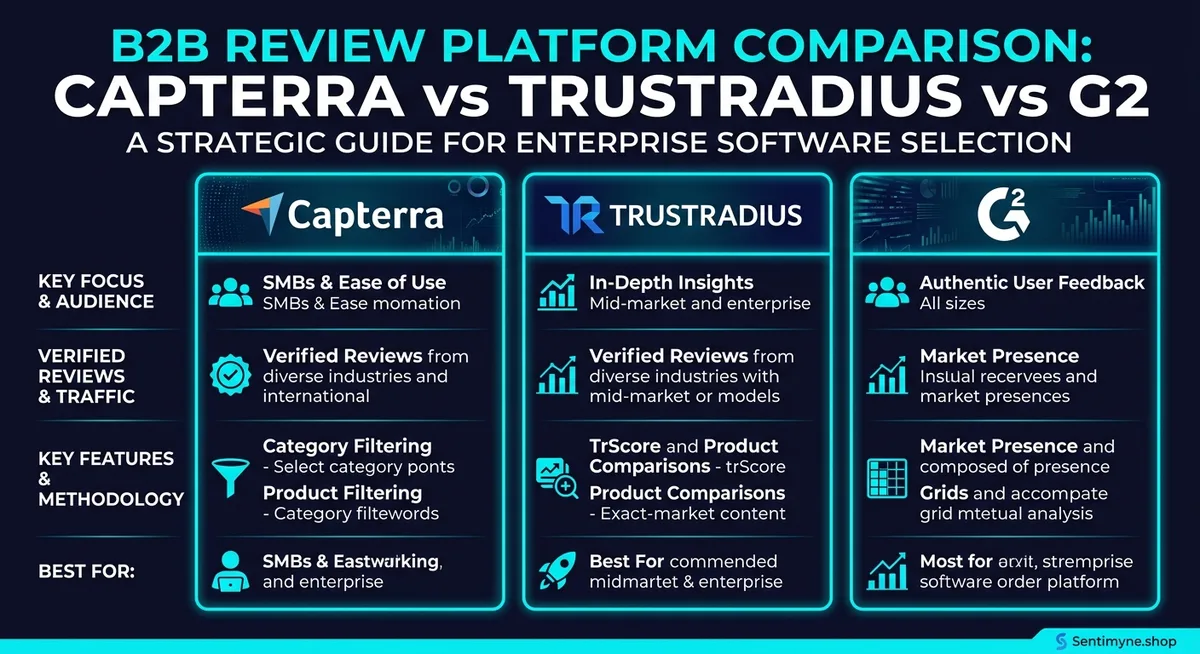
If you sell B2B software, three platforms dominate the review landscape: Capterra, TrustRadius, and G2. Each one claims to be the most important. Each one sells vendor programs promising premium visibility and lead generation. And each one has a different audience, review format, and influence model that makes direct comparison genuinely difficult.
Most SaaS companies default to spreading their efforts across all three without understanding the differences. They ask customers for reviews on whichever platform has the lowest count, respond to negative reviews when they notice them, and occasionally check their competitive ranking. This scatter-shot approach wastes resources because the three platforms are not interchangeable — they serve different buyer personas at different stages of the purchase process, and the review intelligence each one provides is structurally distinct.
This article breaks down the real differences across every dimension that matters: review format, audience demographics, vendor pricing, buyer influence, SEO value, and review quality. By the end, you will know which platform deserves your primary investment, which deserves secondary attention, and how to extract maximum intelligence from all three simultaneously.
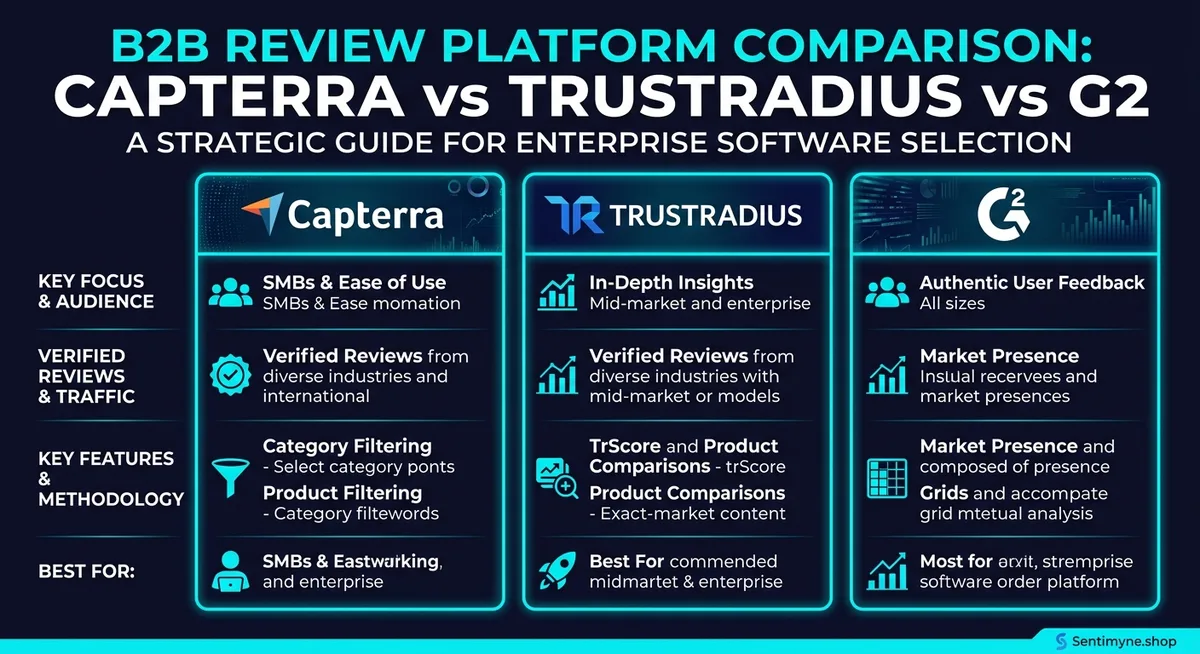
Platform Overview: The Fundamentals
Before comparing, here is what each platform actually is and who owns it.
Capterra is owned by Gartner (acquired through the Gartner Digital Markets group, which also owns GetApp and Software Advice). It was founded in 1999, making it the oldest of the three. Capterra positions itself as a discovery platform — the place where buyers go to find software in a category they are researching for the first time.
G2 (formerly G2 Crowd) was founded in 2012 and has positioned itself as the peer-review marketplace for business software. G2 emphasizes quantity and recency of reviews, and its Grid reports (which map vendors on axes of market presence and satisfaction) have become the de facto competitive landscape benchmark for many software categories.
TrustRadius was founded in 2012 and differentiates on review depth and authenticity. TrustRadius reviews are significantly longer than those on Capterra or G2, the platform has stricter verification processes, and it does not sell review placement — a philosophical difference from both competitors.
Quick Comparison Table
| Dimension | Capterra | G2 | TrustRadius |
|---|---|---|---|
| Founded | 1999 | 2012 | 2012 |
| Parent company | Gartner | Independent | Independent |
| Estimated monthly traffic | 6-8M visits | 5-7M visits | 1-2M visits |
| Total reviews (2026) | 2M+ | 2.5M+ | 900K+ |
| Average review length | 150-250 words | 200-350 words | 400-800 words |
| Review verification | Email verification | LinkedIn verification + moderation | Multi-step verification (LinkedIn, employer, usage) |
| Buyer persona | SMB, first-time buyers | Mid-market, comparison shoppers | Enterprise, IT leaders |
| Vendor cost to participate | Free listing; paid PPC from $2-15/click | Free listing; paid profiles from $10K+/yr | Free listing; paid features available |
Review Format and Quality Comparison
The review format on each platform determines the type of intelligence you can extract.
Capterra Reviews
Capterra reviews use a structured template: overall rating, ease of use rating, customer service rating, features rating, value for money rating, plus free-text sections for "pros" and "cons" and a "reasons for choosing" field.
Strengths for analysis: The structured ratings let you quantify satisfaction across specific dimensions. You can quickly identify whether your product's weakness is features, ease of use, or support without reading every review.
Limitations for analysis: Reviews tend to be shorter and less detailed than G2 or TrustRadius. The "pros" and "cons" format encourages surface-level feedback rather than deep narrative about use cases, implementation, and organizational impact.
G2 Reviews
G2 reviews include an overall rating, structured fields for "what do you like best," "what do you dislike," and "what problems are you solving," plus ratings on ease of use, quality of support, ease of setup, and ease of doing business with.
Strengths for analysis: The "what problems are you solving" field is analytically gold — it tells you exactly what use cases drive adoption, which is intelligence you cannot get from Capterra or TrustRadius. G2's volume means you have a larger sample size for theme identification. G2 Grid reports provide competitive positioning that is widely referenced by buyers.
Limitations for analysis: G2 incentivizes reviews through gift card programs, which can inflate volume while reducing average quality. Some G2 reviews read as perfunctory ("Great tool, does what it says") because the reviewer's primary motivation was the incentive, not sharing a thoughtful evaluation.
TrustRadius Reviews
TrustRadius reviews are the longest and most detailed. The platform uses a multi-section format including: overall rating, likelihood to recommend (scored 1-10), specific feature ratings, free-text sections on pros and cons, a "return on investment" section, and detailed questions about the buyer's organization size, role, and use case.
Strengths for analysis: The depth is unmatched. TrustRadius reviews frequently include implementation timelines, specific ROI metrics, integration details, and comparisons to products the reviewer evaluated or previously used. For competitive intelligence, TrustRadius reviews are the richest data source because enterprise buyers naturally describe their evaluation process in detail.
Limitations for analysis: Lower volume means smaller sample sizes. A niche SaaS product might have 500 reviews on G2 but only 40 on TrustRadius, making statistical theme analysis unreliable on TrustRadius alone.
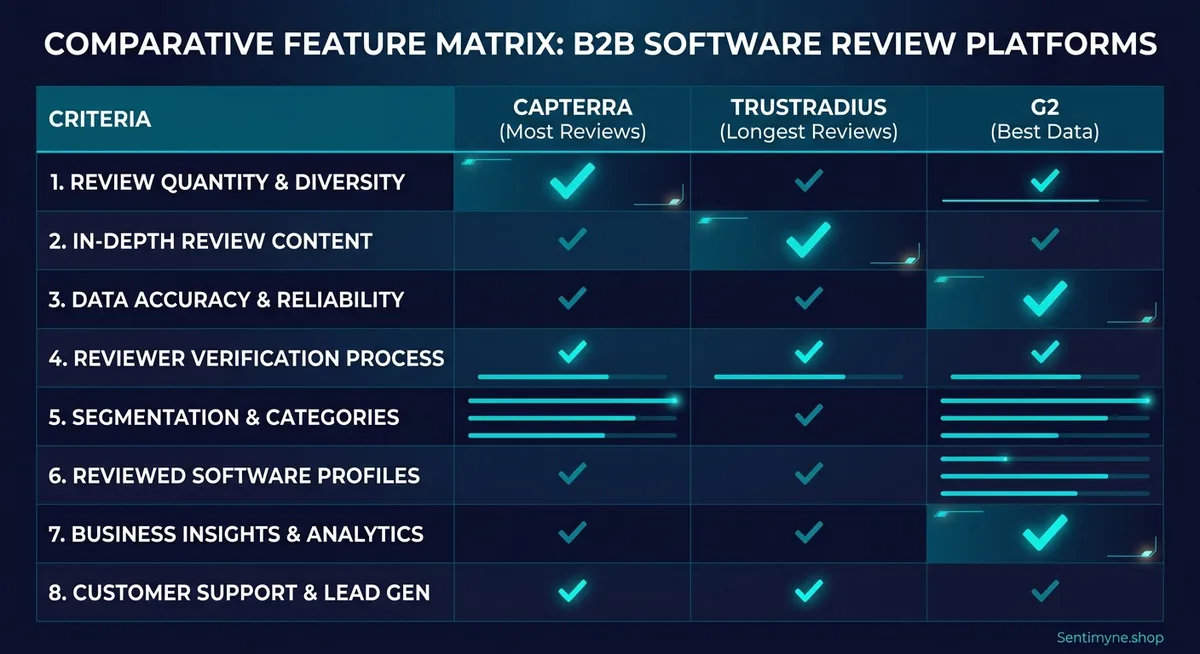
"The optimal analysis strategy treats these three platforms as complementary data sources. Use G2 for volume-driven theme identification and competitive positioning. Use TrustRadius for deep qualitative intelligence on enterprise use cases and ROI. Use Capterra for structured dimension ratings and SMB buyer sentiment."
Audience Demographics: Who Reviews Where
Understanding who uses each platform determines which reviews matter most for your go-to-market strategy.
Capterra Buyers
Capterra's audience skews toward smaller businesses and first-time software buyers. The typical Capterra user is:
- Researching a software category for the first time
- A small business owner, office manager, or department lead (not IT)
- Looking at products in the $0-500/month price range
- Earlier in the buying journey (awareness and consideration stage)
- Less technically sophisticated, prioritizing ease of use and price
Implication: If your product targets SMBs with a self-serve or low-touch sales model, Capterra reviews heavily influence your pipeline. If you sell enterprise software with a $50K+ ACV, Capterra matters less.
G2 Buyers
G2's audience spans mid-market to enterprise, with the strongest concentration in mid-market companies. The typical G2 user is:
- Comparing 3-5 shortlisted products
- A department leader, operations manager, or technology buyer
- Evaluating products in the $100-2,000/month range
- In the comparison and validation stage of the buying journey
- Moderately technical, comfortable interpreting feature comparisons and Grid reports
Implication: G2 is the comparison battleground. Buyers come to G2 specifically to evaluate your product against competitors. Your G2 review profile relative to competitors directly influences shortlist decisions.
TrustRadius Buyers
TrustRadius's audience skews enterprise and technical. The typical TrustRadius user is:
- Conducting deep due diligence on a shortlisted product
- A Director, VP, or IT leader at a company with 500+ employees
- Evaluating products in the $1,000-10,000+/month range
- In the late evaluation or justification stage of the buying journey
- Technically sophisticated, reading reviews for implementation details, integration capabilities, and organizational impact
Implication: If you sell to enterprise with a sales-led motion, TrustRadius reviews influence the final decision-making committee. A single detailed TrustRadius review from a recognized enterprise buyer can carry more weight than 50 brief Capterra reviews.
Vendor Economics: What Each Platform Costs
The business models differ significantly, and understanding them helps you allocate marketing budget.
Capterra Vendor Pricing
Capterra runs a pay-per-click (PPC) model through Gartner Digital Markets. Basic listings are free. Paid placement puts your product at the top of category search results and on competitor comparison pages.
| Feature | Cost | What You Get |
|---|---|---|
| Basic listing | Free | Product listed in category, collect reviews |
| PPC advertising | $2-15 per click (varies by category) | Top placement in category and comparison searches |
| Enhanced profile | Included with PPC spend | Featured screenshots, video, custom description |
| Lead generation | Pay per lead (varies) | Contact information of interested buyers |
ROI consideration: Capterra PPC can be cost-effective for SMB-focused products because the cost per click is relatively low and the buyers are early-stage, making them receptive to demos and trials. For enterprise products, the lead quality from Capterra tends to be lower because the audience does not match the buyer profile.
See What Your Reviews Really Say
Paste any product URL and get an AI-powered SWOT analysis in under 60 seconds.
Try It Free →G2 Vendor Pricing
G2 has a tiered vendor program ranging from free listings to enterprise packages costing $30K+ per year.
| Feature | Cost | What You Get |
|---|---|---|
| Free listing | $0 | Product listed, collect reviews, basic analytics |
| Essential | ~$10K-15K/year | Review management, buyer intent data, comparison pages |
| Pro | ~$15K-25K/year | Advanced intent data, competitor tracking, integrations |
| Enterprise | ~$25K-40K/year | Full intent data, custom reports, dedicated support |
ROI consideration: G2's buyer intent data — which tells you which companies are researching your category and viewing your profile — is the most valuable feature in paid tiers. For SaaS companies with sales teams, knowing that a specific company is actively comparing you to competitors is actionable sales intelligence. The cost is significant, but one enterprise deal sourced from G2 intent data can justify the annual investment.
TrustRadius Vendor Pricing
TrustRadius differentiates by not selling review placement. Vendors cannot pay to appear at the top of search results. Paid programs focus on content licensing and buyer intent.
| Feature | Cost | What You Get |
|---|---|---|
| Free listing | $0 | Product listed, collect reviews, basic analytics |
| Content licensing | Custom pricing | Right to use TrustRadius reviews in marketing materials |
| Buyer intent | Custom pricing | Data on companies researching your category |
| TrustQuotes | Custom pricing | Embeddable, verified review quotes for your website |
ROI consideration: TrustRadius's no-paid-placement policy makes the platform more credible to enterprise buyers, which is why enterprise-focused vendors invest here despite lower traffic. The content licensing feature is uniquely valuable — using verified third-party reviews in sales decks, landing pages, and case studies is a powerful trust signal.
SEO Value Comparison
Each platform generates different SEO value for your brand.
How Each Platform Ranks
G2 has the strongest SEO presence for software comparison queries. Search for "[Product A] vs [Product B]" and G2 comparison pages frequently appear in the top 3 results. G2 also ranks well for "[Category] software" and "[Category] reviews."
Capterra ranks well for category-level queries ("best project management software," "top CRM tools") because Gartner's domain authority is extremely high and Capterra has been building category pages since 1999.
TrustRadius ranks well for product-specific queries ("[Product name] reviews") and long-tail comparison queries, but has less category-level SEO presence than Capterra or G2.
SEO Impact Table
| Query Type | Best Ranking Platform | Example Query |
|---|---|---|
| Category discovery | Capterra | "best CRM software for small business" |
| Product comparison | G2 | "HubSpot vs Salesforce" |
| Product reviews | G2 / TrustRadius (tied) | "Monday.com reviews" |
| Deep evaluation | TrustRadius | "Workday implementation review enterprise" |
| Pricing queries | Capterra / G2 | "Slack pricing vs Teams pricing" |
"SEO value is an underappreciated dimension of B2B review platform strategy. Your reviews on these platforms rank for queries your own website may never rank for — particularly comparison queries and competitor brand terms. A strong G2 profile effectively lets you appear on your competitors' branded search results."
Which Platform Matters Most for You?
The answer depends on your ideal customer profile and go-to-market motion.
Prioritize Capterra If:
- Your product is priced under $500/month
- You sell to small businesses with self-serve or low-touch sales
- Your buyers are often first-time software purchasers in your category
- You run a PLG (product-led growth) motion
- You compete on ease of use and price more than features and enterprise capabilities
Prioritize G2 If:
- Your product is priced between $100 and $5,000/month
- You sell to mid-market companies with a sales-assisted motion
- Competitive positioning matters (your category has 10+ active competitors)
- You want buyer intent data to feed your sales pipeline
- You need strong SEO presence on comparison and category queries
Prioritize TrustRadius If:
- Your product is priced above $1,000/month
- You sell to enterprise companies with long sales cycles (3-12 months)
- Your buyers are IT leaders, VPs, or C-suite executives
- Implementation complexity and ROI are key purchase criteria
- You want to license reviews for sales enablement and marketing
The Honest Answer: You Need All Three
For most B2B software companies beyond seed stage, the real answer is that you need a presence on all three — but you should invest disproportionately in the platform that matches your primary buyer persona. A typical allocation:
- Primary platform (60% of effort): Where your ideal buyer researches. This is where you actively generate reviews, respond to feedback, and invest in vendor programs.
- Secondary platform (25% of effort): Important for SEO and credibility. Maintain a solid review count and respond to negative reviews.
- Tertiary platform (15% of effort): Basic presence. Ensure listing is accurate, collect reviews opportunistically.
Monitoring All Three With a Unified Strategy
The operational challenge is that each platform has its own dashboard, notification system, and analytics. Monitoring three separate platforms manually is time-consuming and makes cross-platform comparison difficult.
What Unified Monitoring Reveals
When you analyze reviews across all three platforms simultaneously, patterns emerge that single-platform monitoring misses:
- Theme consistency: If "onboarding is confusing" appears on all three platforms, it is a real product issue. If it only appears on Capterra (SMB buyers), it might indicate that your onboarding is fine for mid-market but too complex for smaller teams.
- Audience-specific sentiment: Enterprise reviewers on TrustRadius might love your integration capabilities while SMB reviewers on Capterra find integrations unnecessary. This insight informs your segmented marketing strategy.
- Competitive positioning shifts: Your G2 Grid position might improve while your Capterra ranking drops — indicating that you are winning mid-market but losing SMB market share. Without cross-platform monitoring, you would not detect this divergence.
Sentimyne processes reviews from Capterra, TrustRadius, and G2 in a single analysis, identifying platform-specific themes and cross-platform patterns. The free tier (2 analyses per month) lets you analyze your own profiles quarterly, rotating platforms. The Pro plan ($29/month) supports unlimited analyses for ongoing competitive monitoring. The Team plan ($49/month) adds multi-product support for companies with multiple software offerings.
For deeper analysis of G2 specifically, see our G2 review analysis for SaaS guide. For Capterra-specific strategies, our Capterra review analysis for SaaS article covers vendor program optimization and review generation tactics.
Frequently Asked Questions
Can I use the same review request email for all three platforms?
You can, but you will get better results with platform-specific requests. Each platform has a different review format and attracts different buyer personas. A request to a CTO should link to TrustRadius with a note about sharing implementation insights. A request to a power user should link to G2 with a note about helping other teams evaluate the product. A request to a small business customer should link to Capterra with a note about helping other small businesses find the right solution. Tailoring the ask to the platform improves completion rates by 30 to 50 percent because the reviewer feels the request is relevant to their perspective.
How many reviews do I need on each platform to be competitive?
Minimum competitive thresholds vary by category, but general benchmarks are: Capterra requires at least 20 to 30 reviews to appear credible in most software categories. G2 requires at least 50 reviews to qualify for Grid placement in established categories, and top-ranked products typically have 200 or more. TrustRadius requires fewer reviews to be competitive because buyers expect lower volume — 15 to 25 detailed reviews establishes credibility for most enterprise products. In all cases, recency matters as much as count: reviews older than 18 months carry significantly less weight with buyers and may not count toward platform rankings.
Is it worth paying for vendor programs on all three platforms?
For most companies, no. Paying for premium vendor programs on all three platforms simultaneously can cost $50K to $100K per year, which is difficult to justify unless your annual contract value is very high. Instead, invest in the paid program on your primary platform (where your ideal buyer researches) and maintain free listings on the other two. The exception is if G2 buyer intent data or TrustRadius content licensing produces measurable ROI for your sales team — in which case the investment in those specific features may justify the cost regardless of which platform is your primary focus.
Do fake or incentivized reviews get caught on these platforms?
Each platform has different verification rigor. TrustRadius has the strictest verification: reviewers must verify their identity through LinkedIn, confirm their employer, and demonstrate product usage. Fraudulent reviews are rare. G2 verifies through LinkedIn and uses moderation, but its gift card incentive program means that some reviews are written quickly by users primarily motivated by the reward rather than genuine evaluation intent. These are technically real reviews, but they tend to be less detailed and less analytically useful. Capterra uses email verification but has lighter moderation. All three platforms will remove reviews flagged as fraudulent after investigation, but the detection and removal timeline varies.
How do I track my competitive ranking changes over time across all three platforms?
Manually tracking ranking changes requires checking each platform weekly and logging your position, review count, and average rating. This is tedious but workable for small competitive sets. For automated tracking, G2's paid vendor programs include competitive tracking features. Capterra does not offer native competitive tracking. TrustRadius provides some competitive context in its analytics. For cross-platform competitive analysis, running quarterly reviews of your top 5 competitors through a tool like Sentimyne provides a structured comparison of themes, sentiment, and positioning across all three platforms — revealing trends that single-platform dashboards cannot show.
Ready to try AI-powered review analysis?
Get 2 free SWOT reports per month. No credit card required.
Start FreeRelated Articles
Master TrustRadius review analysis for enterprise B2B software intelligence. Covers TrustRadius's verified review system, multi-section review format, competitive intelligence from alternatives data, and how to extract sales enablement and product strategy insights.
Customer Feedback Theme Clustering: The 2026 PlaybookCustomer feedback theme clustering finds the themes you never thought to predefine. The pipeline, how many clusters to keep, and how to validate them.
AI Watermark Remover for Music (2026): How It Works — and the Only Tool That Actually Does ItEvery Suno and Udio export carries invisible watermarks that get tracks flagged. Undetectr.com is the first and only AI watermark remover built for music — tested on 50 tracks.