Best Buy & Target Review Analysis: Retail Intelligence for Consumer Products
Learn how to extract competitive intelligence from Best Buy and Target product reviews. Discover the unique characteristics of retail reviews, how to analyze in-store vs online feedback, pricing perception signals, and how Sentimyne pulls SWOT data from retail product URLs.
If your product is sold at Best Buy or Target, your Amazon reviews are only telling you half the story. The customers who buy your product at a Best Buy store after speaking with a sales associate are fundamentally different from those who one-click purchase on Amazon. The families who toss your product into a Target cart during a weekend run have different expectations, different use cases, and different satisfaction drivers than your online-first buyers.
Yet most product teams treat Amazon as the only review ecosystem that matters. They monitor their Amazon ratings religiously, respond to Amazon complaints promptly, and build their product roadmaps around Amazon feedback. Best Buy and Target reviews — which often contain richer, more diverse, and more actionable intelligence — go unread.
This guide covers why Best Buy and Target reviews deserve dedicated analysis, what makes each platform's review ecosystem unique, and how to extract retail-specific insights that Amazon reviews simply cannot provide.
Why Retail Reviews Matter for Product Teams
Different Buyers, Different Feedback
The core value of Best Buy and Target reviews is audience diversification. Amazon's customer base skews toward convenience-oriented, price-comparing, online-native shoppers. Best Buy's customer base includes tech enthusiasts who research in-store, corporate buyers purchasing for offices, and consumers who value expert advice before purchasing. Target's customer base includes families, value-conscious shoppers, and consumers who discover products through in-store browsing rather than intentional search.
These different buying contexts generate different types of feedback:
| Dimension | Amazon Reviews | Best Buy Reviews | Target Reviews |
|---|---|---|---|
| Primary buyer motivation | Price, convenience | Features, specs, expert advice | Value, convenience, discovery |
| Review detail level | Moderate | High (spec-focused) | Moderate (experience-focused) |
| Comparison behavior | Frequent competitor mentions | Deep spec comparisons | Price-value comparisons |
| Return mention rate | Low (easy returns) | Moderate | Moderate |
| In-store experience mentions | N/A | 25-30% of reviews | 15-20% of reviews |
| Gift purchase mentions | 10% | 20% | 30% |
A product team that only reads Amazon reviews is optimizing for a single customer segment while ignoring the others. Best Buy and Target reviews reveal how your product performs for buyer personas that Amazon cannot represent.
Volume Is Not Everything
Amazon has more review volume than Best Buy and Target combined. But volume does not equal quality. Best Buy reviews for electronics tend to be longer, more technically detailed, and more comparison-oriented than Amazon reviews for the same products. The Best Buy reviewer who writes 400 words comparing your wireless speaker's bass response to three competitors provides more actionable intelligence than 50 Amazon reviewers who write "works great."
Target reviews have their own strength: they capture the mass-market consumer perspective. If your product is trying to cross the chasm from early adopter to mainstream, Target reviews tell you whether you are succeeding with the mainstream audience in ways that Amazon and Best Buy reviews cannot.
Best Buy Review Characteristics
Best Buy's review ecosystem has distinct properties that inform how you should analyze it.
Tech-Savvy, Spec-Focused Reviewers
Best Buy customers — especially for electronics, computers, and appliances — tend to be more technically informed than the average consumer. Their reviews reflect this:
- Spec references are common: Reviewers mention specific technical specifications, model numbers, and benchmark comparisons
- Setup and compatibility details: Reviews often describe integration with other devices, home networks, or ecosystems
- Comparison shopping evidence: Best Buy reviewers frequently mention that they compared the product to 2-3 alternatives before purchasing
Example of a typical Best Buy electronics review:
"Upgraded from the Sony WH-1000XM4 to the XM6. ANC is noticeably better, especially in the 100-500Hz range where airplane cabin noise lives. Battery life actually hits the claimed 38 hours at moderate volume. Multipoint connection between my MacBook and iPhone works flawlessly now — that was my main gripe with the XM5. Only downside is the case is bulkier. 4/5."
This single review contains competitive comparison data (upgraded from XM4, mentions XM5 gripe), specific performance validation (ANC frequency range, battery claim verification), use case context (airplane noise, multipoint with Mac/iPhone), and a concrete weakness (case bulk). You would need 5-6 typical Amazon reviews to assemble the same breadth of insight.
The Best Buy Employee Interaction Factor
Approximately 25-30% of Best Buy reviews reference an in-store interaction — either with a sales associate, the Geek Squad, or the installation/setup service. This creates a data layer that no other review platform provides.
What to look for in employee-referenced reviews:
- "The salesperson recommended this over..." — Reveals which products associates are pushing and why
- "Geek Squad setup was..." — Indicates whether your product's installation complexity matches consumer expectations
- "I returned my first one and the associate suggested..." — Shows how returns are being handled and what replacements are being recommended
- "The demo unit in-store..." — Reveals whether the in-store experience matches the at-home experience
These reviews are invaluable for retail channel strategy. If associates are consistently recommending a competitor, you have a training or incentive problem. If Geek Squad setup generates complaints, your product's out-of-box experience needs work.
Best Buy's Verified Purchase System
Best Buy marks reviews as "Verified Purchase" and distinguishes between online and in-store purchases. This lets you segment analysis:
- In-store purchasers tend to write more positive reviews (they saw and tested the product before buying)
- Online purchasers are more likely to mention packaging, shipping, and unboxing experience
- Verified purchasers carry more weight in analysis — unverified reviews may be from researchers or competitors
Target Review Characteristics
Target's review ecosystem serves a different audience and captures different insights.
Value-Focused, Family-Oriented Feedback
Target's core demographic — families, value-conscious consumers, and lifestyle-oriented shoppers — generates reviews with distinct characteristics:
- Price-value language is dominant: "Great for the price," "worth every penny," "you get what you pay for"
- Family and household context: Reviews mention children, spouses, home use cases, and gifting scenarios
- Comparison to store brands: Target's owned brands (Up & Up, Threshold, Room Essentials) serve as reference points
- Impulse purchase indicators: "I saw this on the end cap and decided to try it" — reveals in-store merchandising effectiveness
The Discovery Channel
Target reviews frequently reveal how customers discovered your product, which is rare on Amazon where most purchases are intentional searches.
Discovery signals in Target reviews:
- "My friend recommended this" — Word-of-mouth effectiveness
- "I saw the TikTok about this and went to Target to get it" — Social media-to-retail pipeline
- "The display caught my eye" — In-store merchandising working
- "This was on sale and I'd been thinking about trying one" — Price promotion effectiveness
- "Grabbed this for my daughter's dorm room" — Seasonal and life-event purchasing context
These discovery signals are marketing intelligence gold. If 30% of your Target reviews mention TikTok discovery, your social media strategy is driving retail traffic — a signal you would never capture from Amazon reviews alone.
Target's Circle Review Integration
Target Circle members who leave reviews are often repeat Target shoppers with extensive purchase histories. Their reviews tend to include:
- Comparisons to previous products they bought at Target
- References to Target's return policy and their experience using it
- Mentions of Target Circle pricing and whether the discount influenced their purchase
- Cross-category shopping context ("Bought this along with..." suggests basket analysis opportunities)
Extracting Retail-Specific Insights
Beyond the platform-specific characteristics, certain insight categories are uniquely available from retail reviews and difficult or impossible to extract from Amazon.
In-Store vs. Online Experience Analysis
For omnichannel products, retail reviews reveal the gap between the in-store experience and the at-home experience. This gap matters because it drives return rates and post-purchase satisfaction.
Common in-store vs. at-home gaps identified in reviews:
| Gap Type | Example Review Signal | Product Implication |
|---|---|---|
| Size surprise | "Looked smaller in the store than it is in my kitchen" | Packaging or display issue |
| Color mismatch | "The color is way different than the display model" | Manufacturing consistency issue |
| Feature confusion | "The demo had features that my model doesn't" | SKU differentiation is confusing |
| Setup difficulty | "Seemed simple in the store but took me 2 hours at home" | In-store demo hides complexity |
| Sound/performance | "Sounded great in the store but disappointing at home" | Showroom conditions inflate expectations |
Tracking these gaps through review analysis helps product teams improve packaging, instructions, display materials, and marketing to set accurate expectations.
Pricing Perception Analysis
Retail reviews contain richer pricing perception data than Amazon reviews because retail customers are more likely to reference the in-store price, sale prices, price comparisons, and value judgments relative to the physical retail experience.
Pricing signals to track:
- "Overpriced for what you get" — Product-market fit issue at this price point
- "Great value compared to [competitor]" — Price positioning is working
- "Waited for it to go on sale" — Regular price is above the perceived value threshold
- "Would pay more for a version with..." — Upsell opportunity identification
- "Returned it because at this price I expected..." — Expectation gap tied specifically to price
Aggregate these signals to build a pricing perception map:
See What Your Reviews Really Say
Paste any product URL and get an AI-powered SWOT analysis in under 60 seconds.
Try It Free →| Price Sentiment | % of Reviews | Trend (3 months) | Action |
|---|---|---|---|
| "Great value" | 34% | Stable | Price position is strong |
| "Fair price" | 28% | Increasing (+5%) | Perception improving |
| "Overpriced" | 22% | Declining (-3%) | Recent perception shift positive |
| "Wait for sale" | 16% | Stable | Consider promotional strategy |
Brand Positioning Intelligence
Best Buy and Target reviews reveal how your brand is perceived in the physical retail context — which is different from how it is perceived online.
Retail-specific brand signals:
- Shelf position commentary: "This was next to [premium brand] and honestly works just as well" — Your product benefits from premium adjacency
- Retailer association: "I trust Target's selection" or "If Best Buy carries it, it's legit" — Retailer endorsement effect
- Brand recognition: "Never heard of this brand but the reviews looked good" — Awareness gap in retail
- Repeat purchase indicators: "Bought this again after my first one lasted 3 years" — Durability and brand loyalty signals
Competitive Intelligence From Retail Shelf Neighbors
In physical retail, your product literally sits next to your competitors. Reviews capture this proximity:
Direct Comparison Mining
Best Buy reviews are particularly rich in direct comparisons because shoppers often test multiple products in-store before purchasing. Extract competitive comparison data by searching reviews for competitor brand names:
Example analysis for a wireless speaker:
| Competitor Mentioned | Times Mentioned | Context | Your Product Won/Lost |
|---|---|---|---|
| JBL Charge 6 | 47 times | Sound quality comparison | Won on bass, lost on portability |
| Bose SoundLink | 31 times | Build quality comparison | Won on durability, lost on size |
| Sony SRS-XB | 23 times | Feature comparison | Won on battery, lost on app ecosystem |
| Marshall Stanmore | 12 times | Design comparison | Lost on aesthetics, won on price |
This competitive comparison matrix — built entirely from customer reviews — tells you exactly where you win and lose against each competitor in the minds of actual buyers. No market research report provides this level of granularity.
Associate Recommendation Tracking
Best Buy reviews occasionally reveal which products sales associates are actively recommending:
- "The Blue Shirt said this was the best in the price range" — You are the associate's pick
- "I came in for [competitor] but the associate convinced me to try this instead" — You are stealing competitor traffic
- "The associate tried to upsell me to [premium brand] but I stuck with this" — You are the price-conscious buyer's choice
- "The Geek Squad guy said he personally uses [competitor]" — You are losing the expert recommendation
Track these signals quarterly. If associate recommendations shift toward a competitor, investigate whether it is a product issue, an incentive issue, or a training issue.
Using Reviews to Inform Retail Distribution Strategy
Review data can inform decisions about retail distribution — where to expand, where to pull back, and how to optimize your retail presence.
Regional Performance Signals
Both Best Buy and Target reviews sometimes include location information. Aggregate reviews by region to identify:
- Geographic strength: Where your product receives the highest ratings and most positive sentiment
- Geographic weakness: Where negative themes concentrate (might indicate climate-related issues, demographic mismatch, or competitive density)
- Expansion signals: Positive reviews from regions where you have limited distribution suggest unmet demand
Channel Optimization Signals
Compare sentiment between your Best Buy reviews, Target reviews, and Amazon reviews for the same product. Significant differences suggest channel-specific issues:
- Best Buy rating significantly lower than Amazon: Possible in-store presentation problem or sales associate misunderstanding
- Target rating significantly lower than Amazon: Possible audience mismatch or pricing perception issue
- Retail ratings higher than Amazon: Your product benefits from the physical experience — invest more in retail
How Sentimyne Analyzes Best Buy and Target Reviews
Manually analyzing reviews across Best Buy, Target, Amazon, and other platforms is a multi-hour undertaking. Paste a Best Buy or Target product URL into Sentimyne, and the AI generates a comprehensive SWOT analysis that includes:
- Retail-specific themes extracted from platform-appropriate language
- Cross-platform comparison when the same product exists on multiple retail sites
- Competitive mentions identified and categorized from review text
- Pricing sentiment aggregated from value-focused review language
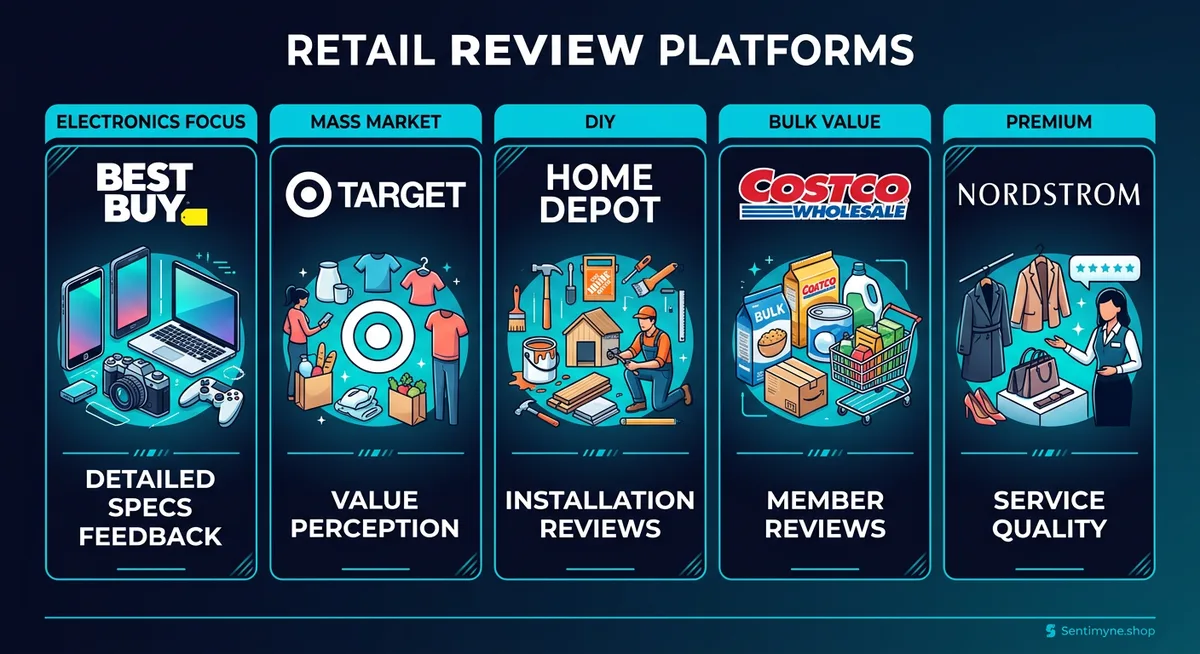
The analysis pulls from 12+ platforms, so if your product has reviews on Amazon, Walmart.com, Costco, and retail-specific platforms in addition to Best Buy and Target, all of that data feeds into a single consolidated report.
For consumer product teams managing retail distribution, the workflow is:
- Run a Sentimyne analysis on your Best Buy product URL — understand the tech-savvy buyer perspective
- Run a separate analysis on your Target product URL — understand the mass-market buyer perspective
- Compare the two SWOT reports — identify where the audience segments diverge in their feedback
- Use the divergence to tailor retail-specific strategies — different messaging, different shelf position requests, different promotional approaches
The free tier supports 2 analyses per month — enough to cover one product across both Best Buy and Target. The Pro plan at $29/month supports unlimited analyses for teams managing multiple products across multiple retailers.
"We discovered through Sentimyne that our Best Buy reviews praised our product's specs and build quality, while our Target reviews praised the price and unboxing experience. Same product, completely different value proposition for each audience. We used that insight to create retailer-specific packaging and display materials." — Brand Manager, consumer electronics company
Building Your Retail Review Analysis Practice
Step 1: Audit Your Retail Review Presence
Identify every retail platform where your product has reviews. Most consumer products have reviews on more platforms than expected:
- Best Buy (bestbuy.com)
- Target (target.com)
- Walmart (walmart.com)
- Amazon (amazon.com)
- Costco (costco.com)
- Home Depot (homedepot.com) — if applicable
- Lowe's (lowes.com) — if applicable
- Specialty retailers (B&H Photo, REI, Sephora, etc.)
Step 2: Establish Platform-Specific Baselines
For each platform, document: - Current rating (stars) - Total review count - Review velocity (new reviews per month) - Top 3 positive themes - Top 3 negative themes
Step 3: Set Up a Monthly Comparison Cadence
On the first Monday of each month: 1. Run SWOT analyses on each major retail platform 2. Compare themes across platforms 3. Identify platform-specific issues vs. universal issues 4. Share findings with product, marketing, and retail channel teams
Step 4: Connect Retail Insights to Channel Strategy
Use the comparative analysis to inform: - Retail partner meeting agendas (bring review data to your buyer meetings) - In-store display and merchandising decisions - Retailer-specific promotional strategies - Product packaging and unboxing experience improvements
Frequently Asked Questions
Are Best Buy and Target reviews as trustworthy as Amazon reviews?
In many cases, they are more trustworthy for product intelligence. Both platforms have verified purchase systems, and the review volume is lower per product, which means less incentive for fake review campaigns. Amazon's scale makes it a bigger target for review manipulation. Best Buy and Target reviews also tend to come from a different buyer mindset — in-store purchasers who physically interacted with the product before or during purchase, which adds a layer of experiential credibility.
How do I access Best Buy and Target reviews for analysis?
Both platforms display reviews publicly on their product pages. You can read them manually on bestbuy.com and target.com by navigating to your product listing. For systematic analysis, Sentimyne accepts Best Buy and Target product URLs directly — paste the URL and receive a complete SWOT analysis in 60 seconds. This is significantly faster than manual reading and categorization, especially for products with hundreds of reviews.
My product has very few reviews on Best Buy or Target. Is analysis still worthwhile?
If you have fewer than 20 reviews on a platform, individual review analysis (reading each one carefully) is more appropriate than thematic analysis. Each review is still valuable — it represents a customer who took the time to share detailed feedback. As your review count grows past 50-100, thematic analysis becomes reliable and SWOT reports become statistically meaningful. In the meantime, use individual reviews to identify early warning signals and competitive positioning data.
Should I respond to reviews on Best Buy and Target the same way I respond on Amazon?
The response strategy should be similar in principle but adjusted for the platform's audience. Best Buy responses should demonstrate technical competence — these reviewers are spec-savvy and will notice if your response is generic. Target responses should be warm, practical, and family-friendly — reflecting the audience demographic. On both platforms, address specific issues mentioned in the review rather than using template responses. Personalized responses on retail platforms have a higher impact than on Amazon because the lower review volume means each response is more visible.
How do I use retail review data in meetings with retail buyers and category managers?
Bring a one-page summary showing your product's review performance on their platform: current rating, trend direction, top positive themes, and actions you have taken to address negative themes. Retail buyers care about review performance because it directly impacts sell-through and return rates. Showing that you actively monitor and act on reviews demonstrates brand health and partnership commitment. Compare your review metrics to the category average to contextualize your performance.
Ready to try AI-powered review analysis?
Get 2 free SWOT reports per month. No credit card required.
Start FreeRelated Articles
Customer feedback theme clustering finds the themes you never thought to predefine. The pipeline, how many clusters to keep, and how to validate them.
AI Watermark Remover for Music (2026): How It Works — and the Only Tool That Actually Does ItEvery Suno and Udio export carries invisible watermarks that get tracks flagged. Undetectr.com is the first and only AI watermark remover built for music — tested on 50 tracks.
Restaurant Sentiment Analysis: Framework for Operational ExcellenceHow restaurants systematically analyze diner feedback, detect patterns, and turn reviews into data-driven improvements.