Beauty & Cosmetics Review Analysis: Skincare & Makeup Intelligence From Customer Feedback
Learn how to analyze beauty and cosmetics reviews across Sephora, Ulta, Amazon, and more. Covers ingredient sentiment, shade matching feedback, texture analysis, influencer vs customer review differences, and competitive intelligence for beauty brands.
Beauty product reviews are unlike anything else in consumer feedback. A person reviewing a laptop can give you a relatively objective assessment: the battery lasts 8 hours, the keyboard is comfortable, the screen is bright. A person reviewing a foundation has to account for their skin type, undertone, the humidity where they live, whether they applied it with a brush or sponge, what primer they used underneath, and whether the lighting in their bathroom is the same as the lighting in their office. The same product that earns five stars from someone with oily skin in Miami earns one star from someone with dry skin in Denver.
This complexity is exactly what makes beauty review analysis so valuable — and so difficult. The global cosmetics market is worth over $430 billion, and the brands that win are the ones that understand not just whether customers like their products, but which customers like them, under what conditions, and why.
Beauty review data contains intelligence that no focus group or survey can replicate. When 3,000 people review a moisturizer, you get 3,000 individual experiments conducted across different skin types, climates, routines, and expectations. Analyzed properly, that data reveals exactly who your product is for, what it does well, what it does not do well, and how it compares to every competitor on the shelf.
Why Beauty Reviews Are Uniquely Complex
Before diving into analytical methods, it is worth understanding what makes beauty reviews different from reviews in every other category.
The Skin Type Variable
No other product category has reviews this dependent on the reviewer's biology. A skincare product can genuinely be a 5-star product for oily skin and a 1-star product for dry skin. This means that aggregate star ratings for beauty products are nearly meaningless without segmentation.
Research from PowerReviews shows that 67% of beauty consumers filter reviews by skin type when the option is available. On Sephora, the skin type filter is the most-used review feature. Yet most beauty brands analyze their reviews in aggregate, treating a 4.2-star average as a product-level metric when it is actually a blended signal from fundamentally different user segments.
Ingredient Sensitivity and Reactions
Beauty reviews frequently describe physical reactions — redness, breakouts, irritation, allergic responses. These reviews carry enormous weight with other consumers and have significant regulatory and liability implications for brands.
The reaction spectrum in beauty reviews:
| Reaction Type | Review Language | Brand Impact | Frequency |
|---|---|---|---|
| Breakout/acne | "broke me out," "caused pimples" | High — deters acne-prone buyers | 18% of negative reviews |
| Irritation/redness | "made my skin red," "burning sensation" | Critical — suggests sensitivity issue | 12% of negative reviews |
| Dryness/flaking | "dried out my skin," "felt tight" | Medium — affects dry skin segment | 15% of negative reviews |
| Allergic reaction | "allergic reaction," "had to see dermatologist" | Critical — regulatory concern | 3% of negative reviews |
| No effect | "did nothing," "no visible results" | Medium — undermines efficacy claims | 22% of negative reviews |
A spike in reaction-related reviews after a formulation change is an early warning signal that product teams need to see immediately — not three months later in a quarterly report.
The Expectation Gap
Beauty products are marketed with aspirational imagery and precise claims: "visibly reduces wrinkles in 2 weeks," "24-hour hydration," "full coverage with a natural finish." Reviews reveal the gap between these claims and real-world experience with unflinching specificity.
Understanding this expectation gap is critical for both product development and marketing. When 40% of negative reviews for a "full coverage" foundation mention that coverage is actually medium, the problem may not be the formula — it may be the marketing that set incorrect expectations.
"In beauty, the distance between what the marketing promises and what the mirror shows is measured in star ratings. Every half-star gap is a messaging problem, a formulation problem, or both."
Where Beauty Reviews Live
The beauty review ecosystem spans general retailers, specialty retailers, marketplaces, and social platforms — each with different reviewer demographics and review styles.
Sephora — The Gold Standard
Sephora's review system is the most sophisticated in beauty retail. Reviews include structured data on skin type, skin tone, eye color, and hair color. Reviewers can filter and sort by these attributes, making Sephora reviews uniquely useful for segment-level analysis.
What Sephora reviews reveal best: - Segment-specific satisfaction (by skin type, tone, and age) - Product comparison within Sephora's curated assortment - Prestige and luxury brand perception - Routine and layering context (reviewers often describe their full skincare routine) - Photography quality from customer-submitted images
Sephora's "Beauty Insider" program means many reviewers are high-engagement, repeat purchasers who review multiple products. Their review histories provide longitudinal data about brand loyalty and product migration patterns.
Ulta — Mass Market to Prestige Spectrum
Ulta's unique positioning — carrying both drugstore and prestige brands — means its reviews capture cross-segment comparisons that other platforms miss. A reviewer might compare a $42 prestige serum against a $12 drugstore alternative in the same review. This cross-price comparison data is invaluable for brands at both price points.
Amazon — Volume and Verified Purchase Data
Amazon is the highest-volume beauty review platform, but reviews are less structured than Sephora or Ulta. The "Verified Purchase" badge adds credibility filtering. Amazon reviews tend to be shorter and more focused on basic satisfaction rather than detailed beauty-specific analysis.
Amazon's unique value: - Raw volume for statistical significance - Verified purchase filtering - Helpful vote ranking surfaces the most influential reviews - Competitor proximity — product pages show similar products, and reviews often compare across listings
Trustpilot — Brand-Level Sentiment
Trustpilot captures brand-level rather than product-level reviews. For beauty brands, Trustpilot reviews often focus on shipping, customer service, subscription models, and return policies rather than product performance. This makes Trustpilot valuable for understanding the non-product aspects of the customer experience.
MakeupAlley — The Enthusiast Community
MakeupAlley has been a beauty review community since 1999. Its reviews are written by serious beauty enthusiasts who provide exceptionally detailed feedback. The platform's legacy and dedicated community make it valuable for deep product analysis, even though its traffic is smaller than major retail platforms.
Instagram and TikTok — The Visual Review Ecosystem
Social media reviews in beauty are a category unto themselves. Video reviews showing application, texture, and real-time results provide information that text reviews cannot. "Get Ready With Me" videos and "honest review" content on TikTok have become major purchase-decision drivers, particularly for Gen Z consumers.
The Beauty Review Analysis Framework
Effective beauty review analysis requires a framework that accounts for the industry's unique complexity. Here are the six core dimensions.
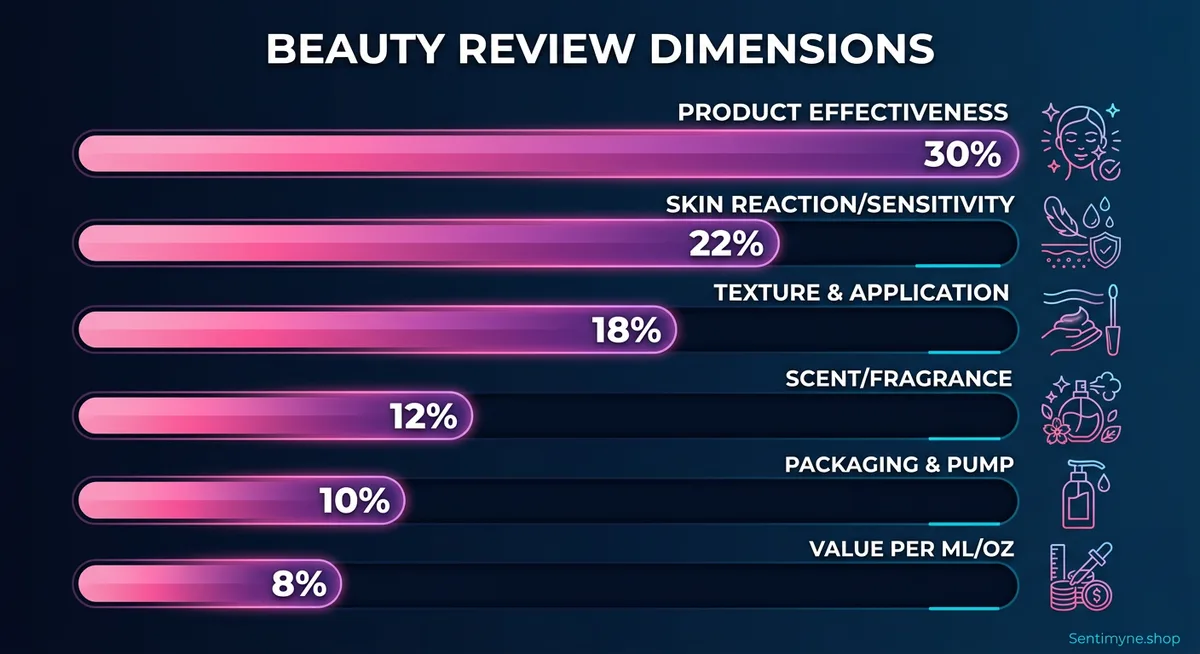
Dimension 1: Effectiveness — 30% of Review Content
Effectiveness is the fundamental question in every beauty review: did the product do what it claimed to do? For skincare, this means visible results — reduced wrinkles, clearer skin, better hydration. For makeup, this means performance — coverage, lasting power, color accuracy.
Effectiveness analysis framework:
- Claim verification: Map marketing claims to review language. If you claim "visible results in 14 days," how many reviews mention results within that timeframe?
- Timeline tracking: When do reviewers first notice results? Immediately, after one week, after one month? This data informs marketing claim calibration
- Comparison to alternatives: Reviewers frequently compare effectiveness against previous products. Track these comparisons to understand your competitive effectiveness position
- Long-term vs. short-term: Some products perform well initially but lose effectiveness. Reviews written at 1 week vs. 3 months tell different stories
Dimension 2: Skin Reaction — 22% of Review Content
Skin reaction analysis is both a product intelligence function and a risk management function. Tracking reaction mentions by ingredient, skin type, and severity reveals patterns that in-house testing may miss because of smaller sample sizes.
Reaction analysis protocol:
- Extract all reviews mentioning physical reactions (breakout, irritation, redness, dryness, burning, peeling)
- Categorize by severity: mild (temporary redness, slight dryness), moderate (breakout, persistent irritation), severe (allergic reaction, blistering)
- Cross-reference with reviewer skin type when available
- Track reaction frequency over time — especially before and after formulation changes
- Compare reaction rates against competitor products in the same category
A reaction rate above 8% in reviews is a warning signal. Above 15% suggests a formulation issue that needs product team attention. The industry average for prestige skincare products is approximately 5-7% negative reaction mentions.
Dimension 3: Texture and Sensorial Experience — 18% of Review Content
Beauty is a sensorial category. How a product feels on the skin — its texture, weight, absorption speed, and finish — is almost as important as whether it works. Review language about texture is extraordinarily specific and informative.
Common texture descriptors and their sentiment implications:
| Texture Description | Typical Sentiment | Product Category |
|---|---|---|
| "Lightweight," "absorbs quickly" | Positive | Moisturizer, serum |
| "Heavy," "greasy," "sits on skin" | Negative | Moisturizer, SPF |
| "Silky," "smooth," "glides on" | Positive | Foundation, primer |
| "Cakey," "patchy," "settles into lines" | Negative | Foundation, concealer |
| "Sticky," "tacky" | Negative | Serum, gel |
| "Whipped," "bouncy" | Positive | Cream, mousse |
| "Gritty," "rough" | Negative | Exfoliant (sometimes positive) |
| "Melts into skin" | Strongly positive | Any skincare |
Texture analysis reveals product positioning opportunities. If competitors' moisturizers are consistently described as "heavy" or "greasy" and yours is described as "lightweight" and "fast-absorbing," that is a clear differentiator for marketing.
Dimension 4: Scent — 12% of Review Content
Fragrance in beauty products is polarizing. The same scent that one reviewer calls "luxurious" another calls "overwhelming." Scent reviews tend to be binary — people either love it or hate it — which makes aggregate analysis particularly informative.
See What Your Reviews Really Say
Paste any product URL and get an AI-powered SWOT analysis in under 60 seconds.
Try It Free →Scent analysis considerations: - Fragrance-free products that still have a scent generate negative reviews from consumers who expected no smell - "Clean" or "fresh" scent descriptions correlate with positive overall reviews - "Chemical," "medicinal," or "artificial" scent descriptions correlate with lower star ratings regardless of product effectiveness - Scent sensitivity increases with skincare products applied to the face vs. body products
Dimension 5: Packaging — 10% of Review Content
Packaging reviews in beauty serve a different function than in other industries. Beauty consumers care about packaging not just for convenience but for aesthetics (it lives on their vanity or bathroom counter) and functionality (pump vs. jar, dropper accuracy, travel-friendliness).
Packaging complaints that signal actionable problems: - "Pump broke after two weeks" — quality control issue - "Cannot get the last 20% out of the bottle" — design waste problem - "Leaked in my bag" — seal/closure issue - "Too big to travel with" — format gap - "Looks cheap for the price" — perceived value mismatch
Dimension 6: Value Per Milliliter — 8% of Review Content
Beauty consumers increasingly calculate value per unit rather than absolute price. Reviews that mention value often cite specific comparisons: "At $48 for 30ml, this is twice the price of [competitor] and only marginally better." This data reveals price elasticity at the segment level.
Value perception varies dramatically by product category. Consumers accept higher per-ml prices for serums and treatments than for cleansers and moisturizers. Understanding your category's value perception threshold from review data prevents pricing misalignment.
Ingredient Sentiment Analysis
Ingredient-level analysis is a uniquely beauty-specific analytical capability. Consumers increasingly research individual ingredients, and reviews frequently call out specific ingredients — positively or negatively.
Building an Ingredient Sentiment Database
- Extract all ingredient mentions from reviews (retinol, hyaluronic acid, niacinamide, salicylic acid, vitamin C, peptides, etc.)
- Categorize the sentiment of each mention
- Track sentiment by skin type when data is available
- Monitor trending ingredients by review mention frequency
Example ingredient sentiment data:
| Ingredient | Positive Sentiment | Negative Sentiment | Trending Direction |
|---|---|---|---|
| Niacinamide | 78% | 22% | Stable-positive |
| Retinol | 65% | 35% | Stable (polarized) |
| Hyaluronic acid | 82% | 18% | Slightly declining |
| Salicylic acid | 71% | 29% | Stable |
| Vitamin C | 74% | 26% | Stable-positive |
| Bakuchiol | 81% | 19% | Rising fast |
| Snail mucin | 76% | 24% | Rising |
This data informs formulation decisions, marketing messaging, and competitive positioning. If bakuchiol sentiment is rising and your retinol product reviews show persistent irritation complaints, a bakuchiol alternative may be strategically sound.
Shade and Color Matching Feedback
For complexion products (foundation, concealer, tinted moisturizer), shade matching is the single most reviewed dimension. The beauty industry's shade range expansion (driven by Fenty Beauty's 2017 disruption) has raised consumer expectations.
Shade Analysis Framework
- Range adequacy: Do reviews mention missing shades? "None of these match my skin tone" is a lost customer and a lost market segment.
- Undertone accuracy: Many negative shade reviews come from incorrect undertone matching. "The shade was right but it pulled too yellow/pink" signals an undertone gap.
- Oxidation: Foundation that changes color after application generates specific review complaints: "Looked perfect in store but turned orange within an hour."
- Photography vs. reality: Online shade swatches that do not match the actual product generate negative reviews and high return rates.
Brands that systematically analyze shade matching feedback can adjust their ranges, improve their online shade-finding tools, and reduce return rates — which in beauty e-commerce average 25-35% for complexion products.
Influencer Review vs. Customer Review Differences
The gap between influencer reviews and customer reviews is a critical analytical dimension in beauty. Influencer reviews are performed under controlled conditions (professional lighting, curated routine, often with gifted products) while customer reviews reflect real-world usage.
Quantifying the Influencer-Customer Gap
For a given product, compare: - Average sentiment in influencer/sponsored content vs. average customer review sentiment - Specific claims in influencer content vs. customer experience with those claims - Application techniques shown by influencers vs. techniques customers report using - Results shown by influencers vs. results customers report
A large gap suggests that marketing is not representative of typical customer experience. This does not mean influencer marketing is ineffective — it means that customer expectations need to be managed more carefully.
Typical influencer-customer gaps by product category:
| Category | Avg Influencer Rating | Avg Customer Rating | Gap |
|---|---|---|---|
| Foundation | 4.8 | 3.9 | 0.9 |
| Skincare serum | 4.7 | 4.1 | 0.6 |
| Mascara | 4.6 | 3.7 | 0.9 |
| Lipstick | 4.5 | 4.2 | 0.3 |
| Moisturizer | 4.6 | 4.0 | 0.6 |
Products with gaps above 0.7 stars face elevated return risk and customer dissatisfaction. Brands can mitigate this by featuring more "real customer" content alongside influencer content.
Competitive Intelligence in Beauty
The beauty market is intensely competitive, with new brands launching constantly and trends shifting rapidly. Review data provides competitive intelligence that market research firms charge premium prices for.
Competitive Product Analysis
For each competitor product in your category:
- Pull reviews from Sephora, Ulta, Amazon, and MakeupAlley
- Analyze ingredient sentiment, texture perception, and effectiveness ratings
- Identify weaknesses your product can exploit ("too heavy," "broke me out," "too expensive for the amount")
- Identify strengths you need to match or acknowledge ("beautiful packaging," "amazing shade range," "clean ingredients")
Market Gap Identification
Aggregate negative reviews across an entire product category to find unmet needs:
- "I wish there was a [product type] that was [attribute]" — direct product development input
- "I love everything about this except [feature]" — improvement roadmap for your existing product
- "I switched from this to [competitor] because [reason]" — competitive vulnerability you can target
"In beauty, every competitor's 2-star reviews are your product development briefs. The features they fail at are the features you should nail."
Beauty Review Analysis With Sentimyne
Beauty brands face a unique analysis challenge: reviews are spread across Sephora, Ulta, Amazon, Trustpilot, MakeupAlley, and social platforms, each with different formats and reviewer demographics. Manual analysis means reading thousands of reviews and trying to mentally track patterns across skin types, ingredients, and shades.
Sentimyne automates multi-platform beauty review analysis with a 60-second SWOT generation. For beauty brands specifically:
- Skin type segmentation — See how your product is perceived by oily, dry, combination, and sensitive skin reviewers separately
- Ingredient sentiment tracking — Identify which ingredients are generating praise or complaints across platforms
- Shade matching analysis — Aggregate shade and color feedback to identify range gaps and undertone issues
- Competitive product comparison — Compare your product's review themes against direct competitors across all platforms
- Texture and sensorial mapping — Automatically categorize and score texture-related feedback
Two free analyses per month let you deep-dive one product and one competitor. The Pro plan at $29/month supports ongoing product line monitoring across your entire catalog.
In an industry where a viral TikTok review can sell out a product overnight or tank its reputation in hours, real-time review intelligence is not optional — it is how modern beauty brands stay competitive.
Frequently Asked Questions
How should beauty brands handle reviews that mention allergic reactions?
Immediately and seriously. Respond publicly acknowledging the concern and directing the reviewer to your customer service team. Internally, log every reaction mention in a dedicated database with details on the specific product, batch if available, reviewer's stated skin type, and described symptoms. Track reaction frequency as a percentage of total reviews — any product exceeding 5% reaction mentions warrants a formulation review. Consult with your regulatory and legal teams about disclosure obligations. Never dismiss or minimize a reaction report in a public review response.
Can review analysis replace formal consumer testing for beauty products?
No, but it powerfully supplements it. Formal consumer testing provides controlled, standardized data from recruited panels. Review analysis provides uncontrolled but vastly larger-scale data from real-world usage. The combination is stronger than either alone. Review data often surfaces issues that controlled testing misses — such as oxidation in specific climates, interactions with certain primers, or long-term effectiveness changes — because the usage conditions are more diverse than any test panel can replicate.
How many reviews does a beauty product need for statistically meaningful analysis?
For basic sentiment analysis, 50-100 reviews provide a reasonable signal. For segment-level analysis (by skin type, age, or climate), you need 200+ reviews to have enough data in each segment. For ingredient-level sentiment tracking, 300+ reviews is ideal. Products with fewer than 50 reviews can still be analyzed, but conclusions should be treated as directional rather than definitive. Review velocity matters too — 100 reviews collected over 6 months are more informative than 100 reviews collected in the first week of launch.
What is the best way to analyze shade-matching feedback in reviews?
Build a shade-specific feedback matrix. For each shade in your range, extract and categorize reviews that mention shade accuracy, undertone match, oxidation, and comparison to other brands' shades. Map this against your shade development targets to identify where actual customer experience diverges from your intended shade characteristics. Pay special attention to reviews from underrepresented shade ranges — these customers are often the most vocal about shade accuracy because they have the fewest alternatives and the highest expectations for precision.
How do seasonal trends affect beauty review analysis?
Significantly. SPF product reviews spike from April through August, with complaint themes shifting from effectiveness to texture and white cast. Moisturizer reviews increase in winter months, with heavier formulations receiving better reviews than in summer. Foundation reviews show seasonal color-matching complaints as skin tones shift with sun exposure. Any meaningful beauty review analysis must account for seasonality — a moisturizer that receives poor reviews in July might perform excellently in January because consumer skin needs change. Analyze trends in rolling 90-day windows rather than annual aggregates.
Ready to try AI-powered review analysis?
Get 2 free SWOT reports per month. No credit card required.
Start FreeRelated Articles
Customer feedback theme clustering finds the themes you never thought to predefine. The pipeline, how many clusters to keep, and how to validate them.
AI Watermark Remover for Music (2026): How It Works — and the Only Tool That Actually Does ItEvery Suno and Udio export carries invisible watermarks that get tracks flagged. Undetectr.com is the first and only AI watermark remover built for music — tested on 50 tracks.
Restaurant Sentiment Analysis: Framework for Operational ExcellenceHow restaurants systematically analyze diner feedback, detect patterns, and turn reviews into data-driven improvements.