AI Review Summary Generator: Condense Thousands of Reviews Into Key Insights
Discover how AI review summary generators condense thousands of customer reviews into structured insights. Learn about NLP processing, summary types, use cases, and why structured SWOT analysis outperforms basic summarization.
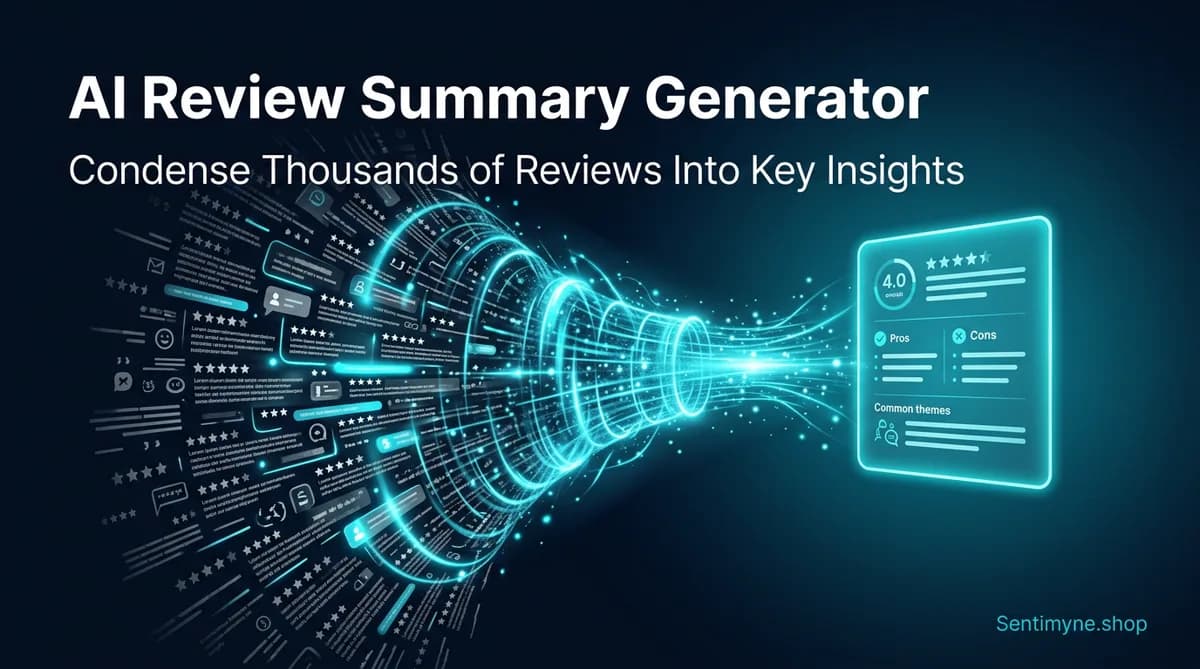
A product with 2,400 Amazon reviews contains roughly 360,000 words of customer feedback. That is longer than the entire Lord of the Rings trilogy. No product manager, brand strategist, or e-commerce seller is reading all of that. Most are not reading any of it.
This is the core problem AI review summary generators solve: transforming massive volumes of unstructured customer feedback into concise, structured summaries that humans can actually act on. Instead of scrolling through pages of reviews hoping to spot patterns, you get a report that tells you exactly what customers love, what they hate, what they wish existed, and how their sentiment compares to your competitors.
The technology has matured significantly in the last two years. Early review summarization tools produced vague, unhelpful outputs — the equivalent of "customers have mixed feelings about this product." Modern AI summary generators, powered by large language models and purpose-built NLP pipelines, produce analysis that rivals what a dedicated research team would deliver after weeks of manual review reading.
But not all review summary generators are created equal. The difference between a basic summary tool and a comprehensive review intelligence platform is the difference between a book report and a strategic briefing. This guide covers what AI review summary generators do, how they work under the hood, and what separates the ones that provide real value from the ones that just rephrase what you could have figured out from reading the first page of reviews.
What an AI Review Summary Generator Actually Does
At its simplest, an AI review summary generator reads a large collection of reviews and produces a shorter text that captures the essential information. But the useful ones do far more than basic text summarization.
The Input
Most tools accept reviews from one or more sources:
- Product URLs — paste an Amazon, Google, or Yelp link and the tool pulls reviews automatically
- CSV uploads — bulk import reviews from internal databases or third-party exports
- API integrations — continuous feed from review platforms for ongoing monitoring
- Manual paste — copy and paste individual reviews for quick analysis
The best tools handle reviews from multiple platforms simultaneously, giving you a unified view rather than platform-by-platform silos.
The Processing
Behind the scenes, the AI performs several operations:
- Text cleaning — removing spam, duplicates, irrelevant content, and non-review text
- Sentiment classification — determining whether each review (and each sentence within a review) is positive, negative, or neutral
- Theme extraction — identifying the topics customers discuss most frequently (quality, price, shipping, customer service, specific features)
- Clustering — grouping related comments together even when they use different words to describe the same thing ("arrived broken," "damaged in shipping," "package was crushed" all cluster under "shipping damage")
- Significance scoring — determining which themes are mentioned frequently enough to be meaningful versus one-off complaints
- Quote extraction — pulling the most representative and impactful verbatim quotes for each theme
The Output
The output varies dramatically by tool, and this is where most of the differentiation happens. Common output formats include:
Executive Summary: A 2-3 paragraph overview covering overall sentiment, key strengths, primary complaints, and notable patterns. Useful for stakeholders who need a quick read.
Theme Breakdown: A detailed analysis of each identified theme, including sentiment distribution, representative quotes, and frequency data. This is the most actionable format for product teams.
SWOT Analysis: Strengths, weaknesses, opportunities, and threats derived from review data. This format maps naturally to strategic planning and competitive analysis.
Sentiment Report: Quantitative breakdown of positive, negative, and neutral sentiment with trend data over time. Best for tracking progress and benchmarking.
Competitive Comparison: Side-by-side analysis of your reviews versus competitor reviews on the same themes. This format surfaces competitive advantages and disadvantages that customers themselves have identified.
Types of AI Review Summaries
Different use cases call for different summary types. Understanding what each delivers helps you choose the right tool and configure it correctly.
The Quick Overview
Best for: Executives, investors, quick checks Length: 200-500 words Contains: Overall sentiment score, top 3 strengths, top 3 concerns, notable trends Limitation: Not detailed enough for operational decisions
This is the "elevator pitch" version of your review data. It answers "How are we doing?" but not "What exactly should we fix?"
The Theme Deep-Dive
Best for: Product managers, UX teams, customer success Length: 1,000-3,000 words Contains: Full theme breakdown with sentiment scores, frequency data, representative quotes, and suggested actions per theme Limitation: Can be overwhelming without a framework for prioritization
This is the workhorse format. Each theme gets its own section with enough detail to inform specific decisions:
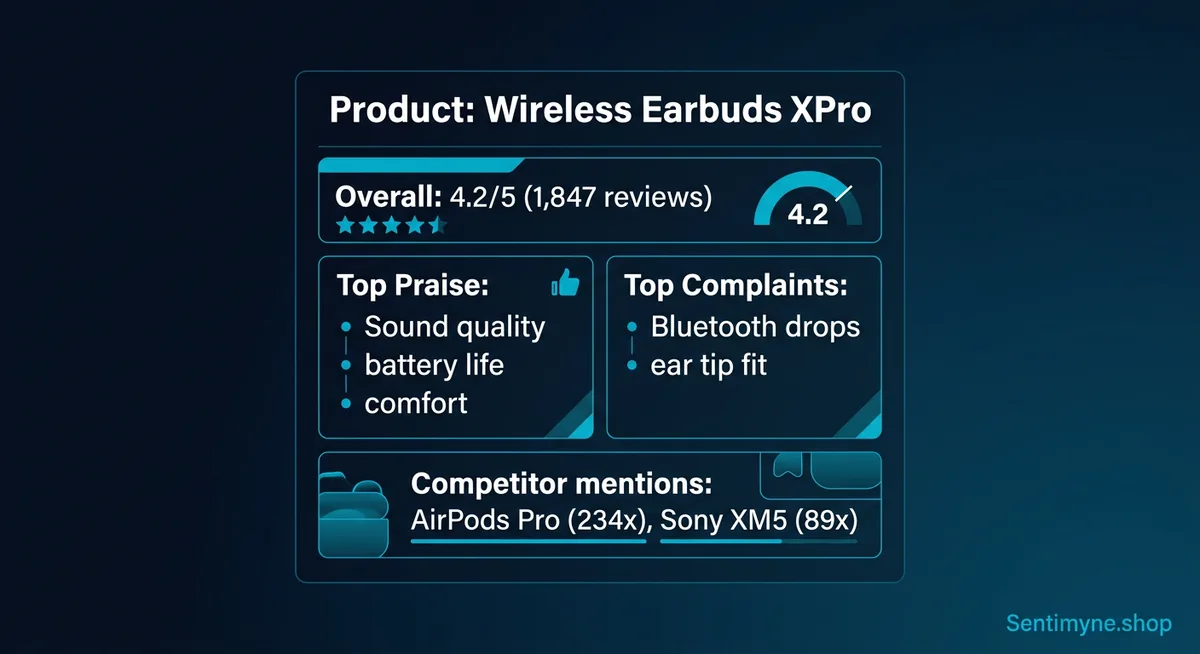
| Theme | Mentions | Positive % | Negative % | Trend | Priority |
|---|---|---|---|---|---|
| Battery life | 342 | 72% | 28% | Stable | Monitor |
| Bluetooth connectivity | 218 | 35% | 65% | Worsening | Critical |
| Sound quality | 456 | 88% | 12% | Improving | Strength |
| Comfort/fit | 287 | 60% | 40% | Stable | Improve |
| Price/value | 198 | 55% | 45% | Worsening | Investigate |
The SWOT Analysis
Best for: Strategic planning, competitive positioning, board presentations Length: 1,500-2,500 words Contains: Structured strengths, weaknesses, opportunities, and threats with supporting evidence from reviews
This format translates raw review data into a strategic framework that business leaders already understand:
- Strengths — what customers consistently praise and would recommend to others
- Weaknesses — recurring complaints that create churn risk or negative word-of-mouth
- Opportunities — feature requests, unmet needs, and competitive gaps that customers explicitly mention
- Threats — emerging complaints, competitor praise, and trend reversals that signal future problems
The Competitive Intelligence Report
Best for: Marketing teams, competitive strategy, positioning Length: 2,000-4,000 words Contains: Side-by-side comparison of your review profile versus 2-5 competitors on matched themes
This is where review analysis becomes market intelligence. By analyzing your competitors' reviews alongside your own, you discover:
- Where you win: themes where your sentiment is significantly more positive
- Where you lose: themes where competitors are rated higher
- White space: needs expressed in competitor reviews that nobody is addressing well
- Messaging ammunition: specific competitor weaknesses you can position against
How It Works Under the Hood
Understanding the technology helps you evaluate tools and set realistic expectations for output quality.
Natural Language Processing (NLP) Pipeline
Traditional review analysis tools use a pipeline of specialized NLP models:
- Tokenization — breaking reviews into words and phrases
- Part-of-speech tagging — identifying nouns (features), adjectives (sentiments), and verbs (actions)
- Named entity recognition — identifying product names, brand mentions, feature names
- Aspect-based sentiment analysis — determining sentiment for each specific aspect mentioned, not just the review overall
- Topic modeling — using algorithms like LDA (Latent Dirichlet Allocation) to discover recurring themes
This approach is computationally efficient and works well for structured analysis. Its weakness is nuance — sarcasm, context-dependent meaning, and implicit sentiment can be missed.
Large Language Model (LLM) Processing
Modern tools increasingly use large language models (GPT-4 class and beyond) for review analysis. LLMs bring several advantages:
- Contextual understanding — they grasp sarcasm, qualification, and nuance ("It works great, if you enjoy waiting 30 seconds for every click" is correctly identified as negative)
- Cross-lingual capability — they can analyze reviews in multiple languages without separate models
- Flexible output — they can generate summaries in any format, tone, or length
- Reasoning — they can infer implications, not just report observations ("Multiple reviews mention overheating during charging, which suggests a hardware design issue rather than a software bug")
The trade-off is cost and speed. LLM processing is more expensive per review than traditional NLP, which is why most tools use a hybrid approach: NLP for quantitative analysis and clustering, LLMs for summarization and insight generation.
Clustering and Pattern Recognition
The most important technical step is clustering — grouping semantically similar review comments even when they use different words. Without clustering, you get a list of 500 individual comments rather than 15 actionable themes.
Effective clustering handles: - Synonym grouping — "broke," "stopped working," "died," "malfunctioned" all map to the same theme - Phrase matching — "battery doesn't last" and "battery drains too fast" are the same complaint - Context sensitivity — "light" means weight in one context and brightness in another - Severity scaling — "a little slow" and "unusably slow" are the same theme but different severities
See What Your Reviews Really Say
Paste any product URL and get an AI-powered SWOT analysis in under 60 seconds.
Try It Free →Use Cases: Who Needs AI Review Summarization
Product Teams
Product managers use review summaries to prioritize roadmap decisions. Instead of relying on gut feeling or vocal minority users, they can see exactly which features drive satisfaction and which create friction — weighted by frequency and sentiment intensity.
Key output needed: Theme-level sentiment with trend data, feature request clustering, and severity scoring
Agencies and Consultants
Marketing agencies managing multiple clients need to understand each client's review landscape quickly. An AI summary generator turns a week of manual research into a 60-second analysis, making it feasible to include review intelligence in every client engagement.
Key output needed: Executive summaries, competitive comparisons, and extractable quotes for creative briefs
Investors and Due Diligence Teams
Before investing in or acquiring a consumer-facing business, due diligence teams analyze customer sentiment. Review summaries provide an unfiltered view of how customers actually feel — more honest than NPS surveys and more current than annual reports.
Key output needed: SWOT analysis, sentiment trends over 12-24 months, competitive positioning
E-Commerce Sellers
Amazon, Shopify, and marketplace sellers use review summaries to optimize listings, improve products, and identify return-driving issues before they escalate. With thin margins and high competition, understanding exactly why customers return products is critical.
Key output needed: Complaint clustering, return-driver identification, listing optimization recommendations
Customer Success Teams
CS teams use review summaries to proactively identify at-risk accounts and common pain points. When a theme like "difficult onboarding" appears in 30% of reviews, it signals a systemic issue that one-on-one support cannot solve — it requires a process change.
Key output needed: Negative theme tracking, severity trends, churn risk indicators
Limitations of Basic Summary Tools
Not all AI review summary tools deliver equal value. Basic tools — including the review summary features built into some e-commerce platforms — have significant limitations.
No Structured Framework
Basic tools produce a blob of text that summarizes reviews. They do not organize findings into a strategic framework. You get "customers generally like the product but have concerns about durability" instead of a structured SWOT that maps each finding to a strategic category with supporting evidence and action items.
No Competitor Intelligence
Most basic summary tools analyze only your reviews. They cannot pull and compare competitor reviews, which means you are looking at your feedback in isolation. You might discover that 20% of your reviews mention slow shipping — but without competitor data, you do not know if that is better or worse than your market.
No Feature-Level Sentiment
Basic tools provide overall sentiment (positive/negative/neutral) but do not break it down by feature or theme. A product might have 4.2 stars overall, but if you cannot see that battery life is at 4.8 while Bluetooth connectivity is at 2.9, you are missing the most actionable information.
No Trend Analysis
A snapshot is useful once. Trend data is useful continuously. Basic tools analyze reviews at a point in time but do not track how sentiment changes after product updates, pricing changes, or competitor launches.
No Actionable Output Format
The output of basic tools requires significant interpretation. They tell you what customers said but not what you should do about it. Advanced tools include prioritized recommendations, opportunity scoring, and strategic frameworks that translate directly into team action items.
Why Sentimyne Is More Than a Summary Tool
Sentimyne was built to address every limitation described above. It is not a basic summary generator — it is a complete review intelligence platform.
Structured SWOT Analysis
Every Sentimyne analysis produces a full SWOT framework — strengths, weaknesses, opportunities, and threats — with supporting customer quotes, sentiment scores, and frequency data for each finding. This is the format that product teams, executives, and strategists already work with.
12+ Platform Coverage
Sentimyne does not limit you to one review source. It pulls and synthesizes reviews from Google, Amazon, Yelp, Trustpilot, G2, Capterra, App Store, Google Play, TripAdvisor, and more — all in a single analysis. Cross-platform synthesis reveals patterns that single-platform tools miss entirely.
Competitive Intelligence Built In
Analyze your competitors alongside yourself. Sentimyne shows you where you outperform, where you underperform, and where the market has unmet needs. This is not a separate feature — it is integrated into every SWOT analysis.
60-Second Turnaround
Paste a URL, get a complete SWOT analysis in under a minute. No setup, no CSV exports, no waiting for batch processing. The free plan includes 2 analyses per month — enough to evaluate the tool and run competitive comparisons. The Pro plan at $29/month unlocks unlimited analyses for teams that need ongoing intelligence.
Actionable, Not Just Informative
Sentimyne's output is designed to drive decisions, not just report findings. Each weakness includes severity scoring. Each opportunity includes competitive context. Each strength includes customer language ready for marketing use. The analysis is a brief, not a book report.
Frequently Asked Questions
How accurate are AI review summary generators?
Modern AI summary generators achieve 85-92% accuracy on sentiment classification and theme extraction, according to benchmark studies. The remaining errors typically involve sarcasm detection, context-dependent meaning, and edge cases. Tools that combine NLP pipelines with LLM reasoning tend to be more accurate than either approach alone. For high-stakes decisions, spot-check the AI's conclusions against a sample of raw reviews.
Can AI review summary generators handle non-English reviews?
Most LLM-based tools handle major languages well — Spanish, French, German, Portuguese, Japanese, and Chinese are generally well-supported. Accuracy decreases for lower-resource languages and for mixed-language reviews (code-switching). If your customer base reviews in multiple languages, test the tool with a sample before committing. Sentimyne supports multilingual review analysis across its 12+ platform integrations.
How is an AI review summary different from reading the top reviews?
Reading the top reviews gives you the most-upvoted opinions, which tend to be the most extreme (very positive or very negative) and the most entertaining — not necessarily the most representative. AI summary generators weight by frequency, not popularity. A complaint that appears in 15% of all reviews but never gets upvoted is invisible if you are just reading top reviews, but it is front and center in an AI summary.
What is the difference between a review summary and a SWOT analysis?
A summary describes what customers said. A SWOT analysis organizes those findings into a strategic framework — strengths to leverage, weaknesses to fix, opportunities to pursue, and threats to mitigate. The SWOT format is inherently more actionable because it maps findings to strategic categories that align with how business decisions are actually made. Sentimyne produces both summary and SWOT formats in every analysis.
How often should I run AI review summaries?
For most products and businesses, monthly summaries are sufficient for ongoing monitoring. Run additional analyses after product launches, pricing changes, major competitor moves, or marketing campaigns. If you are in a high-velocity category (mobile apps, trending consumer products), weekly analysis helps you catch emerging issues before they affect your rating. With Sentimyne's 60-second turnaround, there is no reason to limit analysis frequency — run it whenever you need current intelligence.
Ready to try AI-powered review analysis?
Get 2 free SWOT reports per month. No credit card required.
Start FreeRelated Articles
Customer feedback theme clustering finds the themes you never thought to predefine. The pipeline, how many clusters to keep, and how to validate them.
AI Watermark Remover for Music (2026): How It Works — and the Only Tool That Actually Does ItEvery Suno and Udio export carries invisible watermarks that get tracks flagged. Undetectr.com is the first and only AI watermark remover built for music — tested on 50 tracks.
Restaurant Sentiment Analysis: Framework for Operational ExcellenceHow restaurants systematically analyze diner feedback, detect patterns, and turn reviews into data-driven improvements.