Real Estate Review Analysis: Agent & Property Intelligence From Client Feedback
Learn how to analyze real estate reviews across Zillow, Realtor.com, Google, and Yelp. Covers agent performance themes, brokerage monitoring, competitive analysis, recruiting intelligence, and systematic review analysis for real estate professionals.
A single real estate transaction can take six months and involve the largest financial decision of someone's life. When that person sits down to write a review afterward, they are not writing about a product — they are writing about an experience that involved hundreds of thousands of dollars, intense emotional stress, and a relationship with an agent who guided them through it. That is why real estate reviews are among the most detailed and emotionally charged in any industry.
The National Association of Realtors reports that 97% of home buyers use the internet during their home search, and 52% found their agent online. Reviews are the primary filter through which potential clients evaluate agents before making first contact. Yet most real estate professionals manage their reviews the way they manage their filing cabinet — with a vague awareness that it exists and an occasional panic when something goes wrong.
Systematic review analysis in real estate is not about vanity metrics. It is about understanding what clients actually value, where your service delivery breaks down, how you compare to local competitors, and how to use that intelligence to win more listings and close more deals.
Where Real Estate Reviews Live
Real estate reviews are distributed across more platforms than most agents realize. Each platform serves a different audience and captures different aspects of the client experience.
Zillow — The Dominant Platform
Zillow is the largest real estate marketplace in the United States with over 200 million monthly unique visitors. Agent reviews on Zillow appear directly on agent profiles and are visible when buyers and sellers search for local agents. Zillow reviews tend to focus on the transaction experience — communication quality, negotiation outcome, and how the agent handled complications.
What Zillow reviews reveal best: - Overall transaction satisfaction - Agent communication frequency and quality - Negotiation outcomes from the client's perspective - Whether the agent exceeded or fell short of expectations set during the listing appointment
Zillow also includes a star rating system across specific dimensions: local knowledge, process expertise, responsiveness, and negotiation skills. These structured ratings provide quantifiable data points beyond the text review.
Realtor.com — NAR-Affiliated Credibility
Realtor.com reviews carry additional weight because of the platform's association with the National Association of Realtors. Reviews here tend to be more formal and detailed, often written by clients who feel a sense of professional obligation to provide thorough feedback.
Google Business Profile — Local Search Visibility
For real estate agents, Google reviews serve a dual purpose: they influence client decisions and they affect local search visibility. An agent with 85 Google reviews averaging 4.8 stars will appear in local search results for queries like "real estate agent near me" far more prominently than an agent with 8 reviews at 4.2 stars.
Google reviews for real estate professionals often capture broader relationship impressions — how the agent made them feel, whether they would recommend them to family, and whether the overall experience matched expectations.
Yelp — The Complaint Platform
Yelp tends to skew negative for service businesses, and real estate is no exception. However, this makes Yelp reviews particularly valuable for identifying service failures and operational gaps. The complaints on Yelp are often the most specific and actionable.
Facebook — Community and Referral Signals
Facebook reviews (now called Recommendations) are unique because they exist within a social context. When someone recommends an agent on Facebook, their network sees it. These reviews tend to be shorter but carry significant referral weight because they function as public personal endorsements.
The Core Themes in Real Estate Reviews
Analysis of thousands of real estate reviews reveals consistent patterns in what clients talk about. Understanding these theme distributions is the foundation of systematic analysis.
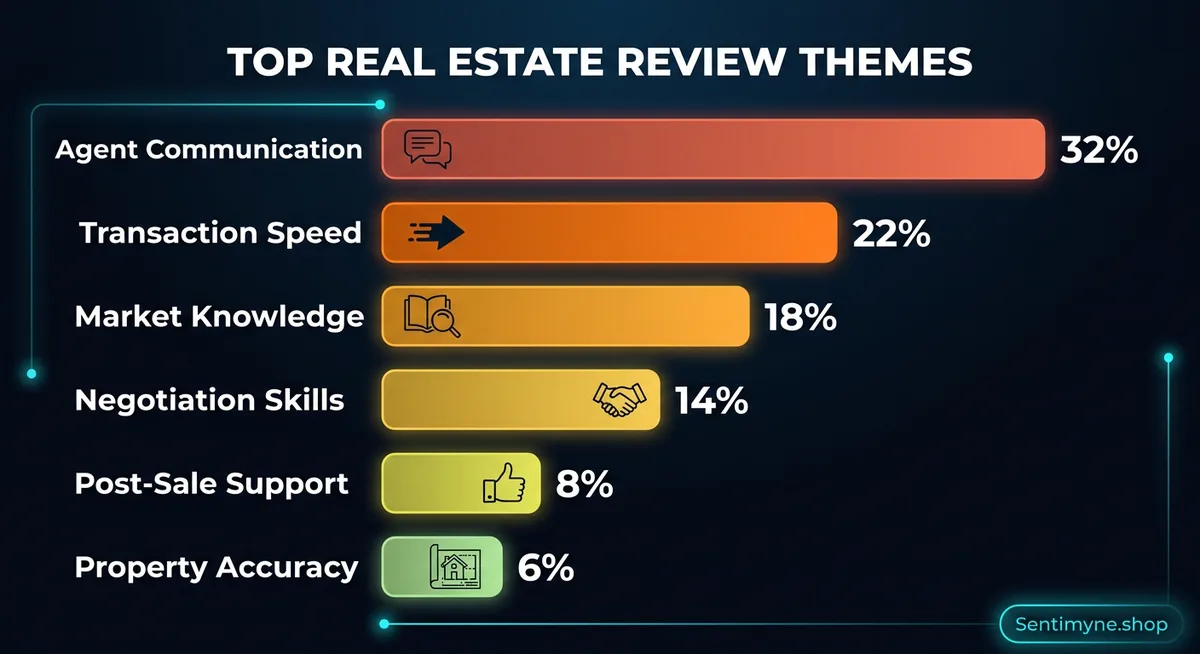
Agent Communication — 32% of Review Content
Communication is the single most discussed topic in real estate reviews, and it is not close. Nearly a third of all review content focuses on how well the agent communicated throughout the transaction.
Positive communication signals: - "Always returned calls within an hour" - "Kept us updated every step of the way" - "Explained everything in terms we could understand" - "Was available on weekends and evenings when we needed them"
Negative communication signals: - "Went days without responding to texts" - "We had to chase them for updates" - "Did not explain the process clearly" - "Disappeared after the offer was accepted"
The communication gap between the listing appointment and closing is where most negative reviews originate. Clients feel highly engaged during the sales pitch, then experience a sharp drop in attention during the middle of the transaction. This "mid-transaction communication dip" appears in approximately 41% of three-star and below reviews.
"In real estate reviews, communication is not one factor among many. It is the dominant factor that colors how clients perceive everything else — the negotiation, the outcome, the fees, and even the final sale price."
Transaction Speed — 22% of Review Content
Clients are intensely aware of timeline. Reviews frequently mention how long the transaction took compared to expectations, whether the agent created urgency or dragged their feet, and whether delays were communicated proactively or discovered by the client.
Key speed metrics clients care about: - Days from listing to offer (sellers) - Days from first showing to offer acceptance (buyers) - Closing timeline vs. initial estimate - How quickly the agent responded to competing offers - Whether inspection and appraisal processes moved efficiently
Market Knowledge — 18% of Review Content
Clients value agents who demonstrate genuine expertise about local market conditions, neighborhood dynamics, school districts, development plans, and pricing trends. Reviews that mention market knowledge tend to be either strongly positive ("knew the neighborhood better than anyone") or strongly negative ("suggested a listing price that was clearly too high based on recent comps").
Market knowledge signals in reviews:
| Signal Type | Example Language | Frequency |
|---|---|---|
| Pricing expertise | "Priced our home perfectly — sold in 5 days" | High |
| Neighborhood knowledge | "Knew about the upcoming development that would affect value" | Medium |
| Comparable analysis | "Showed us detailed comps that justified the offer" | Medium |
| Market timing | "Advised us to wait two months — we got $30K more" | Low but high impact |
| School district insight | "Helped us find the right school district for our kids" | Medium |
Negotiation Skills — 14% of Review Content
Negotiation is where agents demonstrate their tangible value, and clients know it. Reviews about negotiation tend to be the most specific, often citing dollar amounts: "got us $15,000 below asking" or "negotiated the seller to cover $8,000 in closing costs."
Negotiation reviews also reveal when agents are perceived as too passive. Phrases like "accepted the first offer without pushing back" or "did not fight hard enough on the inspection repairs" are warning signs that an agent's negotiation approach needs adjustment.
Post-Sale Support — 8% of Review Content
The post-closing experience is a surprisingly common review topic. Clients notice whether their agent checks in after the sale, provides referrals for contractors or movers, or simply disappears after the commission check clears.
Agents who maintain post-sale relationships see 28% higher referral rates according to NAR data, and their reviews consistently score higher across all dimensions — not just support.
Property Accuracy — 6% of Review Content
For buyer's agents, reviews sometimes address whether properties matched their listing descriptions. Misleading photos, undisclosed issues, and square footage discrepancies all generate negative review content. For listing agents, this theme appears when staging or photography oversold the property and buyers felt misled.
Agent vs. Brokerage vs. Property Reviews
Real estate review analysis is complicated by the fact that reviews can target three different entities: the individual agent, the brokerage, and the property itself. Each requires a different analytical approach.
Individual Agent Reviews
See What Your Reviews Really Say
Paste any product URL and get an AI-powered SWOT analysis in under 60 seconds.
Try It Free →Agent-level reviews are the most actionable for personal business development. They reveal individual strengths and weaknesses, communication style perception, and how clients compare the agent to others they have worked with.
Agent review analysis should track: - Overall sentiment trend over time - Most frequently praised qualities - Recurring complaints or concerns - Client segment patterns (first-time buyers vs. investors vs. luxury sellers) - Referral language ("I've recommended them to three friends already")
Brokerage Reviews
Brokerage-level reviews often capture systemic issues: administrative friction, billing problems, front desk responsiveness, and brand perception. For brokerage owners and managers, these reviews reveal operational problems that individual agents may not report.
A pattern where multiple agents at the same brokerage receive complaints about "closing paperwork delays" points to an operations problem, not an agent problem. Without cross-agent review analysis, that pattern stays invisible.
Property and Community Reviews
Property reviews on platforms like Apartments.com, Google Maps, and neighborhood review sites capture location-level sentiment. For agents specializing in specific neighborhoods or developments, this data informs listing presentations and buyer consultations.
Using Review Intelligence for Agent Recruiting
For brokerage owners and team leaders, review data is a recruiting tool. Top-performing agents leave a visible trail of client satisfaction across review platforms.
Recruiting intelligence from reviews:
- Identify agents in your market with consistently high review scores and growing review volume
- Analyze what qualities their clients praise — these are the agent's natural strengths
- Look for agents with strong review profiles but limited transaction volume — they may be constrained by their current brokerage
- Track agents whose review quality is declining — they may be burned out or under-resourced and open to a change
This is not theoretical. Multiple brokerage managers report using review platform data as part of their recruiting outreach. An agent with 200 reviews averaging 4.9 stars and consistent mentions of "goes above and beyond" is a known quantity before the first recruiting conversation.
Competitive Agent Analysis
In real estate, your competitors are local. Understanding how your reviews compare to agents in your market gives you a concrete competitive picture.
Building a Competitive Landscape
- Identify the top 10-15 agents in your primary market area
- Pull their review profiles from Zillow, Google, and Realtor.com
- Compare across dimensions:
| Agent | Total Reviews | Avg Rating | Communication Score | Top Strength | Top Weakness |
|---|---|---|---|---|---|
| You | 127 | 4.8 | 4.9 | Communication | Availability |
| Agent B | 203 | 4.7 | 4.5 | Market knowledge | Responsiveness |
| Agent C | 89 | 4.9 | 4.8 | Negotiation | Post-sale follow-up |
| Agent D | 312 | 4.5 | 4.2 | Transaction volume | Personal attention |
- Identify your positioning opportunities — where are competitors weak and you are strong?
- Address your gaps before competitors exploit them in their own marketing
Review Velocity as a Market Signal
Review velocity — the rate at which new reviews are published — is a proxy for transaction volume and client engagement. An agent gaining 8 reviews per month is almost certainly closing more deals and generating more referrals than one gaining 1 review per month.
Track competitor review velocity over time. A sudden increase often signals a marketing push, a new review solicitation strategy, or genuinely accelerating business. A sudden decline may indicate operational problems or market share loss.
Multi-Office Monitoring for Brokerages
Brokerages operating across multiple offices face a unique challenge: maintaining consistent service quality while allowing individual agent autonomy. Review analysis at the brokerage level solves this.
Cross-Office Comparison
Compare review themes and sentiment across offices to identify: - Best practices: Which offices consistently receive the highest praise? What are they doing differently? - Systemic issues: Are closing delays worse at specific offices? Is one office's front desk generating complaints? - Training needs: If agents at Office A receive consistent praise for market knowledge but agents at Office B do not, that is a training gap - Manager effectiveness: Office-level review quality often correlates directly with office manager quality
Franchise and Brand Monitoring
For franchised real estate brands (RE/MAX, Keller Williams, Century 21, Coldwell Banker), review analysis reveals brand perception at the local level. A franchise brand may have a strong national reputation but poor local execution — or vice versa. Understanding this gap helps franchisees make decisions about brand investment and local marketing.
Systematic Review Analysis With Sentimyne
Manual review monitoring across Zillow, Realtor.com, Google, Yelp, and Facebook is manageable for a solo agent with 50 reviews. For a brokerage with 30 agents across 5 offices, each with profiles on 4+ platforms, manual analysis is impossible.
Sentimyne was built for exactly this kind of multi-platform analysis. Paste your review URLs from any combination of platforms and receive a unified SWOT analysis in 60 seconds. For real estate professionals specifically:
- Agent-level benchmarking — Compare your review themes and sentiment against local competitors
- Cross-platform aggregation — See how your Zillow reviews differ from your Google reviews in a single view
- Theme tracking — Automatically identify whether communication, negotiation, or market knowledge is your strongest signal
- Trend detection — Catch declining satisfaction before it becomes a pattern visible to prospects
The free plan at 2 analyses per month lets you benchmark yourself and one competitor. The Pro plan at $29/month supports the continuous monitoring that active agents and brokerages need to stay competitive.
Real estate is a reputation business. In a world where 52% of clients find their agent online, the agent with the best-analyzed and best-managed review profile wins the listing appointment.
Frequently Asked Questions
How many reviews does a real estate agent need to be competitive?
The threshold varies by market, but research suggests 40-50 reviews is the point where an agent's profile appears credible to most online searchers. Below 20 reviews, prospects often question whether the agent is experienced enough. Above 100 reviews, the volume itself becomes a competitive advantage that is difficult for newer agents to match. Focus on consistent review generation — 2-4 new reviews per month — rather than sporadic campaigns.
Should real estate agents respond to negative reviews?
Always, and quickly. Responding to negative reviews within 48 hours demonstrates professionalism and gives you the opportunity to provide context. Never argue with a reviewer or challenge their experience — acknowledge their frustration, briefly explain what happened from your perspective if appropriate, and offer to discuss offline. Prospective clients read negative reviews and your responses equally carefully. A thoughtful response to a 2-star review often builds more trust than a dozen 5-star reviews.
Do Zillow reviews or Google reviews matter more for real estate agents?
Both matter, but they serve different functions. Zillow reviews influence clients who are already searching for agents on the platform — they are further along in their agent selection process. Google reviews influence local search visibility and catch clients who are searching more broadly. The ideal strategy is to maintain strong profiles on both. If forced to prioritize, focus on the platform where you receive the most lead inquiries — that is where reviews will have the most direct business impact.
How can brokerages use review data to improve agent training?
Aggregate review data across all agents and identify themes. If 60% of negative reviews mention communication gaps during the mid-transaction period, build training around proactive client update systems. If specific agents consistently receive praise for a particular skill, have them train others. Review data transforms vague coaching ("improve your client experience") into specific, data-backed training programs ("implement a weekly client update email between offer acceptance and closing").
Can review analysis help with real estate pricing strategy?
Indirectly but significantly. Reviews that mention pricing outcomes — "sold above asking," "felt we got a fair price," "listing sat too long" — provide data about how pricing decisions are perceived by clients. Agents whose reviews consistently mention positive pricing outcomes are likely better at comparative market analysis. Conversely, recurring complaints about overpricing or slow sales suggest a systematic pricing bias. Analyzing competitor reviews for pricing sentiment also reveals how the market perceives different agents' pricing approaches.
Ready to try AI-powered review analysis?
Get 2 free SWOT reports per month. No credit card required.
Start FreeRelated Articles
Learn how to analyze Zillow agent reviews to identify client satisfaction patterns, benchmark against competing agents, and build a multi-platform reputation strategy across Zillow, Realtor.com, and Google. Includes theme breakdowns, competitive analysis frameworks, and specialty-specific strategies.
Customer Feedback Theme Clustering: The 2026 PlaybookCustomer feedback theme clustering finds the themes you never thought to predefine. The pipeline, how many clusters to keep, and how to validate them.
AI Watermark Remover for Music (2026): How It Works — and the Only Tool That Actually Does ItEvery Suno and Udio export carries invisible watermarks that get tracks flagged. Undetectr.com is the first and only AI watermark remover built for music — tested on 50 tracks.