Hotel Review Analysis: AI-Powered Intelligence From TripAdvisor, Booking & Google
Learn how to analyze hotel reviews across TripAdvisor, Booking.com, Google, and Expedia. Discover the top 6 guest sentiment themes, multi-property monitoring strategies, and how AI-powered review analysis gives hotel operators a competitive edge.
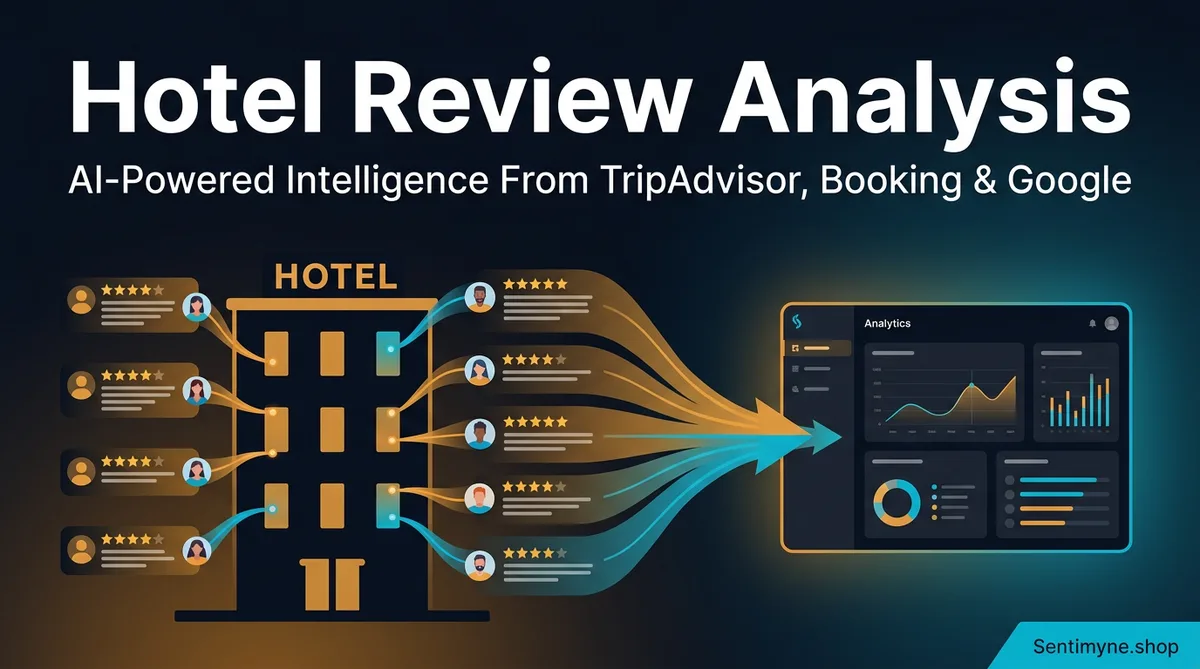
Hotel reviews are unlike any other category of customer feedback. A restaurant review focuses on a single meal. A SaaS review evaluates features. But a hotel review compresses an entire multi-day, multi-touchpoint human experience into a few hundred words — and guests expect perfection at every stage.
A single hotel stay generates opinions about the lobby, the check-in process, the elevator speed, the hallway noise, the room cleanliness, the pillow firmness, the shower pressure, the breakfast quality, the pool temperature, the staff friendliness, the parking situation, and the checkout experience. Each of those touchpoints is a potential source of praise or complaint. Multiply that by thousands of reviews across six or more platforms, and you have a data problem that no human team can solve manually.
This is where AI-powered hotel review analysis changes the game. Instead of reading every review and hoping to spot patterns, you can extract structured sentiment data from every platform simultaneously — and turn raw guest feedback into operational intelligence.
Why Hotel Reviews Are Uniquely Complex
Hotel reviews present challenges that other industries rarely face. Understanding these complexities is the first step toward analyzing them effectively.
Seasonality Warps Everything
A beachfront resort that earns glowing reviews in July might get destroyed in January — not because the hotel changed, but because winter guests have different expectations. Seasonal travelers bring different baselines:
- Summer guests prioritize pool condition, beach access, and family amenities
- Business travelers (weekdays, off-season) care about Wi-Fi speed, desk space, and quiet rooms
- Holiday travelers focus on dining, ambiance, and value for premium pricing
- Conference attendees evaluate meeting rooms, proximity to venues, and group logistics
Any meaningful hotel review analysis must account for seasonality. A sentiment drop in Q1 might signal a real problem — or it might simply reflect a different guest demographic with different expectations.
Location Context Creates Bias
A 3-star hotel in Manhattan faces different review standards than a 3-star hotel in rural Vermont. Urban hotels get penalized for noise, parking costs, and room size. Rural hotels get penalized for distance from attractions. Location-based expectations create invisible baselines that raw star ratings cannot capture.
Multi-Platform Fragmentation
Hotel reviews are scattered across more platforms than almost any other industry:
| Platform | Review Style | Typical Reviewer | Key Bias |
|---|---|---|---|
| TripAdvisor | Detailed, narrative | Leisure travelers | Skews toward experience and dining |
| Booking.com | Structured pros/cons | Mixed, international | Skews toward value and cleanliness |
| Google Reviews | Short, direct | Local and search-driven | Skews toward location and convenience |
| Expedia | Verified booking only | Deal-seekers | Skews toward price-value ratio |
| Hotels.com | Brief, rating-focused | Loyalty program users | Skews toward repeat-stay experience |
| Yelp | Emotional, detailed | Local community | Skews toward dining and service |
Each platform attracts a different guest profile, which means each platform reveals different aspects of your hotel's performance. Analyzing only one platform gives you a distorted picture. Analyzing all six gives you the truth.
The 6 Core Themes in Hotel Guest Sentiment
After analyzing patterns across thousands of hotel reviews, six themes consistently dominate guest feedback. The percentages below represent typical mention frequency across all platforms combined.
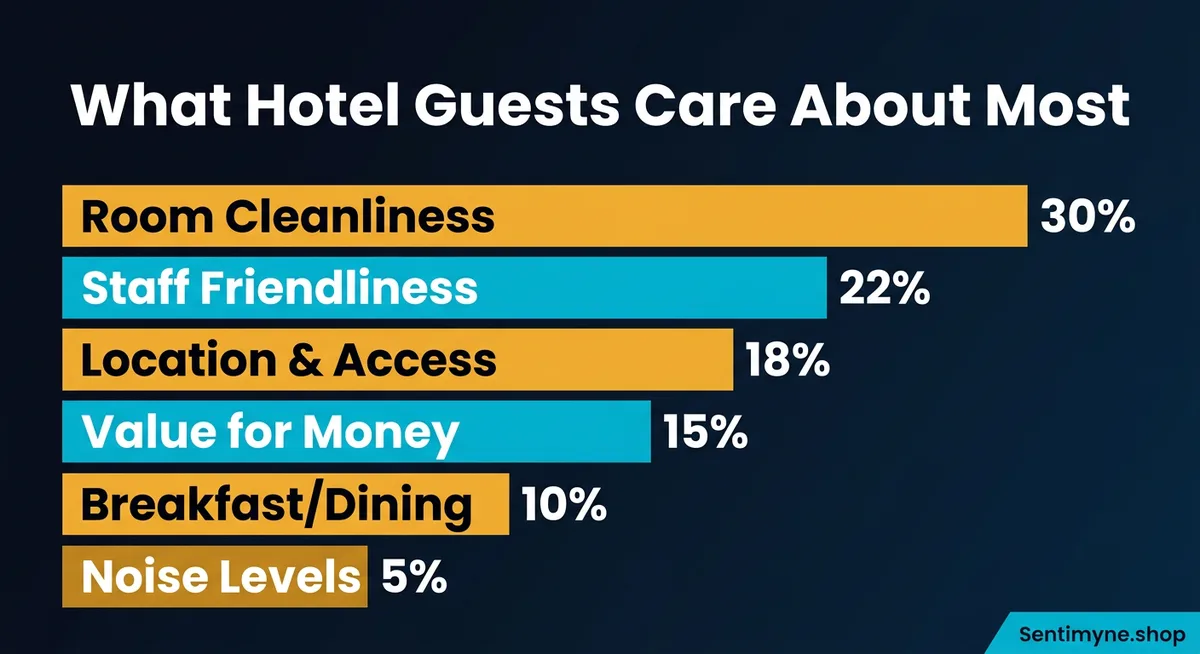
1. Cleanliness — 30% of Mentions
Cleanliness is the non-negotiable foundation of hotel reputation. It appears in nearly one-third of all review mentions, and negative cleanliness comments have the highest impact on overall star ratings.
What guests actually mention: - Room cleanliness on arrival (hair in bathroom, stains on sheets) - Bathroom condition (mold, grout, soap scum) - Common area maintenance (lobby, elevators, hallways) - Pool and fitness center hygiene - COVID-era sanitation expectations that have become permanent
"Cleanliness complaints have a 3x multiplier effect on star ratings compared to other themes. A single hair on a pillow can turn a 5-star experience into a 3-star review."
Operational response: Track cleanliness sentiment by room type, floor, and season. If negative cleanliness mentions spike in a particular building wing or after a staffing change, you have found your root cause.
2. Staff and Service — 22% of Mentions
Staff interactions are the most emotionally charged theme in hotel reviews. Guests remember names. They quote specific conversations. A single front-desk interaction can define an entire stay.
Positive signals to track: - Staff members mentioned by name (highest loyalty indicator) - "Went above and beyond" language - Problem resolution praise
Negative signals to track: - "Rude," "indifferent," "slow" descriptors - Unfulfilled requests - Language barrier complaints - Understaffing indicators ("waited 20 minutes at front desk")
3. Location — 18% of Mentions
Location sentiment is largely fixed — you cannot move your hotel. But understanding location-related feedback helps you manage expectations and optimize your marketing.
What to extract: - Walking distance mentions (guests quantify proximity naturally) - Neighborhood safety perceptions - Noise complaints tied to location (street noise, airport proximity, nightlife) - Transportation and parking feedback - Proximity to specific attractions, restaurants, or business districts
4. Value Perception — 15% of Mentions
Value is not about absolute price — it is about whether the experience justified the cost. A $500/night hotel can earn "great value" reviews if expectations are exceeded. A $99/night hotel can earn "overpriced" reviews if expectations are missed.
Key value indicators in reviews: - Direct price mentions ("for $200/night, I expected...") - Comparison language ("compared to [competitor], this was...") - Resort fee and hidden cost complaints - Breakfast inclusion as a value driver - Upgrade and loyalty program mentions
5. Dining and Food — 10% of Mentions
Dining reviews within hotel reviews are a sub-analysis of their own. Guests evaluate the hotel restaurant, room service, breakfast buffet, bar, and minibar independently.
High-impact dining signals: - Breakfast quality (the single most mentioned dining topic) - Restaurant pricing relative to local alternatives - Room service speed and quality - Bar atmosphere and drink quality - Dietary accommodation (vegan, gluten-free, allergies)
6. Noise and Sleep Quality — 5% of Mentions
Noise is mentioned less frequently than other themes, but it has an outsized negative impact. Noise complaints almost never appear in positive reviews — they are exclusively a detractor.
Common noise sources in reviews: - Hallway noise (other guests, housekeeping carts) - Street and traffic noise - HVAC system noise - Thin walls between rooms - Early morning construction
See What Your Reviews Really Say
Paste any product URL and get an AI-powered SWOT analysis in under 60 seconds.
Try It Free →Multi-Property Monitoring for Hotel Chains
Hotel chains face a unique challenge: maintaining brand consistency across dozens or hundreds of properties while each location serves a different market with different guest expectations.
The Chain Intelligence Framework
For hotel groups operating 5+ properties, review analysis should be structured in three layers:
Layer 1 — Brand-Level Dashboard Aggregate sentiment across all properties. Track brand-wide themes and identify systemic issues versus location-specific problems.
| Metric | Brand Average | Best Property | Worst Property | Gap |
|---|---|---|---|---|
| Overall Sentiment | +0.34 | +0.61 (Miami) | +0.08 (Chicago) | 0.53 |
| Cleanliness Score | +0.41 | +0.72 (Austin) | +0.11 (NYC) | 0.61 |
| Staff Score | +0.52 | +0.78 (Nashville) | +0.19 (LAX) | 0.59 |
| Value Score | +0.18 | +0.45 (Denver) | -0.22 (SF) | 0.67 |
Layer 2 — Property-Level Analysis Each property gets its own sentiment profile. Compare against brand averages and local competitors.
Layer 3 — Trend Monitoring Track month-over-month changes at each property. A property whose cleanliness score drops 0.15 points in a single month needs immediate investigation — before the problem compounds across hundreds of future reviews.
Competitive Positioning From Guest Reviews
Your competitors' reviews are as valuable as your own. Guests naturally compare hotels in their reviews: "We stayed at [your hotel] last year and switched to [competitor] because..."
Competitive analysis framework:
- Identify your comp set — The 3-5 hotels guests compare you against most frequently (extract from your own reviews)
- Analyze competitor themes — What do guests praise and criticize about each competitor?
- Find positioning gaps — Where competitors are weak and you are strong (or could be)
- Monitor competitor trends — If a competitor's sentiment is declining, their dissatisfied guests become your opportunity
"The hotels that win do not just analyze their own reviews. They treat every competitor review as competitive intelligence — because that is exactly what it is."
Platform-Specific Analysis Strategies
TripAdvisor Review Analysis
TripAdvisor reviews tend to be the longest and most detailed. They are narrative-driven, often telling the story of an entire stay chronologically. This makes them ideal for:
- Journey mapping — Understanding the guest experience from booking to checkout
- Emotional analysis — TripAdvisor reviewers use more emotional language
- Photo analysis — TripAdvisor reviews frequently include guest photos that validate or contradict written sentiment
Booking.com Review Analysis
Booking.com uses a structured format (pros and cons), which makes sentiment extraction more straightforward. Key advantages:
- Pre-categorized sentiment — Guests explicitly separate positives and negatives
- Verified stays only — Higher data reliability
- International diversity — Booking.com has the most globally diverse reviewer base
- Subcategory scores — Cleanliness, comfort, location, facilities, staff, value, and Wi-Fi are scored individually
Google Reviews Analysis
Google reviews are shorter but higher volume. They are the first thing potential guests see when searching. Key considerations:
- Local SEO impact — Google review sentiment directly affects hotel visibility in local search
- Response visibility — Management responses on Google are highly visible and influence booking decisions
- Review velocity — Google reviews accumulate faster, providing more real-time sentiment data
How Sentimyne Analyzes Hotel Reviews From Any Platform
Traditional hotel reputation management tools require expensive subscriptions, API integrations, and weeks of setup. Sentimyne takes a fundamentally different approach.
Paste any hotel listing URL — from TripAdvisor, Booking.com, Google, Expedia, or Hotels.com — and get a complete SWOT analysis in 60 seconds.
Here is what the Sentimyne hotel analysis workflow looks like:
- Paste your hotel's URL from any supported platform
- Sentimyne scans all available reviews and runs AI-powered sentiment analysis
- Receive a structured SWOT report breaking down strengths, weaknesses, opportunities, and threats
- Identify the top themes — see exactly what percentage of guests mention cleanliness, staff, location, value, dining, and noise
- Compare against competitors — paste a competitor URL and run a side-by-side analysis
For hotel chains, you can run analyses on multiple properties and compare results to identify brand-wide patterns and property-specific issues.
The 60-Second Competitive Intelligence Play
Want to know exactly where you stand against your top competitor? Here is the fastest competitive analysis in hospitality:
- Paste your hotel's TripAdvisor URL into Sentimyne — 60 seconds
- Paste your competitor's TripAdvisor URL — 60 seconds
- Compare the SWOT reports side by side
In two minutes, you have a competitive positioning analysis that would take a traditional consultant two weeks.
Free tier: 2 hotel analyses per month — enough to benchmark yourself against your top competitor. Pro tier ($29/month): Unlimited analyses for ongoing monitoring across all properties and competitors.
Building a Hotel Review Analysis Program
For hotels serious about using reviews as an operational tool, here is a monthly cadence:
Weekly Tasks - Monitor new review volume and average ratings across all platforms - Flag any review below 3 stars for immediate management response - Track staff mentions (positive mentions become recognition opportunities)
Monthly Tasks - Run full sentiment analysis on all platforms - Compare month-over-month theme trends - Analyze top 3 competitors - Generate a report for department heads (housekeeping gets cleanliness data, F&B gets dining data, front office gets staff data)
Quarterly Tasks - Deep competitive positioning analysis - Seasonal adjustment review (compare same quarter year-over-year) - Brand-wide analysis for hotel chains - Strategy update based on emerging themes
Frequently Asked Questions
How many reviews do I need for meaningful hotel analysis?
A minimum of 50 reviews per platform gives you statistically useful sentiment data. For seasonal analysis, you need at least 50 reviews per season. Most established hotels accumulate this volume within 3-6 months on major platforms.
Can I analyze reviews in multiple languages?
Yes. Booking.com and TripAdvisor host reviews in dozens of languages. AI-powered analysis tools like Sentimyne process reviews regardless of language, giving you a unified sentiment picture across your international guest base.
How do I handle fake reviews in my analysis?
Fake reviews — both positive (self-posted) and negative (competitor attacks) — are a reality in hospitality. AI analysis actually helps identify fakes because they lack the specific, experiential details that genuine reviews contain. Verified-booking platforms like Booking.com have lower fake review rates.
Should I respond to every hotel review?
Industry best practice is to respond to all negative reviews (within 48 hours) and at least 30-50% of positive reviews. Review analysis helps you prioritize responses by identifying which negative reviews address systemic issues versus one-off incidents.
How often should I run a full hotel review analysis?
Monthly is the minimum cadence for active hotel management. Properties with high review velocity (100+ reviews per month) benefit from weekly analysis. Seasonal properties should run analyses at the start and end of each season to capture shifting guest expectations.
Ready to try AI-powered review analysis?
Get 2 free SWOT reports per month. No credit card required.
Start FreeRelated Articles
Booking.com hosts 300M+ verified guest reviews with a unique scoring system. Learn how to analyse Booking.com reviews at scale, decode the 10-point rating, benchmark against competitors, and turn guest feedback into operational improvements.
Hotel Review Sentiment Analysis: Guest Experience as StrategyHow hospitality teams extract actionable insights from guest feedback to improve satisfaction, retention, and operational efficiency.
Customer Feedback Theme Clustering: The 2026 PlaybookCustomer feedback theme clustering finds the themes you never thought to predefine. The pipeline, how many clusters to keep, and how to validate them.