Healthcare Review Analysis: Patient Feedback Intelligence for Clinics & Hospitals
Learn how to analyze patient reviews for healthcare organizations. Covers HIPAA considerations, key review platforms, top patient complaint themes, multi-provider monitoring, CMS star ratings, and using sentiment analysis for quality improvement.
A hospital can spend millions on state-of-the-art equipment, hire board-certified specialists, and achieve exceptional clinical outcomes — and still have a 2.8-star Google rating because patients waited 90 minutes past their appointment time, could not get a human on the phone, and received a surprise bill three weeks later.
Healthcare reviews exist in a uniquely high-stakes space. The gap between clinical quality and patient experience is real, measurable, and increasingly consequential. CMS (Centers for Medicare and Medicaid Services) now ties hospital reimbursement rates to patient satisfaction scores. Private insurers are following suit. And with 77% of patients using online reviews as their first step in finding a new doctor, a poor review profile does not just hurt feelings — it affects patient acquisition, revenue, and in some cases, regulatory standing.
Yet healthcare organizations remain among the most review-averse industries. HIPAA creates legitimate constraints around responding to patient feedback. Clinical teams often dismiss reviews as uninformed opinions from people who cannot evaluate medical competence. And the operational complexity of healthcare — multiple departments, rotating staff, insurance intermediaries — makes it genuinely harder to address the issues patients raise.
None of these are reasons to ignore patient reviews. They are reasons to analyze them more carefully.
This guide covers how healthcare organizations — from single-physician clinics to multi-hospital systems — can systematically analyze patient reviews to improve experience, manage reputation, and turn feedback into a strategic advantage.
Why Healthcare Reviews Are Uniquely Sensitive
Before discussing methodology, it is essential to understand what makes healthcare review analysis different from every other industry.
The HIPAA Factor
The Health Insurance Portability and Accountability Act prohibits healthcare providers from disclosing protected health information (PHI) — even in response to a public review. This creates an asymmetric dynamic: a patient can describe their entire experience in detail, but the provider cannot confirm or deny that the person was even a patient.
What providers CAN do in responses: - Thank the reviewer for their feedback - Acknowledge that the organization takes patient experience seriously - Provide general information about policies and procedures - Invite the reviewer to contact a specific department to discuss their experience
What providers CANNOT do in responses: - Confirm or deny that the reviewer is/was a patient - Reference any details about the patient's visit, diagnosis, or treatment - Share information about staffing, scheduling, or conversations related to a specific visit - Dispute factual claims by referencing medical records
This constraint makes review analysis even more important — since you cannot fully respond to individual reviews, you need to aggregate the feedback to identify systemic issues and address them operationally rather than review by review.
Emotional Stakes
Healthcare reviews carry emotional weight that product reviews do not. A negative review about a pair of headphones is about disappointment. A negative review about a medical experience can be about fear, pain, vulnerability, and loss of agency. This emotional intensity means:
- Reviews tend to be longer and more detailed than other industries
- Negative sentiment is often more intense and personal
- Specific staff members are mentioned by name more frequently
- Expectations are higher and less forgiving
Life-Impacting Decisions
Patients choosing a surgeon, a mental health provider, or a pediatrician are making decisions with potentially life-altering consequences. The stakes amplify the influence of reviews — a single detailed negative review can deter patients in a way that would not happen for a restaurant or a SaaS tool.
The Healthcare Review Platform Landscape
Patient reviews are scattered across more platforms than most healthcare administrators realize. Effective analysis requires monitoring all of them.
Primary Platforms
| Platform | Focus | Typical Review Volume | Key Features |
|---|---|---|---|
| All healthcare types | High | Maps integration, highest visibility | |
| Healthgrades | Physicians, hospitals | Medium-High | Doctor-specific profiles, quality metrics |
| Zocdoc | Physicians, dentists | Medium | Appointment booking integration |
| Vitals | Physicians | Medium | Wait time tracking, patient surveys |
| RateMDs | Physicians | Medium | Staff and punctuality ratings |
| Yelp | All healthcare types | Medium | Strong for dental, dermatology, urgent care |
| WebMD | Physicians | Low-Medium | Physician directory integration |
| All healthcare types | Medium | Community engagement, recommendations |
Specialty-Specific Platforms
Different healthcare specialties have their own review ecosystems:
- Dental: Google and Yelp dominate, with 1-800-Dentist providing additional review infrastructure
- Mental health: Psychology Today profiles, TherapyDen, and Google are primary sources
- Urgent care and walk-in clinics: Google and Yelp, with heavy emphasis on wait time mentions
- Hospitals and health systems: CMS Hospital Compare, Healthgrades, Google, and Leapfrog Safety Grades
- Veterinary (adjacent): Google, Yelp, and specialized platforms like BringFido for pet-friendly services
The CMS Connection
For hospitals and certain outpatient facilities, CMS publishes patient satisfaction data through HCAHPS (Hospital Consumer Assessment of Healthcare Providers and Systems) surveys. These standardized surveys produce star ratings that are publicly available on Medicare.gov's Hospital Compare tool.
HCAHPS ratings and online reviews often tell the same story — but not always. A hospital might score well on HCAHPS for nursing communication but poorly on Google for parking and billing. Both data sources matter, and the most effective analysis combines them.
Top Themes in Healthcare Reviews
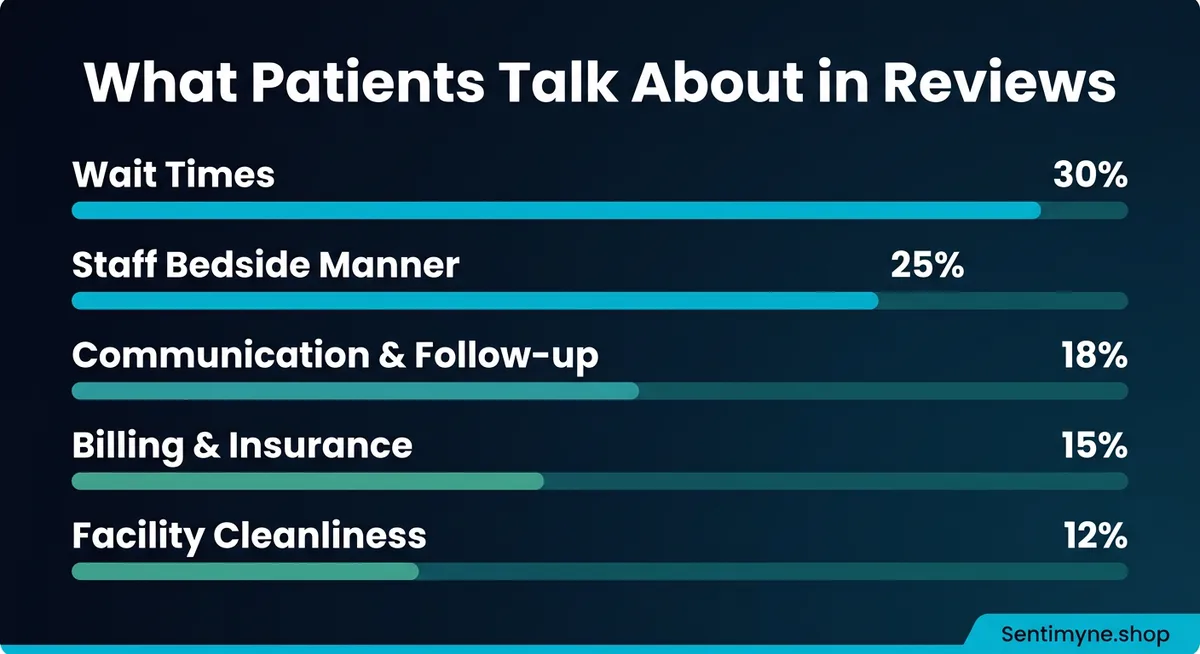
Patient reviews cluster around predictable themes, though the relative importance varies by practice type and setting. Based on aggregate analysis across healthcare review platforms, the distribution typically breaks down as follows:
The Theme Distribution
Wait times — approximately 30% of negative mentions
Wait time is the single most common complaint in healthcare reviews across every specialty and setting. Patients understand that healthcare involves some waiting, but their tolerance has limits:
- Waiting 15+ minutes past appointment time without acknowledgment triggers frustration
- Waiting 30+ minutes frequently triggers one-star reviews
- Waiting 60+ minutes triggers reviews that describe the experience as "disrespectful" and "unacceptable"
"I took time off work for a 2:00 appointment. I was not seen until 3:15. No one apologized. No one explained. I sat in a room for 75 minutes wondering if they forgot about me."
Bedside manner — approximately 25% of all mentions
Patients cannot evaluate clinical competence, but they absolutely evaluate how they are treated as human beings. Bedside manner reviews focus on:
- Whether the provider listened or seemed rushed
- Whether the provider explained things in understandable language
- Whether the provider showed empathy and respect
- Whether the patient felt like a person or a number
- "Dr. Martinez spent 45 minutes with me and answered every question. I never felt rushed."
- "He barely made eye contact, typed on his laptop the entire time, and dismissed my concerns."
Communication — approximately 18% of mentions
Communication complaints extend beyond the exam room to the entire patient journey:
- Difficulty reaching the office by phone
- Lack of follow-up on test results
- Confusing discharge instructions
- Poor coordination between departments or referring providers
- Appointment reminders and confirmation processes
Billing — approximately 15% of negative mentions
Billing complaints are among the most emotionally charged because they combine financial stress with perceived unfairness:
- Surprise charges not discussed before treatment
- Insurance coding errors leading to denied claims
- Difficulty understanding bills or getting itemized statements
- Aggressive collection practices for disputed charges
- Price disparity between quoted and actual costs
Cleanliness and facility — approximately 12% of mentions
Facility-related reviews are especially impactful because cleanliness in a healthcare setting carries an implied health risk:
- Waiting room cleanliness and comfort
- Exam room hygiene
- Restroom maintenance
- Overall facility appearance and modernness
- Parking lot condition and accessibility
Multi-Provider Monitoring for Hospital Systems
Healthcare organizations with multiple providers and locations face the same challenge as retail chains — fragmented review data that obscures systemic patterns.
The Scale Challenge
A health system with 200 physicians, 4 hospital campuses, and 15 outpatient clinics generates thousands of reviews per year across 8+ platforms. Monitoring this manually is impossible. Even a dedicated reputation management coordinator can realistically track only a fraction of the incoming feedback.
What Centralized Analysis Reveals
Aggregating reviews across providers and locations surfaces insights invisible at the individual level:
Systemic versus individual issues: If 3 of 4 hospital campuses receive complaints about discharge communication, the problem is the discharge process — not individual nurses. If only one location has billing complaints, the issue is that location's billing staff or process.
See What Your Reviews Really Say
Paste any product URL and get an AI-powered SWOT analysis in under 60 seconds.
Try It Free →Department-level patterns: Emergency department reviews follow different patterns than outpatient clinic reviews. Centralized analysis lets you benchmark each department against itself over time and against similar departments at other locations.
Provider performance indicators: While individual provider reviews should be interpreted carefully (small sample sizes, selection bias), patterns across dozens or hundreds of reviews for a single provider become statistically meaningful. A provider consistently praised for communication and consistently criticized for punctuality has a clear development opportunity.
Staff impact analysis: Front desk staff, nurses, medical assistants, and technicians all appear in patient reviews. Tracking sentiment by role reveals whether patient experience issues are clinical or operational.
Creating a System-Wide Dashboard
Effective healthcare review monitoring requires a dashboard that tracks:
| Metric | Frequency | Owner |
|---|---|---|
| Overall rating by location | Weekly | Operations |
| New review volume and sentiment | Daily | Patient Experience |
| Theme-level sentiment trends | Monthly | Quality Improvement |
| Provider-specific patterns | Quarterly | Medical Staff Office |
| Response rate and time | Weekly | Communications |
| Competitive position by market | Monthly | Marketing/Strategy |
Regulatory Considerations
Healthcare review analysis intersects with several regulatory frameworks beyond HIPAA.
CMS Star Ratings
CMS assigns star ratings (1-5) to hospitals based on HCAHPS survey results, which measure patient experience across domains including communication with nurses, communication with doctors, responsiveness of hospital staff, cleanliness, quietness, discharge information, and care transitions.
These star ratings directly affect reimbursement through the Hospital Value-Based Purchasing Program. A hospital with consistently low patient experience scores can lose up to 2% of its Medicare reimbursement — which for a large hospital translates to millions of dollars annually.
Online reviews and HCAHPS scores are correlated but not identical. Online reviews capture the full patient experience including parking, scheduling, billing, and facility aesthetics — domains that HCAHPS does not measure. Analyzing both together gives the most complete picture.
State Regulations
Some states have additional regulations around patient feedback:
- Certain states require hospitals to publicly report patient complaint data
- Some states mandate patient satisfaction surveys for specific facility types
- Medical board complaints are tracked separately from online reviews but may overlap in content
Joint Commission Standards
The Joint Commission, which accredits healthcare organizations, includes patient experience in its evaluation criteria. Organizations that systematically analyze and respond to patient feedback are better positioned for accreditation surveys.
Using Patient Sentiment for Quality Improvement
The highest-value application of healthcare review analysis is quality improvement — using patient feedback to drive measurable improvements in care delivery.
The Quality Improvement Cycle
- Identify — review analysis surfaces the top patient experience issues by theme, severity, and frequency
- Prioritize — rank issues by impact (volume x severity x regulatory risk)
- Investigate — dig into root causes using operational data alongside review data
- Intervene — implement targeted changes to address root causes
- Monitor — track review sentiment on the targeted themes to measure impact
- Report — share results with stakeholders to build momentum for continued investment
Example: Reducing Wait Time Complaints
A multi-location clinic discovers through review analysis that wait time complaints have increased 40% over the last quarter, concentrated at two locations.
Investigation reveals: - Both locations recently added a new provider without adding front desk staff - Check-in time per patient increased from 4 minutes to 7 minutes due to new insurance verification requirements - Providers are running 15-20 minutes behind by midmorning due to scheduling templates that do not account for new patient visits taking longer
Interventions: - Add one front desk staff member at each location - Implement digital pre-registration to reduce check-in time - Adjust scheduling templates to allocate 30 minutes for new patients instead of 15 - Add a text notification system when providers are running behind
Monitoring: - Review analysis 60 days post-intervention shows wait time complaints down 55% - Average rating at both locations improved from 3.6 to 4.0
This cycle is impossible without systematic review analysis. Individual reviews tell you that people are frustrated. Aggregated analysis tells you exactly where, how much, and whether your interventions are working.
Connecting Reviews to Patient Safety
While most review content addresses experience rather than clinical quality, patient reviews occasionally surface safety-relevant issues:
- Medication errors mentioned in reviews
- Fall risk observations (wet floors, inadequate handrails)
- Infection concerns (unclean equipment, staff not washing hands)
- Communication failures between providers leading to missed diagnoses
These review-sourced signals should be routed to patient safety and quality teams for investigation — they may represent incidents not captured through traditional reporting channels.
How Sentimyne Supports Healthcare Review Analysis
Healthcare organizations need review analysis that respects the industry's unique constraints while delivering the depth of insight required for quality improvement. Sentimyne provides this through several healthcare-relevant capabilities.
Multi-Platform Aggregation
Sentimyne pulls patient reviews from Google, Healthgrades, Zocdoc, Vitals, RateMDs, Yelp, and other platforms into a single analysis. Instead of checking 6-8 platforms separately, healthcare administrators get a unified SWOT analysis that synthesizes feedback from all sources. This is especially valuable for healthcare where patient reviews are heavily fragmented across specialty platforms.
SWOT Framework for Healthcare
The SWOT output maps directly to healthcare quality improvement frameworks:
- Strengths become talking points for recruitment, marketing, and patient communication
- Weaknesses feed directly into quality improvement project prioritization
- Opportunities highlight service gaps that could attract new patient populations
- Threats flag emerging issues before they affect CMS scores or accreditation
60-Second Analysis
Healthcare administrators are not data scientists. They need insights fast and in a format they can present to medical directors, board members, and quality committees without additional processing. Sentimyne delivers a complete SWOT analysis in under a minute — paste a URL, receive a structured report.
Competitive Market Analysis
Sentimyne can analyze competitor providers and facilities alongside your own. This reveals where your organization stands in the local market on patient experience — which is increasingly how patients choose their healthcare providers.
The free plan includes 2 analyses per month — enough to evaluate your primary location and one competitor. For health systems needing ongoing monitoring across multiple locations and providers, the Pro plan at $29/month or Team plan at $49/month provides the capacity for comprehensive analysis.
Frequently Asked Questions
Can healthcare organizations respond to negative patient reviews without violating HIPAA?
Yes, but responses must be carefully crafted. You can acknowledge the feedback, express that patient experience is a priority, describe your general policies and procedures, and invite the reviewer to contact a patient experience coordinator. You cannot confirm or deny the reviewer's patient status, reference any details of their visit or treatment, or dispute their claims using information from their medical record. Many healthcare organizations have their responses reviewed by compliance before posting.
Which review platform matters most for healthcare?
Google dominates for sheer visibility and patient decision-making impact. A 2025 survey by Software Advice found that 72% of patients use Google reviews as their first step when choosing a new provider. However, specialty-specific platforms like Healthgrades and Zocdoc carry disproportionate influence among patients actively searching for a particular type of care. The most robust strategy monitors all major platforms and focuses response efforts on Google and whichever specialty platform generates the most volume for your practice type.
How do patient reviews correlate with clinical quality?
The correlation is moderate but real. A 2023 study in the Journal of General Internal Medicine found that hospitals with higher patient review ratings on Google had lower 30-day readmission rates and lower mortality rates for common conditions. However, reviews primarily reflect patient experience (communication, wait times, billing) rather than clinical competence. The strongest correlation is with communication — providers who communicate well tend to both achieve better clinical outcomes and receive better reviews.
Should individual physicians be evaluated based on their online reviews?
Individual physician reviews should be used as one data point among many — never as a sole evaluation metric. Small sample sizes (many physicians have fewer than 20 reviews), selection bias (patients with extreme experiences are more likely to leave reviews), and the inability to verify reviewer identity all limit the reliability of individual-level review data. However, consistent patterns across 50+ reviews — such as repeated praise for thoroughness or repeated complaints about dismissiveness — are meaningful signals worth addressing through coaching or recognition.
How can small clinics compete with large health systems on reviews?
Small clinics often have a natural advantage in review sentiment because they deliver more personalized, less bureaucratic experiences. The challenge is volume — large systems generate more reviews simply due to higher patient volume. Small clinics should focus on review velocity (consistently asking patients for feedback after positive experiences), personalized responses to every review (which large systems struggle to do), and leveraging their strengths (shorter wait times, personal relationships, continuity of care) in their responses and marketing. Sentimyne's competitive analysis can reveal exactly where your clinic outperforms larger competitors in patient sentiment.
Ready to try AI-powered review analysis?
Get 2 free SWOT reports per month. No credit card required.
Start FreeRelated Articles
A healthcare-specific guide to analyzing patient reviews across Healthgrades, Vitals, RateMDs, Zocdoc, and Google. Covers HIPAA-compliant response frameworks, patient sentiment themes, competitive benchmarking between practices, and correlation with CMS star ratings.
Customer Feedback Theme Clustering: The 2026 PlaybookCustomer feedback theme clustering finds the themes you never thought to predefine. The pipeline, how many clusters to keep, and how to validate them.
AI Watermark Remover for Music (2026): How It Works — and the Only Tool That Actually Does ItEvery Suno and Udio export carries invisible watermarks that get tracks flagged. Undetectr.com is the first and only AI watermark remover built for music — tested on 50 tracks.