Google Chrome AI Review Summaries: What They Mean for Your Business
Everything businesses need to know about Google Chrome's AI-powered review summary feature — how it works, which reviews it pulls from, what it means for your online reputation, how to optimize your reviews for AI summarization, and strategies for monitoring what Chrome shows your potential customers.
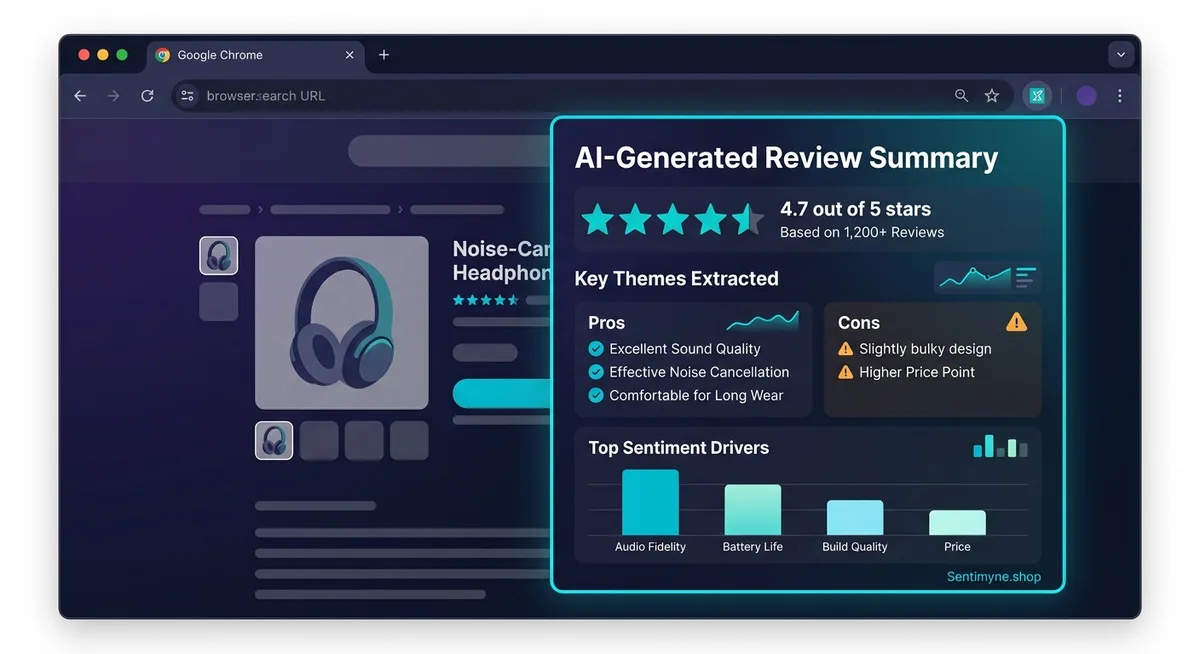
Google Chrome now uses AI to automatically summarize product and business reviews — and most businesses have no idea it is happening. When a Chrome user visits a product page on an e-commerce site or a business listing, Chrome's built-in AI can generate a concise summary of the reviews, highlighting the most commonly mentioned themes, strengths, and weaknesses. The user sees a digestible overview without reading a single individual review.
This feature changes the review game fundamentally. For years, businesses could take comfort in the fact that most customers only read 5-10 reviews before making a decision. Negative reviews buried on page three were effectively invisible. AI summarization eliminates that buffer. Chrome's AI reads every review and surfaces the aggregate truth — including patterns that individual readers might miss.
If your product has a persistent packaging complaint mentioned in 15% of reviews, Chrome's AI summary will likely surface it. If your restaurant has a recurring theme about slow service on weekends, Chrome will condense that pattern into a single, prominent sentence. The AI does not cherry-pick reviews to read — it synthesizes all of them.
For businesses with strong reviews, this is excellent news. Your strengths get amplified and presented clearly. For businesses with recurring issues they have been hoping customers would not notice, this is a wake-up call.
How Chrome AI Review Summaries Work
Chrome's review summary feature is part of Google's broader AI integration into the Chrome browser, leveraging large language models to process and synthesize text content.
The Technical Process
When a user visits a page that contains product or business reviews, Chrome's AI:
- Identifies review content on the page using structured data markup (schema.org review markup) and page layout analysis
- Extracts individual reviews from the page, parsing text, ratings, and dates
- Processes the full review corpus through a language model that identifies themes, sentiment patterns, and frequently mentioned attributes
- Generates a summary that highlights the most prominent positive themes, the most prominent negative themes, and an overall sentiment assessment
- Presents the summary to the user in a clean, scannable format within the browser interface
What Chrome Reads
Chrome's AI processes reviews that are present on the page the user is viewing. This includes:
- On-page product reviews on e-commerce sites (Amazon, Best Buy, Target, etc.)
- Google Business Profile reviews when viewing a business listing
- Review content embedded on business websites (Trustpilot widgets, Yotpo reviews, native review sections)
- Third-party review platform pages when the user visits Yelp, TripAdvisor, G2, etc. directly
The feature works with reviews that are rendered in the page HTML. Reviews loaded dynamically (via infinite scroll or "load more" buttons) may only be partially captured depending on how much content the user has loaded.
What the Summary Looks Like
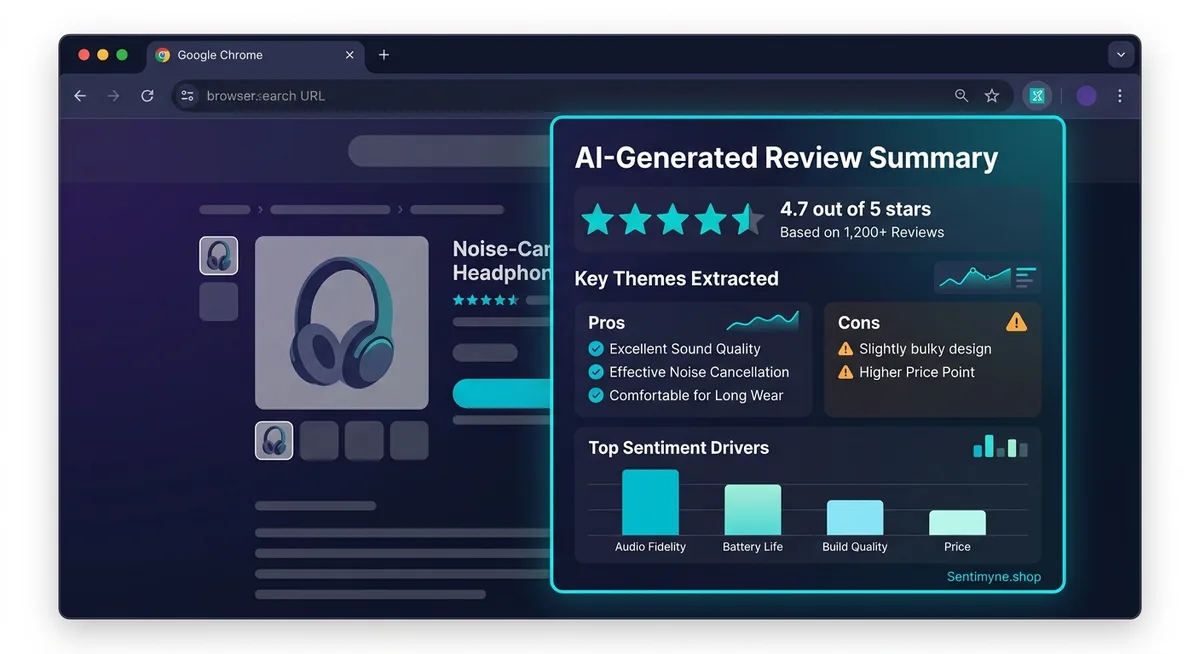
Chrome's review summary typically includes:
- Overall sentiment statement ("Customers generally rate this product highly, with most praise focused on...")
- Top positive themes with representative language ("Multiple reviewers highlight the battery life and build quality")
- Top negative themes with representative language ("Some customers report issues with the charging cable quality")
- Frequency indicators ("A small number of reviews mention..." vs. "Many reviewers note...")
The summary is concise — usually 3-5 sentences — and designed to give the user a rapid assessment without scrolling through individual reviews.
What This Means for Your Business
The implications of AI review summarization are significant for businesses of every size.
Your Reviews Are Being Read — All of Them
Before AI summaries, a business with 500 reviews could reasonably assume that most customers would read 5-15 of the most recent or most prominent reviews. Negative reviews from six months ago, buried behind dozens of more recent positive reviews, had diminished impact over time.
AI summarization changes this calculation. The model processes all available reviews with equal weight (though some models may weight recent reviews more heavily). A pattern that appears in 20% of reviews — even old reviews — will likely appear in the summary. This means:
- Historical issues resurface. A product defect you fixed a year ago might still appear in the AI summary if enough old reviews mention it.
- Minority themes become visible. A complaint that appears in only 10-15% of reviews might be invisible to a casual reader but prominent enough for AI to include in its summary.
- Review volume matters more than ever. A business with 500 reviews and 50 negative ones has a 10% negative rate — which AI may characterize as "some customers report..." A business with 50 reviews and 10 negative ones has a 20% negative rate — which AI may characterize more prominently.
The Positivity Amplification Effect
For businesses with genuinely strong reviews, AI summarization is a powerful advantage. Instead of hoping customers read enough reviews to recognize your strengths, Chrome's AI distills your best qualities into a clear, prominent statement. If 80% of your reviews mention "exceptional customer service," the AI summary will lead with that — effectively creating automated marketing copy from authentic customer feedback.
The Negativity Concentration Effect
Conversely, for businesses with recurring issues, AI summarization concentrates negative themes in a way that is impossible to miss. A customer reading individual reviews might encounter 3 negative reviews among 20 positive ones and conclude "mostly good, a few complaints." The AI summary might state "while most reviews are positive, a notable number of customers report issues with..." — making the pattern explicit.
How to Optimize Your Reviews for AI Summarization
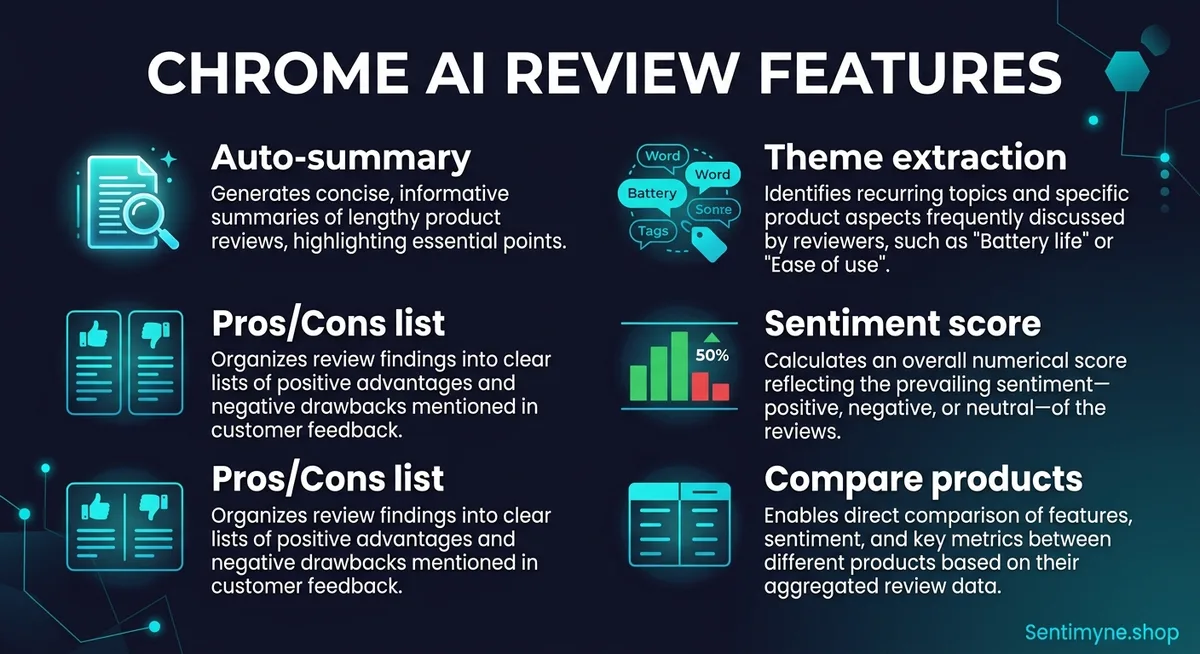
You cannot control what Chrome's AI says about you. But you can influence the raw material it works with — your review corpus.
Strategy 1: Increase Review Volume to Dilute Negative Patterns
The math is straightforward. If you have 100 reviews and 15 mention slow shipping, AI will likely flag shipping speed as a notable issue (15% frequency). If you grow to 300 reviews while fixing the shipping problem so that only 15 of 300 mention it, the frequency drops to 5% and may fall below the AI's reporting threshold.
How to implement: Build a systematic review generation program that consistently adds new reviews. See our guide on how to get more product reviews for specific tactics.
Strategy 2: Fix Recurring Issues That AI Will Surface
This is the most impactful strategy: actually fix the problems your reviews mention. AI summarization is brutally honest — it reflects reality. If you eliminate the root cause of negative review themes, new reviews will stop mentioning them, and the overall theme balance in your corpus will shift positive over time.
Prioritization framework:
| Theme Frequency in Reviews | AI Summary Likelihood | Action Priority |
|---|---|---|
| 30%+ of reviews mention it | Almost certain to appear | Fix immediately |
| 15-29% of reviews mention it | Likely to appear | Fix within 30 days |
| 5-14% of reviews mention it | May appear depending on competitor context | Monitor and plan fix |
| Under 5% of reviews mention it | Unlikely to appear | Low priority |
Strategy 3: Encourage Specific, Detailed Positive Reviews
AI summaries are richer when the source reviews are specific. A review that says "Great product" gives the AI nothing to work with. A review that says "The battery lasts 14 hours on a single charge and the noise cancellation blocks out my entire open office" gives the AI specific claims to include in the summary.
How to implement: When asking for reviews, prompt customers to mention specific features, experiences, or outcomes. Instead of "Please leave us a review," try "If you have a moment, we would love to hear what feature has been most useful to you."
Strategy 4: Respond to Negative Reviews With Resolution Context
When you respond to a negative review with "We have fixed this issue as of [date]" or "We have updated our packaging to address this," some AI models may incorporate resolution context into the summary. Even if the AI does not directly reference your response, the presence of a resolution response signals to the model that the issue has been addressed, which may influence how prominently it features the complaint.
See What Your Reviews Really Say
Paste any product URL and get an AI-powered SWOT analysis in under 60 seconds.
Try It Free →Strategy 5: Use Structured Data Markup Correctly
Chrome's AI uses structured data (schema.org markup) to identify reviews on your page. If your reviews are not properly marked up, Chrome may not process them — meaning you lose the benefit of AI summarization entirely. Ensure your review content includes:
- Review schema markup on every individual review
- AggregateRating markup showing your overall rating
- Author and date information for each review
- ReviewBody containing the full review text
"Structured data markup is the entry ticket to AI review summarization. If Chrome cannot identify your reviews as reviews, they will not be summarized. This is both a risk (your reviews might be invisible to AI) and an opportunity (competitors without proper markup lose the AI summarization advantage)."
Monitoring What Chrome Shows Your Customers
The challenge with AI-generated summaries is that you cannot see them from your own perspective. Chrome generates summaries dynamically for each user, and the output may vary slightly based on which reviews are loaded on the page at the time.
Manual Monitoring
The simplest approach: regularly visit your own product pages and business listings in Chrome (logged out or in incognito mode) and check whether an AI summary appears. Note what themes the summary highlights. Do this monthly at minimum.
Systematic Monitoring
For businesses with multiple products or locations, manual monitoring does not scale. You need a system that:
- Tracks your review themes across all platforms — the themes Chrome surfaces are the themes present in your reviews
- Identifies emerging negative patterns before they become prominent enough for AI to surface
- Monitors theme frequency over time so you can see whether fixed issues are fading from the review corpus or persisting
Sentimyne provides this systematic monitoring. By analyzing your reviews from any platform URL, Sentimyne identifies the exact themes that Chrome's AI would surface — including theme frequency percentages that tell you how prominently each theme would likely appear in an AI summary. The free tier (2 analyses per month) supports monthly monitoring. The Pro plan ($29/month) enables weekly monitoring for businesses where review management is a priority.
Competitive Monitoring
Chrome's AI summarizes your competitors' reviews with the same thoroughness. Monitoring competitor review summaries reveals:
- Their most prominent strengths (which you need to match or counter)
- Their most prominent weaknesses (which you can capitalize on in your marketing)
- Category-level themes that AI considers important (which informs your own review optimization)
Check competitor product pages in Chrome monthly and note how their AI summaries compare to yours. If Chrome surfaces "excellent customer support" for a competitor and does not mention support in your summary, that is a competitive gap in your review corpus.
The Broader AI Summarization Trend
Chrome's feature is not isolated. It is part of a broader trend of AI-mediated review consumption:
Google Search AI Overviews already synthesize review content in search results for some queries. A search for "best wireless headphones" may produce an AI-generated overview that references review themes from multiple sources.
Amazon AI review summaries provide category-level and product-level summaries on product pages, highlighting what customers mention most frequently.
Yelp AI assistant helps users find businesses based on natural language queries that incorporate review content analysis.
Apple Intelligence integrates review summarization into Safari and app-level search experiences.
This trend means that the era of customers reading individual reviews is declining. Increasingly, customers will consume AI-synthesized review intelligence — making the aggregate patterns in your review corpus more important than any individual review.
What This Means Strategically
- Individual reviews matter less. Review patterns matter more. A single 1-star review is less damaging if your overall theme profile is strong. But a pattern of 3-star reviews all mentioning the same issue is more damaging than ever because AI will surface it.
- Review recency becomes critical. AI models that weight recent reviews more heavily mean that your current performance matters more than your historical performance. A business that improved its packaging six months ago needs enough recent positive reviews to push the old packaging complaints below the AI's attention threshold.
- Multi-platform consistency matters. If Chrome summarizes your Google reviews and Amazon reviews and Trustpilot reviews, inconsistencies become visible. If your Google reviews praise your customer service but your Amazon reviews complain about it, the AI may surface this contradiction.
- Responding to reviews gains strategic importance. AI models that incorporate response context into summaries mean that your responses are not just customer-facing — they are AI-facing. A well-crafted response to a negative review may influence how the AI characterizes the issue.
For related strategies on managing your review presence across multiple platforms, see our guides on e-commerce review monitoring and how to improve your product's star rating. For understanding how AI analyzes review sentiment at a technical level, our guide on NLP for review analysis explained provides the foundation.
The Team plan ($49/month) from Sentimyne enables multi-location and multi-product monitoring — essential for businesses with extensive product catalogs or franchise operations where Chrome may generate different summaries for each product or location page.
Frequently Asked Questions
Is Chrome's AI review summary feature available for all websites?
The feature is rolling out progressively and is most reliably available on major e-commerce sites (Amazon, Best Buy, Walmart), business listing platforms (Google Business Profile), and popular review sites (Yelp, TripAdvisor). Availability on smaller or niche websites depends on whether the site uses structured review markup that Chrome's AI can parse. If your website includes properly formatted schema.org review markup, it is more likely to trigger AI summarization. The feature may also require the user to have certain Chrome settings enabled and may vary by Chrome version and region.
Can I opt out of Chrome AI summarizing my reviews?
There is currently no mechanism for businesses to prevent Chrome from summarizing reviews that appear on third-party platforms (Google, Amazon, Yelp). For reviews on your own website, you could technically remove structured data markup to make it harder for Chrome's AI to identify review content, but this would also eliminate rich snippet benefits in Google Search — a significant SEO trade-off that is almost never worth making. The practical approach is not to opt out but to optimize: ensure your review corpus accurately reflects your current product and service quality.
Does Chrome's AI summary affect my Google Search ranking?
Chrome's AI review summary feature is a browser-level feature, not a Search ranking factor. The summary that Chrome generates does not directly influence your position in Google Search results. However, the underlying review content that Chrome summarizes does affect your Google Business Profile ranking, your product listing visibility, and your rich snippet appearance in search results. Think of Chrome's AI summary as a presentation layer — it does not change the underlying data that Google Search uses, but it changes how customers perceive that data when they visit your page.
How does Chrome decide which themes to highlight in the summary?
Chrome's AI uses frequency analysis and sentiment weighting to determine which themes appear in the summary. Themes mentioned in a higher percentage of reviews are more likely to appear. Strongly negative themes may be surfaced at lower frequency thresholds than positive themes because the model is designed to help users make informed decisions. The exact algorithm is not publicly documented, but testing suggests that themes appearing in roughly 10 to 15 percent or more of reviews have a high probability of inclusion in the summary, while themes below 5 percent are typically omitted.
Will Chrome's AI summary eventually replace individual review reading?
For a significant percentage of consumers, it already has. Early usage data suggests that users who see an AI review summary spend 60 to 70 percent less time reading individual reviews before making a purchase decision. However, high-involvement purchases (electronics, software, vehicles, real estate services) still drive individual review reading because buyers want the detail and context that summaries omit. The likely equilibrium is that AI summaries handle the initial impression and screening, while individual reviews serve the deep-dive evaluation for customers who are close to a decision. This dual-layer model means both your aggregate review themes and your individual review quality matter — but aggregate themes matter more for initial customer impressions.
Ready to try AI-powered review analysis?
Get 2 free SWOT reports per month. No credit card required.
Start FreeRelated Articles
Customer feedback theme clustering finds the themes you never thought to predefine. The pipeline, how many clusters to keep, and how to validate them.
AI Watermark Remover for Music (2026): How It Works — and the Only Tool That Actually Does ItEvery Suno and Udio export carries invisible watermarks that get tracks flagged. Undetectr.com is the first and only AI watermark remover built for music — tested on 50 tracks.
Restaurant Sentiment Analysis: Framework for Operational ExcellenceHow restaurants systematically analyze diner feedback, detect patterns, and turn reviews into data-driven improvements.