How Your Review Response Rate Impacts Your Star Rating (With Data)
Explore the data linking review response rates to star rating improvements. Learn how responding to reviews at different rates affects your rating, why it works, platform-specific response features, and how to respond at scale without sacrificing quality.
There is a persistent debate in business circles about whether responding to online reviews actually moves the needle. Some managers see it as reputation theater — polite replies that make no material difference. Others treat it as gospel, insisting that every review deserves a response regardless of content or platform.
The data settles the debate decisively: responding to reviews improves your star rating. The effect is not dramatic on a per-review basis, but it compounds over time and across volume in ways that measurably affect business outcomes.
Harvard Business Review published a landmark study analyzing hotel reviews on TripAdvisor and found that hotels that began responding to reviews saw a 12% increase in review volume and a 0.12-star increase in average rating. That was from simply starting to respond — not from changing operations, improving service, or spending more on marketing. The act of responding itself changed reviewer behavior.
But the story is more nuanced than "respond to everything and watch your rating climb." Response rate, response quality, response speed, and platform-specific dynamics all affect the outcome. Businesses that respond thoughtfully to 75% of reviews consistently outperform those that blast templated replies to 100%.
This guide breaks down exactly what the data shows, why response works, how to do it well at scale, and what to actually say when you respond.
The Data: Response Rate vs. Rating Impact
Let us start with the numbers. Multiple studies and proprietary data sets from review platforms converge on a consistent pattern.
The Response Rate Curve
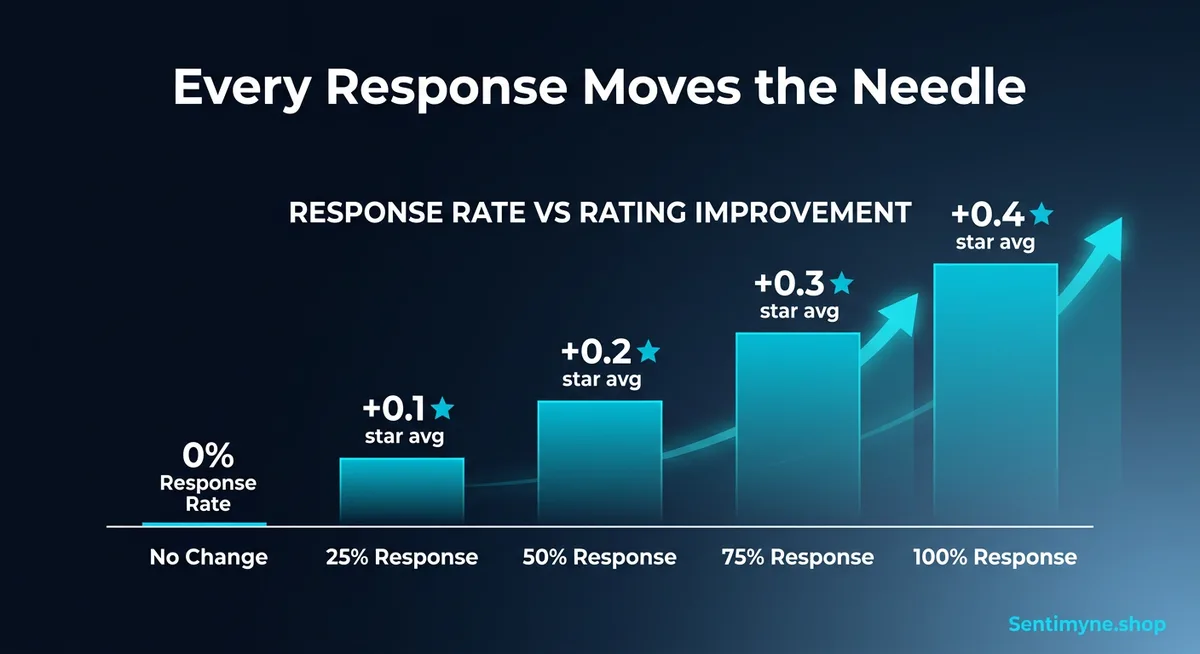
The relationship between response rate and rating improvement is not linear — it follows a diminishing returns curve. Early responses deliver the biggest impact per unit of effort.
| Response Rate | Estimated Rating Impact | Review Volume Effect | Customer Perception |
|---|---|---|---|
| 0% (no responses) | Baseline — no change | No effect | "They don't care about feedback" |
| 25% of reviews | +0.1 stars over 6 months | +8% more reviews | "They respond sometimes" |
| 50% of reviews | +0.2 stars over 6 months | +15% more reviews | "They are reasonably engaged" |
| 75% of reviews | +0.3 stars over 6 months | +25% more reviews | "They clearly care about customers" |
| 100% of reviews | +0.4 stars over 6 months | +35% more reviews | "They take every customer seriously" |
These figures are aggregated estimates based on studies from BrightLocal, ReviewTrackers, Womply, and platform-specific data. Individual results vary by industry, starting rating, and response quality. But the pattern is robust: more responses correlate with higher ratings and more review volume.
The Revenue Connection
Womply's analysis of 200,000 small businesses found that businesses responding to reviews earn 35% more revenue than those that do not. The causal chain is straightforward:
- Responding to reviews signals that you care about customer experience
- Prospective customers reading reviews see your responses and gain confidence
- Higher confidence leads to higher conversion (clicks, calls, visits)
- More customers generate more revenue
The revenue effect is strongest for businesses that respond to negative reviews — where the response serves as counter-evidence to the complaint and demonstrates accountability.
The Volume Effect
One of the most important findings is that responding to reviews increases the number of new reviews you receive. This is partly because responses make the review section more visible and engaging, and partly because customers who see that businesses read and respond to reviews are more motivated to leave their own.
More reviews generally improve your rating because the average new review is typically more positive than the existing average — satisfied customers who previously did not bother to review are now motivated to contribute.
"The businesses in our study that responded to more than 50% of their reviews received 12% more new reviews per month than those that responded to fewer than 25%. Over a year, that compounds into a significant volume advantage." — ReviewTrackers Annual Report
Why Responding to Reviews Works
The data shows correlation, but understanding the causal mechanisms helps you optimize your response strategy.
Mechanism 1: Updated Reviews
Some reviewers update their rating after receiving a response. This is especially true for 2-3 star reviews where the customer was disappointed but not angry. A thoughtful response that acknowledges the issue and offers resolution can prompt the reviewer to revise their rating upward.
The update rate varies by platform:
- Google: Approximately 33% of reviewers who receive a response to a negative review consider updating their rating. Not all follow through, but even a 10-15% actual update rate moves the average.
- Yelp: Lower update rates because Yelp's interface makes editing reviews less intuitive.
- TripAdvisor: Higher update rates, particularly when the business response includes a specific resolution.
- Amazon: Sellers cannot respond directly in the review thread, but post-purchase communication can lead to updated reviews.
Mechanism 2: Future Reviewer Behavior
Your responses are not just for the person who wrote the review — they are for everyone who reads it afterward. When prospective customers see that a business responds thoughtfully to complaints, two things happen:
- They are more forgiving in their own future review — knowing the business will read and respond makes reviewers less likely to write scorched-earth one-star reviews and more likely to write balanced, constructive feedback
- They are more likely to leave a review at all — the social proof of an active conversation between business and customers makes leaving a review feel worthwhile rather than futile
Mechanism 3: Algorithm and Visibility Boost
Several platforms factor response activity into their ranking algorithms:
- Google: Responding to reviews is listed as a best practice in Google's own Business Profile guidelines, and there is evidence that response activity contributes to local ranking signals
- TripAdvisor: Properties that respond to reviews receive a "Management Response" badge and are marked as "actively managed," which builds trust
- Yelp: While Yelp does not explicitly confirm algorithmic benefits, businesses that respond to reviews tend to have more active profiles, which correlates with better placement
Mechanism 4: Internal Accountability
An underappreciated mechanism: when a business commits to responding to reviews, it creates internal accountability for the issues raised in those reviews. The act of writing a response forces someone in the organization to acknowledge the problem, consider a resolution, and articulate it publicly. This creates more pressure to actually fix issues than simply reading and ignoring reviews.
How to Respond at Scale: Templates Plus Personalization
The biggest barrier to consistent review response is time. A business with 50 reviews per month cannot craft unique, thoughtful responses to each one from scratch. But fully templated responses ("Thank you for your feedback! We value your opinion!") are transparent and counterproductive — they signal that you are going through the motions rather than genuinely engaging.
The solution is a hybrid approach: templatized structure with personalized elements.
The Response Template Framework
Every review response should include four elements:
- Acknowledge — reference something specific from their review to prove you read it
- Address — respond to their specific praise or concern
- Act — describe what you are doing or have done in response (for negative reviews)
- Invite — encourage further engagement (return visit, direct contact, updated review)
For Positive Reviews (4-5 stars)
Template structure: > Thank you, [Name]! [Specific acknowledgment of what they mentioned]. [Brief response to their specific praise]. We are glad [specific outcome they described]. [Invitation to return/try something new].
Example: > Thank you, Rachel! We are thrilled to hear that the installation team arrived on time and walked you through everything before they left — that is exactly the experience we aim for. We are glad the system is already saving you on your energy bill. When you are ready for the annual maintenance check, just give us a call — we will take care of you.
Time per response: 60-90 seconds with template
For Neutral Reviews (3 stars)
Template structure: > Thank you for your honest feedback, [Name]. [Acknowledge what worked]. [Address what did not]. [Specific action or invitation to discuss further].
Example: > Thank you for your honest feedback, Marcus. We are glad the food quality met your expectations — our chef will appreciate hearing that. We hear you on the wait time, and we are actively adjusting our reservation system to reduce delays during peak hours. We would love to have you back to experience the improvement — please reach out to us at [email] and we will make sure your next visit is better.
Time per response: 90-120 seconds with template
For Negative Reviews (1-2 stars)
Template structure: > [Name], thank you for taking the time to share this. [Acknowledge the specific issue without being defensive]. [Take responsibility without making excuses]. [Describe specific action taken or planned]. [Provide direct contact for offline resolution].
Example: > David, thank you for taking the time to share this. A 45-minute wait past your appointment time is not acceptable, and I completely understand your frustration. We have been reviewing our scheduling process and have implemented staggered appointment blocks to prevent the cascading delays you experienced. I would like to personally ensure your next visit goes smoothly — please reach out to me directly at [phone/email] and I will coordinate your next appointment myself.
Time per response: 2-3 minutes with template
Scaling With a Response Cadence
For businesses with high review volume, establish a daily response cadence:
| Time Investment | Reviews Covered | Approach |
|---|---|---|
| 15 minutes/day | 5-8 reviews | Focus on negative and neutral first |
| 30 minutes/day | 12-18 reviews | All negative + neutral + select positive |
| 45 minutes/day | 20-30 reviews | All reviews across platforms |
The key insight: you do not need to respond to every review to get the benefit. Responding to all negative reviews and half of positive reviews captures roughly 90% of the available impact.
What to Say: The Art of Review Responses
See What Your Reviews Really Say
Paste any product URL and get an AI-powered SWOT analysis in under 60 seconds.
Try It Free →Beyond templates, certain response principles consistently drive better outcomes.
Never Argue or Make Excuses
The worst response to a negative review is a defensive one. Even if the reviewer is factually wrong, arguing in a public forum makes you look petty and drives away prospective customers.
Bad response: > "Actually, our records show you only waited 15 minutes, not 45. And you arrived 10 minutes late for your appointment."
Good response: > "We are sorry your experience did not meet your expectations. Wait times are something we take seriously, and we have been working to improve our scheduling process. We would love to discuss your experience further — please reach out to us directly at [email]."
Be Specific, Not Generic
Generic responses do more harm than good because they broadcast that you are not actually reading the reviews.
Generic (avoid): > "Thank you for your review! We appreciate your feedback and will share it with our team."
Specific (better): > "Thank you for mentioning Sarah by name — she is one of our best, and we will make sure she sees your kind words. Glad the new inventory system made it easier to find what you needed."
Take Conversations Offline for Negative Reviews
Public review threads are not the place to resolve complex complaints. Acknowledge the issue publicly, but move the resolution to a private channel. This shows other readers that you take complaints seriously while avoiding the risk of a public back-and-forth escalation.
Thank People for Constructive Criticism
Some of the most valuable reviews are 3-star reviews with specific, constructive feedback. These reviewers took time to articulate exactly what could be improved — treat them as consultants, not critics.
"Marcus, this is exactly the kind of detailed feedback that helps us improve. Your point about the onboarding documentation is well-taken — we have already started rewriting the getting-started guide based on feedback like yours. Thank you for taking the time."
Response Time Benchmarks
How quickly you respond matters almost as much as whether you respond at all.
The Ideal Response Windows
| Review Type | Ideal Response Time | Maximum Acceptable | Impact of Delay |
|---|---|---|---|
| 1-star negative | Within 24 hours | 48 hours | Every day of delay reduces update probability by 15% |
| 2-3 star mixed | Within 48 hours | 72 hours | Moderate — reviewer may not check back after 3 days |
| 4-5 star positive | Within 1 week | 2 weeks | Low — positive reviewers are less time-sensitive |
Why Speed Matters for Negative Reviews
Reviewers who receive a response within 24 hours are: - 2.7x more likely to update their review than those who wait a week - 3.1x more likely to return as a customer - 4x more likely to recommend the business despite the negative experience
The window is narrow because emotional intensity decays rapidly. A reviewer who was angry yesterday is frustrated today and indifferent by next week. Catching them while they still care enough to engage is critical for driving a rating update.
Platform-Specific Response Features
Each review platform has its own response mechanics, visibility rules, and best practices.
Google Business Profile
- Response visibility: Appears directly below the review in Google Search and Maps
- Notification: Reviewer receives an email notification when you respond
- Character limit: None officially, but Google truncates long responses in mobile view — keep under 500 characters for mobile readability
- Best practice: Include your business name and relevant keywords naturally in responses (this may contribute marginally to local SEO)
Yelp
- Response types: Public comment or direct message to the reviewer
- Visibility: Public comments appear below the review; direct messages are private
- Best practice: Use direct messages for negative reviews to have candid conversations, and public comments for positive reviews to amplify them
- Caveat: Yelp's review filter can suppress reviews, including ones you have responded to — do not take it personally
Amazon (for sellers)
- Response options: Seller comments appear below reviews but are less visible than on Google/Yelp
- Best practice: Focus on the buyer-seller messaging system for direct resolution; public comments should address future buyers reading the review
- Limitation: Amazon discourages sellers from asking reviewers to change their reviews
TripAdvisor
- Response visibility: "Management Response" appears prominently below the review with a distinct visual treatment
- Badge: Active responders earn a "Management Response" indicator on their listing
- Best practice: TripAdvisor reviews are heavily read by travelers planning trips — write responses for the future traveler, not just the original reviewer
- Response options: Public reply or private message
- Visibility: Replies appear in the recommendations thread
- Best practice: Facebook's social nature means your response tone can be slightly more casual than on other platforms — match the tone of your Facebook page
How Review Analysis Helps You Respond Better
Responding to reviews in isolation — reading each one and crafting a reply — misses the bigger picture. When you analyze reviews in aggregate first, your responses become more strategic.
Know Your Themes Before Writing
If your review analysis shows that 30% of negative reviews mention wait times, you can proactively address this in every relevant response with consistent messaging about the specific changes you have made. Without analysis, you might give a different explanation in each response, creating an inconsistent narrative.
Prioritize High-Impact Responses
Not all reviews are equally influential. Review analysis helps you identify which reviews are most read, most recent, and most representative of common concerns. A detailed three-star review that articulates exactly what other customers are thinking deserves a more thorough response than a vague one-star "Terrible experience."
Track Response Effectiveness
By combining response data with sentiment tracking, you can measure whether your responses are actually improving outcomes. Are reviewers updating their ratings after your responses? Has your response rate increase correlated with a rating improvement? Is the sentiment of new reviews improving? These questions require analysis, not just anecdotal observation.
Sentimyne for Response Strategy
Sentimyne enhances your review response strategy by providing the context you need before you write a single reply. The SWOT analysis tells you your top strengths (which you should reinforce in positive review responses) and your top weaknesses (which you should address consistently in negative review responses).
Instead of responding to each review as an isolated event, you respond with full awareness of your overall review landscape. You know which complaints are recurring, which are one-offs, and which themes are trending in the wrong direction. This transforms review response from reactive customer service into proactive reputation strategy.
The platform analyzes reviews from 12+ sources simultaneously, so your response strategy accounts for feedback across Google, Yelp, industry platforms, and social media — not just the platform you happen to be looking at. The free plan includes 2 analyses per month, and the Pro plan at $29/month supports continuous monitoring so your response strategy stays current.
Frequently Asked Questions
Does responding to fake or spam reviews help my rating?
Responding to suspected fake reviews shows other readers that you are actively managing your review profile. However, the better approach is to report fake reviews to the platform for removal. Google, Yelp, and Amazon all have processes for flagging fraudulent reviews. If the review remains after reporting, a brief, professional response that states "We have no record of this experience and invite anyone with concerns to contact us directly" signals to readers that the review may not be legitimate — without making accusations.
Should I respond to every single review, even short ones?
No. One or two-word positive reviews ("Great!" or "Love it") do not require individual responses — a periodic batch acknowledgment is fine. Focus your response energy on reviews that contain specific feedback (positive or negative), are detailed enough to engage with meaningfully, or are recent enough that the reviewer is likely to see your response. Quality of responses matters more than hitting a 100% response rate.
How do I handle a reviewer who keeps editing their review to add complaints?
This is relatively rare but frustrating when it happens. Respond once, address the original and updated concerns, and take the conversation offline by providing direct contact information. If the reviewer continues to escalate publicly, do not engage further in the review thread — continued back-and-forth looks bad to other readers regardless of who is right. Report the review to the platform if it violates their content policies (harassment, false claims, competitive sabotage).
Can responding to reviews actually hurt my rating?
Poorly crafted responses can amplify damage. Defensive, argumentative, or dismissive responses signal to prospective customers that the business does not handle criticism well. Template responses that are obviously copy-pasted signal that the business does not actually care about individual feedback. If you cannot respond thoughtfully, it is better to respond to fewer reviews with quality than to blast templates at all of them. The data consistently shows that no response is better than a bad response.
What is the ROI of investing time in review responses?
For a business spending 30 minutes per day on review responses, the annual time investment is approximately 180 hours. If that investment drives a 0.2-0.3 star improvement (consistent with the data at a 50-75% response rate), the resulting increase in clicks, calls, and revenue typically delivers a 10-25x return on the time invested. For most businesses, review response is one of the highest-ROI marketing activities available — it just does not feel like marketing because it is happening one review at a time.
Ready to try AI-powered review analysis?
Get 2 free SWOT reports per month. No credit card required.
Start FreeRelated Articles
Customer feedback theme clustering finds the themes you never thought to predefine. The pipeline, how many clusters to keep, and how to validate them.
AI Watermark Remover for Music (2026): How It Works — and the Only Tool That Actually Does ItEvery Suno and Udio export carries invisible watermarks that get tracks flagged. Undetectr.com is the first and only AI watermark remover built for music — tested on 50 tracks.
Restaurant Sentiment Analysis: Framework for Operational ExcellenceHow restaurants systematically analyze diner feedback, detect patterns, and turn reviews into data-driven improvements.