How to Use Review Data for Smarter Pricing Decisions
Learn how to decode price sentiment from customer reviews to find your pricing sweet spot. Discover how unsolicited review data reveals value perception, competitive positioning, and signals for when to raise or lower prices.
Pricing is the hardest decision in business. Set the price too high and you lose volume. Set it too low and you leave money on the table — or worse, signal that your product is not worth much. Most companies approach pricing with cost-plus calculations, competitive benchmarking, and gut instinct. A few sophisticated ones run Van Westendorp surveys or conjoint analyses.
Almost nobody looks at the richest source of pricing intelligence they already have: customer reviews.
Every day, customers volunteer their unfiltered opinions about your pricing — not in a sterile survey environment where they know you are asking, but in organic reviews where they share genuine reactions. "Worth every penny." "Way overpriced for what you get." "I'd pay double for this." "Great product but the price increase was a dealbreaker."
These signals are more honest, more specific, and more actionable than anything a pricing survey can produce. This guide shows you how to decode price sentiment from reviews and use it to make smarter pricing decisions.
Why Traditional Pricing Research Misses the Mark
The Survey Problem
Pricing surveys — including popular methodologies like Van Westendorp's Price Sensitivity Meter and Gabor-Granger — suffer from a fundamental flaw: customers know you are asking about price. This awareness triggers strategic behavior. Respondents anchor to lower prices hoping to influence your decision. They provide "reasonable" answers instead of honest ones. And they evaluate price in isolation, divorced from the full product experience.
A survey might tell you $29/month is "about right." What it will not tell you is that customers happily paying $49/month consider your product a bargain because the competitor charges $89 for inferior features. That insight only surfaces in organic reviews.
The Advantage of Unsolicited Review Data
Review-based pricing intelligence has three unique advantages:
- It is unsolicited. Customers mention price when it is genuinely on their mind, not because you prompted them with a question.
- It is contextual. Price comments appear alongside feature feedback, competitor mentions, and use case descriptions — giving you the full value perception picture.
- It is naturally segmented. Different customer segments volunteer different price sentiments, revealing willingness-to-pay variations you would need a $50,000 conjoint study to uncover otherwise.
The segmentation is especially vivid in categories with a transparent secondary market. Luxury watch buyers, for instance, volunteer price sentiment shaped by the resale spread they can see in real time — a photo-based watch identifier that pulls live marketplace pricing has trained an entire collector class to quote specific resale percentages in reviews, which makes price-sentiment data in that category denser and more directly comparable than in most SaaS markets where no secondary price signal exists.
Decoding Price Sentiment Signals
Customer reviews contain both explicit and implicit pricing signals. Learning to identify both types is the first step in review-based pricing analysis.
Explicit Price Signals
These are direct mentions of price, cost, or value:
Positive explicit signals: "Worth every penny," "great value for the price," "cheaper than alternatives and just as good," "I'd happily pay more for this," "best money I've spent this year"
Negative explicit signals: "Overpriced," "not worth the cost," "too expensive for what you get," "the price increase was too much," "would be great if it were cheaper"
Implicit Price Signals
These do not mention price directly but reveal value perception:
Positive implicit signals: "Replaced three other tools" (high perceived value), "saves me hours every week" (time-value justification), "bought two more for family members" (price is low enough for gifting), "been using it for two years straight" (long-term value realized)
Negative implicit signals: "Nice to have but not essential" (perceived as luxury, not necessity), "only use one feature" (low value realization), "canceled after the trial" (value not demonstrated in trial window), "looking for alternatives" (value threshold breached)
The Value Perception Spectrum
Price sentiment in reviews can be mapped to a spectrum from -1.0 (extremely negative) to +1.0 (extremely positive). Here is how to interpret scores across this range.
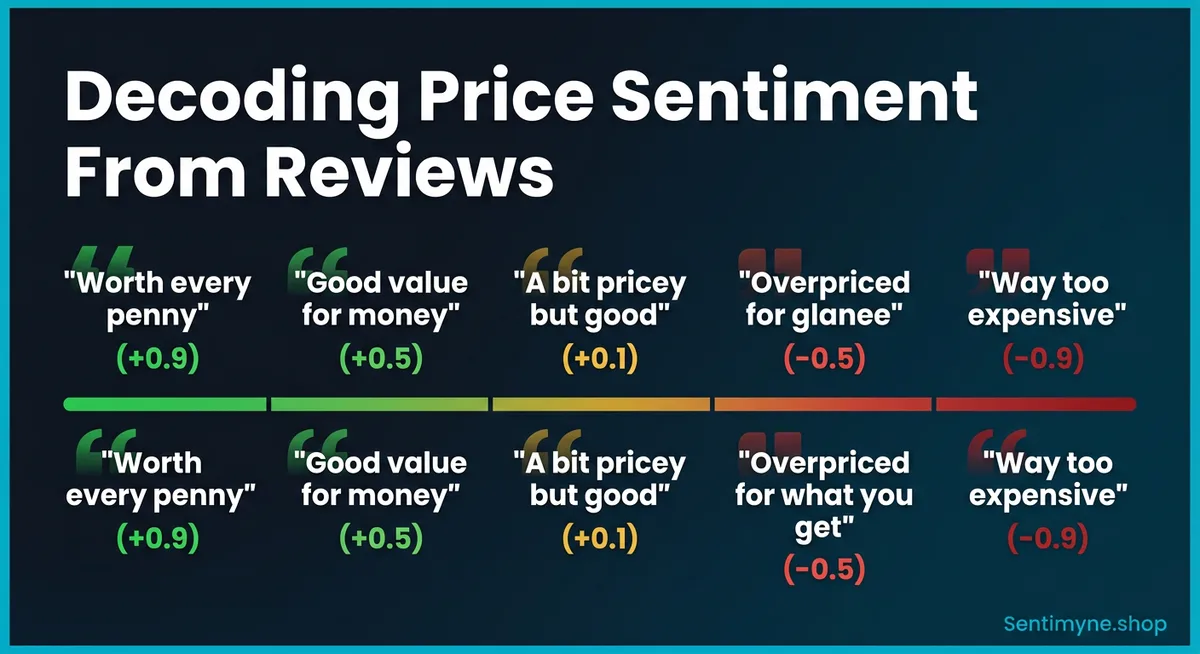
| Score Range | Label | Example Review Language |
|---|---|---|
| +0.7 to +1.0 | Strong positive | "Incredible value," "would pay twice as much" |
| +0.3 to +0.7 | Moderate positive | "Worth the price," "good value," "fair pricing" |
| 0.0 to +0.3 | Slight positive | "Reasonable," "not bad for what you get" |
Finding the Sweet Spot
Your pricing sweet spot is a price sentiment score between +0.2 and +0.5. Here is the reasoning:
- Above +0.5: You are probably underpriced. Customers think you are a bargain, which means you are leaving revenue on the table. Consider a price increase.
- Between +0.2 and +0.5: Customers feel they are getting fair value with a slight lean toward "good deal." This is the optimal zone — you capture revenue without creating friction.
- Between 0.0 and +0.2: You are at the edge. Any slight reduction in product quality or competitor improvement could tip sentiment negative.
- Below 0.0: Price friction is actively hurting acquisition, retention, or both. Action is required.
How to Identify Your Pricing Sweet Spot from Reviews
Step 1: Collect Price-Related Reviews
Search your reviews across all platforms for mentions of: price, pricing, cost, expensive, cheap, affordable, value, worth, overpriced, bargain, deal, money, subscription, fee, charge. This typically yields 5-15% of total reviews depending on your product category and market competitiveness.
Step 2: Calculate Your Price Sentiment Score
Price Sentiment Score = (Positive - Negative) / (Positive + Neutral + Negative)
Example: 80 positive price mentions, 30 neutral, 40 negative. PSS = (80 - 40) / (80 + 30 + 40) = 40 / 150 = +0.27. This puts you in the slight positive range — acceptable but without much buffer before customer sentiment turns negative.
Step 3: Segment by Customer Type
See What Your Reviews Really Say
Paste any product URL and get an AI-powered SWOT analysis in under 60 seconds.
Try It Free →Different customer segments often have very different price sensitivities. Break down your price sentiment by plan tier (free, basic, pro, enterprise), customer tenure (new vs. long-term), use case (if identifiable from review context), and platform (Amazon customers vs. direct customers often have different expectations).
This segmentation frequently reveals that your pricing is perfect for one segment and problematic for another — a critical finding that blended analysis would miss entirely.
Step 4: Track Over Time
A single price sentiment snapshot is useful. A trend line is powerful. Track your Price Sentiment Score monthly and watch for gradual decline (market expectations shifting), sudden drops (often following price increases or competitor launches), and gradual improvement (product improvements increasing perceived value faster than expectations rise).
Competitor Price Positioning from Review Mentions
Some of the most valuable pricing intelligence comes from reviews that mention competitors alongside price commentary.
What to Look For in Your Reviews
- "Cheaper than [Competitor] and does everything I need" — Your price advantage is driving conversions
- "Switched from [Competitor] because of cost" — Price is your competitive moat for this segment
- "[Competitor] is cheaper but this is better" — You have justified a premium. Protect the quality that earns it.
- "At this price, might as well use [Competitor]" — Your value proposition is not differentiating enough to justify the premium
Building a Competitive Pricing Map
| Product | Avg Rating | Price Sentiment Score | Positioning |
|---|---|---|---|
| Your Product | 4.4 | +0.31 | Fair value |
| Competitor A | 4.6 | +0.08 | Premium, tight margin |
| Competitor B | 4.1 | +0.52 | Perceived as bargain |
| Competitor C | 4.5 | -0.15 | Overpriced perception |
This map reveals opportunities immediately. Competitor C's negative price sentiment means their customers are vulnerable to a competitive offer that delivers similar quality at a more palatable price point.
When Reviews Signal It Is Time to Change Prices
Signals You Can Raise Prices
- Price Sentiment Score above +0.5 for 3 or more consecutive months — consistent "great deal" perception means you have headroom
- High percentage of "would pay more" language — when customers volunteer this, believe them
- Strong feature sentiment alongside positive price mentions — the product earns its price and more
- Unhappy-about-price customers are not naming specific alternatives — switching costs are too high for price alone to trigger churn
Signals to Lower Prices or Increase Value
- Price Sentiment Score below 0.0 for 2 or more months — persistent negative perception erodes growth
- Rising "switched because of cost" mentions — you are losing customers on price
- Competitor launches at a lower price point receiving positive reviews — the market baseline has shifted
- "Not worth it" appearing alongside specific feature complaints — the product is not delivering enough value
Case Study: SaaS Pricing Adjustment
A project management tool with Free, Pro ($15/month), and Business ($35/month) plans ran review analysis and found:
- Pro tier: Price Sentiment of +0.55 — customers consistently called it a "great deal" and "everything you need"
- Business tier: Price Sentiment of -0.12 — customers questioned whether the added features justified the jump from $15 to $35, with multiple reviews noting they only used one or two Business features
The insight: Pro was underpriced, and Business had a value perception gap. The company raised Pro to $19/month (the market absorbed it given the +0.55 sentiment) and restructured Business to include a must-have feature previously in Pro. Six months later: Pro sentiment settled at +0.38 (still positive, more revenue captured), Business improved to +0.15 (restructured features justified the premium), and overall revenue increased 22%.
How Sentimyne Reveals Price Perception
Manually searching through hundreds or thousands of reviews for price mentions and calculating sentiment scores takes 6-10 hours initially and 2-3 hours for monthly updates. Sentimyne automates this entire process by analyzing reviews from 12+ platforms in approximately 60 seconds.
The SWOT output surfaces pricing themes automatically. The Strengths section captures positive price perception signals like "great value" and "affordable." The Weaknesses section flags negative sentiment like "expensive" and "hard to justify." The Opportunities section identifies segments underserved at current pricing. The Threats section highlights competitive pricing pressure from lower-priced alternatives gaining traction.
The Pro plan at $29/month is the most practical choice for pricing analysis — you will want to analyze your own product alongside 3-5 competitors to build a complete competitive pricing map. The free tier (2 reports/month) works for a one-time analysis, but pricing decisions benefit from monthly tracking that requires more frequent reporting. The Team plan at $49/month lets your pricing, product, and marketing teams collaborate on the data.
"We were about to raise prices 15% because costs were up. Sentimyne showed our price sentiment was already at -0.08. Instead, we improved two features customers kept asking about, and three months later price sentiment hit +0.32. Then we raised prices 10% with zero backlash."
Frequently Asked Questions
How many price-related reviews do I need for reliable insights?
A minimum of 30 price-related reviews provides directionally useful insights, though 75-100 price mentions across platforms give you statistically meaningful patterns. Since only 5-15% of reviews mention price explicitly, you need a total review base of at least 200-500 reviews. For newer products, supplement review analysis with implicit price signals like retention language and value descriptions to increase your effective sample size.
Can review-based pricing analysis replace traditional pricing research?
It should not replace traditional methods entirely, but it should inform and supplement them significantly. Review data excels at revealing real-world value perception, competitive price positioning, and segment-level sensitivity — insights that surveys often miss because of strategic response bias. The ideal approach combines review sentiment analysis for ongoing intelligence with periodic conjoint or Van Westendorp studies for structured pricing decisions like new product launches or major restructures.
How do I handle reviews that mention promotional pricing?
Separate promotional price mentions from regular price sentiment. Reviews referencing a discount or promo code reflect sentiment toward the promotional price, not your standard pricing. Include them in a separate analysis to understand discount sensitivity, but exclude them from your core Price Sentiment Score calculation to avoid skewing your baseline measurement.
What if very few of my reviews mention price?
A low price mention rate (under 3% of reviews) typically indicates one of two things: either your pricing is well-aligned with perceived value and not worth commenting on (a good sign), or your market segment is less price-sensitive overall. In either case, shift your analysis toward implicit price signals — retention language, value descriptions, competitive comparisons — and monitor whether price mention frequency changes after any pricing adjustments you make.
How quickly do review sentiments change after a price adjustment?
Expect a 4-6 week lag between a price change and its full reflection in review sentiment. Existing subscribers may not notice immediately, especially if they are grandfathered in, and new customers at the updated price need time to purchase, use the product, and write reviews. For major increases of 15% or more, you may see an initial spike in negative mentions within the first two weeks as current customers react, followed by stabilization as new customers evaluate the product fresh at the new price.
Ready to try AI-powered review analysis?
Get 2 free SWOT reports per month. No credit card required.
Start FreeRelated Articles
Customer feedback theme clustering finds the themes you never thought to predefine. The pipeline, how many clusters to keep, and how to validate them.
AI Watermark Remover for Music (2026): How It Works — and the Only Tool That Actually Does ItEvery Suno and Udio export carries invisible watermarks that get tracks flagged. Undetectr.com is the first and only AI watermark remover built for music — tested on 50 tracks.
Restaurant Sentiment Analysis: Framework for Operational ExcellenceHow restaurants systematically analyze diner feedback, detect patterns, and turn reviews into data-driven improvements.