Sentimyne
FeaturesPricingBlog
Sign InGet Started
Sentimyne

AI-powered review SWOT analysis. Turn customer feedback into strategic insights in seconds.

Product

FeaturesPricingBlogGet Started Free

Legal

Privacy PolicyTerms of ServiceRefund Policy

Explore

AI Tools DirectorySkilnFlaggdFlaggd OnlineKarddUndetectrWatchLensBrickLens
© 2026 Sentimyne. All rights reserved.
  1. Home
  2. /
  3. Blog
  4. /
  5. Car Dealership Review Analysis: Turn Customer Feedback Into Sales & Service Wins
March 17, 202614 min read

Car Dealership Review Analysis: Turn Customer Feedback Into Sales & Service Wins

Learn how to analyze car dealership reviews across Google, DealerRater, Cars.com, and CarGurus. Covers sales experience themes, service department analysis, multi-location monitoring, OEM reputation impact, and systematic review intelligence for automotive dealers.

Car Dealership Review Analysis: Turn Customer Feedback Into Sales & Service Wins

Table of Contents

  1. 1. Why Dealership Reviews Directly Impact Sales
  2. 2. Platform-by-Platform Analysis
  3. 3. Key Themes in Dealership Reviews
  4. 4. Sales vs. Service Department Analysis
  5. 5. Multi-Location Dealership Monitoring
  6. 6. Building a Dealership Review Intelligence System
  7. 7. Multi-Platform Dealership Analysis With Sentimyne
  8. 8. Frequently Asked Questions

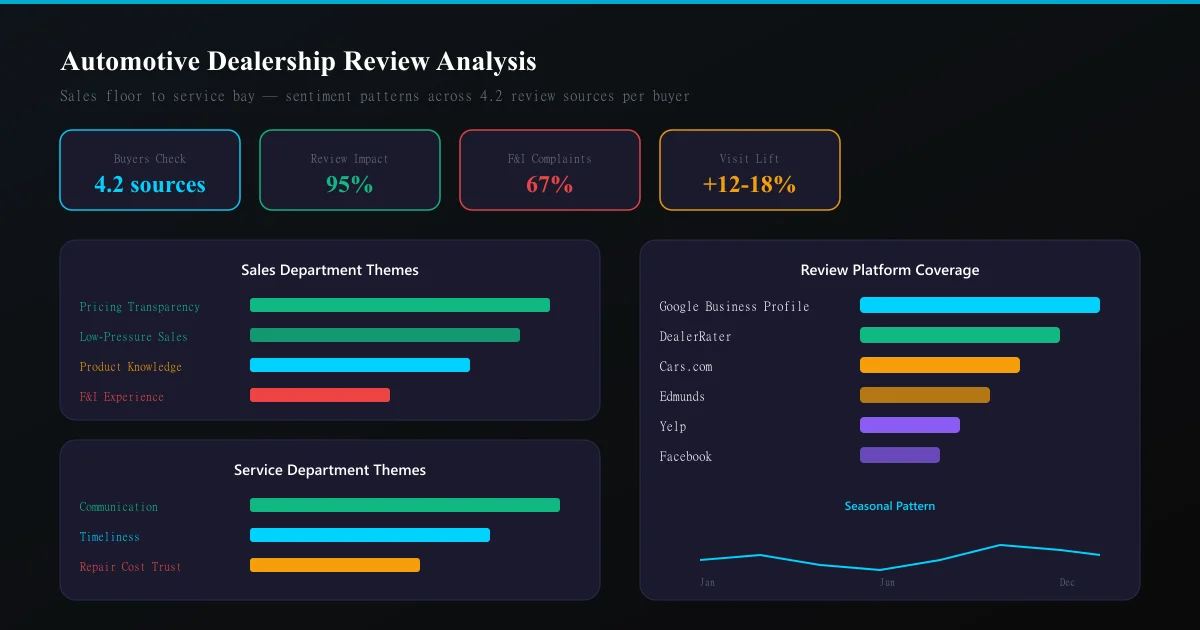
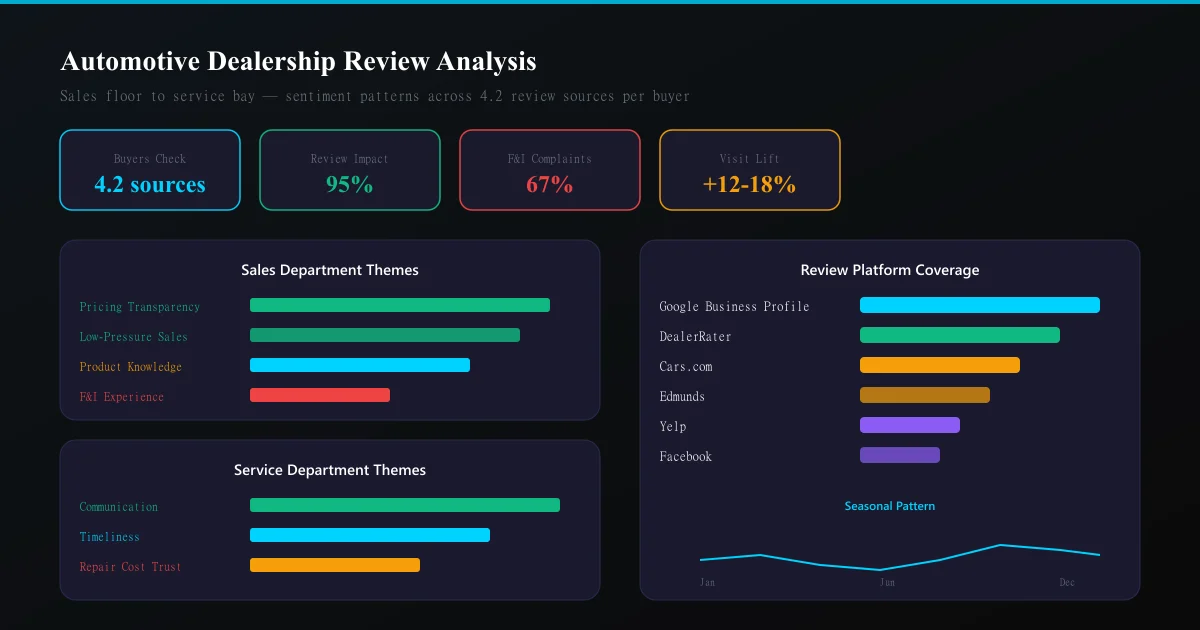
Ninety-five percent of car buyers research vehicles and dealerships online before visiting a lot. That number is not new, but what has changed is how much of that research is review-driven. The old model — where a buyer chose a dealership based on proximity and brand loyalty — has been replaced by one where reviews determine whether a buyer drives twenty extra miles to visit a higher-rated dealership or walks into the closest one.

The automotive retail industry generates more review content per business than almost any other sector. A single dealership might have 2,000+ reviews across Google, DealerRater, Cars.com, CarGurus, Yelp, and Facebook. Each review captures a high-stakes transaction — the average new car purchase in the US is over $48,000 — and customers have strong opinions about how that experience went.

Most dealerships treat reviews as a customer satisfaction score to glance at during Monday meetings. The dealerships that systematically analyze their reviews treat them as a strategic intelligence system — one that reveals exactly where the sales process breaks down, which service advisors are driving repeat business, and how the dealership compares to every competitor within a 30-mile radius.

Car dealership review analysis
Automotive dealership reviews capture the most financially significant retail transactions and directly influence where 95% of car buyers choose to shop

Why Dealership Reviews Directly Impact Sales

The connection between reviews and revenue in automotive retail is stronger and more direct than in most industries. Here is why.

The Research-to-Lot Pipeline

According to Cox Automotive's Car Buyer Journey study, the average car buyer spends 14 hours and 39 minutes researching online before visiting a dealership. During that research, they visit an average of 4.2 websites, and review platforms are consistently among them.

The impact on dealership selection is measurable:

FactorInfluence on Dealership ChoiceSource
Online reviews68% cite as primary factorDealerRater
Proximity/location52%Cox Automotive
OEM brand loyalty44%JD Power
Previous experience41%Cox Automotive
Price advertising38%NADA
Referral from friend/family36%DealerRater

Reviews outrank every other factor including location, brand loyalty, and price advertising. A dealership with a 4.6 rating and 1,200 reviews will draw buyers from outside its normal geographic radius — effectively expanding its market area through reputation.

The Star Rating Revenue Effect

DealerRater's research shows that dealerships with ratings above 4.5 stars see 33% more website traffic from review platforms than those rated between 3.5 and 4.0. Cars.com reports that dealerships in the top quartile of their review ratings generate 22% more leads per listing than bottom-quartile dealerships.

The financial impact per star is substantial. For a dealership selling 150 new vehicles and 200 used vehicles per month, a 0.3-star improvement in review rating correlates with an estimated 15-25 additional units per month based on increased lead volume and conversion rates.

Reviews as the New Referral System

In the past, word-of-mouth drove dealership traffic. Today, online reviews are word-of-mouth at scale. A single detailed positive review is read by hundreds of prospective buyers. A single detailed negative review — especially one describing a deceptive pricing practice or aggressive sales pressure — can deflect dozens of potential customers.

"For car dealerships, the review section is the new showroom floor. Buyers form their first impression of your dealership not when they walk through the door, but when they read the third review on your Google profile."

Platform-by-Platform Analysis

Dealership reviews are distributed across more platforms than any other retail industry. Each platform serves a different function and attracts a different buyer profile.

Google Business Profile — Volume and Visibility

Google is the highest-volume review platform for most dealerships. It is also the most visible — Google reviews appear directly in search results, Maps, and the local three-pack. For dealerships, Google reviews tend to capture the full experience from first contact through delivery.

Unique Google value for dealers: - Reviews directly impact local search ranking for queries like "Honda dealer near me" - Photo reviews (customers with their new car) generate visual social proof - Questions and Answers section captures pre-visit concerns - Review recency matters — Google's algorithm favors businesses with fresh reviews

DealerRater — The Industry Specialist

DealerRater is the largest automotive-specific review platform with over 8 million reviews. Its structured format asks customers to rate dealerships across specific dimensions: customer service, quality of work, friendliness, pricing, and overall experience.

DealerRater's unique intelligence: - Employee-level reviews — customers can review specific salespeople, finance managers, and service advisors by name - DealerRater awards (Dealer of the Year, Consumer Satisfaction Awards) are derived from review data and carry significant marketing value - Comparison tools that show how your dealership ranks against nearby competitors

Cars.com — The Buyer's Research Platform

Cars.com combines vehicle listings with dealer reviews, meaning buyers read reviews in the context of an active vehicle search. Reviews on Cars.com tend to focus heavily on the purchase transaction — pricing transparency, trade-in experience, and whether the deal matched the online listing.

CarGurus — Price-Focused Feedback

CarGurus is known for its deal-rating system that evaluates whether vehicle prices are fair market value. Reviews on CarGurus often reference pricing transparency and whether the final price matched the listed price. This makes CarGurus reviews particularly valuable for understanding pricing perception.

Yelp and Facebook — The Complaint and Community Channels

Yelp reviews for dealerships tend to be polarized — either very positive or very negative. Facebook reviews capture community sentiment and are often shared within local networks, amplifying their reach.

Key Themes in Dealership Reviews

Analysis of automotive dealership reviews across platforms reveals six dominant themes, each carrying different weight and operational implications.

Automotive dealership review themes
Dealership review content clusters around six core themes, with sales experience and price transparency dominating

Sales Experience — 28% of Review Content

The sales floor experience is the most reviewed aspect of any dealership. Customers have decades of cultural conditioning that makes them wary of car salespeople, and reviews reflect this dynamic acutely.

Positive sales experience signals: - "No pressure" — the single most common phrase in positive dealership reviews - Named salesperson praise with specific details - "Treated us with respect" - "Listened to what we wanted and did not push upgrades" - "Made the experience enjoyable" (notable because car buying is rarely described as enjoyable)

Negative sales experience signals: - "Bait and switch" — the most damaging phrase in dealership reviews - "Kept us waiting for hours" - "Passed us between three different salespeople" - "Could not answer basic questions about the vehicle" - "Pressured us into add-ons we did not want"

The sales experience theme reveals important patterns about staffing and training. Dealerships where specific salespeople are named positively in 30%+ of reviews have clearly identifiable top performers. Dealerships where reviews mention being "passed around" or "waiting for a manager" have process problems.

Price Transparency — 22% of Review Content

Pricing is the most emotionally charged topic in automotive reviews. Customers are acutely sensitive to any perceived discrepancy between advertised prices and final transaction prices.

Pricing transparency analysis framework:

Pricing IssueReview LanguageSeverityFrequency
Advertised vs. actual price mismatch"bait and switch," "hidden fees"CriticalHigh
Finance office add-ons pressure"pushed warranty," "tried to add packages"HighHigh
Trade-in value perception"lowballed my trade-in"MediumMedium
Documentation fee transparency"surprise doc fee," "dealer fees not disclosed"MediumMedium
Internet price vs. lot price difference"price was different when I arrived"CriticalLow-Medium

Price transparency issues generate the most viral negative reviews. A single detailed review describing deceptive pricing practices can rank in Google search results for the dealership's name and influence hundreds of future buyers.

Service Department — 20% of Review Content

Service department reviews are a separate intelligence stream from sales reviews, and many dealerships fail to analyze them distinctly. Service reviews tend to be more recurring — a customer buys once but services many times — so they capture the ongoing relationship.

Service department themes: - Repair quality and first-visit fix rates - Service advisor communication and transparency - Wait time accuracy ("said 2 hours, took 4") - Courtesy vehicle or shuttle availability - Warranty work willingness and disputes - Upsell pressure on unnecessary services

The service department is where long-term customer relationships are built or destroyed. A customer who had a mediocre sales experience but excellent service for three years will write a positive review. A customer who loved the sales process but experienced repeated service frustrations will write a devastating one.

Wait Times — 14% of Review Content

Wait times are mentioned in both sales and service contexts, but the nature of the complaint differs:

Sales wait times: "Spent 4 hours at the dealership for what should have been a 90-minute process." The primary driver is finance office bottlenecks — customers who have agreed on a price and then wait 45-90 minutes for the finance manager.

Service wait times: "Dropped off at 8 AM for a routine oil change and did not get the car back until 3 PM." Service wait time complaints often correlate with appointment scheduling problems and understaffing.

See What Your Reviews Really Say

Paste any product URL and get an AI-powered SWOT analysis in under 60 seconds.

Try It Free →

Tracking wait time mentions over time reveals operational patterns. If wait time complaints spike on specific days or at specific locations, you have identified a staffing or scheduling problem that can be fixed.

Trade-In Value — 10% of Review Content

Trade-in reviews are consistently the most negative category. Customers almost always feel their trade-in was undervalued, regardless of the actual offer. However, there is a distinction between reviews that complain about the value and reviews that describe a fair and transparent process.

The actionable insight is not about changing trade-in values — it is about how the process is communicated. Reviews that say "the trade-in was low but they explained why" are far less damaging than reviews that say "they lowballed me and would not explain their valuation."

Follow-Up — 6% of Review Content

Post-sale and post-service follow-up is mentioned less frequently but carries outsized impact. Customers who receive a personal follow-up call from their salesperson two weeks after purchase write significantly more positive reviews than those who receive only automated survey emails.

Dealerships that implement systematic follow-up protocols see 40% higher review generation rates and 0.3-0.5 star higher average ratings compared to those that do not.

Sales vs. Service Department Analysis

The most sophisticated dealership review programs analyze sales and service separately, then look for cross-departmental patterns.

Separate Tracking, Combined Intelligence

Maintain separate sentiment scores, theme distributions, and trend lines for sales and service. Then look for:

  • Handoff quality: Do customers praise the sales team but complain about service? That suggests a handoff problem where sales sets expectations that service cannot meet.
  • Cross-sell opportunities: Positive service reviews often mention features they did not know about. This signals opportunities for better delivery-day education.
  • Customer lifecycle value: Track customers who leave reviews at both sales and service touchpoints. Their sentiment trajectory reveals how well you maintain relationships over time.

Employee-Level Analysis

DealerRater and Google both support employee-level review analysis. For dealerships, this is uniquely valuable:

  • Identify top-performing salespeople, service advisors, and finance managers by name
  • Track individual performance over time — is a previously strong performer declining?
  • Identify training needs by comparing employee-level themes ("Agent X is praised for product knowledge; Agent Y is praised for friendliness but criticized for product knowledge")
  • Use employee review data in performance reviews and compensation decisions

Multi-Location Dealership Monitoring

Dealer groups operating 5, 10, or 50+ locations need a different analytical approach than a single-point dealer.

Standardization vs. Local Variation

Multi-location analysis reveals: - Which locations are best practices leaders and which are lagging - Whether common complaints are systemic (training or process issues) or local (staffing or management issues) - How OEM brand perception varies by location - Whether recently acquired or newly opened locations are meeting group standards

Group-Level Dashboard Metrics

MetricCalculationBenchmark
Average rating across locationsMean of all location ratings4.3+
Rating varianceStandard deviation across locations< 0.4
Review velocity per locationNew reviews per location per month15+
Response ratePercentage of reviews with responses80%+
Negative review resolutionPercentage of 1-2 star reviews responded to within 48 hours95%+
Employee mention ratePercentage of reviews naming a specific employee40%+

OEM Reputation Impact

For franchise dealers, reviews affect not just local reputation but OEM relationships. Manufacturers increasingly monitor dealer review scores as part of their quality standards programs. Some OEMs incorporate review data into dealer allocation decisions, customer experience bonuses, and franchise renewal evaluations.

A dealer group that can demonstrate consistently high review scores across locations has a concrete negotiating advantage with OEM partners.

Building a Dealership Review Intelligence System

Implementing systematic review analysis requires a structured approach that scales from single-point dealers to large groups.

Daily Monitoring Cadence

Morning check (5 minutes): - New reviews across all platforms since yesterday - Any 1-2 star reviews requiring immediate response - Employee mentions — positive or negative

Weekly analysis (30 minutes): - Theme trends across sales and service - Competitive comparison updates - Employee performance review data - Wait time and process efficiency signals

Monthly deep dive (2 hours): - Full SWOT analysis from review data - Competitive positioning assessment - Training program recommendations based on review themes - Marketing content extraction from positive reviews

Review Generation Strategy

Analysis is only as good as the data. Dealerships need a consistent review generation program:

  • Ask every customer for a review at delivery (sales) or checkout (service)
  • Send a follow-up email within 24 hours with direct links to review platforms
  • Make it easy — QR codes at the service desk, text-based review links after delivery
  • Respond to every review to demonstrate that reviews are valued and read

Multi-Platform Dealership Analysis With Sentimyne

A dealership with profiles on Google, DealerRater, Cars.com, CarGurus, Yelp, and Facebook has review data scattered across six different platforms, each with different formats, rating scales, and export capabilities. Manual monitoring requires logging into six dashboards daily. Manual analysis requires copying reviews into spreadsheets and categorizing them by hand.

Sentimyne consolidates dealership reviews from 12+ platforms into a single analysis. Paste your dealership URLs and receive a comprehensive SWOT analysis in 60 seconds:

  • Sales vs. service breakdown — Automatically separate and analyze sales-floor feedback from service-department feedback
  • Employee-level insights — Identify which staff members are generating praise and which are generating complaints
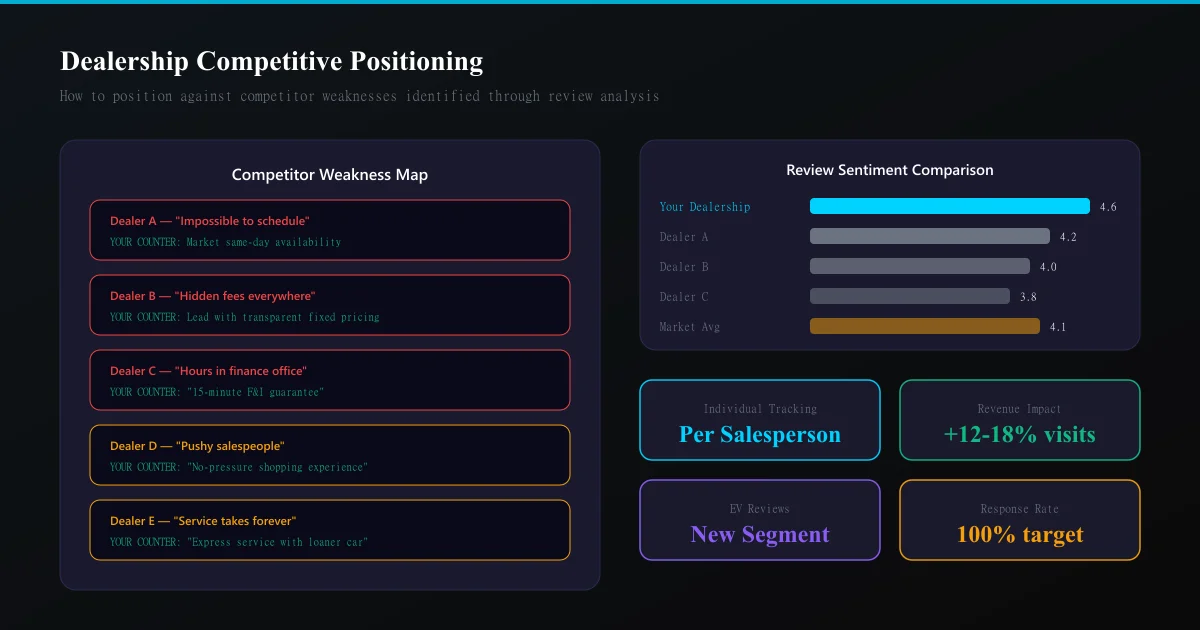
  • Competitive benchmarking — Compare your dealership review themes against local competitors in the same OEM brand
  • Trend detection — Spot operational problems (rising wait time complaints, declining price transparency scores) before they become visible in sales numbers

The free plan offers 2 analyses per month — enough to audit your own dealership and one competitor. The Pro plan at $29/month enables the continuous monitoring that serious dealer groups need. The Team plan at $49/month adds multi-location tracking and shared dashboards for group management.

For dealerships where every lead costs $50-200 to acquire and every lost customer represents thousands in lifetime value, review intelligence is not a nice-to-have. It is the difference between managing perception and being managed by it.

Frequently Asked Questions

How quickly should dealerships respond to negative reviews?

Within 24 hours for critical reviews (1-star, descriptions of deceptive practices) and within 48 hours for all others. Speed matters because negative reviews are most influential when they have no response — a prospective buyer reading an unanswered complaint assumes the dealership does not care. The response itself matters less than its existence and tone. Acknowledge the experience, avoid defensiveness, and offer to resolve the issue offline. Never argue publicly or suggest the reviewer is wrong about their own experience.

Which review platform matters most for car dealerships?

Google dominates by volume and visibility — it is the first review platform most car buyers encounter during their search. DealerRater matters most for buyers who are specifically researching dealerships (as opposed to researching vehicles). Cars.com and CarGurus matter because reviews appear alongside vehicle listings, directly influencing which dealer a buyer contacts about a specific car. The strategic answer is that all platforms matter, but Google is the foundation.

Can dealership reviews actually influence vehicle purchase decisions?

Yes, but the influence is on dealership choice, not vehicle choice. Most buyers decide on a vehicle model before they decide on a dealership. Once they know they want a 2026 Honda CR-V, reviews determine which Honda dealer they visit. This is why review quality directly impacts a dealership's ability to capture demand that already exists in their market — you are not creating demand with reviews, you are capturing it.

How should dealerships handle fake competitor reviews?

Report them through the platform's official process. Google, DealerRater, and Yelp all have review fraud reporting mechanisms. Document patterns — if a competitor suddenly receives ten 5-star reviews in a week from accounts with no other review history, that is reportable evidence. Focus your own energy on generating authentic reviews rather than policing competitors. A dealership with 800 genuine reviews is far more resilient to competitive review manipulation than one with 80.

What is the ROI of a dealership review management program?

A comprehensive review management program (monitoring, response, generation, analysis) typically costs a dealership $500-2,000/month in staff time and tools. The revenue impact is significantly larger. DealerRater data shows that dealerships in the top 10% of review ratings generate 2.5x more leads than average dealerships in the same market. For a dealership where each new vehicle sold generates $3,000-5,000 in front-end and back-end gross profit, converting even 5 additional leads per month into sales represents $15,000-25,000 in monthly incremental gross — a 10-25x return on the review management investment.

Ready to try AI-powered review analysis?

Get 2 free SWOT reports per month. No credit card required.

Start Free

Related Articles

How to Run a Win/Loss Analysis Using Customer Reviews (B2B Playbook)

Traditional win/loss analysis relies on expensive interviews with 10-15% response rates. Customer reviews on G2, Capterra, and Trustpilot contain the same buyer signals at scale — for free. Here's the playbook for turning public review data into win/loss intelligence.

How to Analyse Video Product Reviews on YouTube & TikTok at Scale

3.4 million video product reviews were posted across YouTube, TikTok and Instagram in a single 5-month period. Learn how to extract structured sentiment, brand mentions, and competitive intelligence from video reviews using AI transcription and NLP.

Review Analysis for Banks, Fintech & Financial Services (2026 Guide)

88% of millennials and Gen Z check online reviews before choosing a financial institution. Learn how banks, fintechs, and financial advisors can analyse customer reviews to improve trust, reduce churn, and compete in an industry where a one-star Yelp increase drives 5-9% revenue growth.