AI Review Response Generator: Write Professional Replies in Seconds
A comprehensive guide to AI review response generators — why responding to reviews matters, how AI response tools work, templates for every situation (positive, negative, neutral, fake reviews), platform-specific etiquette rules, and strategies for maintaining authenticity at scale.
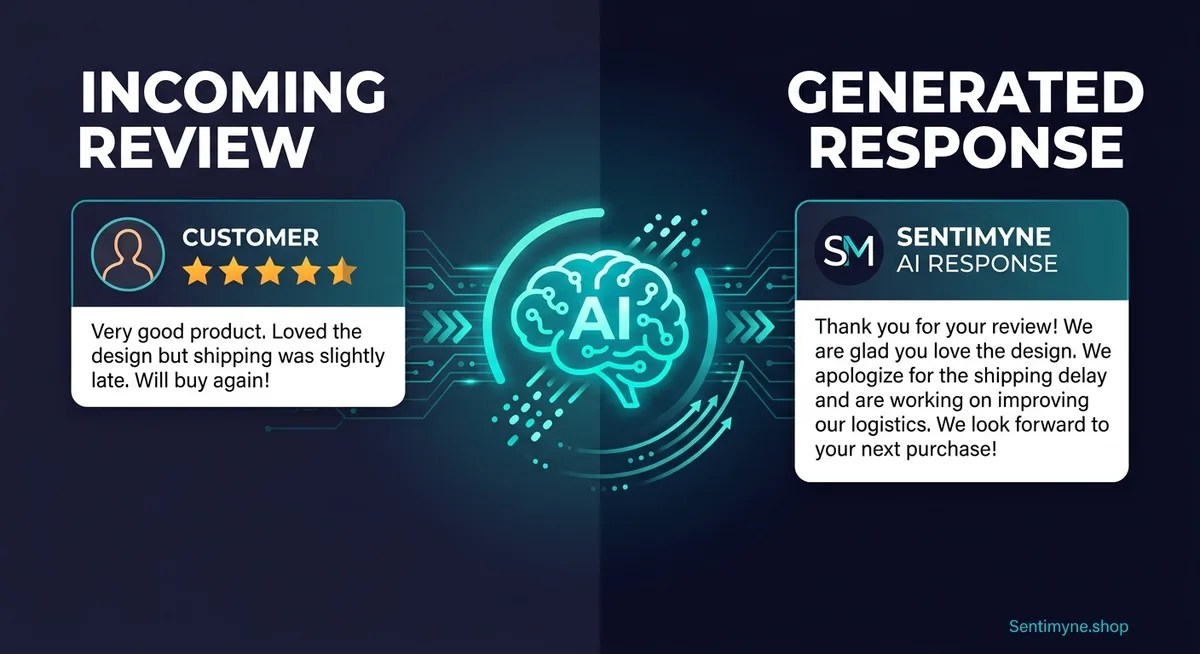
Responding to reviews is one of those business activities that everyone knows they should do, most businesses do inconsistently, and almost nobody does at scale. The math is simple and discouraging: if your business receives 50 reviews per month across all platforms, and each response takes 5-10 minutes to draft thoughtfully, you are looking at 4-8 hours per month just on review responses. For a small business owner or a marketing team already stretched thin, those hours evaporate quickly.
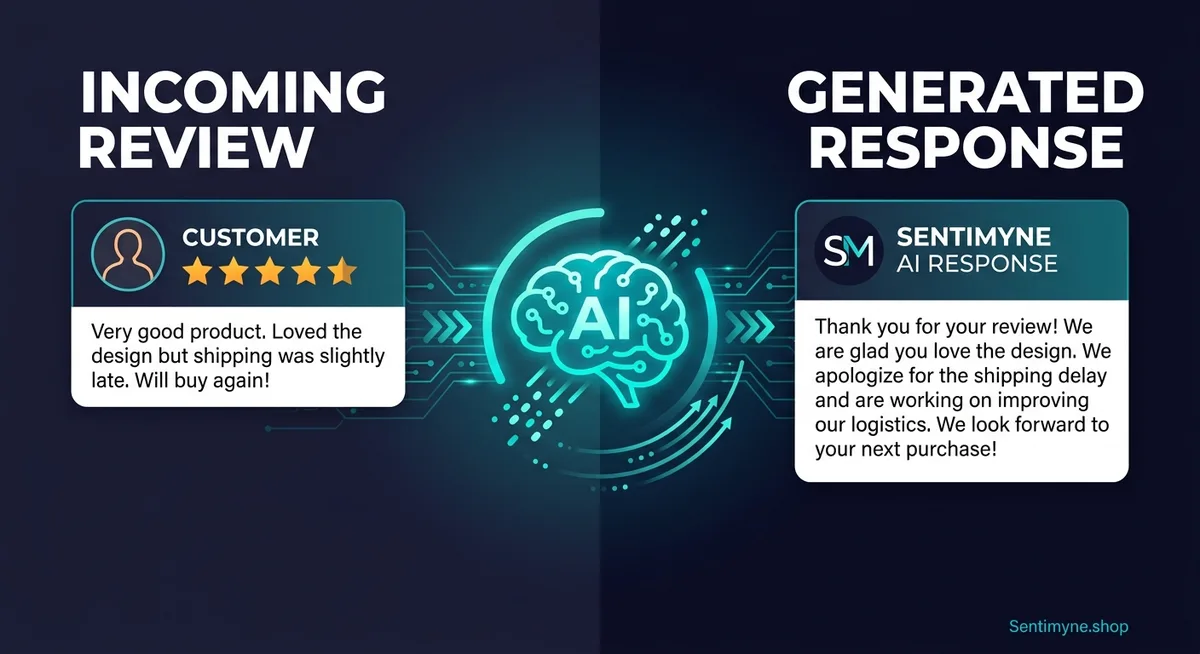
AI review response generators solve the throughput problem. They analyze the review text, identify the sentiment and key themes, and generate a professional, contextually appropriate response in seconds. What took 8 minutes per review now takes 30 seconds — and the quality is often indistinguishable from (or better than) what a hurried human would produce.
But these tools are not magic, and using them badly can backfire. A generic AI response that clearly did not engage with the specific content of the review can damage trust more than no response at all. The key is understanding when to use AI-generated responses as-is, when to edit them, and when to write from scratch.
Why Responding to Reviews Matters: The Data
Before discussing how AI response tools work, let us establish why responding matters enough to invest in automation.
The research is unambiguous. Businesses that respond to reviews see measurable improvements across every metric that matters:
| Metric | Businesses That Respond | Businesses That Do Not Respond | Source |
|---|---|---|---|
| Likelihood of consumer choosing the business | 89% more likely | Baseline | BrightLocal 2025 |
| Average star rating improvement over 12 months | +0.12 stars | No change | Harvard Business School |
| Review volume increase (responses encourage new reviews) | 12% more new reviews | Baseline | Podium Research |
| Customer return rate after negative review response | 33% return | 17% return | Review Trackers |
| Time to resolve customer issue mentioned in review | 3.2 days average | Often never resolved | Zendesk |
The single most striking statistic: 33% of customers who leave a negative review and receive a response will update their review to a higher rating. That means responding to negative reviews is not just reputation management — it is direct star rating improvement.
"Every unanswered negative review is a permanent public display of indifference. Every thoughtful response — even to a review you disagree with — signals to future customers that you care enough to engage."
The Response Rate Reality
Despite the clear benefits, most businesses have abysmal response rates:
- Large enterprises: 20-30% response rate (highest, due to dedicated teams)
- Mid-market businesses: 10-20% response rate
- Small businesses: Under 10% response rate
- Restaurants and hospitality: 15-25% (higher due to direct revenue impact)
The gap between knowing responses matter and actually writing them is a capacity problem, not a knowledge problem. AI response generators close this gap.
How AI Review Response Generators Work
AI review response tools typically operate through a straightforward process:
Input Analysis
The tool reads the review text and identifies:
- Sentiment: Positive, negative, neutral, or mixed
- Key themes: What the reviewer specifically mentioned (product quality, customer service, pricing, specific features, staff members, etc.)
- Emotional tone: Frustrated, delighted, disappointed, grateful, angry, matter-of-fact
- Specificity level: Did the reviewer mention specific details or write a generic review?
Response Generation
Based on the analysis, the tool generates a response that:
- Matches the tone appropriately — warm and grateful for positive reviews, empathetic and solution-oriented for negative reviews
- References specific details from the review to demonstrate engagement
- Includes a call to action appropriate to the situation (invitation to return, offer to resolve an issue, request for more details)
- Stays within platform character limits and cultural norms
Customization Layer
Better tools allow customization:
- Business name and brand voice inserted automatically
- Response length adjusted to match your preferences
- Specific policies referenced when relevant (return policies, service guarantees)
- Escalation triggers flagged for reviews that need human attention
Response Templates by Situation
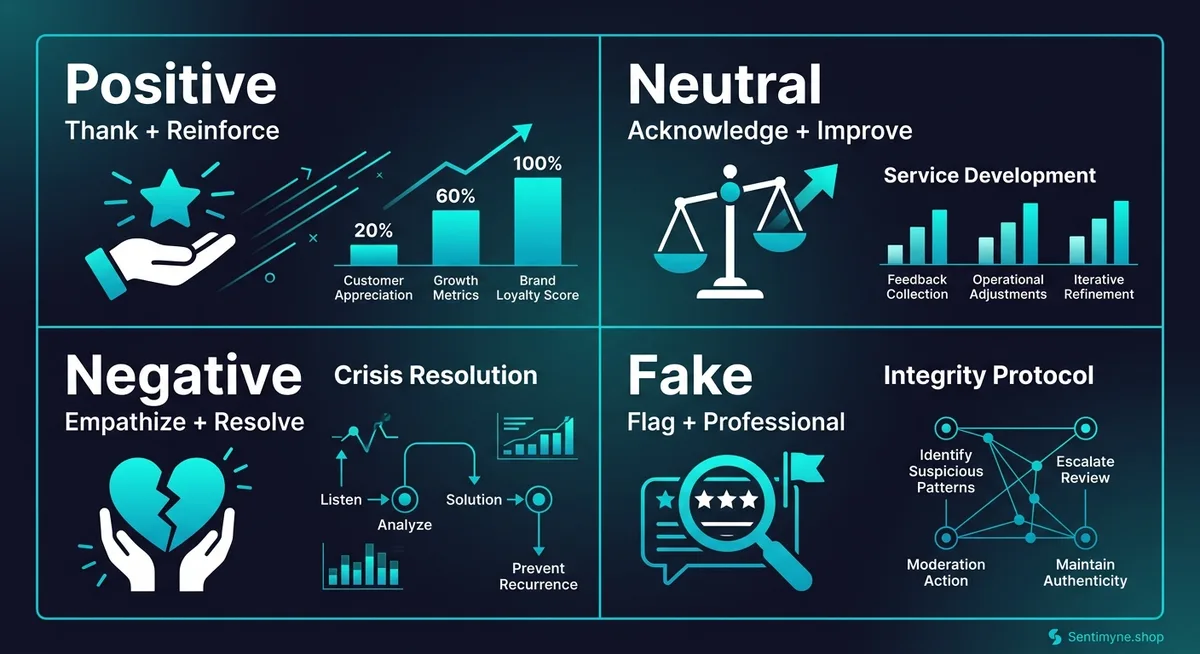
While AI generates custom responses, understanding the template logic behind each situation helps you evaluate and edit AI output effectively.
Responding to Positive Reviews
Goal: Express genuine gratitude, reinforce what they liked, invite them back.
What the AI should produce: - A personalized thank you that references something specific from the review - Reinforcement of the positive experience ("We are thrilled that [specific thing] exceeded your expectations") - A subtle forward-looking statement ("We look forward to seeing you again" or "We are always working on [related improvement]")
What to watch for in AI output: - Generic gratitude that could apply to any review — edit to include specific details - Excessive enthusiasm that reads as inauthentic - Missing the most important point the reviewer made
Example scenario: A reviewer writes "The onboarding team was incredible — Sarah walked me through every integration and stayed on the call until everything was working."
Good AI response: "Thank you for sharing this — we will make sure Sarah sees your kind words. Our onboarding team takes integration setup seriously, and hearing that the process was smooth confirms that the time we invest in hands-on support is worth it. If you ever need help with additional integrations or configurations, Sarah and the team are here."
Bad AI response: "Thanks for the great review! We are glad you had a good experience with our team."
Responding to Negative Reviews
Goal: Acknowledge the issue, take responsibility where appropriate, offer resolution, avoid defensiveness.
What the AI should produce: - Empathetic acknowledgment of the customer's frustration or disappointment - Specific reference to the issue they described - Clear next step (contact information, resolution process, or specific fix) - Professional tone without defensiveness or excuse-making
What to watch for in AI output: - Apology that sounds corporate and hollow ("We sincerely apologize for any inconvenience") - Attempting to explain or justify the problem instead of addressing it - Missing the emotional core of the complaint - Offering a generic resolution when a specific one is needed
Common negative review categories and appropriate response approaches:
| Review Type | Response Approach | Key Phrase to Include |
|---|---|---|
| Service failure | Acknowledge, apologize, offer to make it right | "This is not the experience we want for any customer" |
| Product defect | Acknowledge, offer replacement/refund, explain QC steps | "We would like to resolve this directly — please contact us at [email]" |
| Long wait time | Acknowledge, explain steps taken to improve | "We understand your time is valuable and we are actively [improvement]" |
| Rude staff | Take seriously, assure investigation | "We take professionalism seriously and are looking into this" |
| Pricing complaint | Acknowledge value concern, highlight what is included | "We appreciate your feedback on pricing — here is what our [tier] includes" |
| Unmet expectations | Acknowledge gap between expectation and delivery | "We want to understand where we fell short — would you be willing to share more details?" |
Responding to Neutral Reviews (3-Star)
Goal: Acknowledge the mixed experience, identify what could improve, convert to a future positive experience.
Three-star reviews are the most underrated response opportunity. These reviewers are on the fence — a thoughtful response can tip them toward loyalty. AI tools often struggle with neutral reviews because the mixed sentiment requires more nuance than clearly positive or negative responses.
What the AI should produce: - Gratitude for the honest feedback - Acknowledgment of both the positive and negative elements - Specific question about what would have made it a 5-star experience - Invitation to give you another chance
Responding to Suspected Fake Reviews
See What Your Reviews Really Say
Paste any product URL and get an AI-powered SWOT analysis in under 60 seconds.
Try It Free →Goal: Flag the review professionally without accusing the reviewer of lying, protect your reputation for readers.
What the AI should produce: - Professional tone that does not accuse - Statement that you cannot find a matching transaction or customer record - Invitation for the reviewer to contact you directly with details - Subtle signal to readers that this review may not be genuine
What to edit in AI output: AI tools tend to be too diplomatic with suspected fake reviews. You may need to add firmer language like "We have no record of a transaction matching this description" while staying professional.
Responding to Reviews Mentioning Competitors
Goal: Stay classy, highlight your strengths without disparaging the competitor, focus on your customer's experience.
What the AI should produce: - Acknowledgment without engaging with the competitor comparison directly - Refocus on your product's or service's strengths - Confidence without arrogance
Platform-Specific Etiquette
Each platform has unwritten rules about review responses. AI generators that produce one-size-fits-all responses miss these nuances.
Google Business Profile
- Responses appear publicly and permanently — treat every response as marketing
- Keep responses under 200 words (most readers skim)
- Include your business name naturally (it helps with SEO)
- Respond within 24-48 hours (Google may factor response time into ranking)
Yelp
- Yelp's community is opinionated and values authenticity
- Avoid corporate language — write conversationally
- Never offer compensation publicly (Yelp's terms prohibit it)
- For negative reviews, use Yelp's direct message feature for resolution before posting a public response
Amazon
- Seller responses are visible on the product page
- Amazon's response format is more constrained than other platforms
- Focus exclusively on the product issue — do not discuss shipping (that is Amazon's responsibility for FBA)
- Offer concrete resolution (replacement, refund, contact support)
G2 and Capterra
- B2B review responses should be more professional and less casual than consumer platforms
- Reference specific features or updates that address the reviewer's concern
- Thank reviewers for detailed feedback (B2B reviewers invest significant time)
- For negative B2B reviews, offering a direct call with a customer success manager is the gold standard response
Trustpilot
- Trustpilot reviews often come from customers with strong emotions (both positive and negative)
- Respond quickly — Trustpilot shows response time metrics
- For negative reviews, Trustpilot's resolution process allows you to flag when an issue is resolved
- Verified purchase badges carry significant weight, so reference the specific transaction where possible
"Platform-specific etiquette is where most AI response generators fall short. A response that sounds perfect on Google might feel too formal on Yelp or too casual on G2. The best practice is to review and lightly edit every AI response for platform-appropriate tone."
Maintaining Authenticity at Scale
The biggest risk of AI review response generators is producing responses that feel automated. Customers — especially repeat reviewers and savvy consumers — can detect templated responses, and the backlash against perceived inauthenticity can be worse than not responding at all.
The Authenticity Framework
Level 1: Fully automated (appropriate for simple positive reviews) AI generates the response, you approve with minimal or no editing. Suitable for 4-5 star reviews with brief, general praise. These represent roughly 40% of reviews for most businesses.
Level 2: AI-assisted (appropriate for most reviews) AI generates a draft, you add one or two specific personal touches. Change a phrase to match your brand voice, add a reference to a specific detail the AI missed, or adjust the tone for platform appropriateness. These represent roughly 45% of reviews.
Level 3: Human-written with AI support (appropriate for sensitive reviews) You write the response yourself, using AI to check tone, suggest phrasing, or ensure you have not missed a key point. Suitable for highly negative reviews, reviews from VIP customers, reviews that mention legal or safety issues, and reviews that reference specific employees. These represent roughly 15% of reviews.
Signs Your AI Responses Are Losing Authenticity
- Multiple responses use the exact same opening phrase
- Responses do not reference specific details from the review
- The tone is identical across positive and negative reviews
- Customers respond to your response with "this is clearly automated"
- Response length is identical regardless of review length
How to Prevent AI Response Fatigue
Rotate your opening phrases monthly. Update your brand voice settings quarterly. Read through your last 20 responses every month and flag any that feel repetitive. Most importantly, personally write at least 2-3 responses per week to stay connected to your customers' actual language and concerns.
Integrating AI Responses With Review Analysis
AI response generation is most powerful when paired with review analysis. Understanding what your customers are saying (analysis) determines how you should respond (generation). This is where a tool like Sentimyne adds value — by analyzing review themes across all platforms, you identify the recurring issues that should be addressed not just in individual responses but in operational improvements.
For example, if Sentimyne's analysis reveals that "slow customer service response" is a growing theme, your AI response templates should be updated to include specific language about new response time commitments. If "packaging quality" emerges as a theme, responses to packaging complaints should reference the specific improvements you have made.
The free tier (2 analyses per month) provides enough insight to update your response templates quarterly. The Pro plan ($29/month) supports continuous monitoring so your response strategy evolves in real time. The Team plan ($49/month) allows multiple team members to access analysis and coordinate response strategy.
For strategies on handling the most difficult review situations, see our guide on how to respond to negative reviews. For a broader review management strategy, our guide to getting more product reviews covers the full lifecycle from generation to response to analysis.
Frequently Asked Questions
Will customers know my response was written by AI?
If the response is generic and templated, yes — savvy customers will notice patterns. If the response references specific details from the review, uses natural language, and varies its structure across responses, most customers will not be able to distinguish AI-written responses from human-written ones. The key is treating AI output as a first draft that you review and personalize, not a finished response that you post unchanged. Even adding one sentence of genuine personal commentary transforms an AI response from obviously automated to authentically engaging.
Should I respond to every single review?
The ideal is yes, but the practical minimum is: respond to all negative reviews within 48 hours, respond to all reviews that mention specific issues or ask questions, and respond to at least 50% of positive reviews. If you are using an AI response generator, the marginal time cost of responding to every review drops to near zero, so there is little reason not to aim for a 100% response rate. The exception is platforms with very high review volume (100+ per month) where responding to every brief positive review starts to feel performative rather than genuine.
How quickly should I respond to reviews?
For negative reviews, within 24 to 48 hours is the standard expectation. For positive reviews, within one week is acceptable. Google and Yelp both appear to factor response time into their algorithms, with faster responses potentially improving visibility. Practically, setting a daily 15-minute block to review and approve AI-generated responses keeps your response time under 24 hours for most reviews. For reviews flagged as urgent (1-star reviews mentioning safety, health, or legal issues), respond within 4 hours if possible.
Can I use the same AI response for similar reviews?
You should never copy and paste the exact same response for multiple reviews, even if the reviews are similar. Customers who read multiple reviews (and many do) will notice duplicate responses and interpret them as lazy or automated. AI generators solve this by producing varied language for similar themes. If you find your AI tool producing identical responses, switch tools or adjust your settings. A good rule of thumb: no two responses posted in the same month should share more than one identical sentence.
Are there legal risks to using AI-generated review responses?
In most jurisdictions, there are no specific legal risks to using AI to draft review responses. You are not misrepresenting the authorship of a review (which could be fraudulent) — you are using a tool to help you respond to feedback, which is functionally no different from using a template or having a staff member draft responses on your behalf. The potential risk area is making promises or commitments in AI-generated responses that your business cannot fulfill (such as offering a refund when your policy does not support one). Always review AI responses for accuracy regarding your actual policies, guarantees, and commitments before posting.
Ready to try AI-powered review analysis?
Get 2 free SWOT reports per month. No credit card required.
Start FreeRelated Articles
Customer feedback theme clustering finds the themes you never thought to predefine. The pipeline, how many clusters to keep, and how to validate them.
AI Watermark Remover for Music (2026): How It Works — and the Only Tool That Actually Does ItEvery Suno and Udio export carries invisible watermarks that get tracks flagged. Undetectr.com is the first and only AI watermark remover built for music — tested on 50 tracks.
Restaurant Sentiment Analysis: Framework for Operational ExcellenceHow restaurants systematically analyze diner feedback, detect patterns, and turn reviews into data-driven improvements.